Improper integrals
Part 7 · Integrals · Chapter 4 · Lecture notes, volume 7 (PDF) · Exercises, volume 7 (PDF) · Exercises: Integrals · Exercises: Improper integrals · Slides (PDF)
Prerequisites
-
From this module, «Fundamental theorem of calculus» and «Integration techniques and applications»: computing definite integrals with antiderivatives.
-
From this module, «Fundamental limits and asymptotic estimates» and «Monotone functions on an interval and invertibility»: asymptotic equivalences and limits of monotone functions.
-
From this module, «Series with non-negative terms»: comparison tests and the generalized harmonic series.
Objectives
At the end of this chapter you will be able to:
-
define the improper integral on an unbounded interval and of an unbounded function, and compute it with the limit;
-
determine the behaviour of the standard integrals \(\int_1^{\ip} \frac{dx}{x^p}\) and \(\int_0^1 \frac{dx}{x^p}\);
-
state, prove and use the comparison test, the limit comparison test and absolute convergence;
-
use the integral test to study a series with positive terms.
- The Riemann integral is defined for bounded functions on closed and bounded intervals. In this chapter we extend it, by means of a limit, to unbounded intervals and to unbounded functions.
1. Integrals on unbounded intervals
Definition 1: improper integral on an unbounded interval
Let \(f\) be continuous on \([a, \ip)\). The improper integral of \(f\) on \([a,\ip)\) is the limit
If the limit is finite the integral is called convergent, if it is \(\ip\) or \(\im\) it is called divergent; if the limit does not exist the integral does not exist.
-
In the same way \(\int_{\im}^{b} f(x)\,dx = \lim_{\omega \rr \im} \int_{\omega}^{b} f(x)\,dx\) for \(f\) continuous on \((\im, b]\).
-
For \(f\) continuous on \(\R\) we fix \(c \in \R\) and set \(\int_{\im}^{\ip} f = \int_{\im}^{c} f + \int_{c}^{\ip} f\): the integral converges if both integrals converge, and the value does not depend on \(c\).
-
If \(\int_a^{\ip} f\) converges we also say that \(f\) is integrable in the improper sense on \([a,\ip)\).
Example 1: improper integrals on unbounded intervals
-
\(\displaystyle \int_0^{\ip} e^{-x}\,dx = \lim_{\omega \rr \ip} \big[-e^{-x}\big]_0^{\omega} = \lim_{\omega \rr \ip} \left(1 - e^{-\omega}\right) = 1\): it converges.
-
\(\displaystyle \int_0^{\ip} \cos x\,dx\): \(\int_0^{\omega} \cos x\,dx = \sin\omega\) has no limit as \(\omega \rr \ip\), so the integral does not exist.
-
\(\displaystyle \int_{\im}^{\ip} \frac{dx}{1+x^2} = \lim_{\omega \rr \im} \big[\arctan x\big]_{\omega}^{0} + \lim_{\omega \rr \ip} \big[\arctan x\big]_0^{\omega} = \frac{\pi}{2} + \frac{\pi}{2} = \pi\).
Theorem 1: standard improper integral at infinity
Let \(p \in \R\). The integral \(\displaystyle \int_1^{\ip} \frac{dx}{x^p}\) converges if and only if \(p > 1\), and in that case
For \(p \le 1\) it diverges to \(\ip\).
Proof
-
For \(p \neq 1\):
\[ \int_1^{\omega} \frac{dx}{x^p} = \left[\frac{x^{1-p}}{1-p}\right]_1^{\omega} = \frac{\omega^{1-p} - 1}{1 - p} \]If \(p > 1\), the exponent \(1 - p\) is negative and \(\omega^{1-p} \rr 0\): the limit is \(\frac{-1}{1-p} = \frac{1}{p-1}\). If \(p < 1\), \(\omega^{1-p} \rr \ip\) and the integral diverges.
-
For \(p = 1\): \(\int_1^{\omega} \frac{dx}{x} = \log\omega \rr \ip\).
□
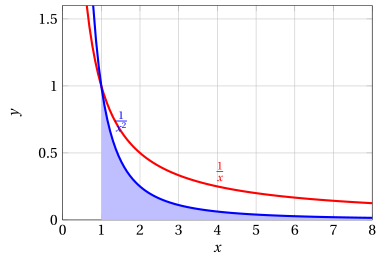
- In the figure the blue area under \(\frac{1}{x^2}\) on \([1, \ip)\) is finite and equals \(1\), while the area under \(\frac1x\) is infinite: the two graphs look alike, but \(\frac{1}{x^2}\) tends to zero fast enough.
2. Integrals of unbounded functions
Definition 2: improper integral of an unbounded function
Let \(f\) be continuous on \((a, b]\). The improper integral of \(f\) on \((a,b]\) is the limit
with the same terminology: convergent, divergent, does not exist.
-
The interesting case is when \(f\) is unbounded near \(a\) (if \(f\) has a continuous extension at \(a\), the limit is the Riemann integral of the extension).
-
In the same way, for \(f\) continuous on \([a, b)\) we set \(\int_a^b f = \lim_{\varepsilon \rr 0^+} \int_a^{b - \varepsilon} f\). If there are several critical points (both endpoints, an interior point, an infinite endpoint) we split the interval: the integral converges if all the pieces converge.
Theorem 2: standard improper integral at zero
Let \(p \in \R\). The integral \(\displaystyle \int_0^{1} \frac{dx}{x^p}\) converges if and only if \(p < 1\), and in that case
For \(p \ge 1\) it diverges to \(\ip\).
Proof
-
For \(p \neq 1\):
\[ \int_{\varepsilon}^{1} \frac{dx}{x^p} = \frac{1 - \varepsilon^{1-p}}{1 - p} \]If \(p < 1\), \(\varepsilon^{1-p} \rr 0\) as \(\varepsilon \rr 0^+\) and the limit is \(\frac{1}{1-p}\). If \(p > 1\), \(\varepsilon^{1-p} \rr \ip\) and the integral diverges.
-
For \(p = 1\): \(\int_{\varepsilon}^{1} \frac{dx}{x} = -\log\varepsilon \rr \ip\).
□
- The two standard integrals behave in opposite ways: at infinity we need \(p > 1\), at zero we need \(p < 1\). With the change of variable \(t = x - a\) we see that \(\int_a^b \frac{dx}{(x-a)^p}\) converges if and only if \(p < 1\).
Example 2: integrals of unbounded functions
-
\(\displaystyle \int_0^1 \frac{dx}{\sqrt{x}} = \frac{1}{1 - \frac12} = 2\) (theorem on the standard improper integral at zero with \(p = \frac12\)).
-
\(\displaystyle \int_0^1 \log x\,dx = \lim_{\varepsilon \rr 0^+} \big[x\log x - x\big]_{\varepsilon}^{1} = -1 - \lim_{\varepsilon \rr 0^+} (\varepsilon\log\varepsilon - \varepsilon) = -1\), because \(\varepsilon\log\varepsilon \rr 0\).
-
\(\displaystyle \int_0^{1/2} \frac{dx}{x\log^2 x}\): with \(t = \log x\) an antiderivative is \(-\frac{1}{\log x}\), hence
\[ \int_0^{1/2} \frac{dx}{x\log^2 x} = \lim_{\varepsilon \rr 0^+} \left( -\frac{1}{\log\frac12} + \frac{1}{\log\varepsilon} \right) = \frac{1}{\log 2} \]
Beware of points where the function is unbounded inside the interval. The computation \(\int_{-1}^{1} \frac{dx}{x^2} = \left[-\frac1x\right]_{-1}^{1} = -2\) is wrong: the integrand is positive and it is not defined at \(0\). Splitting at \(0\), \(\int_0^1 \frac{dx}{x^2}\) diverges (with \(p = 2\)), hence \(\int_{-1}^{1} \frac{dx}{x^2} = \ip\).
3. Convergence tests
- Often we do not need the value of an improper integral, only whether it converges, even when an antiderivative cannot be written. As for series, for non-negative functions there are comparison tests.
Remark 1: non-negative functions
If \(f\) is continuous and non-negative on \([a, \ip)\), the function \(\omega \mapsto \int_a^{\omega} f(x)\,dx\) is non-decreasing. By the monotonicity theorem for functions its limit as \(\omega \rr \ip\) exists: the integral either converges or diverges to \(\ip\), and it converges if and only if \(\int_a^{\omega} f\) is bounded.
Theorem 3: comparison test for improper integrals
Let \(f\) and \(g\) be continuous on \([a, \ip)\) with \(0 \le f(x) \le g(x)\) for every \(x \ge a\). Then:
Proof
By the monotonicity of the integral, for every \(\omega \ge a\)
where the last inequality holds because the integral function of \(g \ge 0\) is non-decreasing. If \(\int_a^{\ip} g\) converges, \(\int_a^{\omega} f\) is bounded and by the Remark on non-negative functions \(\int_a^{\ip} f\) converges: this is \(i)\). Statement \(ii)\) is the contrapositive of \(i)\), because both integrals either converge or diverge to \(\ip\). □
Theorem 4: limit comparison test for improper integrals
Let \(f\) and \(g\) be continuous and positive on \([a, \ip)\) and let
(in particular if \(f(x) \sim g(x)\) as \(x \rr \ip\)). Then \(\int_a^{\ip} f(x)\,dx\) and \(\int_a^{\ip} g(x)\,dx\) are both convergent or both divergent.
Proof
By the definition of limit with \(\varepsilon = \frac{\ell}{2}\), there exists \(x_1 \ge a\) such that
By the comparison test applied on \([x_1, \ip)\): if \(\int g\) converges, \(\int f\) converges (second inequality); if \(\int g\) diverges, \(\int f\) diverges (first inequality). Finally \(\int_a^{x_1} f\) and \(\int_a^{x_1} g\) are integrals of continuous functions on a closed and bounded interval, hence finite: they do not change the behaviour. □
-
If the limit is \(\ell = 0\) only one implication holds: if \(\int_a^{\ip} g\) converges, then \(\int_a^{\ip} f\) converges too (because eventually \(f \le g\)).
-
The same tests hold for unbounded functions on \((a,b]\), with the limits as \(x \rr a^+\); the typical comparison is with \(\frac{1}{(x-a)^p}\).
Example 3: limit comparison at infinity
-
\(\displaystyle \int_1^{\ip} \frac{x+1}{x^3+2}\,dx\): as \(x \rr \ip\), \(\frac{x+1}{x^3+2} \sim \frac{1}{x^2}\), and \(\int_1^{\ip} \frac{dx}{x^2}\) converges: the integral converges.
-
\(\displaystyle \int_1^{\ip} \frac{dx}{\sqrt{x^2 + x}}\): as \(x \rr \ip\), \(\frac{1}{\sqrt{x^2+x}} \sim \frac{1}{x}\): the integral diverges.
-
\(\displaystyle \int_0^{\ip} e^{-x^2}\,dx\): for \(x \ge 1\) we have \(x^2 \ge x\) and hence \(0 < e^{-x^2} \le e^{-x}\); since \(\int_1^{\ip} e^{-x}\,dx\) converges, by comparison \(\int_1^{\ip} e^{-x^2}\,dx\) converges, and \(\int_0^1 e^{-x^2}\,dx\) is finite: the integral converges.
Example 4: limit comparison at zero
-
\(\displaystyle \int_0^{1} \frac{\sin x}{x^{3/2}}\,dx\): as \(x \rr 0^+\), \(\sin x \sim x\) and \(\frac{\sin x}{x^{3/2}} \sim \frac{1}{x^{1/2}}\); since \(\frac12 < 1\), the integral converges.
-
\(\displaystyle \int_0^{1} \frac{dx}{e^x - 1}\): as \(x \rr 0^+\), \(e^x - 1 \sim x\) and \(\frac{1}{e^x - 1} \sim \frac1x\): the integral diverges.
Example 5: an integral with a parameter
For which \(\alpha \in \R\) does \(\displaystyle \int_0^{\ip} \frac{x^{\alpha}}{1+x^2}\,dx\) converge? The integrand is continuous and positive on \((0, \ip)\); we split at \(x = 1\).
-
On \((0,1]\): \(\frac{x^{\alpha}}{1+x^2} \sim x^{\alpha} = \frac{1}{x^{-\alpha}}\) as \(x \rr 0^+\); it converges if and only if \(-\alpha < 1\), that is, \(\alpha > -1\).
-
On \([1,\ip)\): \(\frac{x^{\alpha}}{1+x^2} \sim \frac{1}{x^{2-\alpha}}\) as \(x \rr \ip\); it converges if and only if \(2 - \alpha > 1\), that is, \(\alpha < 1\).
The integral converges if and only if \(-1 < \alpha < 1\).
Theorem 5: absolute convergence for improper integrals
Let \(f\) be continuous on \([a, \ip)\). If \(\int_a^{\ip} |f(x)|\,dx\) converges, then \(\int_a^{\ip} f(x)\,dx\) converges too and
Proof
We have \(0 \le f(x) + |f(x)| \le 2\,|f(x)|\). By the comparison test \(\int_a^{\ip} \big(f + |f|\big)\) converges. Then
converges as well, because both terms have a finite limit as \(\omega \rr \ip\). The inequality follows by taking the limit in \(\left|\int_a^{\omega} f\right| \le \int_a^{\omega} |f|\). □
Example 6: absolute convergence
The integrand of \(\displaystyle \int_1^{\ip} \frac{\sin x}{x^2}\,dx\) changes sign infinitely many times, so the comparison tests do not apply directly. But \(\left|\frac{\sin x}{x^2}\right| \le \frac{1}{x^2}\) and \(\int_1^{\ip} \frac{dx}{x^2}\) converges: the integral converges absolutely, hence it converges.
4. Integral test for series
Theorem 6: integral test
Let \(f: [1, \ip) \rr \R\) be continuous, non-negative and non-increasing. Then the series \(\sum_{k=1}^{\infty} f(k)\) and the integral \(\int_1^{\ip} f(x)\,dx\) are both convergent or both divergent. Moreover, for every \(n \ge 2\),
Proof
For \(x \in [k, k+1]\), since \(f\) is non-increasing, \(f(k+1) \le f(x) \le f(k)\). By the Corollary on the estimates of the integral
Summing over \(k \in \{1, 2, \dots, n-1\}\) and using additivity we get the inequalities of the statement.
-
If the integral converges, the partial sums \(\sum_{k=1}^{n} f(k) \le f(1) + \int_1^{\ip} f\) are bounded: the series, with non-negative terms, converges.
-
If the series converges, \(\int_1^{n} f \le \sum_{k=1}^{\infty} f(k)\) for every \(n\); since \(\omega \mapsto \int_1^{\omega} f\) is non-decreasing, it is bounded and the integral converges by the Remark on non-negative functions.
□
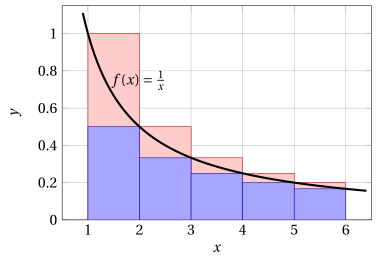
-
In the figure, with \(f(x) = \frac1x\): the blue rectangles (heights \(f(2), f(3), \dots\)) lie below the graph, the red ones (heights \(f(1), f(2), \dots\)) above. The series and the integral differ at most by the first term.
-
The test also applies starting from an integer \(k_0\) other than \(1\): we compare \(\sum_{k=k_0}^{\infty} f(k)\) and \(\int_{k_0}^{\ip} f\).
Example 7: series and integrals
-
Generalized harmonic series. For \(p > 0\) the function \(\frac{1}{x^p}\) is positive and decreasing: by the theorem on the standard improper integral at infinity, \(\sum_{k=1}^{\infty} \frac{1}{k^p}\) converges if and only if \(p > 1\) (for \(p \le 0\) the general term does not tend to \(0\)). We recover the behaviour of the generalized harmonic series.
-
\(\displaystyle \sum_{k=2}^{\infty} \frac{1}{k\log k}\) diverges: with \(t = \log x\), \(\int_2^{\omega} \frac{dx}{x\log x} = \log(\log\omega) - \log(\log 2) \rr \ip\).
-
\(\displaystyle \sum_{k=2}^{\infty} \frac{1}{k\log^2 k}\) converges: \(\int_2^{\omega} \frac{dx}{x\log^2 x} = \frac{1}{\log 2} - \frac{1}{\log\omega} \rr \frac{1}{\log 2}\).
Example 8: how fast the harmonic series grows
With \(f(x) = \frac1x\) the inequalities of the integral test give, for \(n \ge 2\),
that is
The partial sums of the harmonic series grow like \(\log n\): to exceed \(10\) more than \(8000\) terms are needed, because \(1 + \log n < 10\) as long as \(n < e^9 \approx 8103\).
5. In summary
In summary
-
An improper integral is a limit of Riemann integrals: \(\int_a^{\ip} f = \lim_{\omega \rr \ip} \int_a^{\omega} f\), \(\int_a^b f = \lim_{\varepsilon \rr 0^+} \int_{a+\varepsilon}^b f\) if \(f\) is unbounded near \(a\). With several critical points we split the interval.
-
\(\int_1^{\ip} \frac{dx}{x^p}\) converges if and only if \(p > 1\); \(\int_0^1 \frac{dx}{x^p}\) converges if and only if \(p < 1\).
-
For non-negative functions the integral converges or diverges to \(\ip\); the comparison test and the limit comparison test hold (with \(f \sim g\) same behaviour).
-
If \(\int |f|\) converges, then \(\int f\) converges too (absolute convergence).
-
For \(f\) non-negative and non-increasing, \(\sum f(k)\) and \(\int_1^{\ip} f\) have the same behaviour (integral test).
Exercises on this chapter: Integrals · Improper integrals