Series with non-negative terms
Part 5 · Series · Chapter 2 · lecture notes by Fabio Furini · Chapter PDF
1. Series with non-negative terms
A series \(\sum a_k\) with non-negative terms (or positive terms) is regular, that is, it is either convergent or divergent to \(\ip\) (it cannot be irregular, as we have proved). Such a series converges if and only if the sequence of its partial sums is bounded.
1.1 Comparison test
Theorem 1: Comparison test
Let \(\{a_k\}\) and \(\{b_k\}\) be two sequences with non-negative terms such that \(a_k \le b_k\) eventually; then:
- The series \(\sum b_k\) is called the dominating series (majorant), while the series \(\sum a_k\) is called the dominated series (minorant).
Proof
Since \(a_k \le b_k\) eventually, there exists \(m \in \N\) such that:
Let us now consider the \(n\)-th partial sums of the tails of the two sequences \(\{a_k\}\) and \(\{b_k\}\), with \(n >m\):
Since \(0\le a_k \le b_k\), \(\forall k \ge m\), we have
The sequences \(\{s^a_n\}\) and \(\{s^b_n\}\) are regular, since \(\{a_k\}\) and \(\{b_k\}\) have non-negative terms. Hence the claims \(i)\) and \(ii)\) are logically equivalent, so it suffices to prove the second one.
Saying that \(\sum a_n\) is divergent means, by the definition of divergent series, that \(s_n \rr \ip\) as \(n \rr \ip\). Moreover, since every tail has the same behavior as the original series, we have \(s^a_n \rr \ip\) as \(n \rr \ip\).
From \(\eqref{JJJJ}\), by the comparison theorem for sequences, also \({s}^b_n \rr \ip\) as \(n \rr \ip\). Hence the tail of \(\{b_k\}\) is divergent and consequently \(\sum b_n\) is divergent. □
Remark 1
Given \(\alpha \le1\), the series \(\sum_{k=1}^{\infty} \frac{1}{k^{\alpha}}\) is divergent to \(\ip\).
Proof
With \(\alpha= 1\) we have the harmonic series, which diverges to \(\ip\). With \(\alpha <1\), the series dominates the harmonic series, since:
hence \(\sum_{k=1}^{\infty} \frac{1}{k^{\alpha}}\) is divergent by the comparison test. □
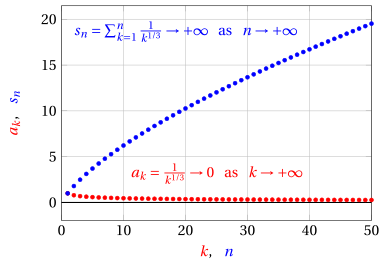
- Graphically, for example with \(\alpha= \frac{1}{3}\), we have:
1.2 Limit comparison test
Theorem 2: Limit comparison test
Let \(\{a_k\}\) and \(\{b_k\}\) be two sequences with positive terms. If the sequences are asymptotically equivalent, that is, if:
then the corresponding series \(\sum a_k\) and \(\sum b_k\) are regular and have the same behavior, i.e., either they are both convergent or they are both divergent.
Proof
The series \(\sum a_k\) and \(\sum b_k\) are regular because the sequences \(\{a_k\}\) and \(\{b_k\}\) have positive terms. Since \(a_k \sim b_k\) as \(k \rr \ip\), we have:
Hence, for every \(\varepsilon >0\), there exists \(m \in \N\) such that \(\forall k \ge m\) we have:
We have thus proved that \((1- \varepsilon)\; b_k < a_k < (1 +\varepsilon)\; b_k\) eventually. Hence, by the comparison test, the series \(\sum a_k\) and \(\sum b_k\) have the same behavior.
The first of the two inequalities implies that if \(\sum a_k\) is convergent then \(\sum b_k\) is also convergent, while the second one implies that if \(\sum a_k\) is divergent then \(\sum b_k\) is also divergent. □
Remark 2
Given \(\alpha \ge 2\), the series \(\sum_{k=1}^{\infty} \frac{1}{k^{\alpha}}\) is convergent.
Proof
With \(\alpha= 2\) we have:
and the series \(\sum_{k=1}^{\infty} \frac{1}{k \; (k+1)}\) converges (Mengoli's series). Hence, by the limit comparison test, \(\sum_{k=1}^{\infty} \frac{1}{k^2}\) also converges.
With \(\alpha> 2\), the series is dominated by the series \(\sum_{k=1}^{\infty} \frac{1}{k^2}\), since:
hence \(\sum_{k=1}^{\infty} \frac{1}{k^{\alpha}}\) is convergent by the comparison test. □
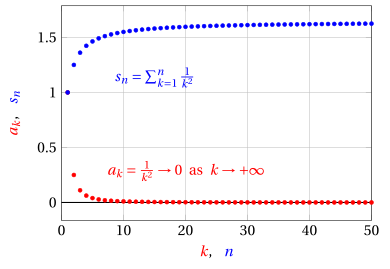
- Graphically, for example with \(\alpha= 2\), we have:
Example 1: limit comparison test
Let us determine the behavior of the series:
We have:
hence the series is convergent by the limit comparison test.
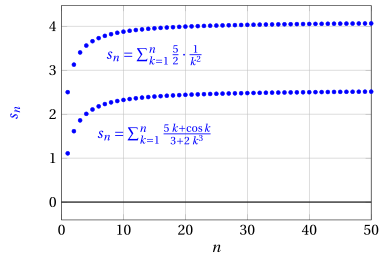
However, even if the sequences are asymptotically equivalent, the corresponding series may not have the same sum.
1.3 Condensation test
Theorem 3: Condensation test
If \(\{a_k\}\) is an eventually decreasing sequence with non-negative terms, then the series \(\sum_{k=1}^{\infty} a_k\) and \(\sum_{k=0}^{\infty} 2^k\; a_{2^k}\) are regular and have the same behavior, i.e., either they are both convergent or they are both divergent.
-
Before proving the theorem, let us consider the sequence \(\{\tilde{s}_n\}\) of the partial sums of the sequence \(\{2^k \; a_{2^k}\}\), that is, the sequence:
\[ \tilde{s}_n = \sum_{k=0}^n 2^k \; a_{2^k}\qquad \forall n \ge 0 \]and let us derive two important relations with the sequence \(\{s_n\}\) of the partial sums of the sequence \(\{a_{k}\}\), that is, the sequence:
\[ {s}_n = \sum_{k=1}^n a_{k}\qquad \forall n \ge 1 \] -
We observe that, for certain values of \(n\), the partial sums \(s_n\) are:
\[\begin{align*} \underbrace{s_1}_{\displaystyle =s_{2^1-1}}&=a_1,\qquad \underbrace{s_3}_{\displaystyle =s_{2^2-1}}=s_1 + a_2+\underbrace{a_3}_{\le a_2} \le a_1 + 2\;a_2\\[1ex] \underbrace{s_7}_{\displaystyle =s_{2^3-1}}&=s_3 + a_4 + \underbrace{a_5}_{\le a_4}+ \underbrace{a_6}_{\le a_4}+ \underbrace{a_7}_{\le a_4} \le a_1 + 2\;a_2 + 4\;a_4\\[1ex] \underbrace{s_{15}}_{\displaystyle =s_{2^4-1}}&=s_7 + a_8 + \underbrace{a_9}_{\le a_8} + \underbrace{a_{10}}_{\le a_8}+ \underbrace{a_{11}}_{\le a_8}+ \underbrace{a_{12}}_{\le a_8}+ \underbrace{a_{13}}_{\le a_8}+ \underbrace{a_{14}}_{\le a_8}+ \underbrace{a_{15}}_{\le a_8} \le a_1 + 2\;a_2 + 4\;a_4 + 8\;a_8 \end{align*}\]
Remark 3
Given an eventually decreasing sequence \(\{a_k\}\) with non-negative terms, we have:
Proof
We prove by induction on \(2^n\) that
Base case. Let \(n = 1\). Then the claim becomes \(s_{2^1-1} \le 2^0 \; a_1\), i.e., \(a_1 \le a_1\), which is clearly true.
Inductive step. Assume that it is true for \(2^{n-1}\) and let us prove it for \(2^n\). By the inductive hypothesis, we have \(s_{2^{n-1}-1} ~\le~ \sum_{k=0}^{n-2} 2^k \; a_{2^k}\). Moreover, we have:
which is exactly the desired claim for \(2^n\). □
-
We now observe that the values of \(\tilde{s}_n\) are:
\[\begin{align*} \tilde{s}_0&=a_1 \le 2 \; a_1 = 2\;\underbrace{s_1}_{\displaystyle =s_{2^0}},\qquad \tilde{s}_1=\tilde{s}_0 + 2\;a_2 \le 2\;s_1 + 2 \; a_2 = 2\;\underbrace{s_2}_{\displaystyle =s_{2^1}}\\[2ex] \tilde{s}_2&=\tilde{s}_1 + 4\;a_4 \le 2\;s_2 + 2 \; a_3 + 2 \; a_4 = 2\;\underbrace{s_4}_{\displaystyle =s_{2^2}} ~~~ ({\rm since~} a_4 \le a_3 )\\[2ex] \tilde{s}_3&=\tilde{s}_2 + 8\;a_8 \le 2\;s_4 + 2 \; a_5 + 2 \; a_6 + 2 \; a_7 + 2 \; a_8 = 2\;\underbrace{s_8}_{\displaystyle =s_{2^3}}~~~ ({\rm since~} a_8 \le a_7 \le a_6 \le a_5 ) \end{align*}\]
Remark 4
Given an eventually decreasing sequence \(\{a_k\}\) with non-negative terms, we have:
Proof
We prove by induction on \(2^n\) that
Base case. Let \(n = 0\). Then the claim becomes \(\tilde{s}_{0} \le 2 \; s_{2^0} = 2 s_1\), i.e., \(a_1 \le 2\;a_1\), which is clearly true.
Inductive step. Assume that it is true for \(n-1\) and let us prove it for \(n\). By the inductive hypothesis, we have \(\tilde{s}_{n-1} ~\le~ 2 \; s_{2^{n-1}}\). Moreover, we have:
which is exactly the desired claim for \(n\). □
- We are now able to prove the theorem.
Proof
From relation \(\eqref{P1}\) we have:
Hence, if \(\{\tilde{s}_n\}\) is convergent, that is, if \(\sum_{k=0}^{\infty} 2^k\; a_{2^k}\) is convergent, the subsequence \(\{s_{2^{n}-1}\}\) is bounded. Since \(\{s_n\}\) is monotone, the whole sequence \(\{s_n\}\) is bounded and convergent by the monotone sequence theorem. Consequently, if \(\sum_{k=0}^{\infty} 2^k\; a_{2^k}\) is convergent, then \(\sum_{k=1}^{\infty} a_{k}\) is also convergent.
From relation \(\eqref{P2}\) we have:
Hence, if \(\{{s}_n\}\) is convergent, that is, if \(\sum_{k=1}^{\infty} a_{k}\) is convergent, then the subsequence \(\{s_{2^n}\}\) is convergent (since \(\{{s}_n\}\) is monotone). Consequently, by comparison, \(\{\tilde{s}_{n}\}\) is also convergent, that is, \(\sum_{k=0}^{\infty} 2^k\; a_{2^k}\) converges.
Moreover, since \(\{a_k\}\) has non-negative terms, the series cannot be irregular; consequently, we also have:
which completes the proof of the theorem. □
Given an eventually decreasing sequence \(\{a_k\}\) with non-negative terms, we have proved that:
Hence the convergence/divergence of \(\sum_{k=0}^{\infty} 2^k\; a_{2^k}\) is a necessary and sufficient condition for the convergence/divergence of \(\sum_{k=1}^{\infty} a_{k}\).
1.4 Generalized harmonic series
Definition 1: Generalized harmonic series
Given \(\alpha \in \R\), the series \(\sum_{k=1}^{\infty} \frac{1}{k^{\alpha}}\) is called the generalized harmonic series
Theorem 4: Behavior of the generalized harmonic series
Given \(\alpha \in \R\),
Proof
We have already established that it diverges for \(\alpha \le 1\). For \(\alpha >1\), the sequence \(\left\{\frac{1}{k^{\alpha}}\right\}\) is a decreasing sequence with positive terms. We have:
that is, a geometric series with ratio \(2^{1-\alpha}\), which converges if and only if \(2^{1-\alpha}<1\), that is, if \(1 -\alpha < 0\). Hence, for \(\alpha >1\), by the condensation test, the series converges. □
Try it — the interactive graph below shows what you have just read: move the sliders.
1.5 Passing from the discrete to the continuous
- The tools used to establish asymptotic estimates of functions can also be used to obtain asymptotic estimates of sequences (passing from the discrete to the continuous), and they provide useful tools for studying the behavior of a series with positive terms.
Example 2: passing from the discrete to the continuous
Let us determine the behavior of the series:
From the asymptotic equivalence
we have
Therefore the series, which has positive terms, converges by limit comparison with the series of \(1/k^2\).
Example 3: passing from the discrete to the continuous
Let us determine the behavior of the series:
We have
From the asymptotic equivalence
we have
Thus it is a series with positive terms whose general term is asymptotically equivalent to \(1/k\). By comparison with the harmonic series, this series diverges to \(\ip\).
Example 4: passing from the discrete to the continuous
Let us determine the behavior of the series:
From the third-order Maclaurin expansion
we have
Therefore the series, which has positive terms, converges by limit comparison with the series of \(1/(6\:k^3)\).
1.6 Root test
Theorem 5: Root test
Let \(\{a_k\}\) be a sequence with non-negative terms. If the following limit exists:
Proof
Suppose that \(\lim_{k \rr \ip} \sqrt[k]{a_k} = \ell < 1\). Since \(\sqrt[k]{a_k} \rr \ell \in \R\), for every \(\varepsilon >0\) there exists \(m \in \N\) such that \(\forall k \ge m\):
Moreover, since \(\ell < 1\), we have \(\ell < 1 - \varepsilon\) for a suitable \(\varepsilon > 0\). For this \(\varepsilon\) we therefore have, eventually:
We have thus proved that \(a_k < \left(1 - \frac{\varepsilon}{2} \right)^k\) eventually. The geometric series:
Hence, by the comparison test, the original series converges.
Suppose that \(\lim_{k \rr \ip} \sqrt[k]{a_k} = \ell > 1\). Since \(\sqrt[k]{a_k} \rr \ell \in \R\), for every \(\varepsilon >0\) there exists \(m \in \N\) such that \(\forall k \ge m\):
Moreover, since \(\ell > 1\), we have \(\ell > 1 + \varepsilon\) for a suitable \(\varepsilon > 0\). For this \(\varepsilon\) we therefore have, eventually:
We have thus proved that \(a_k > \left(1 + \frac{\varepsilon}{2} \right)^k\) eventually. The geometric series:
Hence, by the comparison test, the original series diverges. □
Clearly, these arguments remain valid also if \(\ell = \im\) or \(\ip\), respectively.
Remark 5
Proof
It is a series with non-negative terms, and we have:
hence, by the root test, it converges for \(b < 1\) and diverges for \(b > 1\). If \(b=1\), the series becomes:
that is, a generalized harmonic series; it is convergent for \(\beta < -1\), while it is divergent for \(\beta \ge -1\). □
Remark 6
The series \(\sum_{k=1}^{\infty} b^k / k^k\) with \(b \ge 0\) is convergent
Proof
It is a series with non-negative terms, and we have:
hence the series converges by the root test. □
1.7 Ratio test
Theorem 6: Ratio test
Let \(\{a_k\}\) be a sequence with positive terms. If the following limit exists:
Proof
Suppose that \(\lim_{k \rr \ip} a_{k+1}/ a_k = \ell<1\). Reasoning as in the proof of the root test, there exists \(m \in \N\) such that \(\forall k \ge m\):
for a suitable \(\varepsilon >0\). Reasoning iteratively, this implies that:
We have thus proved that \(a_k < \left(1 - \frac{\varepsilon}{2} \right)^{k-m} \; a_m\) eventually. The geometric series:
Hence, by the comparison test, the original series converges.
Suppose that \(\lim_{k \rr \ip} a_{k+1}/a_k = \ell>1\). Reasoning as in the proof of the root test, there exists \(m \in \N\) such that \(\forall k \ge m\):
for a suitable \(\varepsilon >0\). Reasoning iteratively, this implies that:
We have thus proved that \(a_k > \left(1 + \frac{\varepsilon}{2} \right)^{k-m} \; a_m\) eventually. The geometric series:
Hence, by the comparison test, the original series diverges. □
Clearly, these arguments remain valid also if \(\ell = \im\) or \(\ip\), respectively.
Remark 7
Proof
We have
Therefore the series, which has non-negative terms, converges by the ratio test. The proof that the sum of the series is equal to \(e\) will be given later using series of functions. □
1.8 Series with non-positive terms
-
We know that the behavior of a series does not change if we alter a finite number of its terms. Consequently, the tests for series with non-negative terms also apply to series whose terms are eventually non-negative.
-
Moreover, by factoring a minus sign out of the whole series, we see that these tests can also be applied to series with non-positive terms, and hence to series whose terms are eventually non-positive.
In summary, therefore, the tests we have seen apply to series all of whose terms (except for a finite number) have the same sign.