Inverse functions
Exercises · Functions · with worked solutions · PDF
Exercise 1
Prove that the function
is invertible on its domain and determine the analytic expression of the inverse \(f^{-1}\). Specify the domain of \(f^{-1}\).
Solution
The domain of the given function is
the interval where the argument of the logarithm is strictly positive. To prove that \(f\) is invertible, it suffices to verify that it is injective, i.e.,
Imposing \(f(x_1) = f(x_2)\) is equivalent to imposing that
The function \(f\) is injective and, consequently, invertible. We look for the analytic expression of the inverse function \(f^{-1}\) by solving, with respect to the variable \(x\), the equation
which has the unique solution
Solution
More formally, the inverse function of \(f\) is
whose domain is the image of the original function \(f\), that is, \(\mathbb{R}\). Hence \(f:\left(-\frac{2}{3},+\infty\right)\to(-\infty, +\infty)\), while \(f^{-1}:(-\infty, +\infty) \to\left(-\frac{2}{3},+\infty\right)\).
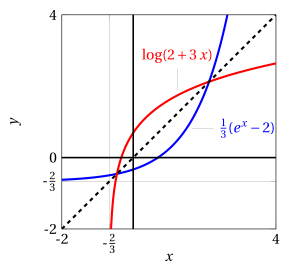
The graphs \(y=\log{(2+3x)}\) and \(y=\frac{1}{3}(e^{x}-2)\) are symmetric with respect to the bisector \(y=x\):
Exercise 2
Prove that the function
is invertible on its domain and determine the analytic expression of the inverse \(f^{-1}\). Specify the domain of \(f^{-1}\).
Solution
The domain of the given function is
the interval where the radicand is non-negative.
Solution
To prove that \(f\) is invertible, it suffices to verify that it is injective, i.e.,
Imposing \(f(x_1) = f(x_2)\) is equivalent to imposing that
The function \(f\) is injective and, consequently, invertible. We look for the analytic expression of the inverse function \(f^{-1}\) by solving, with respect to the variable \(x\), the equation
which, for \(y \geq 0\) (a square root is never negative in \(\mathbb{R}\)), has the unique solution
More formally, the inverse function of \(f\) is
whose domain is the image of the original function \(f\), that is, \([0, +\infty)\). Hence \(f:\left(-\infty,\frac{1}{2}\right]\to[0, +\infty)\), \(f^{-1}:[0, +\infty) \to\left(-\infty,\frac{1}{2}\right]\).
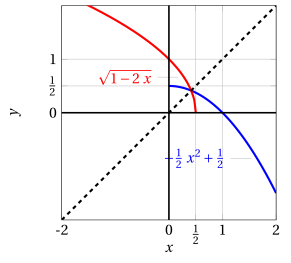
The graphs \(y=\sqrt{1-2x}\) and \(y=-\frac{1}{2}x^2+\frac{1}{2}\) are symmetric with respect to the bisector \(y=x\):
Exercise 3
Prove that the function
is invertible on its domain and determine the analytic expression of the inverse \(f^{-1}\). Specify the domain of \(f^{-1}\).
Solution
The domain of the given function is
since the exponential function is defined for every \(x\in\mathbb{R}\). To prove that \(f\) is invertible, it suffices to verify that it is injective, i.e.,
Imposing \(f(x_1) = f(x_2)\) is equivalent to imposing that
The function \(f\) is injective and, consequently, invertible. We look for the analytic expression of the inverse function \(f^{-1}\) by solving, with respect to the variable \(x\), the equation
It makes sense to solve this equation only for \(y > 0\), since it would have no solutions when \(y\leq0\) (the exponential never vanishes and is never negative). The equation has the unique solution
More formally, the inverse function of \(f\) is
whose domain is the image of the original function \(f\), that is, \((0, +\infty)\). Hence \(f:(-\infty,+\infty)\to(0, +\infty)\), \(f^{-1}:(0, +\infty) \to (-\infty,+\infty)\).
Exercise 4
Prove that the function
is invertible on its domain and determine the analytic expression of the inverse \(f^{-1}\). Specify the domain of \(f^{-1}\).
Solution
The arctangent function, which we recall is the inverse function of the restriction of \(y=\tan(x)\) to the interval \((-\frac{\pi}{2},\frac{\pi}{2})\), has the following properties:
-
its domain is the set \(\mathbb{R}\);
-
its image is the interval \((-\frac{\pi}{2},\frac{\pi}{2})\);
-
it is a strictly increasing monotonic function.
Since it is strictly increasing, the function \(f\) is invertible (note that this is only a sufficient condition). We look for the analytic expression of the inverse function \(f^{-1}\) by solving, with respect to the variable \(x\), the equation
where \(y \in (-\frac{\pi}{2},\frac{\pi}{2})\). The equation becomes
More formally, the inverse function of \(f\) is
whose domain is the image of the original function \(f\), that is, \((-\frac{\pi}{2},\frac{\pi}{2})\). Hence \(f:\mathbb{R}\to(-\frac{\pi}{2},\frac{\pi}{2})\), while \(f^{-1}:(-\frac{\pi}{2},\frac{\pi}{2})\to\mathbb{R}\)
Exercise 5
Prove that the function
is invertible on its domain and determine the analytic expression of the inverse \(f^{-1}\). Specify the domain of \(f^{-1}\).
Solution
The domain of the given function is
since it is defined \(\forall x \in \mathbb{R}, \, x \neq -2\). To prove that \(f\) is invertible, it suffices to verify that it is injective, i.e.,
To simplify the subsequent computations, it is convenient to rewrite the function \(f\) as:
Imposing \(f(x_1) = f(x_2)\) is equivalent to imposing that
The function \(f\) is injective and, consequently, invertible. We look for the analytic expression of the inverse function \(f^{-1}\) by solving, with respect to the variable \(x\), the equation
Rewriting the function again as before
we obtain
More formally, the inverse function of \(f\) is
whose domain is the image of the original function \(f\), that is, \((-\infty, 1)\cup(1,+\infty)\). Hence \(f:(-\infty, -2)\cup(-2,+\infty)\to(-\infty, 1)\cup(1,+\infty)\), \(f^{-1}:(-\infty, 1)\cup(1,+\infty) \to (-\infty, -2)\cup(-2,+\infty)\).
Exercise 6
Prove that the function
is invertible on a restriction of its domain and determine the analytic expression of the inverse \(f^{-1}\). Specify the domain of \(f^{-1}\).
Solution
The domain of the given function is
since the exponential function is defined for every \(x\in\mathbb{R}\). It is clear that \(f\) is not invertible on all of \(\mathbb{R}\), since it is an even function, i.e., symmetric with respect to the \(y\)-axis:
This implies that any horizontal line intersects the graph of the function in two points. The function is not injective, hence not invertible on \(\mathbb{R}\). However, we can restrict the domain by considering only the positive \(x\)-half-axis including the origin, i.e., the set
Let us verify that, on this restricted domain, the function \(f\) is injective. To this end, we impose \(f(x_1) = f(x_2)\), i.e.,
where the last equivalence holds since \(x \in [0, +\infty)\), i.e., \(x \geq 0\), so the solution \(x_1=-x_2\) is excluded. We have thus proved that the function \(f\) is injective on the restricted domain and, consequently, invertible on \([0, +\infty)\).
We look for the analytic expression of the inverse function \(f^{-1}\) by solving, with respect to the variable \(x\), the equation
The equation is solved by
where, however, it is now clear that the negative solution must be excluded, since \(x\) varies in the restriction \([0, +\infty)\).
Solution
More formally, the inverse function of \(f\) is
whose domain is the image of the original function \(f\), that is, \([e, +\infty)\). Hence \(f:[0,+\infty)\to[e, +\infty)\), \(f^{-1}:[e, +\infty) \to [0,+\infty)\).
Exercise 7
Prove that the function
is invertible on its domain and determine the analytic expression of the inverse \(f^{-1}\). Specify the domain of \(f^{-1}\).
Solution
The domain of the given function is
since the denominator is always nonzero (the exponential never vanishes). To prove that \(f\) is invertible, it suffices to verify that it is injective, i.e.,
Imposing \(f(x_1) = f(x_2)\) is equivalent to imposing that
The function \(f\) is injective and, consequently, invertible. We look for the analytic expression of the inverse function \(f^{-1}\) by solving, with respect to the variable \(x\), the equation
with \(y >0\), which has the unique solution
Solution
More formally, the inverse function of \(f\) is
whose domain is the image of the original function \(f\), that is, \((0, +\infty)\). Hence \(f:\mathbb{R}\to(0, +\infty)\), while \(f^{-1}:(0, +\infty) \to\mathbb{R}\).
Exercise 8
Prove that the function
is invertible on its domain and determine the analytic expression of the inverse \(f^{-1}\). Specify the domain of \(f^{-1}\).
Solution
The domain of the given function is
since roots of odd index are always defined. To prove that \(f\) is invertible, it suffices to verify that it is injective, i.e.,
Imposing \(f(x_1) = f(x_2)\) is equivalent to imposing that
The function \(f\) is injective (it is also strictly increasing) and, consequently, invertible. We look for the analytic expression of the inverse function \(f^{-1}\) by solving, with respect to the variable \(x\), the equation
which has the unique solution
Solution
More formally, the inverse function of \(f\) is
whose domain is the image of the original function \(f\), that is, \(\mathbb{R}\). Hence \(f:\mathbb{R}\to\mathbb{R}\), and also \(f^{-1}:\mathbb{R} \to\mathbb{R}\).
Exercise 9
Prove that the function
is invertible on its domain and determine the analytic expression of the inverse \(f^{-1}\). Specify the domain of \(f^{-1}\).
(Hint: perform the division of \(1-3x\) by \(x+1\)).
Exercise 10
Prove that the function
is invertible on a restriction of its domain and determine the analytic expression of the inverse \(f^{-1}\) on the restriction. Specify the domain of \(f^{-1}\).
Exercise 11
Prove that the function
is invertible on its domain and determine the analytic expression of the inverse \(f^{-1}\). Specify the domain of \(f^{-1}\).