Maxima, minima, suprema and infima
Exercises · Numbers and logic · with worked solutions · PDF
Exercise 1
Determine whether the set
has a maximum, a minimum, a supremum, an infimum and, if so, determine these elements.
Solution
The minimum of \(A\) is \(0\). \(A\) has no maximum; its supremum is \(\sqrt{2}\).
Exercise 2
Determine whether the set
has a maximum, a minimum, a supremum, an infimum and, if so, determine these elements.
Solution
\(A\) has neither a minimum nor a maximum. The infimum is \(\sqrt{2}\), the supremum is \(\sqrt{3}\).
Exercise 3
Determine whether the set
has a maximum, a minimum, a supremum, an infimum and, if so, determine these elements.
Solution
\(A\) has no minimum; the infimum is \(0\). The maximum of \(A\) is \(\sqrt{2}\).
Exercise 4
In each of the following cases, say whether the set
has a maximum, a minimum, a supremum, an infimum and, if so, determine these elements.
Solution
\(A\) is not bounded below, hence it has no infimum in \(\R\). \(A\) has no maximum; the supremum is \(\sqrt{2}\).
Exercise 5
Say whether the following set \(A \subset\R\) has a maximum, a minimum, a supremum, an infimum, and whether it is bounded:
Solution
From \((2n+1)/n=2+(1/n)\) we have that the maximum of \(A\) is attained for \(n=1\) and is equal to \(3\). \(A\) has no minimum; the infimum is \(2\). In particular, \(A\) is bounded.
Exercise 6
Say whether the following set \(A \subset\R\) has a maximum, a minimum, a supremum, an infimum, and whether it is bounded:
Solution
From \((n-1)/n=1-(1/n)\) we have that the minimum of \(A\) is attained for \(n=1\) and is equal to \(0\). \(A\) has no maximum; the supremum is \(1\). In particular, \(A\) is bounded.
Exercise 7
Say whether the following set \(A \subset\R\) has a maximum, a minimum, a supremum, an infimum, and whether it is bounded:
Solution
From \((3n^{2}+1)/n^{2}=3+(1/n^{2})\) we have that the maximum of \(A\) is attained for \(n=1\) and is equal to \(4\). \(A\) has no minimum; the infimum is \(3\). In particular, \(A\) is bounded.
Exercise 8
Say whether the following set \(A \subset\R\) has a maximum, a minimum, a supremum, an infimum, and whether it is bounded:
Solution
The maximum value of \(A\) is attained for \(n=1\) and is equal to \(1/2\). \(A\) has no minimum; the infimum is \(0\). In particular, \(A\) is bounded.
Exercise 9
Let
Choose the correct statements among the following:
Solution
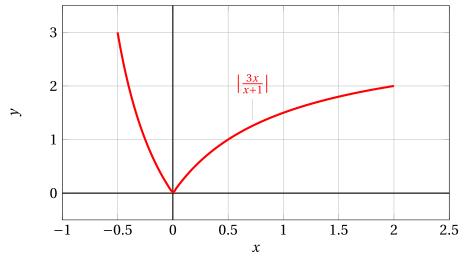
\(A\) is the set of values of \(|f(x)|\) on the interval \((-1/2,2]\), with \(f(x)=\frac{3x}{x+1}\). From
we have that the function \(f\) is strictly increasing on the given interval \((-1/2,2]\), negative on \((-1/2,0)\), zero for \(x=0\), and positive on \((0,2]\). It follows that
is strictly decreasing on \((-1/2,0]\), where it takes all the values in \([0,3)\), and strictly increasing on \([0,2]\), where it takes all the values in \([0,2]\). The minimum value is therefore attained for \(x=0\) and is equal to \(0\). The supremum is \(3\); there is no maximum value. The correct answer is (a).
Exercise 10
For \(I=[1/3,+\infty)\) consider the function
Determine, among the following intervals, the set \(J=f(I)\) of the values taken by \(f\).
Solution
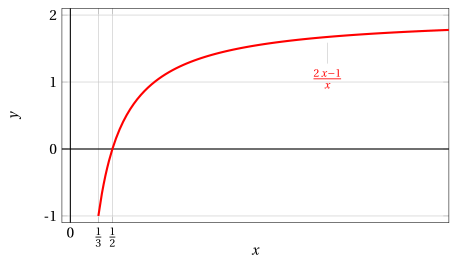
The function \(f\) has the same monotonicity behavior as
with
Solution
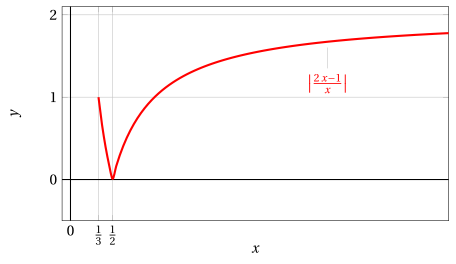
The function \(g\) is strictly increasing on the interval \(I=[1/3,+\infty)\), negative on \([1/3,1/2)\), zero for \(x=1/2\), and positive on \((1/2,+\infty)\). It follows that \(|g(x)|\) is strictly decreasing on \([1/3,1/2]\), where it takes all the values in \([0,1]\), and strictly increasing on \([1/2,+\infty)\), where it takes all the values in \([0,2)\). The set of values \(|g|(I)\) is \([0,2)\), hence for \(f(x)=e^{|g(x)|}\) we have
The correct answer is (c).
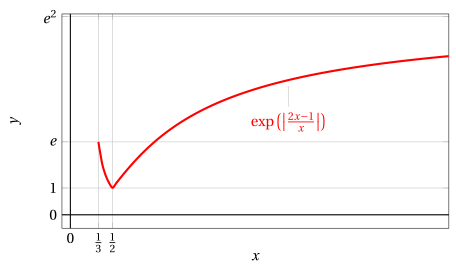
More precisely, \(f\) is strictly decreasing on \([1/3,1/2]\), where it takes all the values in \([1,e]\), and strictly increasing on \([1/2,+\infty)\), where it takes all the values in \([1,e^{2})\).
Exercise 11
Let \(A=A_{+}\cup A_{-}\) with
Choose the correct statements among the following:
Solution
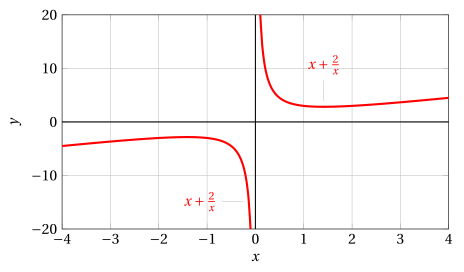
Clearly, \(A_{+}\) is not bounded above, hence statement (a) is correct (and statement (e) is false). For \(x\neq0\), we consider the equation
There are solutions \(x\in\R\) if and only if \(y\in(-\infty,-2\sqrt{2}]\cup[2\sqrt{2},+\infty)\). Moreover, for every \(y\in(-\infty,-2\sqrt{2}]\) the solutions \(x\) are negative, while for every \(y\in[2\sqrt{2},+\infty)\) the solutions \(x\) are positive. This means
Therefore (b) is true, (c) is false, (d) is false.