Continuous functions
Part 3 · Limits of functions and continuity · Chapter 4 · lecture notes by Fabio Furini · Chapter PDF
1. Algebra of continuous functions theorem
Theorem 1: Algebra of continuous functions
Let \(f\) and \(g\) be two functions defined at least in a neighborhood of \(x_0 \in \R\) and continuous at \(x_0\). Then:
Proof
Let us prove, for example, claim 3., the others being analogous. By hypothesis we know that \(f\) and \(g\) are continuous at \(x_0\), that is:
Moreover \(g(x_0) \neq 0\) and hence, by the sign-preservation theorem for continuous functions, \(g(x) \neq 0\) eventually as \(x \rr x_0\).
Then, by the theorem on the algebra of limits, we conclude that
that is, \(f(x)/g(x)\) is continuous at \(x_0\). □
2. Continuity of elementary functions theorem
Theorem 2: Continuity of elementary functions
The following elementary functions are continuous at all points of their domain:
-
Powers with integer, rational or real exponent;
-
Exponential functions;
-
Logarithmic functions;
-
Elementary trigonometric functions (\(\sin x\), \(\cos x\))
Proof
For example, let us prove the continuity on the whole of \(\R\) of the functions \(\sin x\) and \(\cos x\).
-
We have seen that \(\sin x\) is continuous at \(x =0\); let us show that \(\cos x\) is also continuous at \(x=0\).
-
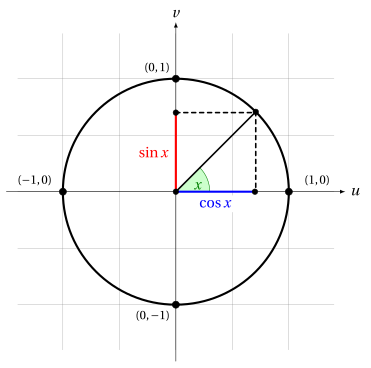
The unit (trigonometric) circle shows that, if \(x\) is an angle in the first quadrant,
\[ \sin x + \cos x \ge 1 \]since 1 is the hypotenuse of a right triangle with legs \(\sin x\), \(\cos x\).
-
It follows that
\[ 0 \le 1 - \cos x \le \sin x ~~~ {\rm ~for~} x \in \left[0, \frac{\pi}{2}\right], {\rm~~and~hence} \]\[ 0 \le 1 - \cos x \le |\sin x| ~~~ {\rm ~for~} x \in \left[-\frac{\pi}{2}, \frac{\pi}{2}\right] \] -
Then, by the comparison theorem,
\[ 1 - \cos x \rr 0 {\rm ~~as~~} x \rr 0 {\rm ~~hence~~} \cos x \rr 1 {\rm ~~as~~} x \rr 0 \]and therefore \(\cos x\) is continuous at \(0\).
□
Proof
-
To now prove the continuity of \(\sin x\) at a generic point \(x_0 \in \R\) we consider the chain of relations:
\[\begin{align*} | \sin(x_0 + h) - \sin x_0| &= | \sin x_0 \: \cos h + \sin h \:\cos x_0 - \sin x_0| \\[2ex] & = | \sin x_0 \: (\cos h -1) + \cos x_0 \: \sin h | \\[2ex] & \le |\sin x_0 \; (\cos h -1)| + |\cos x_0 \;\sin h|\\[2ex] & = |\sin x_0| \: |\cos h -1| + |\cos x_0| \: |\sin h| \end{align*}\]Now \(|\sin h|\) and \(|\cos h - 1|\) tend to zero as \(h \rr 0\), by what we have just proved, while \(|\sin x_0|\) and \(|\cos x_0|\) are constants, so
\[ \sin(x_0 + h) - \sin x_0 \rr 0 {\rm ~~as~~} h \rr 0 \]that is
\[ \sin(x_0 + h) \rr \sin x_0 {\rm ~~as~~} h \rr 0 \]and \(\sin x\) is continuous at \(x_0\). An analogous argument shows the continuity of \(\cos x\).
□
-
Having proved that \(\sin x\), \(\cos x\) are continuous on the whole of \(\R\), we deduce that the functions \(\tan x\), \(\cot x\) are continuous on their domain (by the theorem on the algebra of continuous functions)
-
Power functions with integer exponent are continuous (on the whole of \(\R\)), since \(f(x)=x\) is obviously continuous, and \(f(x) = x^n\) is the product of \(n\) continuous functions.
-
Polynomials are continuous functions, since they are obtained by adding functions of the type \(c \: x^n\), which are continuous by the previous point.
-
Rational functions (i.e., quotients of polynomials) are continuous functions, except at the points where the denominator vanishes (the denominator is a polynomial, hence it vanishes at a finite number of points)
3. Continuity of composite functions theorem
Theorem 3: Continuity of the composite function
Let:
-
\(g\) be a function defined at least in a neighborhood of \(x_0\) and continuous at \(x_0\),
-
\(f\) be a function defined at least in a neighborhood of \(t_0=g(x_0)\) and continuous at \(t_0\),
then \(f \circ g\) is defined at least in a neighborhood of \(x_0\) and is continuous at \(x_0\).
Proof
Since \(g\) is continuous at \(x_0\),
then, by the change of variable theorem for limits, we have:
and since \(f\) is continuous at \(t_0\), we have
and the thesis is proved. □
- It follows that all the functions that can be obtained from elementary functions by sums, products, quotients and compositions are continuous on their domain. Hence, by combining functions in this way, we still obtain continuous functions.
To summarize:
-
sums, products and quotients of continuous functions give continuous functions (where the denominator does not vanish);
-
the elementary functions of mathematical analysis are continuous on their domain;
-
the composition of continuous functions gives a continuous function.
- It is therefore possible to know a priori that a function is continuous on its domain, without applying the definition of continuity case by case.
For continuous functions, if \(x_0\) is a point of the domain, the limit as \(x \rr x_0\) is computed simply by substituting \(x_0\) into the analytic expression of the function, that is:
Example 1: Continuous functions and finite limits at a finite point
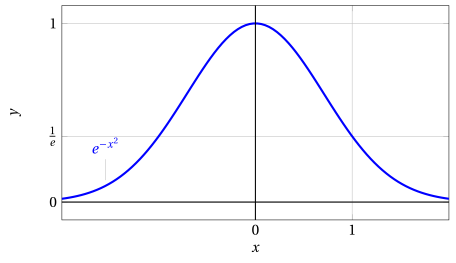
The following function is continuous for \(x \in \R\):
hence:
Example 2: Continuous functions and finite limits at a finite point
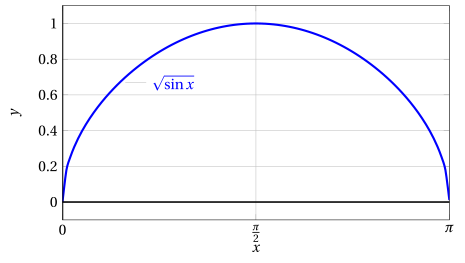
The following function is continuous for \(x \in \R\) with \(2 \;k \;\pi \le x \le 2 \;k \;\pi+\pi, \forall k \in \Z\):
Example 3: Continuous functions and finite limits at a finite point
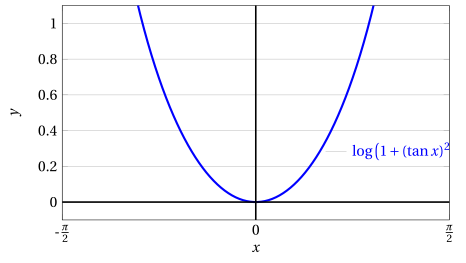
The following function is continuous for \(x \in \R\) with \(x \neq (2\:k+1) \: \frac{\pi}{2}, \forall k \in \mathbb{Z}\):
hence:
For example, with \(a=e\) we have: