Differentiability
Exercises · Derivatives · with worked solutions · PDF
Exercise 1
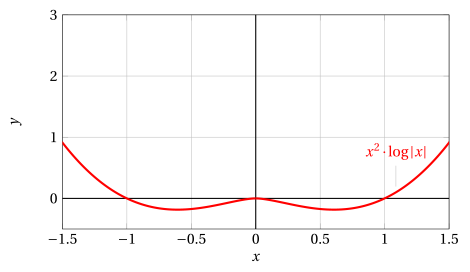
Study the differentiability of the function \(f(x) = x^2 \cdot \log | x|\) defined for \(x \neq 0\).
Solution
We know that the following limit exists
and we can extend \(f\) by continuity by defining \(f(0) =0\), so that \(f\) is continuous at \(0\) as well. For \(x \neq 0\), we have:
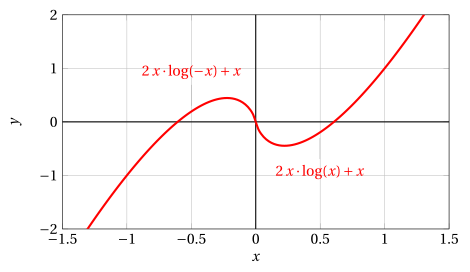
At \(x = 0\) the function is continuous, and we have:
hence the derivative limit theorem can be applied and we have:
Exercise 2
Determine the values of \(\alpha\) and \(\beta \in \mathbb{R}\) for which the function
is continuous and differentiable at \(x=0\).
Solution
We start with continuity at the junction point:
hence the function is continuous at \(x=0\) if and only if \(\alpha=2\) and \(\beta\in\mathbb{R}\).
For \(\alpha=2\) and \(x>0\), we have:
Therefore it is clear that, in order to smoothly join two lines passing through the same point (in our case, the \(y\)-intercept (\(0, 2\))), their equations must coincide, from which \(\beta=1\).
Alternatively, one can write the analytic expression of \(f'(x)\) and impose the condition
and observe that the same conclusion is reached.
Exercise 3
Determine the values of \(\alpha\) and \(\beta \in \mathbb{R}\) for which the function
is continuous and differentiable on \((0,+\infty)\).
Solution
The given function is continuous on the intervals (0, 1), (1, 2) and (2,\(+\infty\)), since each branch is a composition of continuous functions.
In order to ensure continuity at \(x=1\), we impose the equality
and, observing that, for \(x\to1^-\),
we obtain \(\alpha+\beta=\frac{1}{2}\).
We now study continuity at the junction point \(x=2\); we impose
and since
we obtain \(2\alpha+\beta=0\). Solving the system of the two conditions we get \(\alpha=-\frac{1}{2}\) and \(\beta=1\), which guarantee the continuity of \(f\) on (0,\(+\infty\)).
To check differentiability, we observe that computing \(f'(x)\) on (0,1) is much more complicated than on (2,\(+\infty\)). It is therefore convenient to first check the differentiability of \(f\) at \(x=2\). Since
we have that
Therefore, for \(\alpha=-\frac{1}{2}\) and \(\beta=1\), the function is not differentiable on \((0,+\infty)\), due to the presence of a corner point at \(x=2\). We might ask what would happen for other values of \(\alpha\) and \(\beta\), but the answer is immediate: the function would not be continuous on \((0, +\infty)\), and hence not differentiable either.
Exercise 4
Given the function
determine for which values of the real parameters \(\alpha,\lambda\in\mathbb{R}\) the function is continuous and differentiable at \(x=0\).
Solution
The given function is continuous on the intervals \((-\infty, 0)\) and \((0, +\infty)\) since it is a composition of continuous functions. It remains to ensure continuity at the junction point \(x=0\), where the following must hold:
We have
and
It is clear that the function is continuous at \(x=0\) if and only if \(\alpha=4, \lambda=-2\). Let us check whether, for the values of \(\alpha, \lambda\) obtained, the function is also differentiable at \(x=0\). We rewrite the function substituting the values of \(\alpha, \lambda\) obtained:
and we write the analytic expression of its first derivative:
We have
while
since
We conclude that \(\nexists \; \alpha, \lambda \in \mathbb{R}\) for which the function is also differentiable at \(x=0\).
Exercise 5
Prove that the following inequality holds:
Solution
The function \(f(x)=\log (1+x)\) is continuous and differentiable on \((-1,+\infty)\). We can apply Lagrange's theorem on every interval of the form \([0,x]\), with \(x>0\). Therefore, for a suitable \(\eta\in (0,x)\), \(x>0\), we obtain
where we took into account that \(\frac{1}{1+\eta}<1\) for every \(\eta>0\).
Exercise 6
Determine the minimum and maximum points (if any), relative and absolute, of the function
on \([0, 2\pi]\). At how many points does \(g(x)\) vanish? Why?
Solution
The function is continuous on the closed and bounded interval \([0, 2\pi]\), hence by the Weierstrass theorem the absolute maximum and minimum points exist. We have
and
and verify as an exercise that the function is not differentiable at the junction points. The first derivative is always positive where it is defined, hence the function is always increasing and attains its absolute maximum and minimum values at the endpoints of the interval. More precisely, \(x=0\) is the absolute minimum point with \(g(0)=1\) and \(x=2\pi\) is the absolute maximum point with \(g(2\pi)=2\pi+1\). The function never vanishes since it is always increasing and \(g(0)=1\).
Exercise 7
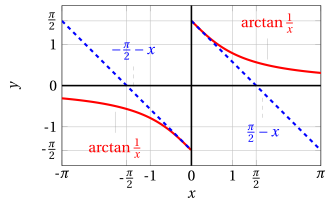
Study the differentiability of the function \(f(x) = \arctan \frac{1}{x}\) defined for \(x \neq 0\).
Solution
For \(x \neq 0\), we have:
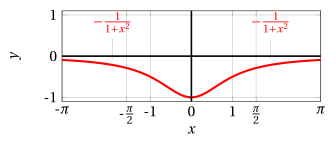
But in this case the hypothesis of continuity of \(f\) at \(0\) fails, since:
and it is not possible to use the derivative limit theorem to compute the derivative at \(x=0\). Since it is not continuous at \(x=0\), the function is not differentiable. If instead we consider only the left limit of the derivative, the hypotheses of the derivative limit theorem are satisfied and since:
moreover, since: