Principle of mathematical induction
Part 1 · Numbers and logic · Chapter 8 · lecture notes by Fabio Furini · Chapter PDF
1. The principle of mathematical induction
-
We now present a proof technique called proof by induction. This procedure can be applied to theorems with the following structure:
“ for every \(n \in \N\), \(n \ge n_0\), property \(p (n)\) holds ”
-
The number \(n_0\) is the smallest integer for which we want the property to be true; if \(n_0 = 0\) the theorem simply states that the property is true for every \(n \in \N\).
A proof by induction consists of the following two steps:
-
We prove that \(p (n)\) is true for \(n = n_0\) (base case of the induction).
-
We prove that, if n is an arbitrary natural number \(\ge n_0\), the fact that \(p(n)\) is true implies that \(p( n + 1)\) is true (inductive step).
We can then conclude that for every \(n \ge n_0\), \(p (n)\) is true.
-
-
The validity of this proof technique, intuitively, is based on the following fact:
-
By point 1, we know that \(p (n_0)\) is true. Suppose for example \(n_0 = 1\): we therefore know that \(p(1)\) is true (this must be proved explicitly).
-
By point \(2\), since \(p(1)\) is true, \(p (2)\) will be true: indeed, we have proved that for any \(n\), if \(p ( n)\) is true then \(p ( n + 1)\) is also true. But then, since \(p (2)\) is true, \(p (3)\) will be true; but then \(p (4)\) is true, … and so on, hence \(p (n)\) is true for every \(n \ge 1\).
-
-
In practice, the proof consists of two phases.
-
Prove \(p (n_0)\) directly;
-
Assume \(p (n)\) as a hypothesis (inductive hypothesis) and prove \(p (n + 1)\).
-
-
This is the delicate point, often subject to misunderstandings. “Assuming as a hypothesis” \(p (n)\) does not mean assuming the thesis as a hypothesis. What must be proved is that:
“ for every \(n \ge n_0\), if \(p( n)\) is true then \(p (n + 1)\) is also true ”
and not
“ if \(p (n)\) is true for every \(n\), then \(p (n + 1)\) is also true”
2. Proofs based on the principle of mathematical induction
2.1 Bernoulli's inequality
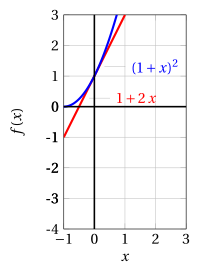
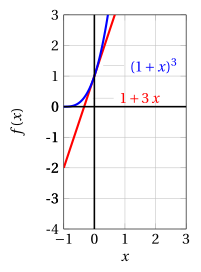
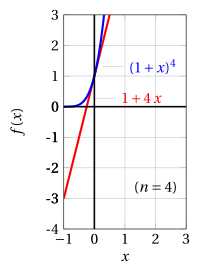
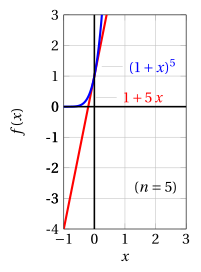
Remark 1: Bernoulli's inequality
For every integer \(n \ge 0\), \(x \in \R\), \(x \ge -1\), we have:
Proof
By induction on \(n\).
-
Base case of the induction
Let \(n = 0\). Then the statement becomes:
\[ (1+x)^0 \ge 1 + 0\: x \text{ ~~ i.e. ~~} 1 \ge 1 \]which is clearly true.
-
Inductive step
Suppose it is true for \(n\), and let us prove it for \((n + 1)\). By the inductive hypothesis, we have:
\[ (1+x)^n \ge 1 + n\: x \]and moreover we have
\[ (1+x) \ge 0 {\rm~~~since~~~} x \ge -1. \]Then we can write:
\[\begin{align*} (1+x)^{n+1} &= (1+x) \cdot (1+x)^{n} \\[2ex] &\ge (1+x) \cdot (1 + n\: x) \\[2ex] &= 1 + (n+1)\: x + n\: x^2 \\[2ex] &\ge 1 + (n+1) \: x \end{align*}\]where in the last inequality we used the fact that \(n\:x^2 \ge 0\).
The chain of inequalities shows that, for \(n + 1\), we have
\[ (1 + x)^{n+1} \ge 1 + (n + 1) \: x \]which is exactly the desired statement, for \(n + 1\).
□
Example 1: Bernoulli's inequality
2.2 Some important summations
Remark 2: sum of the first \(n\) natural numbers
For every integer \(n \ge 1\), we have:
Proof
By induction on \(n\).
-
Base case of the induction
Let \(n = 1\). Then the statement becomes:
\[ \sum_{k=1}^1 k = \frac{1\:(1+1)}{2} \text{ ~~ i.e. ~~} 1 = 1 \]which is clearly true.
-
Inductive step
Suppose it is true for \(n\), and let us prove it for \((n + 1)\). By the inductive hypothesis, we have:
\[ \sum_{k=1}^n k = \frac{n\:(n+1)}{2}. \]Hence we can write:
\[\begin{align*} \sum_{k=1}^{n+1} k &= \sum_{k=1}^{n} k + (n+1) \\[2ex] &= \frac{n\:(n+1)}{2} + (n+1) \\[2ex] &= \frac{n\:(n+1) + 2\:(n+1)}{2} \\[2ex] & = \frac{(n+1)\:( n + 2 )}{2} = \frac{(n+1)\:\big(( n+1) +1\big)}{2} \end{align*}\]which is exactly the desired statement, for \(n + 1\).
□
2.3 Sum of the terms of the geometric progression
Remark 3: sum of the first \(n\) terms of the geometric progression (\(a=1\))
Given \(q \in\ \R_+\), for every integer \(n \ge 1\) we have:
Proof
By induction on \(n\).
-
Base case of the induction
Let \(n = 1\). Then the statement becomes:
\[ \sum_{k=1}^{1} q^{k-1} = \frac{q^1-1}{q-1} \text{ ~~ i.e. ~~} 1 = 1 \]which is clearly true.
-
Inductive step
Suppose it is true for \(n\), and let us prove it for \((n + 1)\). By the inductive hypothesis, we have:
\[ \sum_{k=1}^{n} q^{k-1} = \frac{q^n-1}{q-1} \]Hence we can write
\[\begin{align*} \sum_{k=1}^{n+1} q^{k-1}&= \sum_{k=1}^{n} q^{k-1} + q^n = \frac{q^n-1}{q-1} + q^n\\[2ex] & = \frac{q^n-1+q^{n+1}-q^n}{q-1} = \frac{q^{n+1}-1}{q-1} \end{align*}\]which is exactly the desired statement, for \(n + 1\).
□