Properties of sequences
Exercises · Limits of sequences · with worked solutions · PDF
Exercise 1
Consider the sequence
Questions:
-
Is the sequence bounded above? If so, determine \(\sup \big\{a_n \big\}\).
-
Does the sequence have a maximum? If so, determine \(\max \big\{a_n \big\}\).
-
Is the sequence bounded below? If so, determine \(\inf \big\{a_n \big\}\).
-
Does the sequence have a minimum? If so, determine \(\min \big\{a_n \big\}\).
Solution
For \(n=1\) we have
For \(n=2\) we have
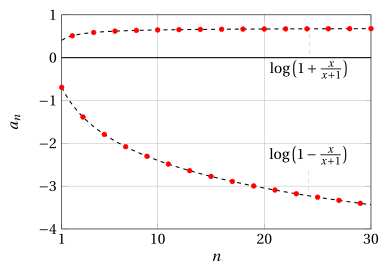
The presence of the alternating sign \((-1)^n\) suggests studying the behavior of the sequence by distinguishing what happens for even \(n\) and odd \(n\).
Solution
-
If \(n\) is even:
\[ a_n = \log \left( 1 + \frac{n}{n+1}\right), \quad {\rm ~~for~~} n=2,4,6 \dots \]hence the argument of the logarithm is
\[ 1 + \frac{n}{n+1} = 1 + \frac{n+1-1}{n+1} = 2 - \frac{1}{n+1} \]which varies in
\[ \left[\frac{5}{3},2\right) {\rm ~and~the~logarithm~in} \left[\log \frac{5}{3}, \log 2\right), \]i.e., it is positive and bounded above. Hence
\[ \sup \big\{a_n: n {\rm ~~is~even~} \big\} = \log 2 \approx 0.69314 \]but \(\log 2\) is not the maximum of these values.
-
If \(n\) is odd:
\[ a_n = \log \left( 1 - \frac{n}{n+1}\right), \quad {\rm ~~for~~} n=1,3,5 \dots \]hence the argument of the logarithm is
\[ 1 - \frac{n}{n+1} = \frac{1}{n+1} \]which varies in
\[ \left(0,\frac{1}{2}\right] {\rm ~and~the~logarithm~in} \left(- \infty, \log \frac{1}{2}\right], \]i.e., it is negative and, as \(n\) increases, it is unbounded below.
The sequence as a whole is therefore bounded above but not bounded below; it has no maximum (although its \(\sup\) is finite) and no minimum (because it is unbounded below).
Exercise 2
Consider the sequence
Questions:
-
Is the sequence bounded above?
-
Is the sequence bounded below?
-
Is it eventually positive?
-
Does it never vanish?
-
Does it have a limit (finite or infinite)?
Solution
For \(n=1\) we have
For \(n=2\) we have
For \(n=10\) we have
For \(n=20\) we have
Solution
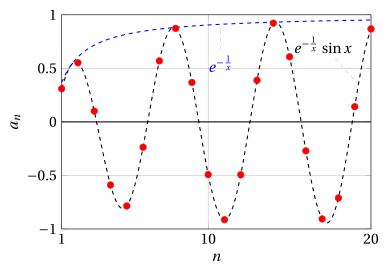
The sequence is the product of the sequence
which is bounded, always nonzero, convergent, and of the sequence
which is bounded but irregular, and never zero (since \(n\) starts from 1, by the irrationality of \(\pi\), the angle \(n\) is never an integer multiple of \(\pi\)).
Hence, the sequence given by the product of these two is bounded, never zero, and irregular.
Since
and the sign of \(\sin n\) is not eventually constant, the sequence given by the product of the two is not eventually positive.
Exercise 3
Consider the sequence
Questions:
-
Is the sequence bounded above?
-
Is the sequence bounded below?
-
Is it eventually positive?
-
Does it never vanish?
-
Does it have a limit (finite or infinite)?
Solution
For \(n=1\) we have
For \(n=2\) we have
For \(n=5\) we have
Solution
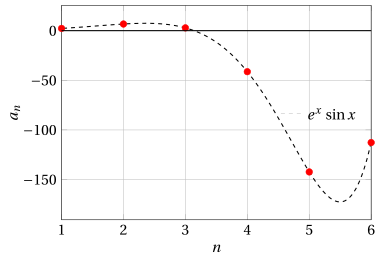
The sequence is the product of the sequence
which is unbounded above, bounded below, always nonzero, divergent, and of the sequence
which is bounded but irregular, and never zero (since \(n\) starts from 1, by the irrationality of \(\pi\), the angle \(n\) is never an integer multiple of \(\pi\)).
Hence, the sequence given by the product of these two is unbounded above, unbounded below, never zero, and irregular.
Since
and the sign of \(\sin n\) is not eventually constant, the sequence given by the product of the two is not eventually positive.
Exercise 4
Consider the sequence
Questions:
-
Is the sequence bounded above? If so, determine \(\sup \big\{a_n \big\}\).
-
Does the sequence have a maximum? If so, determine \(\max \big\{a_n \big\}\).
-
Is the sequence bounded below? If so, determine \(\inf \big\{a_n \big\}\).
-
Does the sequence have a minimum? If so, determine \(\min \big\{a_n \big\}\).
Solution
For \(n=1\) we have
For \(n=2\) we have
For \(n=3\) we have
For \(n=4\) we have
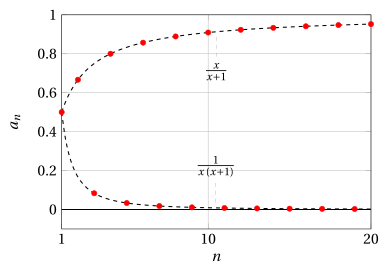
The presence of the alternating sign \((-1)^n\) suggests studying the behavior of the sequence by distinguishing what happens for even \(n\) and odd \(n\).
Solution
-
If \(n\) is even:
\[ a_n = \frac{n}{n+1}, \quad {\rm ~~for~~} n=2,4,6 \dots \]Adding \(+1\) and \(-1\) to the numerator, we obtain
\[ a_n=\frac{n}{n+1} = \frac{n+1-1}{n+1} = 1 - \frac{1}{n+1} \]which varies in
\[ \left[\frac{2}{3},1\right), \]i.e., it is positive and bounded above. Hence
\[ \sup \big\{a_n: n {\rm ~~is~even~} \big\} = 1 \]but \(1\) is not the maximum of these values.
-
If \(n\) is odd:
\[ a_n = \frac{\frac{1}{n}}{n+1} = \frac{1}{n}\cdot\frac{1}{n+1}=\frac{1}{n(n+1)}, \quad {\rm ~~for~~} n=1,3,5 \dots \]which varies in
\[ \left(0,\frac{1}{2}\right], \]i.e., it is positive and bounded below. Hence
\[ \inf \big\{a_n: n {\rm ~~is~odd~} \big\} = 0 \]but \(0\) is not the minimum of these values.
The sequence as a whole is bounded; it has no maximum (although its \(\sup\) is finite) and no minimum (although its \(\inf\) is finite).