Complex numbers
Part 1 · Numbers and logic · Chapter 12 · lecture notes by Fabio Furini · Chapter PDF
1. Definition of \(\C\) and field structure
-
We have denoted by \(\R^2\) (short for \(\R \times \R\)) the set of ordered pairs \((a, b)\) of real numbers.
-
On these pairs we directly define the operations of sum and product with the following rules:
\[\begin{align} \label{OP1}(a, b) + (c, d) &= (a+ c, b + d)\\[2ex] \label{OP2}(a, b) \cdot (c, d) &= (ac - bd, ad+ bc) \end{align}\]Example 1: sum
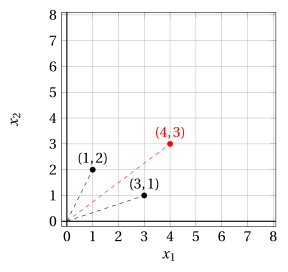
Example 2: product
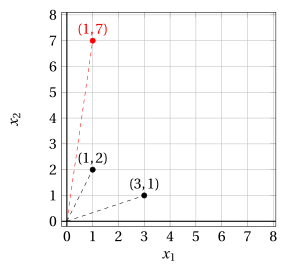
-
This “sum” and this “product” satisfy the commutative, associative and distributive properties
-
We also observe that, \(\forall (a, b) \in \R^2\):
\[ (a, b) + (0, 0) = (0, 0) + (a, b) = (a, b) \]hence the pair \((0, 0)\) is the identity element for the sum. Moreover:
\[ (a, b) \cdot (1, 0) = (1, 0) \cdot (a, b) = (a, b) \]hence the pair \((1, 0)\) is the identity element for the product. We have:
\[ (a,b) + (-a,-b)= (0,0) \]hence \((-a , -b)\) is the opposite of \((a, b)\). Moreover, if \((a,b) \neq (0,0)\) then:
\[ (a,b) \cdot \left(\frac{a}{a^2+b^2}~,~\frac{-b}{a^2+b^2} \right)= (1,0) \]hence the pair \((a/(a^2 + b^2 ) , -b/(a^2 + b^2 ))\) is the reciprocal of \((a, b)\).
Definition 1: field of complex numbers
Properties \(R_1\), \(R_2\) are satisfied by the sum and the product defined above, and therefore the set \(\R^2\) with this structure is a field, which we will call the field of complex numbers and denote by \(\C\)
-
We now observe that \(\C\) contains the subset \(\C_0\) of pairs of the form \((a,0)\); it is a subfield of \(\C\), since the sum and product of pairs of this form are again pairs of the same form; indeed we have:
\[ (a,0) + (b,0) =(a+b,0) {\rm ~~~and~~~} (a,0) \cdot (b,0) =(a \cdot b,0) \]Moreover, \(\C_0\) can be ordered by setting \((a, 0) < (b, 0)\) if \(a <b\).
-
If we then put the set of real numbers \(\R\) in one-to-one correspondence with \(\C_0\), by setting
\[ (a,0) \longleftrightarrow a \]we can identify the real numbers \(a \in \R\) with the complex numbers of the form \((a, 0) \in \R^2\). In this sense the field of complex numbers \(\C\) is an extension of the field of real numbers \(\R\).
Let us now consider the number \((0, 1) \in \C\). It has the remarkable property that:
i.e., its square coincides with the real number \(-1\)
Definition 2: imaginary unit
The pair \((0, 1) \in \C\) is denoted by the letter “\(i\)” and is called the imaginary unit
2. Algebraic form of complex numbers
We observe that, if we write any complex number \((c, 0)\) simply as \(c\), we have:
With this notation, rules \(\eqref{OP1}\) and \(\eqref{OP2}\) are the ordinary rules of algebraic calculation, keeping in mind that \(i^2 = - 1\):
Definition 3: algebraic form, real part and imaginary part
The expression:
is called the algebraic form of complex numbers; \(a\) is called the real part of \(z\) and is denoted by \(\Re(z)\) (or Re(\(z\))) while \(b\) is called the imaginary part and is denoted by \(\Im(z)\) (or Im(\(z\))).
Complex plane
-
In a Cartesian plane, the complex numbers \(a+ib\) can be represented as points with coordinates \((a, b)\). In this context:
-
the plane is called the complex plane or Gauss plane
-
the \(x\), \(y\) axes are called the real axis and the imaginary axis
-
the points on the real axis are the real numbers
-
the points on the imaginary axis are the purely imaginary numbers (i.e., of the form \(ib\))
-
-
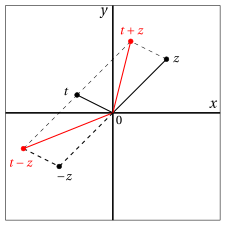
The sum of two complex numbers is the complex number whose coordinates are the sums of the coordinates: the geometric meaning of this fact is that the point \(z + t\) is constructed from the points \(z\), \(t\) according to the “parallelogram rule”, illustrated in the following figure:
Remark 1
The set of complex numbers \(~\C\) is not an ordered field
Proof
-
We have seen that \(\C\) satisfies the field axioms; however, it does not satisfy those of an ordered field, that is, it is not possible to define a relation \(\le\) between complex numbers in such a way that properties \(R3\) hold
-
It can be proved that properties \(R3\) imply that the square of any number is never negative, and on the other hand, if a number is positive its opposite is negative. Now, in \(\C\) we have:
\[ 1^2 = 1 {\rm ~~~and ~~~} i^2=-1 \]We therefore have two squares, each the opposite of the other. Neither of them, however, can be negative (because they are squares), and this is absurd (because between \(a\) and \(- a\) one must be negative, if \(a\neq 0\)). We conclude that \(\C\) is not an ordered field.
□
Definition 4: conjugate
The complex number \(a - ib\) is called the complex conjugate of \(z = a + ib\) and is denoted by \(\overline{z}\).
We have:
-
The conjugation operation has the following elementary properties with respect to sum and product:
\[\begin{align} \overline{(z_1+z_2)} &= \overline{z}_1 + \overline{z}_2 \\[2ex] \overline{(z_1 \cdot z_2)} &= \overline{z}_1 \cdot \overline{z}_2 \\[2ex] \overline{\left(\frac{1}{z}\right)} &= \frac{1}{\overline{z}} \end{align}\]
Definition 5: modulus
The modulus of \(z = a+ ib\) is the non-negative real number \(\sqrt{a^2 + b^2}\); it is denoted by \(|z|\).
-
If \(z = a\) is real, its modulus is called the absolute value and is still denoted by \(|a|\). The following properties hold:
-
\(|z| = 0 \Longleftrightarrow z=0, {\rm ~~moreover~~} |z| \ge 0\)
-
\(|z| = |\overline{z}|\)
-
\(\Re(z) \le |z| ~~~~ \Im(z) \le |z| ~~~~ |z| \le |\Re(z)| + |\Im(z)|\)
-
\(|z_1 + z_2| \le |z_1| + |z_2| ~~~~\) triangle inequality
-
\(|z_1 + z_2| \ge \big| |z_1| - |z_2| \big| ~~~~\)
-
-
Properties a), b) , c) are immediately verified.
Proof
-
Let us prove properties d) and e). They are equivalent to the following:
\[ (|z_1| - |z_2|)^2 ~~\le~~ |z_1 + z_2|^2 ~~\le~~ (|z_1| + |z_2|)^2 \] -
Setting \(z_1 = a + ib\), \(z_2 = c + id\) we obtain:
\[\begin{align*} |z_1 + z_2|^2 &= \big| (a + ib) + (c + id)\big|^2\\[2ex] &= \big| (a + c) + i(b+d) \big|^2\\[2ex] &= \left(\sqrt{(a + c)^2+(b + d)^2}\right)^2=(a+c)^2 + (b+d)^2 \end{align*}\]and hence we have:
\[ \underbrace{\left(\sqrt{a^2+b^2} - \sqrt{c^2+d^2}\right)^2}_{=(a^2+b^2)+(c^2+d^2)-2\:\sqrt{a^2+b^2} \cdot \sqrt{c^2+d^2} } ~~\le~~ \underbrace{(a+c)^2 + (b+d)^2}_{=a^2+2ac+c^2+b^2+2bd+d^2} ~~\le~~ \underbrace{\left(\sqrt{a^2+b^2} + \sqrt{c^2+d^2}\right)^2}_{=(a^2+b^2)+(c^2+d^2)+2\:\sqrt{a^2+b^2} \cdot \sqrt{c^2+d^2} } \]After simplification, this double inequality reduces to:
\[ -\sqrt{a^2+b^2} \cdot \sqrt{c^2+d^2} ~~\le~~ ac+bd ~~\le~~ \sqrt{a^2+b^2} \cdot \sqrt{c^2+d^2} \]which is equivalent to the following:
\[ |ac + db | ~\le~ \sqrt{a^2+b^2} \cdot \sqrt{c^2+d^2} \]Squaring both sides we arrive at:
\[ \underbrace{\big(ac + db\big)^2}_{=a^2c^2+d^2b^2+2acbd} ~\le~ \underbrace{\left(a^2+b^2\right) \cdot \left(c^2+d^2\right)}_{=a^2c^2+a^2d^2+b^2c^2+b^2d^2} \]that is,
\[ 0 ~~\le~~ - 2acbd + a^2d^2 + b^2 c^2 ~~=~~ \big(ad-bc\big)^2 \]which is true for every \(a, b, c, d \in \R\).
□
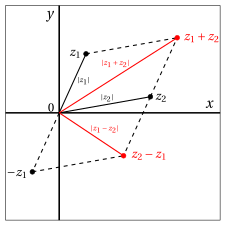
- Geometrically, \(|z|\) represents the distance of the point (or complex number) \(z\) from the origin; \(|z_1 - z_2|\) represents the distance between the two points \(z_1\) and \(z_2\); inequalities d) and e) express the well-known theorem on the lengths of the sides of a triangle1:
-
Using the concepts just introduced, we can write the quotient of two complex numbers in algebraic form:
\[ \frac{a+ib}{c+id} \]it suffices to multiply the numerator and the denominator by \(c-id\), and we obtain:
\[ \frac{a+ib}{c+id} = \frac{(a+ib)(c-id)}{\underbrace{(c+id)(c-id)}_{=c^2+d^2}} = \frac{ac-aid+ibc-i^2bd}{c^2+d^2}= \frac{(ac+bd)}{c^2+d^2} + i \frac{(bc-ad)}{c^2+d^2} \]
2.1 Equations in the complex field
-
Let us see how to solve an equation in the complex field, when it involves the unknown \(z = x + iy\) also through \(\Re(z)\), \(\Im(z)\), \(z\), \(|z|\).
-
We illustrate, with the following example, the procedure of transforming the equation in one complex unknown into a system of two equations in two real unknowns. The method consists in taking the real and imaginary parts of the equation.
Example 3: equations in the complex field (algebraic method)
-
We want to solve:
\[ z^2 + i \;\Im \;z + 2 \;\overline{z} =0 \]We set \(z = x + iy\), with \(x\), \(y\) real unknowns, and rewrite the equation:
\[ \begin{cases} z^2= (x + i\:y)^2 = x^2 - y^2 + 2\:i\:x\:y\\[2ex] i \;\Im\;z= i\:y\\[2ex] 2 \;\overline{z}= 2\: (x - i\:y) = 2\: x - 2\:i\:y \end{cases} \]Substituting, we therefore obtain:
\[ (x^2 - y^2 + 2\:i\:x\:y) + (i\:y) + (2\: x - 2\:i\:y) =0 \] -
Now, a complex number is zero if and only if its real part and imaginary part are zero. Therefore we separate the real part and the imaginary part of the left-hand side:
\[ (x^2 - y^2 + 2\:x) + i \:(2\: x\:y + y - 2\:y) =0 \]and set both equal to zero:
\[ \begin{cases} x^2 - y^2 + 2\:x = 0\\[2ex] 2\: x\:y - y = 0 \end{cases} \]We have thus transformed the equation in one complex unknown into a system of two equations in two real unknowns.
-
We solve the system. The second equation gives:
\[ y=0 {\rm ~~~~or~~~~} x= \frac{1}{2} \]-
For \(y=0\) the first equation becomes
\[ x^2 + 2\:x = 0 {\rm ~~~which~gives~~~} x=0 {\rm ~~~~or~~~~} x= -2 \] -
For \(x=\frac{1}{2}\) the first equation becomes
\[ -y^2 + \frac{5}{4}= 0 {\rm ~~~which~gives~~~} y=\pm \frac{\sqrt{5}}{2} \]
-
-
Hence the equation has the following 4 solutions:
\[ z=0,~~~~~ z=-2,~~~~~z= \frac{1}{2} + i\:\frac{\sqrt{5}}{2},~~~~~z= \frac{1}{2} - i\:\frac{\sqrt{5}}{2} \]
The method seen in this example can in principle be applied to any equation in \(\C\), but a generic system of two equations in two unknowns is almost always impossible to solve algebraically.
3. Trigonometric form of complex numbers
-
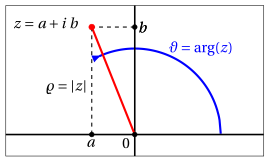
As is known from Geometry, the points of the plane can be identified not only by their Cartesian coordinates , but also by their polar coordinates:
-
\(\varrho\) \(\rightarrow\) polar radius, i.e., the distance of the point from the origin
-
\(\vartheta\) \(\rightarrow\) polar angle, i.e., the angle that the line joining the point to the origin forms with the positive \(x\)-axis, measured counterclockwise.
-
-
Clearly, a pair \(\varrho\) , \(\vartheta\), with \(\varrho > 0\), identifies a well-defined point of the plane; conversely, a point of the plane uniquely determines the coordinate \(\varrho\), but the angle \(\vartheta\), measured in radians, is determined only up to multiples of \(2\:\pi\).
-
Given a complex number \(z\) , its modulus \(|z|\) coincides with the polar radius \(\varrho\) of the point representing it in the complex plane.
-
We call argument of \(z\), and denote by arg\((z)\), any of the angles \(\vartheta\) associated with the point \(z\). In this way the argument of \(z\) is not uniquely determined. Often this indeterminacy does not cause any problem. At other times, however, it is preferable to assign a well-defined argument to a complex number. This can be done in infinitely many ways, by fixing any interval of length \(2\;\pi\) within which the angle \(\vartheta\) is allowed to vary
-
The intervals most commonly used for this purpose are \([0, 2\:\pi)\) and \((-\pi, \pi]\); the argument of \(z\) is then called the principal argument.
Example 4: arguments of complex numbers
-
the number \(-i\) has argument \(- \pi / 2\) or \(3\pi / 2\) or any other value of the form \(- \pi / 2 + 2\:k\:\pi\) with \(k \in \Z\). Its principal argument will be \(3\pi / 2\) if we adopt the convention \(\vartheta \in [0, 2\:\pi)\), and \(-\pi / 2\) with the convention \(\vartheta \in (-\pi, \pi]\).
-
Positive real numbers have principal argument \(0\) and negative ones \(\pi\), with both conventions.
-
Given the number \(z = a+ ib\), from trigonometry we immediately obtain the relations between the Cartesian coordinates \(a\), \(b\) and the polar ones \(\varrho\), \(\vartheta\):
The inverse relations are:
Definition 6: trigonometric form
A complex number \(z = a+ ib\) can also be written in the form
which is called the trigonometric form of complex numbers.
Example 5: trigonometric form
Let us write the following complex number in trigonometric form:
We have \(\varrho=\sqrt{a^2+b^2}=\sqrt{3+1}=2\), hence:
3.1 De Moivre's formulas
-
The trigonometric form is convenient for expressing products and quotients of complex numbers. Indeed, if we have:
\[ z_1= \varrho_1 \; (\cos \vartheta_1 + i \; \sin \vartheta_1) ~~~~~~ z_2= \varrho_2 \; (\cos \vartheta_2 + i \; \sin \vartheta_2) \]for the product we obtain:
\[\begin{align} z_1 z_2 & = \varrho_1\varrho_2 \cdot \bigg\{~~\cos \vartheta_1 \; \cos \vartheta_2 - \sin \vartheta_1 \; \sin \vartheta_2 + i ~~\big(\sin \vartheta_1 \cos \vartheta_2+ \cos \vartheta_1 \sin \vartheta_2\big)~~\bigg\} \nonumber \\[2ex] & = \varrho_1\varrho_2 \cdot \bigg\{~~ \cos \big(\vartheta_1+\vartheta_2\big) + i ~~ \sin \big(\vartheta_1+\vartheta_2\big)~~\bigg\} \label{PPP} \end{align}\]for the quotient, if \(z_2\neq0\), we have:
\[ \frac{z_1}{z_2} = \frac{\varrho_1}{\varrho_2} \cdot \frac{\cos \vartheta_1 + i \; \sin \vartheta_1}{\cos \vartheta_2 + i \; \sin \vartheta_2}, \]multiplying numerator and denominator by \((\cos \; \vartheta_2 - i \; \sin \; \vartheta_2)\) and, taking into account that \(( \cos \; \vartheta_2)^2 + (\sin \; \vartheta_2)^2 = 1\), we obtain:
\[\begin{align} \frac{z_1}{z_2} & = \frac{\varrho_1}{\varrho_2} \cdot \bigg\{~~ (\cos \vartheta_1 + i \; \sin \vartheta_1) \cdot (\cos \vartheta_2 - i \sin \vartheta_2) ~~\bigg\} \nonumber \\[2ex] & = \frac{\varrho_1}{\varrho_2} \cdot \bigg\{~~ \cos \big(\vartheta_1-\vartheta_2\big) + i ~~ \sin \big(\vartheta_1-\vartheta_2\big)~~\bigg\} \end{align}\] -
Therefore the modulus of the product and of the quotient of two complex numbers is, respec- tively, the product and the quotient of the moduli; the argument is, respectively, the sum and the difference of the arguments:
\[\begin{align} |z_1 \cdot z_2| = |z_1|\cdot|z_2|~~~~{\rm and} ~~~~{\rm arg}(z_1 \cdot z_2) = {\rm arg}(z_1)+{\rm arg}(z_2)\\[2ex] \left|\frac{z_1}{z_2}\right| = \frac{|z_1|}{|z_2|}~~~~{\rm and} ~~~~{\rm arg}\left(\frac{z_1}{z_2}\right) = {\rm arg}(z_1) - {\rm arg}(z_2) \end{align}\] -
Formula \(\eqref{PPP}\) generalizes to the case of any number of factors \(z_1, z_2,\dots, z_n\):
\[\begin{align} z_1z_2 \dots z_n= \varrho_1\varrho_2\dots\varrho_n \cdot \bigg\{~~ \cos \big(\vartheta_1+\vartheta_2+\dots+\vartheta_n\big) + i ~~ \sin \big(\vartheta_1+\vartheta_2+\dots+\vartheta_n)~~\bigg\} \end{align}\]If, moreover, all the factors are equal, we obtain:
\[\begin{align} z^n= \varrho^n \cdot \bigg\{~~ \cos \big(n\: \vartheta\big) + i ~~ \sin \big(n\: \vartheta)~~\bigg\} \end{align}\] -
These relations on products and quotients of complex numbers are known as De Moivre's formulas.
Example 6: powers of complex numbers with De Moivre's formulas
Write in algebraic form:
We determine the modulus and argument of \((1 + i)\) and then apply De Moivre's formula.
Hence we have:
Consequently:
-
De Moivre's formulas allow us to give a geometric interpretation of the product of complex numbers.
-
Let \(z\), to begin with, be a complex number with modulus \(1\), hence of the form \(( \cos \vartheta + i \sin \vartheta)\). Then, multiplying a number by \(z\) means adding \(\vartheta\) to its argument, i.e., performing a rotation by the angle \(\vartheta\).
-
If \(z\) has modulus \(\varrho\) instead of 1, in addition to a rotation we perform a dilation by the factor \(\varrho\).
Example 7: geometric interpretation of the product of complex numbers
-
multiplying by \(i\) means performing a rotation by \(\frac{\pi}{2}\);
-
multiplying by \(- 1\) means performing a rotation by \(\pi\);
-
multiplying by \((1 +i)\) means performing a dilation by the factor \(\sqrt{2}\) and a rotation by \(\frac{\pi}{4}\)
Example 8: equations in the complex field (trigonometric method)
-
We want to solve:
\[ z^3 - |z| =0 \]We rewrite the equation in the form
\[ z^3 = |z| \]and we set \(z= \varrho \; (\cos \vartheta + i \; \sin \vartheta)\) (trigonometric form) and rewrite the equation:
\[ \begin{cases} z^3= \varrho^3 (\cos 3\:\vartheta + i \; \sin 3\:\vartheta)\\[2ex] |z|= \varrho \end{cases} \]Substituting, we therefore obtain:
\[ \varrho^3 (\cos 3\:\vartheta + i \; \sin 3\:\vartheta) = \varrho \]The equation is satisfied if and only if the two sides have equal moduli and arguments that differ by multiples of \(2\pi\) (the right-hand side has argument 0), that is:
\[ \begin{cases} \varrho^3 = \varrho\\[2ex] 3 \vartheta = 2k\pi & {\rm with~~} k \in \Z \end{cases} \]The first equation gives \(\varrho = 0\) and \(\varrho = 1\) (careful: \(\varrho\) must be \(\ge 0\) because it is the modulus of the complex number; therefore \(\varrho = -1\) is not acceptable); the second one gives \(\vartheta=\frac{2k\pi}{3}, k \in \Z\). Hence:
\[ z=0, ~~ z=\cos \frac{2k\pi}{3} + i \sin \frac{2k\pi}{3} ~~~~~~{\rm with~~} k \in \Z \]Explicitly:
\[ z=0, ~~~~ z=1, ~~~~ z=-\frac{1}{2} + i \:\frac{\sqrt{3}}{2}, ~~~~ z=-\frac{1}{2} - i \:\frac{\sqrt{3}}{2} \]
3.2 \(n\)-th roots of complex numbers
Definition 7: \(n\)-th root of a complex number
Given a complex number \(w\), we say that \(z\) is an n-th (complex) root of \(w\) if \(z^n = w\).
Theorem 1
Let \(w \in \C\), \(w \neq 0\), and \(n\) an integer \(\ge 1\). There exist exactly \(n\) complex \(n\)-th roots \(z_0, z_1, \dots , z_{n-1}\) of \(w\); setting
we have
Proof
-
The numbers \(z_k\) are clearly roots of \(w\), as can be seen by computing \(z^n_k\) with De Moivre's formula. Let us show that there are no others.
-
If a number \(R( \cos \: \psi + i\; \sin \psi)\) is an \(n\)-th root of \(w\), we must have
\[ R^n = r ~~~~{\rm and}~~~~ n \: \psi = \varphi + 2h\pi ~~~~{\rm with}~~~~ h \in \Z \]or equivalently:
\[ R = r^{1/n} ~~~~{\rm and}~~~~ \psi = \varphi/n + 2h\pi/n ~~~~{\rm with}~~~~ h \in \Z \] -
Giving \(h\) the values \(0, 1, \dots, n-1\) we find exactly the numbers \(z_k\).
-
Giving \(h\) any other value \(\bar{h}\) different from the previous ones, it can be written in the form \(\bar{h} = k + mn\) ( \(m \in \Z\) is the quotient and \(k\) is the remainder of the division of \(\bar{h}\) by \(n\)), so that we would have
\[ \psi = \frac{\varphi}{n} + \frac{2k\pi}{n} + 2m\pi = \vartheta_k + 2m\pi \]and we would find again the same \(z_k\) as before.
□
Example 9: fifth root of a complex number
-
Let us compute \(\sqrt[5]{1+i}\): the complex number \((1+i)\) has modulus \(\sqrt{2}\) and argument \(\pi/4\). The fifth roots will therefore be:
\[ \sqrt[5]{1+i} =\sqrt[5]{\sqrt{2}} \left[ \cos \left( \frac{\frac{\pi}{4}+2k\pi}{5} \right) + i \: \sin \left( \frac{\frac{\pi}{4}+2k\pi}{5} \right) \right] = \]\[ = \sqrt[10]{2} \left[ \cos \left( \frac{\pi}{20} + \frac{2}{5} k\pi \right) + i \: \sin \left( \frac{\pi}{20} + \frac{2}{5} k\pi \right) \right]~~~~{\rm with}~~~~ k=0,1,2,3,4 \] -
The angles found are not standard angles, but if desired, their sines and cosines can be computed approximately using a calculator.
-
Unfortunately, a somewhat ambiguous notation is used for complex roots, the same one used to denote the arithmetic root; that is, \(\sqrt[n]{z}\) or \(z^{1/n}\) denotes the set of the \(n\) complex roots of \(z\).
-
This can create confusion when \(z\) is real. Indeed, the symbol \(\sqrt{4}\), understood as the arithmetic root of 4, is 2; understood as the complex root of 4, it is the set of the two numbers + 2 and - 2.
Example 10: cube root of a complex number
-
Let us compute \(\sqrt[3]{-1}\): the complex number \((-1)\) has modulus \(1\) and argument \(\pi\). The cube roots will therefore be:
\[ \sqrt[3]{-1} = \underbrace{\sqrt[3]{1}}_{=1} \left[ \cos \left( \frac{\pi}{3} + \frac{2}{3} k\pi \right) + i \: \sin \left( \frac{\pi}{3} + \frac{2}{3} k\pi \right) \right]~~~~{\rm with}~~~~ k=0,1,2 \]that is, the numbers \(z_k\) of the form:
\[ \cos \: \vartheta_k + i\: \sin \: \vartheta_k ~~~~{\rm with}~~~~ \vartheta_k=\frac{\pi}{3} + \frac{2}{3} k\pi ~~~~{\rm and}~~~~ k=0,1,2 \] -
Explicitly we have:
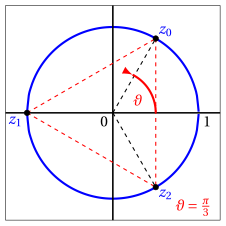
\[ \begin{cases} z_0 = \cos \left( \frac{\pi}{3} \right) + i \: \sin \left( \frac{\pi}{3} \right) = \frac{1}{2} + i \; \frac{\sqrt{3}}{2} =\frac{1}{2} (1 + i \; \sqrt{3} ) \\[2ex] z_1 = \cos \left( \frac{\pi}{3} + \frac{2\pi}{3} \right) + i \: \sin \left( \frac{\pi}{3} + \frac{2\pi}{3} \right)=\cos \left( \pi \right) + i \: \sin \left( \pi \right) = -1\\[2ex] z_2 = \cos \left( \frac{\pi}{3} + \frac{4\pi}{3} \right) + i \: \sin \left( \frac{\pi}{3} + \frac{4\pi}{3} \right) = \cos \left( \frac{5\pi}{3} \right) + i \: \sin \left( \frac{5\pi}{3} \right) = \frac{1}{2} - i \; \frac{\sqrt{3}}{2} =\frac{1}{2} (1 - i \; \sqrt{3} ) \end{cases} \]
-
The arrangement of the roots of complex numbers in the Gauss plane is not random.
-
Indeed, if \(w = r\:( \cos \varphi + i \; \sin \varphi)\), the \(n\)-th roots \(z_0, z_1 , \dots, z_{n-1}\) of \(w\) lie at the vertices of the regular polygon with \(n\) sides inscribed in the circle with center \(0\) and radius \(r^{1/n}\) , with the vertex \(z_0\) located at the point with argument \(\vartheta = \varphi/n\).
Example 11: roots in the Gauss plane
-
The figure shows the cube roots of -1 : \(z_0, z_1, z_2\) from the previous exercise:
-
The figure shows the sixth roots of \(i\) : \(z_0, z_1, z_2, z_3,z_4,z_5\),
\[ \sqrt[6]{i} = \underbrace{\sqrt[6]{1}}_{=1} \left[ \cos \left( \frac{\pi}{2\cdot 6} + \frac{2}{6} k\pi \right) + i \: \sin \left( \frac{\pi}{2\cdot 6} + \frac{2}{6} k\pi \right) \right]~~~~{\rm with}~~~~ k=0,1,2,3,4,5 \]that is, the numbers \(z_k\) of the form:
\[ \cos \: \vartheta_k + i\: \sin \: \vartheta_k ~~~~{\rm with}~~~~ \vartheta_k=\frac{\pi}{12} + \frac{1}{3} k\pi ~~~~{\rm and}~~~~ k=0,1,2,3,4,5 \]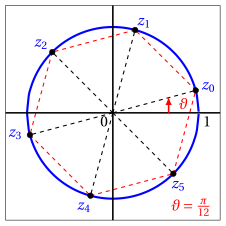
Try it — the interactive graph below shows what you have just read: move the sliders.
3.3 Exponential form of complex numbers
-
The following notation is useful:
\[ e^{i \: \varphi} = \cos \; \varphi + i \; \sin \; \varphi \quad {\rm ~~with~~} \varphi \in \R \]where \(e\) is Euler's number (Napier's constant).
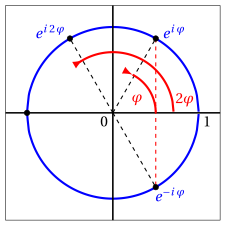
With this notation, the trigonometric form can be equivalently rewritten as:
\[ z = |z| \; ( \cos \; \varphi + i \; \sin \; \varphi) = |z|e^{i \:\varphi}, \qquad \varphi = {\rm arg}(z) ~~~{\rm with~~} z \neq 0 \]This notation is called the exponential form of complex numbers.
-
This form is useful since we have:
\[ e^{i \: \varphi_1} \cdot e^{i \:\varphi_2} = e^{i \:\left(\varphi_1+\varphi_2 \right)} \]that is, it is very easy to compute products of complex numbers.
De Moivre's formulas become:
\[ \left( e^{i \: \varphi} \right)^n = e^{i \:n \:\varphi} \]The exponential notation is widely used in applications because it greatly simplifies manipulations involving trigonometric quantities.
We have:
\[ e^{2k\pi i} =1 {\rm ~~~~and~~~~} e^{i (\varphi + 2 k \pi)} =e^{i\varphi} ~~~ \forall k \in \Z, {\rm ~~~~moreover~~~~} |e^{i \varphi}|=1 \]We also have:
\[ e^{i \: \pi} = -1,~~~e^{i \: \frac{\pi}{2}} = i,~~~e^{i \: \frac{3\:\pi}{2}} = -i,~~~e^{i \: \frac{3\:\pi}{4}} = \frac{-1+i}{\sqrt{2}} \]Rewriting, we obtain Euler's formula:
\[ e^{i \: \pi} +1 =0 \]which links in a simple way five of the most important constants: \(0\), \(1\), \(i\), \(\pi\), \(e\).
The exponential notation can be generalized consistently with the properties of powers, by defining the complex exponential:
\[ e^z = e^{x + i\;y} = e^x \: e^{i \: y} = e^x(\cos y + i \: \sin y),\qquad \forall z= x +i\:y \in \C \] -
From the definition of exponential form it follows that
\[ e^{-i\varphi} = \cos \; (- \varphi) + i \; \sin \; (-\varphi) = \cos \; \varphi - i \; \sin \; \varphi \]and we easily obtain:
\[ \cos \varphi = \frac{e^{i \: \varphi} + e^{-i \: \varphi}}{2},~~~\sin \varphi = \frac{e^{i \: \varphi} - e^{-i \: \varphi}}{2\:i} \quad {\rm ~~with~~} \varphi \in \R \]These formulas allow us to express sine and cosine as combinations of complex exponentials.
4. Quadratic equations
-
A second-degree equation or quadratic equation in one real unknown \(x\) is an algebraic equation in which the highest power of the unknown is \(2\), and it can always be written in the form:
\[\begin{equation} \label{eq2grado} a\: x^2 + b \: x + c = 0 \qquad (a \neq 0) \end{equation}\]where \(a,b\) and \(c\) are real numbers.
The solutions are also called roots or zeros of the equation.
Remark 2: quadratic formula
Given a quadratic equation \(a\: x^2 + b \: x + c = 0\) \((a \neq 0)\), its zeros or roots are:
- A quadratic equation is called a “complete quadratic equation” when all its coefficients are different from \(0\). It is solved with the so-called method of completing the square, so called because the equation is modified until its left-hand side becomes the square of a binomial.
Proof
Isolating the constant term, we obtain:
□
-
If the discriminant \(\Delta\) is negative there are no real solutions.
-
If \(\Delta = 0\), the quadratic formula becomes:
\[ { x=-{\frac {b}{2a}}} \]therefore there is only one root, with multiplicity two.
-
Finally, if \(\Delta < 0\), the equation has no real solutions. In particular, there are always two solutions, but they belong to the field of complex numbers: they are two complex conjugate numbers and are computed with the two formulas:
\[ x_{+}={\frac {-b}{2a}}+i\left({\frac {\sqrt {4ac-b^{2}}}{2a}}\right) \]\[ x_{-}={\frac {-b}{2a}}-i\left({\frac {\sqrt {4ac-b^{2}}}{2a}}\right) \]where \(i\) is the imaginary unit (\(i^2 = -1\)).
A quadratic equation in one complex unknown \(z\) has the following form
where \(a,b\) and \(c\) are complex numbers. It is solved with the same formula as in the case of a real unknown:
where the square root is understood in the complex sense (the \(\pm\) sign is superfluous, because in the complex field the root denotes two numbers, each the opposite of the other)
Example 12: quadratic equations in the complex field
-
We want to solve:
\[ z^2 + 2\: i \; z - \sqrt{3}i =0 ~~~~~~a=1,b=2\;i,c=-\sqrt{3}i \]we have (switching to the trigonometric form to compute the root):
\[ z= \frac{-2\;i\pm \sqrt{2^2i^2+ 2^2\sqrt{3}i}}{2} = \frac{-2\;i\pm 2\sqrt{-1+ \sqrt{3}i}}{2} = -i \pm \sqrt{-1+ \sqrt{3}i} = -i \pm \sqrt{ 2 \left( -\frac{1}{2} + i \; \frac{\sqrt{3}}{2} \right)} \]\[ =-i \pm \sqrt{ 2 \left( \cos \; \frac{2}{3} \pi + i \; \sin \; \frac{2}{3} \pi \right) } = -i \pm \sqrt{2} \; \left( \underbrace{\cos \; \frac{\pi}{3}}_{=\frac{1}{2}} + i \; \underbrace{\sin \; \frac{\pi}{3}}_{=\frac{\sqrt{3}}{2}} \right) = \pm \frac{\sqrt{2}}{2} + i \; \left(-1 \pm \frac{\sqrt{6}}{2} \right) \]
-
The previous theorem tells us that a polynomial of the form \(z^n + a\) (with \(a\) complex) has exactly \(n\) roots in \(\C\); in the real field, instead, the equation \(x^n + a = 0\) may have two, one, or no roots (examples: \(x^2 - 1 =0, x^3 - 1 = 0, x^2 + 1 = 0\)); we now know that such an equation always has \(n\) roots in \(\C\), but only occasionally one or two of them lie in \(\R\).
-
The result is much more general, as stated by the following theorem, whose proof we do not report.
Theorem 2: fundamental theorem of algebra
A polynomial equation of the form
\[ a_0 + a_1 \; z +\dots + a_n \; z^n = 0 ~~~~~~(a_n \neq 0) \]with arbitrary complex coefficients has exactly \(n\) roots in \(\C\), if each of them is counted with its multiplicity 2.
Cosines and sines of the main angles
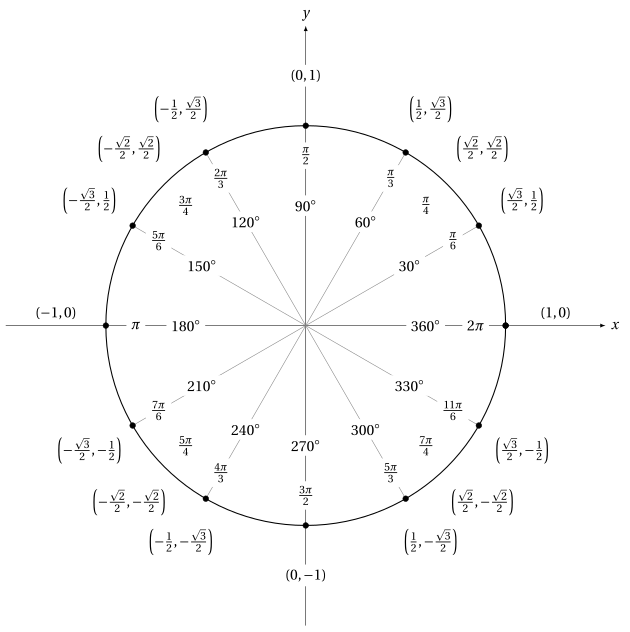
-
In a non-degenerate triangle, the sum of the lengths of two sides is greater than the length of the third one. ↩
-
If \(P(z)\) is a polynomial in \(z\) of degree \(n\) and \(z_0\) is one of its roots, we say that \(z_0\) has multiplicity \(k\) (\(k\) integer, \(\ge 1\)) if the formula \(P(z)=(z-z_0)^k\;Q(z)\) holds, where \(Q\) is a polynomial such that \(Q(z_0) \neq 0\). ↩