Sequences and limits of sequences
Part 3 · Limits of sequences · Chapter 1 · lecture notes by Fabio Furini · Chapter PDF
1. Definition of sequence and properties
-
Consider the set \(\mathbb{N}\) of non-negative integers, ordered according to the natural order
\[ \mathbb{N}: 0,1,2,3,\dots,n,\dots \]
Definition 1: Sequence
A sequence is a relation that associates with each natural number \(n \in \mathbb{N}\) (or from a certain natural number \(n_0\) onward) a real number \(a_n \in \R\).
-
A sequence is therefore a function:
\[ f: \mathbb{N} \rightarrow \mathbb{R} \]\[ f: n \mapsto a_n \]or possibly
\[ f: \{n \in \mathbb{N}: n \ge n_0\} \rightarrow \mathbb{R} \]for some fixed integer \(n_0 \in \N\).
The sequence associates with the input variable \(n\) the output value \(a_n\).
-
The fact that the domain of the function \(f\) is the set of natural numbers makes it possible to write the sequence by listing its values, in the order in which they follow one another as \(n\) increases:
\[ a_0,~~a_1,~~a_2,~~ \dots,~~ a_n,~~ \dots \] -
The dots after \(a_n\) indicate that we are not considering only the first \(n\) terms of the sequence (i.e., a finite set of numbers), but the whole sequence of infinitely many terms (i.e., an infinite set of numbers).
Example 1: Sequences
The last sequence is called a constant sequence.
Example 2: Sequences
We can represent sequences graphically by the points of the Cartesian plane with coordinates \((n, a_n)\).
Example 3: Graph of a sequence
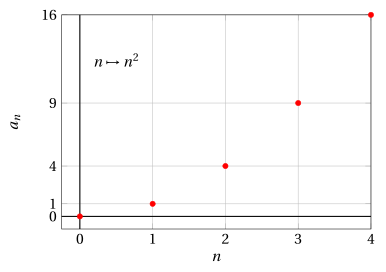
The graph of the sequence \(n \mapsto n^2\) with \(n\in\{0,1,2,3,4\}\) is:
To denote a sequence we will use the notation:
possibly specifying the set in which the input variable \(n\) varies (the whole set \(\mathbb{N}\) or from a certain value \(n_0 \in \N\) onward).
A sequence \(\{a_n\}\) is bounded if there exist two numbers \(m \in \R\) and \(M \in \R\) such that:
It is bounded below if \(m\) exists. It is bounded above if \(M\) exists.
Example 4: Bounded sequences
-
the sequence \(\left\{ (-1)^n \right\}\) is bounded
-
the sequence \(\left\{ n^2 \right\}\) is only bounded below
-
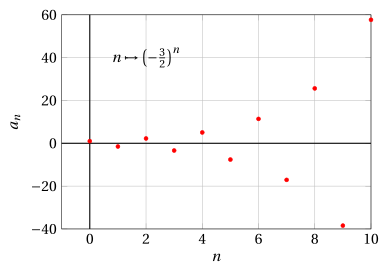
the sequence \(\left\{( -2)^n \right\}\) is not bounded (neither below nor above).
Definition 2: Property that holds eventually
We say that a sequence \(\{a_n\}\) has (or acquires) a certain property eventually if there exists \(\tilde{n} \in \mathbb{N}\) such that \(a_n\) satisfies that property for every \(n \ge \tilde{n}\).
Example 5: Properties that hold eventually
Consider the sequence \(\left\{ n - 2 \: \sqrt{n} \right\}\). The graph of the sequence with \(n\in\{0,1,2,\dots,10\}\) is:
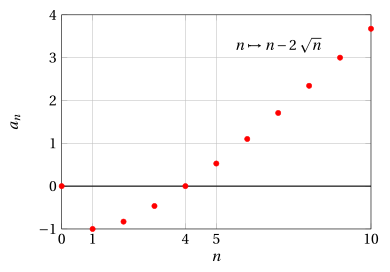
This sequence is eventually positive. With \(n=4\) we have \(a_n=0\), hence taking \(\tilde{n}=5\), we have \(a_n > 0\) for \(n \ge \tilde{n}\).
Example 6: Properties that hold eventually
Now consider the sequence \(\left \{ \frac{1}{n} \right \}\). The graph of the sequence with \(n\in\{1,2,\dots,4\}\) is:
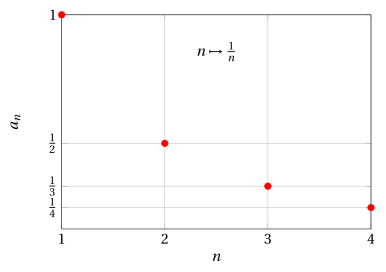
This sequence is eventually less than \(10^{-100}\). With \(n=10^{100}\) we have \(a_n =10^{-100}\), hence taking for example \(\tilde{n} = 10^{100} +1\) we have \(a_n < 10^{-100}\) for \(n \ge \tilde{n}\).
1.1 Convergent sequences and definition of the limit of a sequence
Definition 3: Convergent sequence
A sequence \(\{ a_n\}\) is called convergent if there exists a number \(\ell \in \mathbb{R}\) such that:
for every \(\varepsilon > 0\).
A sequence \(\{ a_n\}\) is therefore called convergent if for every \(\varepsilon > 0\) (as small as we like) there exists a number \(n(\varepsilon) \in \N\) such that:
The number \(n(\varepsilon)\) depends (in general) on the value of \(\varepsilon\). If the sequence \(\{a_n\}\) is convergent, then the number \(\ell \in \R\) is associated with it.
Definition 4: Limit of a sequence
The number \(\ell \in \R\) appearing in inequality \(\eqref{limite_successione}\) is called the limit of the sequence \(\{a_n\}\), and we write:
-
read, respectively:
-
**** the limit of \(a_n\), as \(n\) tends to infinity, is \(\ell\)
-
**** \(a_n\) tends to \(\ell\) as \(n\) tends to infinity
-
Inequality \(\eqref{limite_successione}\) corresponds to the following two:
-
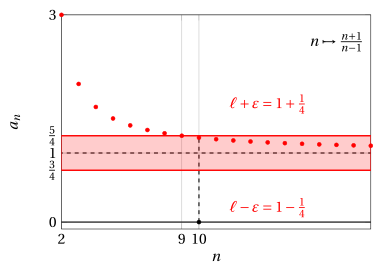
Representing the points of a sequence graphically, we have:
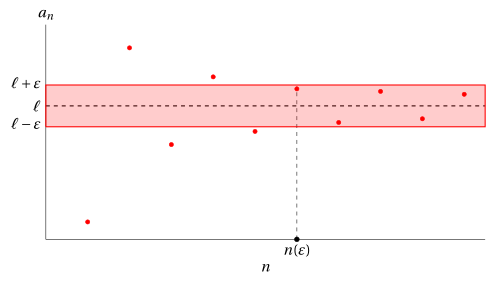
The convergence condition means that, having fixed a horizontal strip “as narrow as we like”:
\[ [\ell - \varepsilon, \ell + \varepsilon] \]from a certain value of \(n\) onward, called \(n(\varepsilon)\), the points \(a_n\) of the sequence no longer leave this strip. In the previous graph, having fixed the width of the strip, the values \(a_n\) lie inside the strip for \(n \ge n(\varepsilon)\).
Theorem 1: Uniqueness of the limit of a sequence
If a sequence \(\{a_n\}\) converges to the limit \(\ell \in \R\), then this limit is unique.
Proof
Suppose, by contradiction, that there exist two different limits, \(\ell_1\) and \(\ell_2\), associated with the same sequence \(\{a_n\}\). Then, eventually, for every \(\varepsilon >0\) we would have:
We used the triangle inequality. Since \(\varepsilon >0\) can be chosen arbitrarily small, \(\eqref{MMM}\) can be satisfied if and only if:
Hence two different values \(\ell_1\) and \(\ell_2\) cannot exist and consequently the limit (if it exists) is unique. □
Example 7: Verifying the limit of a sequence
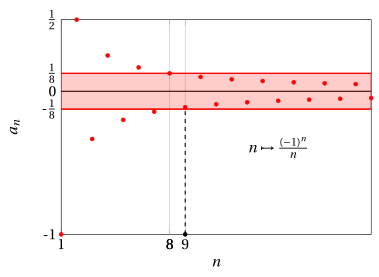
The graph of the sequence \(n \mapsto \frac{(-1)^n}{n}\), for example starting from \(n=9\), lies within the horizontal strip:
given by \(\ell=0\) and \(\varepsilon = \frac{1}{8}\). With \(n=8\) we have \(a_n=\frac{1}{8}\), with \(n=9\) we have \(a_n=-\frac{1}{9}\), hence
To prove that:
we must verify that for every \(\varepsilon>0\) there exists \(n(\varepsilon) \in \N\) such that
The inequality is equivalent to
Having fixed \(\varepsilon > 0\), it will suffice to choose the first integer
to satisfy the condition required by the definition of limit.
Convergent sequences are (eventually) bounded.
Example 8: Verifying the limit of a sequence
Consider the sequence:
This is the graph of the sequence with \(n\in\{2,3,\dots,20\}\):
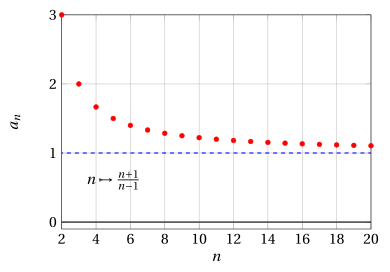
We see that the values \(a_n\) get closer to \(1\), hence we try to prove, using the definition of limit, that:
We must verify that for every \(\varepsilon>0\) there exists \(n(\varepsilon) \in \N\) such that:
The left inequality is always satisfied (the numerator of the fraction is always larger than the denominator). We take the right one:
Having fixed \(\varepsilon > 0\), it will suffice to choose the first integer
to satisfy the condition required by the definition of limit.
Example 9: Verifying the limit of a sequence
For the previous example, we proved that the limit equals \(1\). Let us now check what happens when we fix \(\varepsilon=\frac{1}{2}\). In this case \(n\left(\frac{1}{2}\right)> \frac{2+1/2}{1/2}=5\).
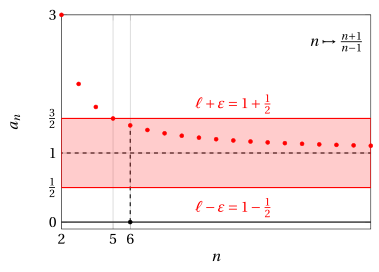
If instead we fix \(\varepsilon=\frac{1}{4}\), in this case we have \(n\left(\frac{1}{4}\right)> \frac{2+1/4}{1/4}=9\).
Example 10: Verifying the limit of a sequence
Consider the sequence:
This is the graph of the sequence with \(n\in\{1,2,\dots,20\}\):
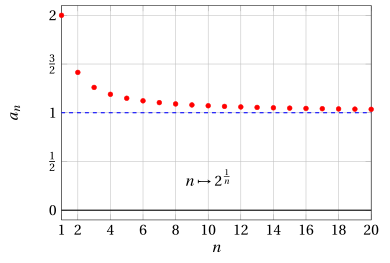
We see that the values \(a_n\) get closer to \(1\), hence we try to prove, using the definition of limit, that:
We must verify that for every \(\varepsilon>0\) there exists \(n(\varepsilon) \in \N\) such that:
The left inequality is always satisfied (2 raised to a positive rational number), while for the right one, taking the logarithm to base \(2\), we obtain:
Hence it is satisfied if:
Having fixed \(\varepsilon > 0\), it suffices to choose the first integer
to satisfy the condition required by the definition of limit.
Example 11: Limit of sequences
Consider the sequence:
This is the graph of the sequence with \(n\in\{1,2,\dots,50\}\):
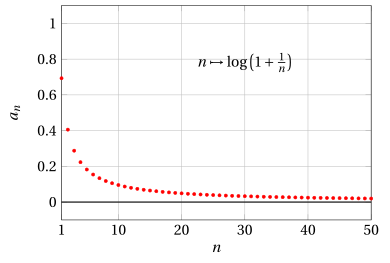
We see that the values \(a_n\) get closer to \(0\), hence we try to prove, using the definition of limit, that:
We must verify that for every \(\varepsilon>0\) there exists \(n(\varepsilon) \in \N\) such that:
The left inequality is always satisfied (the logarithm to base \(e\) of a number greater than 1), while for the right one, exponentiating, we obtain:
Having fixed \(\varepsilon > 0\), it suffices to choose the first integer
to satisfy the condition required by the definition of limit.
Try it — the interactive graph below shows what you have just read: move the sliders.
1.2 Divergent sequences and irregular sequences
Definition 5: Sequence divergent to \(+\infty\)
A sequence \(\{ a_n\}\) is called divergent to \(+\infty\) if for every \(M>0\) there exists a number \(n(M) \in \N\) such that:
Definition 6: Sequence divergent to \(-\infty\)
A sequence \(\{ a_n\}\) is called divergent to \(-\infty\) if for every \(M>0\) there exists a number \(n(M) \in \N\) such that:
The number \(n(M)\) depends (in general) on the value of \(M\).
-
In the two cases we will say, respectively, that \(+\infty\) and \(-\infty\) are the limits of the sequence and we will write, respectively:
\[ \lim_{n \rightarrow +\infty} a_n = +\infty {\rm ~~~~~or~~~~~} \lim_{n \rightarrow +\infty} a_n = -\infty \]The values of a sequence divergent to \(\ip\) eventually exceed any fixed real number. The values of a sequence divergent to \(\im\) eventually fall below any fixed real number.
The symbols \(+\infty\) and \(-\infty\) are not numbers.
-
If we represent the real numbers on the Euclidean line, each number corresponds to a point and each point to a number.
-
With the symbols \(+\infty\) and \(-\infty\) we agree to denote two “points”:
-
\(+\infty\) lies to the right of every point of \(\mathbb{R}\)
-
\(-\infty\) lies to the left of every point of \(\mathbb{R}\)
however, no number corresponds to these two points.
-
-
On the symbols \(+\infty\) and \(-\infty\) the operations of sum and product with the properties stated in \(R_1\) and \(R_2\) are not defined, even though we will be able to perform these operations “partially” (as we will see later).
Definition 7: The set \(\mathbb{R}^*\)
The set of real numbers \(\mathbb{R}\) with the addition of the two elements \(+\infty\) and \(-\infty\) will be denoted by:
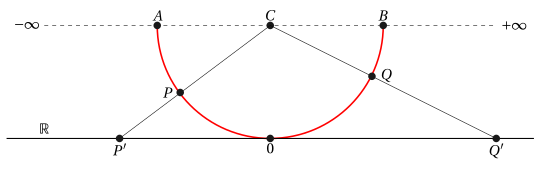
- We can represent the set \(\mathbb{R}^*\) “visually” by putting the points of the line in one-to-one correspondence with those of a semicircle (projecting them from the center of the semicircle onto the line \(\mathbb{R}\)):
-
No point on \(\mathbb{R}\) corresponds to the points \(A\) and \(B\); we will say that \(-\infty\) is the “counterpart” of the point \(A\) and \(+\infty\) the “counterpart” of \(B\).
-
The limit operation becomes fully meaningful if set in \(\mathbb{R}^*\) instead of \(\mathbb{R}\), i.e., the limit of a sequence can be a real number \(\ell\) or \(+\infty\) or \(-\infty\).
Sequences whose limit is a real number are convergent; those whose limit is \(+\infty\) or \(-\infty\) are divergent.
Example 12: Convergent and divergent sequences
-
the canonical sequence \(\{ n \}\) is divergent to \(+\infty\);
-
the sequence \(\{ 2^n \}\) is divergent to \(+\infty\);
-
the sequence \(\{ -2^n \}\) is divergent to \(-\infty\);
-
the sequence \(\{ 2^{\frac{1}{n}} \}\) is convergent to \(1\).
Remark 1
Proof
If \(\alpha>0\), we must prove that the sequence diverges to \(\ip\). We must therefore verify that for every \(M>0\) there exists \(n(M) \in \N\) such that
The inequality
Hence, having fixed \(M > 0\), it will suffice to choose the first integer
to satisfy the required divergence condition.
Hence there is no \(M>0\) such that \(n^{\alpha} \le M\) for \(n \in \N\), and the sequence is not bounded. Hence \(n^{\alpha} \rr \ip\) for \(n \rr \ip\).
If \(\alpha<0\), we must verify that for every \(\varepsilon>0\) there exists \(n(\varepsilon) \in \N\) such that
The left inequality is always satisfied. For the right inequality, since \(n^{\alpha}=\frac{1}{n^{|\alpha|}}\), we obtain
which is satisfied if
Having fixed \(\varepsilon > 0\), it will suffice to choose the first integer
to satisfy the condition required by the definition of limit. □
- Finally, we observe that there are sequences that are neither convergent nor divergent
Definition 8: Irregular (indeterminate) sequence
A sequence that is neither convergent nor divergent is called irregular (oscillating) or indeterminate.
Example 13: Irregular sequences
-
the sequence \(\{ (-1)^n \}\) is neither convergent nor divergent (but it is bounded)
-
the sequence \(\{ (-2)^n \}\) is neither convergent nor divergent (and not even bounded).
- For irregular sequences, the limit operation is not defined, i.e., their limit does not exist.
Summarizing, the operation of computing the limit allows us to answer rigorously the question: how do the numbers \(a_n\) behave as \(n\) becomes larger and larger?
2. Unbounded sets and their suprema/infima
- It is convenient to adopt the convention introduced for limits also for the \(\sup\) and the \(\inf\), extending the definition of these quantities as follows
Definition 9: Supremum and infimum \(\sup\) and \(\inf\) (unbounded sets)
If a set \(E \subseteq \mathbb{R}\) is not bounded above (below), we will say that
-
In this way, property \(R_4\) of the real numbers can be stated as follows:
- \(R_4 \rightarrow\) every non-empty set \(E \subseteq \mathbb{R}\) has a supremum and an infimum; \(\sup E\) (\(\inf E\)) is a number if \(E\) is bounded above (below), otherwise it is \(+\infty\) (\(-\infty\)).
3. Infinitesimal and infinite sequences
Definition 10: Infinitesimal sequence
A sequence \(\{a_n\}\) tending to zero is called infinitesimal
Example 14: Infinitesimal sequences
-
the sequence \(\left\{ \frac{1}{n} \right\}\) is infinitesimal
-
the sequence \(\left\{ \frac{1}{n^2} \right\}\) is infinitesimal
- The concept of infinitesimal plays a central role and is also fundamental for having a correct and effective intuitive picture of the concepts of infinitesimal calculus.
an “infinitesimal” is not an “infinitely small number” (a meaningless concept) but a variable quantity (a sequence or, as we will see, a function) that becomes indefinitely small.
Definition 11: Infinite sequence
A sequence \(\{a_n\}\) tending to \(\pm \infty\) is called infinite (an infinity)
Example 15: Infinite sequences
-
the sequence \(\left\{ n^2 \right\}\) is infinite
-
the sequence \(\left\{ n! \right\}\) is infinite
- Sometimes it is possible to specify whether a convergent sequence approaches its limit from above or from below
Definition 12: Limit from above
We say that the sequence \(\{a_n\}\) tends to \(\ell \in \mathbb{R}\) from above and we write
if for every \(\varepsilon > 0\) we have that
Definition 13: Limit from below
We say that the sequence \(\{a_n\}\) tends to \(\ell \in \mathbb{R}\) from below and we write
if for every \(\varepsilon > 0\) we have that
-
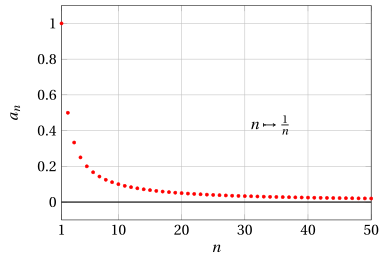
Saying that \(a_n \rightarrow \ell^+\) for \(n \rr \ip\) means stating that \(a_n \rightarrow \ell\) and moreover \(a_n \ge \ell\) eventually; hence \(a_n\) approaches \(\ell\) from above, i.e., it approximates \(\ell\) from above.
-
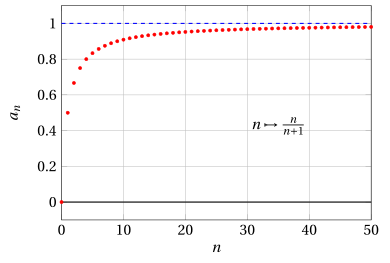
Saying that \(a_n \rightarrow \ell^-\) for \(n \rr \ip\) means stating that \(a_n \rightarrow \ell\) and moreover \(a_n \le \ell\) eventually; hence \(a_n\) approaches \(\ell\) from below, i.e., it approximates \(\ell\) from below.
Example 16: Sequence with limit from above
Example 17: Sequence with limit from below
Example 18: Sequence with a limit, but neither from below nor from above
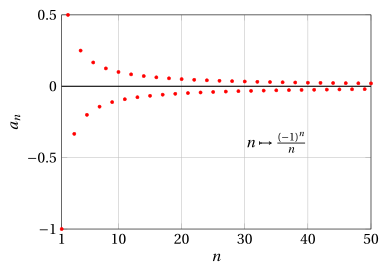
In this case we can state neither that \(a_n \rightarrow 0^+\) nor that \(a_n \rightarrow 0^-\) for \(n \rr \ip\).
4. Monotone sequences
Definition 14: Monotone sequences
A sequence \(\{a_n\}\) is called monotone increasing if:
A sequence \(\{a_n\}\) is called strictly monotone increasing if:
A sequence \(\{a_n\}\) is called monotone decreasing if:
A sequence \(\{a_n\}\) is called strictly monotone decreasing if:
Example 19: Monotone increasing/decreasing sequences
-
The sequence \(\{ n^2\}\) is strictly monotone increasing
-
The sequence \(\left\{ \frac{1}{n} \right\}\) is strictly monotone decreasing
-
The sequence \(\left\{ (-1)^n \right\}\) is not monotone
-
every constant sequence is monotone (increasing or decreasing, not strictly)
- With regard to the limit operation, these sequences are of particular importance; indeed, they are never irregular, but are convergent or divergent depending on whether they are bounded or not.
Theorem 2: Monotone sequence theorem
-
Let \(\{a_n\}\) be a monotone increasing sequence that is bounded above. Then \(\{a_n\}\) is convergent, and its limit equals
\[ \sup \{a_n: n \in \N\}. \] -
Let \(\{a_n\}\) be a monotone decreasing sequence that is bounded below. Then \(\{a_n\}\) is convergent, and its limit equals
\[ \inf \{a_n: n \in \N\}. \]
Proof
We consider the case of monotone increasing sequences that are bounded above.
Since the sequence is bounded above, the set of values taken by the sequence \(\{a_n : n \in \N\}\) is bounded above.
By the supremum property enjoyed by \(\R\), there therefore exists a finite supremum, which we denote by \(\ell\):
We now need to prove that
and hence that for every \(\varepsilon > 0\) we have
The second inequality is obvious. For every \(n \in \N\) we have
since \(\ell\) is the supremum of \(\{a_n : n \in \N\}\) and hence an upper bound.
By definition of supremum, \(\ell\) is the least of the upper bounds of the set \(\{ a_n: n \in \N\}\). Therefore, since
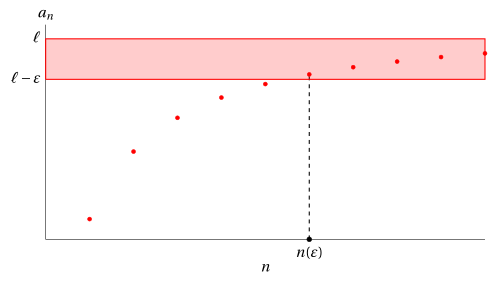
certainly \(\ell - \varepsilon\) is not an upper bound of the set \(\{ a_n: n \in \N\}\). This means that there exists an \(n(\varepsilon) \in \N\) for which
On the other hand, the sequence is monotone increasing, therefore for every \(n \ge n(\varepsilon)\) we have \(a_n \ge a_{n(\varepsilon)}\). We have thus proved that
Consequently, we have the claim:
The case of monotone decreasing sequences that are bounded below is proved analogously. □
-
The idea of the proof is conveyed by the following figure:
-
To express symbolically as well that the limit is the \(\sup\) (or the \(\inf\)) of an increasing (or decreasing) sequence, we use the notation
\[ a_n \uparrow \ell {\rm ~~~or~~~} a_n \downarrow \ell \]This in particular implies that \(a_n \rightarrow \ell^-\) (respectively, \(\ell^+\)), but it contains a further piece of information: the monotonicity of the sequence.
-
This theorem is a consequence of the completeness axiom (axiom of continuity) \(R_4\) of the real numbers and therefore holds if the setting we consider is \(\R\). For example, it is not true that an increasing and bounded sequence of rational numbers always has a rational limit, i.e., in \(\Q\).
Example 20: Increasing and bounded sequence in \(\Q\)
Let \(\{a_n\}\) be the sequence defined as follows:
\[ a_0 = 0, a_1 = 0,1, a_2= 0,1011, a_3= 0,10110111, a_4= 0,1011011101111 \dots \]At step \(n\) we append to the decimal number obtained at the previous step a digit zero followed by \(n\) digits equal to \(1\). The sequence \(\{a_n\}\) is evidently increasing, and bounded above (for example, \(a_n \le 1\)).
-
In \(\R\) the sequence converges to the number \(\sup \{a_n : n \in \N\}\), which after the decimal point has an infinite, non-periodic decimal expansion (one digit 1, one digit 0, two digits 1, one digit 0, three digits 1, one digit 0, and so on forever)
-
Hence the limit of the sequence is an irrational number. This example shows that in the set \(\Q\) the monotone sequence theorem is false.
-
-
The monotone sequence theorem can be completed with the next corollary, which considers bounded or unbounded sequences.
Corollary 1: Of the monotone sequence theorem
Let \(\{a_n\}\) be a monotone increasing sequence. Then there exists
Proof
If \(\{a_n\}\) is bounded above, the statement is contained in Theorem Theorem 2 (monotone sequence theorem).
If instead \(\{a_n\}\) is unbounded above, this means that, having fixed \(M > 0\), there exists an \(n(M) \in \N\) such that
On the other hand, the sequence is increasing, therefore for every \(n \ge n(M)\) we have
We have thus proved that for every \(M>0\) we have \(a_n > M\), eventually. This means that \(a_n \rightarrow +\infty\) for \(n \rr \ip\). □
Summarizing, we have:
-
if \(\{a_n\}\) is bounded above, then it converges (and its limit equals the supremum of its values, which in this case is a real number)
-
if instead \(\{a_n\}\) is unbounded above, then \(a_n\) tends to \(+\infty\) (which in this case equals the supremum of its values).
A monotone sequence either converges or diverges (it cannot be irregular).
5. Limits of geometric progressions
-
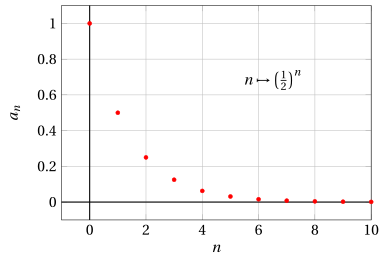
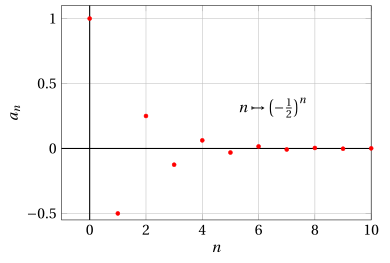
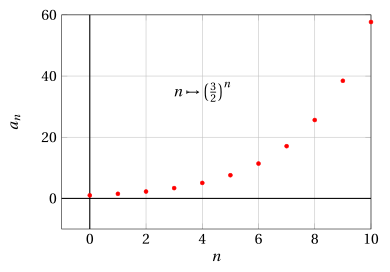
Consider the geometric progression with common ratio \(a \in \R\):
\[ 1,~~a,~~a^2,~~a^3,~~ \dots,~~ a^n,~~ \dots \]it is equivalent to the sequence \(\{a^n\}\):
\[ n \mapsto a^n \] -
If \(a > 1\), the sequence is monotone increasing and unbounded above.
-
If \(a = 1\), the sequence is constant.
-
If \(0 < a < 1\), the sequence is monotone decreasing and tends to zero.
-
If \(a\) is negative, the sequence is not monotone.
Remark 2
Proof
If \(|a| <1\), we must verify that for every \(\varepsilon>0\) there exists \(n(\varepsilon) \in \N\) such that
Hence we must verify that
The first inequality is always true, while the second is satisfied if
Having fixed \(\varepsilon > 0\), it will suffice to choose the first integer
to satisfy the condition required by the definition of limit.
If \(a > 1\), we must verify that for every \(M>0\) there exists \(n(M) \in \N\) such that
The inequality
Hence, having fixed \(M > 0\), it will suffice to choose the first integer
to satisfy the required divergence condition. □
Example 21: Infinitesimal and monotone decreasing geometric progression
Example 22: Infinitesimal (but not monotone) geometric progression
Example 23: Divergent geometric progression
Example 24: Geometric progression that is neither convergent nor divergent