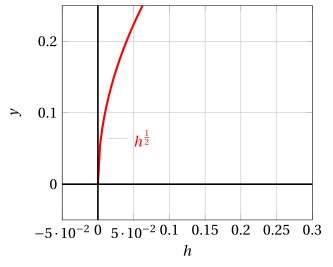
Cusps, inflection points and tangents
Exercises · Derivatives · with worked solutions · PDF
Exercise 1
Using the definition of derivative, determine the behavior at the origin of the following function:
Solution
Let
then for \(x_0=0\)
and the limits are:
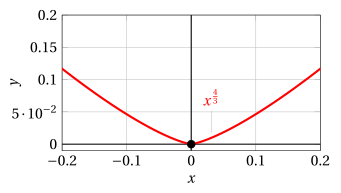
The function has a point with horizontal tangent at \(x_0=0\). The function:
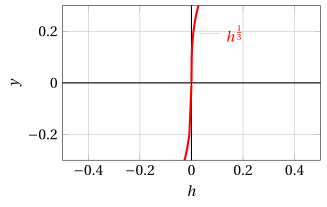
is a power with positive rational exponent \(\frac{m}{n}\) with \(n\) odd (hence defined on all of \(\R\)) and \(m\) odd (hence an odd function). Its graph is:
Exercise 2
Using the definition of derivative, determine the behavior at the origin of the following function:
Solution
Let
then for \(x_0=0\)
and the limits are:
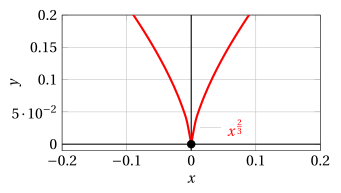
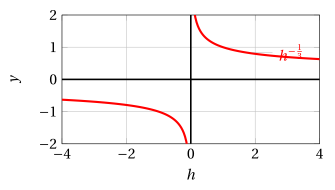
The function has a cusp at \(x_0=0\). The function:
is a power with negative rational exponent \(\frac{m}{n}\) with \(n\) odd (hence defined on all of \(\R\)) and \(m\) odd (hence an odd function). Its graph is:
Exercise 3
Using the definition of derivative, determine the behavior at the origin of the following function:
Solution
Let
then for \(x_0=0\)
and the limits are:
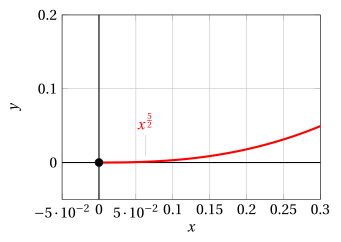
The function has a point with horizontal tangent at \(x_0=0\). The function:
is a power with positive rational exponent \(\frac{m}{n}\) with \(n\) even (hence defined only on \(\R_+\)). Its graph is:
Exercise 4
Using the definition of derivative, determine the behavior at the origin of the following function:
Solution
Let
then for \(x_0=0\)
and the limits are:
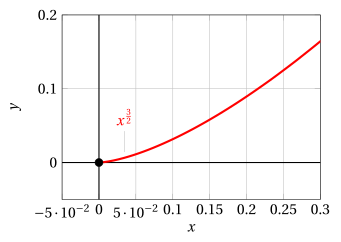
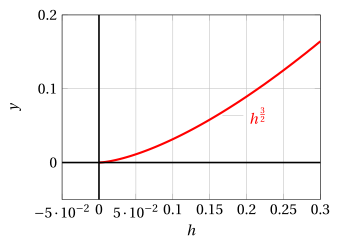
The function has a point with horizontal tangent at \(x_0=0\). The function:
is a power with positive rational exponent \(\frac{m}{n}\) with \(n\) even (hence defined only on \(\R_+\)). Its graph is: