Finding local and global extrema and extremum points
Exercises · Derivatives · with worked solutions · PDF
Exercise 1
Compute all the maximum and minimum points (global and local) of the function:
Solution
-
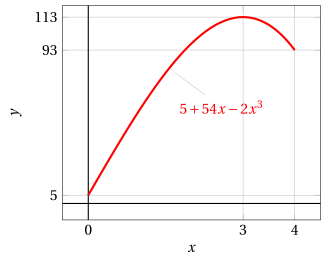
The values of the function at the endpoints of the interval are: \(f(0)=5\) and \(f(4)=93\).
-
The derivative is:
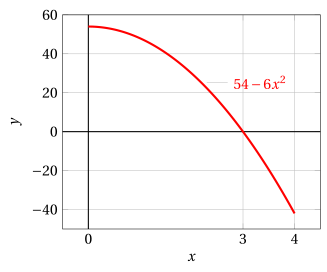
\[ f'(x)=54-6\;x^2=-6\;(x^2-9)=-6\;(x+3)\;(x-3) \]We solve the equation:
\[ f'(x) = 0 \Longleftrightarrow -6\;(x+3)\;(x-3)=0 \Longleftrightarrow x=\pm 3 \]\[ x_1 = 3 \in [0,4]~~~~ {\rm stationary~point} \] -
We have \(f'(x) \ge 0\) for \(x \in [-3,3]\). Studying the sign of \(f'\) near \(x = 3\), we deduce that \(x=3\) is a local maximum point and \(f(3)=113\) is a local maximum.
-
We have:
\[ f(3) = 113 > f(0) =5, ~~ f(3) = 113 > f(4) = 93 \]We therefore conclude that:
-
\(f(0)=5\) is the global minimum and \(x=0\) is a global minimum point
-
\(f(3)=113\) is the global maximum and \(x=3\) is a global maximum point
-
\(f(4)=93\) is a local minimum and \(x=4\) is a local minimum point
-
Exercise 2
Compute all the maximum and minimum points (global and local) of the function:
Solution
-
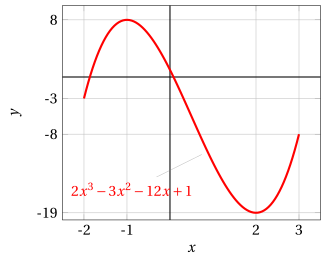
The values of the function at the endpoints of the interval are: \(f(-2)=-3\) and \(f(3)=-8\).
-
The derivative is:
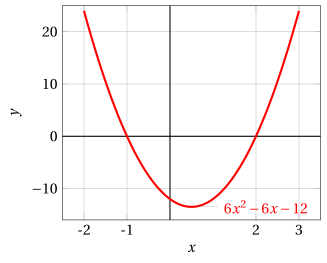
\[ f'(x)=6\;x^2-6\:x-12=6\;(x^2-x-2)=6\;(x+1)\;(x-2) \]We solve the equation:
\[ f'(x) = 0 \Longleftrightarrow 6\;(x^2-x-2)=0 \Longleftrightarrow x=\frac{1\pm 3}{2} \]\[ x_1 = -1 \in [-2,3] {\rm ~~and~~} x_2 = 2 \in [-2,3] ~~~{\rm stationary~points} \] -
We have \(f'(x) \ge 0\) for \(x \in (\im,-1] \cup [2,\ip)\). Studying the sign of \(f'\) near \(x = -1\), we deduce that \(x=-1\) is a local maximum point and \(f(-1)=8\) is a local maximum. Studying the sign of \(f'\) near \(x = 2\), we deduce that \(x=2\) is a local minimum point and \(f(2)=-19\) is a local minimum.
-
We have:
\[ f(-1) = 8 > f(-2) =-3, ~~ f(-1) = 8 > f(3) = -8 \]\[ f(2) = -19 < f(-2) =-3, ~~ f(2) = -19 < f(3) = -8 \]We therefore conclude that:
-
\(f(-2)=-3\) is a local minimum and \(x=-2\) is a local minimum point
-
\(f(-1)=8\) is the global maximum and \(x=-1\) is a global maximum point
-
\(f(2)=-19\) is the global minimum and \(x=2\) is a global minimum point
-
\(f(3)=-8\) is a local maximum and \(x=3\) is a local maximum point
-
Exercise 3
Compute all the maximum and minimum points (global and local) of the function:
Solution
-
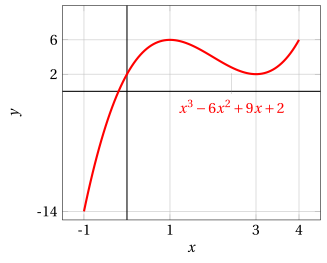
The values of the function at the endpoints of the interval are: \(f(-1)=-14\) and \(f(4)=6\).
-
The derivative is:
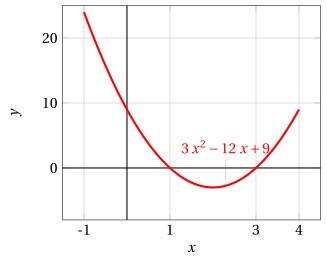
\[ f'(x)=3\;x^2-12\:x+9=3\;(x^2-4\:x+3)=3\;(x-3)\;(x-1) \]We solve the equation:
\[ f'(x) = 0 \Longleftrightarrow 3\;(x^2-4\:x+3)=0 \Longleftrightarrow x=\frac{4\pm 2}{2} \]\[ x_1 = 1 \in [-1,4] {\rm ~~and~~} x_2 = 3 \in [-1,4] ~~~{\rm stationary~points} \] -
We have \(f'(x) \ge 0\) for \(x \in (\im,1] \cup [3,\ip)\). Studying the sign of \(f'\) near \(x = 1\), we deduce that \(x=1\) is a local maximum point and \(f(1)=6\) is a local maximum. Studying the sign of \(f'\) near \(x = 3\), we deduce that \(x=3\) is a local minimum point and \(f(3)=2\) is a local minimum.
-
We have:
\[ f(1) = 6 > f(-1) =-14, ~~ f(1) = 6 \ge f(4) = 6 \]\[ f(3) = 2 > f(-1) =-14, ~~ f(3) = 2 < f(4) = 6 \]We therefore conclude that:
-
\(f(-1)=-14\) is the global minimum and \(x=-1\) is a global minimum point
-
\(f(1)=6\) is the global maximum and \(x=1\) is a global maximum point
-
\(f(3)=2\) is a local minimum and \(x=3\) is a local minimum point
-
\(f(4)=6\) is the global maximum and \(x=4\) is a global maximum point
-
Exercise 4
Compute all the maximum and minimum points (global and local) of the function:
Solution
-
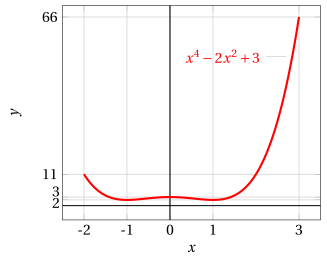
The values of the function at the endpoints of the interval are: \(f(-2)=11\) and \(f(3)=66\).
-
The derivative is:
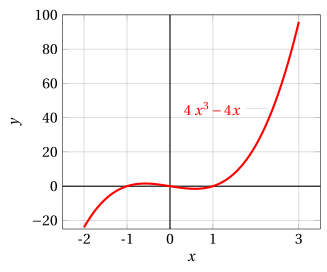
\[ f'(x)=4\;x^3-4\:x=4\;x\;(x^2-1) \]We solve the equation:
\[ f'(x) = 0 \Longleftrightarrow 4\;x\;(x^2-1)=0 \Longleftrightarrow x=\pm 1 {\rm ~~and~~} x=0 \]\[ x_1 = -1 \in [-2,3],~~x_2 = 0 \in [-2,3] {\rm ~~and~~} x_3 = 1 \in [-2,3] ~~~{\rm stationary~points} \] -
We have \(f'(x) \ge 0\) for \(x \in [-1,0] \cup [1,\ip)\). Studying the sign of \(f'\) near \(x = -1\), we deduce that \(x=-1\) is a local minimum point and \(f(-1)=2\) is a local minimum. Studying the sign of \(f'\) near \(x = 0\), we deduce that \(x=0\) is a local maximum point and \(f(0)=3\) is a local maximum. Studying the sign of \(f'\) near \(x = 1\), we deduce that \(x=1\) is a local minimum point and \(f(1)=2\) is a local minimum.
-
We have:
\[ f(-1) = 2 < f(-2) =11, ~~ f(-1) = 2 < f(3) = 66 \]\[ f(0) = 3 < f(-2) =11, ~~ f(0) = 3 < f(3) = 66 \]\[ f(1) = 2 < f(-2) =11, ~~ f(1) = 2 < f(3) = 66 \]We therefore conclude that:
-
\(f(-2)=11\) is a local maximum and \(x=-2\) is a local maximum point
-
\(f(-1)=2\) is the global minimum and \(x=-1\) is a global minimum point
-
\(f(0)=3\) is a local maximum and \(x=0\) is a local maximum point
-
\(f(1)=2\) is the global minimum and \(x=1\) is a global minimum point
-
\(f(3)=66\) is the global maximum and \(x=3\) is a global maximum point
-
These are the graphs of the function \(f(x)= 5 +54x -2x^3\) and of its derivative on the interval \([0,4]\):
These are the graphs of the function \(f(x)= 2x^3 -3x^2-12x +1\) and of its derivative on the interval \([-2,3]\):
These are the graphs of the function \(f(x)= x^3 - 6x^2 + 9x + 2\) and of its derivative on the interval \([-1,4]\):
These are the graphs of the function \(f(x)= x^4 - 2x^2 + 3\) and of its derivative on the interval \([-2,3]\):