Numerical series
Part 5 · Series · Chapter 1 · lecture notes by Fabio Furini · Chapter PDF
1. Numerical series
- We now introduce numerical series, which extend the operation of addition to an infinite number of terms.
The sum of infinitely many terms, even if they are all positive, can give a finite result.
-
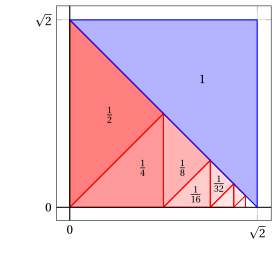
Imagine measuring a square of area 2 using the following procedure: we divide the square in half along the diagonal and measure the first right triangle: we obtain 1; then we divide the second right triangle in half and measure the first of the two resulting right triangles: we obtain \(\frac{1}{2}\); the remaining right triangle is again divided in half... and so on indefinitely. We obtain the infinite sum:
\[ 1 + \frac{1}{2} + \frac{1}{4} + \frac{1}{8} + \frac{1}{16} + \frac{1}{32} + {\rm \dots} + \frac{1}{2^k} + {\rm \dots} = \sum_{k=0}^{\infty} \frac{1}{2^k} \]which, by the way it was constructed, must give 2 as its result.
Definition 1: of numerical series
Given a sequence \(\{a_k\}_{k \in \N}\), we call numerical series of the terms \(a_k\) the expression:
- It is read “series (or also sum) for \(k\) from 0 to \(\ip\) of \(a_k\)”. The values \(a_k\) are called the general terms of the series.
Definition 2: of sequence of partial sums
The numbers
are called the \(n\)-th partial sums of the series and they define the sequence \(\{s_n\}\) of partial sums.
The behavior (character) of the series is determined by the limit of the sequence \(\{ s_n\}\) as \(n\) tends to infinity. We say that a series is convergent, divergent, irregular, if the sequence \(\{s_n\}\) of partial sums is convergent, divergent or irregular, respectively.
Definition 3: of sum of the series
If the sequence \(\{s_n\}\) of partial sums is convergent, that is, if
we say that \(s\) is the sum of the series, and we write \(\sum_{k=0}^{\infty} a_k = s\).
Hence, if the sequence \(\{s_n\}\) is convergent, we have:
The series makes precise the idea of a sum of infinitely many terms, that is, we compute the limit as \(n \rr \ip\) of the finite sum of the first \(n\) terms.
-
If, instead of summing starting from \(0\), we start from an index \(n_0 >0\), we write \(\sum_{k=n_0}^{\infty} a_k\)
-
To denote a generic numerical series without specifying the starting index \(n_0\) we will use the symbol \(\sum a_k\)
A generic numerical series \(\sum a_k\) always involves two different sequences:
-
the sequence \(\{a_k\}\) of the terms of the series
-
the sequence \(\{ s_n\}\) of partial sums
Example 1: behavior of a series
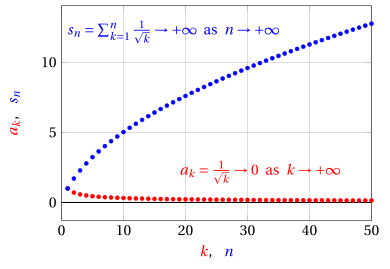
Let us determine the behavior of the series:
We have:
Hence the sequence of partial sums \(\{s_n\}\) is divergent by the comparison theorem for sequences and, consequently, the series is divergent.
1.1 Main properties of numerical series
Remark 1
If a sequence \(\{a_k\}\) has non-negative terms, that is, \(a_k \ge 0,\forall k\), then the sequence of partial sums \(\{s_n\}\) is increasing and regular.
Proof
Given a sequence \(\{a_k\}\) with non-negative terms, the sequence of partial sums \(\{s_n\}\) is increasing since:
by the monotonicity theorem for sequences. Consequently the sequence \(\{s_n\}\) cannot be irregular. It is therefore regular, that is, it either converges or diverges. □
Given a sequence \(\{a_k\}\) with non-negative terms:
-
If \(\{s_n\}\) is increasing and bounded, then it has a finite limit and \(\sum a_k\) converges.
-
If \(\{s_n\}\) is increasing and unbounded, then \(\sum a_k\) diverges to \(\ip\).
- This remark also holds for sequences with eventually non-negative terms, positive terms, or eventually positive terms.
Theorem 1
If a series \(\sum a_k\) is convergent, then \(\lim_{k \rr \ip} a_k=0\)
Proof
By definition of convergent series, the sequence of partial sums \(\{s_n\}\) converges to a real number \(s\), i.e., \(s_n \rr s \in \R\) as \(n \rr \ip\). Without loss of generality we consider \(n_0=0\).
We observe that the sequence \(\{s_n\}\) can be defined recursively:
Consequently we have:
□
The convergence of a series therefore implies that \(a_k \rr 0\) as \(k \rr \ip\), that is:
but the converse is not true (Example 1 is a counterexample):
Hence the fact that \(a_k \rr 0\) as \(k \rr \ip\) is a necessary but not sufficient condition for the convergence of a series.
-
From the contrapositive of \(\eqref{BBB}\) we have:
\[ \lim_{k \rr \ip} a_k \neq 0 ~~\Rightarrow~~ \sum a_k {\rm ~is~divergent~or ~irregular~~} \]that is, if the limit is not equal to zero, then the series is not convergent.
1.2 Tails of series
If we modify a finite number of terms of a series, the value of the sum may change, but the behavior of the series remains unchanged.
- If we modify the value of one term, for example \(a_{n_0}\), for \(n \ge n_0\) the sequences of partial sums, the original and the modified one, differ only by that term: hence both converge, both diverge, or both are irregular. The same holds if we modify a finite number of terms.
The results on the behavior of series therefore also hold if the hypotheses are satisfied “eventually”, i.e., from a certain index \(n_0\) onward.
Definition 4: of tail of a series
Given a series \(\sum_{k=0}^{\infty} a_k\) and a value \(m \in \N\), the series \(\sum_{k=m+1}^{\infty} a_k\) is called a tail of the series.
-
Given a series \(\sum_{k=0}^{\infty} a_k\) and \(m \in \N\) we have:
\[\begin{equation} \sum_{k=m+1}^{n} a_k = \left(\sum_{k=0}^{n} a_k\right) - \left(\sum_{k=0}^{m} a_k\right) = s_n -s_m, \qquad \forall n > m \label{MMMMM} \end{equation}\]hence for every tail (that is, for every \(m\)) the associated sequence of partial sums is equal to that of the original series minus a constant. Consequently we have the following remark:
Every tail of a series has the same behavior as the original series.
-
Given a convergent series, taking the limit as \(n \rr \ip\) in \(\eqref{MMMMM}\) we obtain the relation:
\[\begin{equation} \sum_{k=m+1}^{\infty} a_k = \left(\sum_{k=0}^{\infty} a_k\right) - \left(\sum_{k=0}^{m} a_k\right) = s -s_m~~~ {\rm ~~as~~} n \rr \ip \label{NNNNN} \end{equation}\]Consequently we have the following remark:
Given \(m \in \N\), every tail \(\sum_{k=m+1}^{\infty} a_k\) of a convergent series can be interpreted as the error that we make when approximating the sum \(s\) with the partial sum \(s_m\).
Theorem 2
If a series \(\sum a_k\) is convergent, then
Proof
For every \(n > m\), the \(n\)-th partial sum of the series is:
Taking the limit as \(n \rr \ip\), we have:
Now taking the limit as \(m \rr \ip\), we have:
that is, the claim of the theorem. □
This theorem tells us that, if a series is convergent, then the value \(s - s_m\), that is, the error that we make when approximating the sum \(s\) with the partial sum \(s_m\), tends to zero as \(m \rr \ip\). In other words, the tail of a convergent series tends to zero as \(m\) tends to infinity.
1.3 Harmonic series
Definition 5: of harmonic series
The harmonic series is the series \(\sum_{k=1}^{\infty} \frac{1}{k}\)
Theorem 3: behavior of the harmonic series
The harmonic series diverges to \(\ip\)
- Graphically we have:
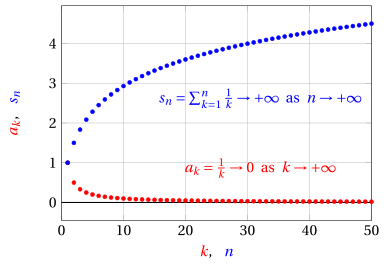
The harmonic series \(\sum_{k=1}^{\infty} \frac{1}{k}\) is a counterexample that proves \(\eqref{CCC}\), since:
-
Before proving the theorem, we observe that for certain values of \(n\) the partial sums are:
\[ \underbrace{s_1}_{\displaystyle =s_{2^{\red 0}}}=1+\frac{\red 0}{2},~~~~\underbrace{s_2}_{\displaystyle =s_{2^{\red 1}}}= s_1 +\frac{1}{2}=1+\frac{0}{2}+\frac{1}{2} = 1+\frac{\red 1}{2},~~~~\underbrace{s_4}_{\displaystyle =s_{2^{\red 2}}}=s_2 + \underbrace{\left(\frac{1}{3}+\frac{1}{4}\right)}_{\ge \frac{1}{4}+\frac{1}{4}=\frac{1}{2}}\ge 1+\frac{1}{2} + \frac{1}{2}=1 + \frac{\red 2}{2} \]\[ \underbrace{s_8}_{\displaystyle =s_{2^{\red 3}}}=s_4 + \underbrace{\left(\frac{1}{5}+\frac{1}{6}+\frac{1}{7}+\frac{1}{8}\right)}_{\ge \frac{1}{8}+\frac{1}{8}+\frac{1}{8}+\frac{1}{8}=\frac{1}{2}} \ge 1 + \frac{2}{2} + \frac{1}{2} = 1 + \frac{\red 3}{2} \]\[ \underbrace{s_{16}}_{\displaystyle =s_{2^{\red 4}}}=s_8 + \underbrace{\left(\frac{1}{9}+\frac{1}{10}+\frac{1}{11}+\frac{1}{12}+ \frac{1}{13}+\frac{1}{14}+\frac{1}{15}+\frac{1}{16} \right)}_{\ge \frac{1}{16}+\frac{1}{16}+\frac{1}{16}+\frac{1}{16}+\frac{1}{16}+\frac{1}{16}+\frac{1}{16}+\frac{1}{16}=\frac{1}{2}} \ge 1 + \frac{3}{2} + \frac{1}{2} = 1 + \frac{\red 4}{2} \]
Proof
We prove by induction on \(2^n\) that
Base case. Let \(n = 0\). Then the statement becomes \(s_{2^0} \ge 1+\frac{0}{2}\), i.e., \(1 \ge 1\), which is clearly true.
Inductive step. Assume that it is true for \(2^{n-1}\) and let us prove it for \(2^{n}\). By the inductive hypothesis, we have:
Moreover, we have:
which is exactly the desired statement for \(2^{n}\).
We therefore have:
and \(\{s_n\}\) is unbounded above and also monotonically increasing, since \(a_k=1/k>0, \forall k >1\). Consequently \(\{s_n\}\) diverges to \(\ip\) by the monotonicity theorem for sequences, and the harmonic series diverges to \(\ip\). □
The sequence \(a_k=1/k, \forall k \ge 1\), of the harmonic series has positive terms, hence the sequence of partial sums \(\{s_n\}\) is increasing, and it is divergent since it is unbounded.
1.4 Geometric series
Definition 6: of geometric series
Given \(q \in \R\), the geometric series with ratio \(q\) is the series \(\sum_{k=0}^{\infty} q^k\)
Theorem 4: behavior and sum of the geometric series
Given the ratio \(q \in \R\),
If the geometric series is convergent, its sum \(s\) is \(\frac{1}{1-q}\)
Proof
Given \(q \in \R\) and \(n \in \N\), the \(n\)-th partial sum of the geometric series is:
since it equals the sum of the first \(n+1\) terms of the geometric progression. Moreover, we have:
Hence, if \(q \neq 1\):
and if \(q=1\) we have:
□
Example 2: geometric series
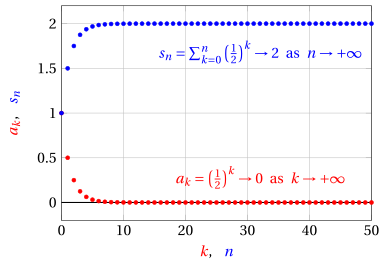
Let us determine the behavior of the series:
It is a geometric series with ratio \(q=1/2\), hence it is convergent and its sum \(s\) is \(1/(1-1/2) =2\).
Let us determine the behavior of the series:
It is a geometric series with ratio \(q=13/12\), hence it is divergent.
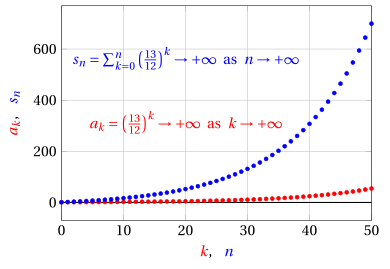
Try it — the interactive graph below shows what you have just read: move the sliders.
1.5 Telescoping series
Definition 7: of telescoping series
A telescoping series is a series of the form:
Theorem 5: behavior and sum of the telescoping series
A telescoping series converges, diverges or is irregular according to whether the sequence \(\{b_k\}\) converges, diverges or is irregular, respectively.
Moreover, if \(\ell \in \R\), then the telescoping series is convergent and its sum \(s\) is \(b_{n_0} - \ell\)
Proof
We have
hence:
□
Remark 2
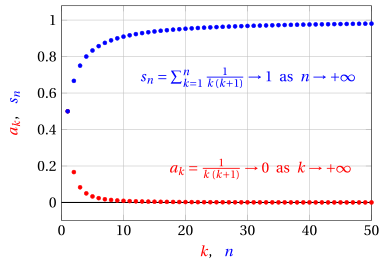
The series \(\sum_{k=1}^{\infty} \frac{1}{k \; (k+1)}\), called Mengoli's series, is convergent and its sum \(s\) is equal to \(1\).
Proof
We have:
Mengoli's series therefore has the form:
hence it is a convergent telescoping series (\(n_0=1\)) and moreover \(s= b_1 = 1\). □
- Graphically we have:
Proof
Alternative proof
For every \(n\ge 1\), the value of the partial sum of Mengoli's series is:
Hence we have
Consequently Mengoli's series is convergent and its sum \(s\) is 1. □
Example 3: telescoping series
Let us determine the behavior of the series:
We have:
consequently:
The series therefore has the form:
that is, a telescoping series (\(n_0=1\)), and we have:
Hence it is a convergent telescoping series and its sum \(s\) is \(\frac{1}{15}\).