Hyperbolic functions
Part 2 · Functions · Chapter 8 · lecture notes by Fabio Furini · Chapter PDF
1. Hyperbolic functions
Definition 1: hyperbolic sine function and hyperbolic cosine function
The hyperbolic functions:
\[\begin{align}
\label{seno_iper} f: \mathbb{R} \rightarrow \mathbb{R},~~~ f: x \mapsto \sinH x =\frac{e^x-e^{-x}}{2} \\[2ex]
\label{coseno_iper}
f: \mathbb{R} \rightarrow \mathbb{R},~~~ f: x \mapsto \cosH x=\frac{e^x+e^{-x}}{2}
\end{align}\]
are called hyperbolic sine and hyperbolic cosine.
-
The hyperbolic sine is an odd function, while the hyperbolic cosine is an even function. Hence we have:
\[ \sinH(-x)=-\sinH x, ~~~\forall x \in \R {\rm ~~~~and~~~~} \cosH(-x)=\cosH x, ~~~\forall x \in \R \] -
We have the fundamental relations:
\[\begin{align} \cosH^2 x - \sinH^2 x = 1,~~~\forall x \in \mathbb{R} {\rm ~~~~~~~and~~~~~~~} \sinH x \le \frac{e^x}{2} \le \cosH x,~~~ \forall x \in \mathbb{R} \end{align}\]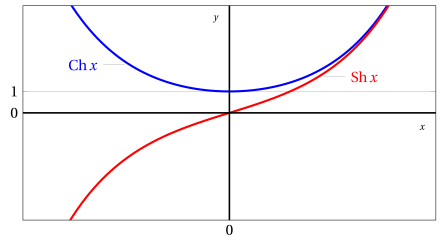
-
For the sign and monotonicity of the hyperbolic sine function we have:
\[ \sinH x = 0 \Longleftrightarrow x = 0 \qquad \begin{cases} \sinH x > 0 & {\rm if~~~} x >0 \\[3ex] \sinH x < 0 & {\rm if~~~} x <0 \end{cases} \]\[ f {\rm ~~is~increasing ~~~~} \forall x \in \R \] -
For the sign and monotonicity of the hyperbolic cosine function we have:
\[ \cosH x > 0,~~~~ \forall x \in \R \]\[ \begin{cases} {\rm if~~~} x < 0 & f {\rm ~~is~decreasing} \\[3ex] {\rm if~~~} x > 0 & f {\rm ~~is~increasing} \end{cases} \]
The hyperbolic function:
\[\begin{align}
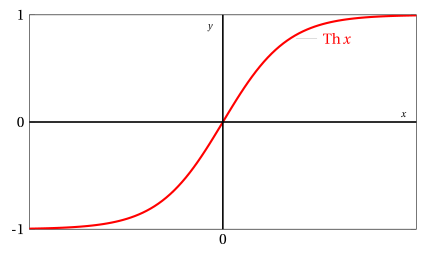
\label{tangente_iper} f: \mathbb{R} \rightarrow \mathbb{R},~~~ f: x \mapsto \tanH x= \frac{e^x-e^{-x}}{e^x+e^{-x}}
\end{align}\]
is called the hyperbolic tangent and it is an odd function.
2. Main hyperbolic formulas
Addition
\[\begin{align}
\sinH ( x_1 + x_2) &= \sinH x_1 \: \cosH x_2 + \sinH x_2 \: \cosH x_1\\[2ex]
\cosH ( x_1 + x_2) &= \cosH x_1 \: \cosH x_2 + \sinH x_1 \: \sinH x_2\\[2ex]
\tanH ( x_1 + x_2) &= \frac{\tanH x_1 + \tanH x_2}{1 + \tanH x_1 \: \tanH x_2}
\end{align}\]
Double-argument formulas
\[\begin{align}
\sinH ( 2 \: x) &= 2 \: \sinH x \: \cosH x\\[2ex]
\cosH ( 2 \: x) &= \cosH^2 x + \sinH^2 x
\end{align}\]