Newton's method
Exercises · Derivatives · with worked solutions · PDF
Exercise 1
Consider
and verify whether Newton's method can be applied on the interval \([0,1]\). If so, find an estimate of \(x \in[0,1]\) such that:
Solution
We consider the function:
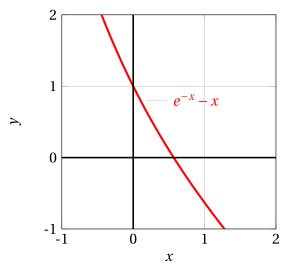
We have:
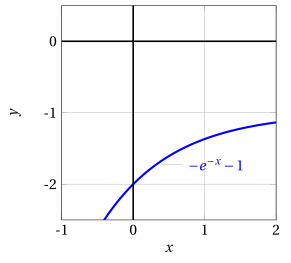
We consider the interval \([0,1]\); for \(x \in [0,1]\) we have:
Solution
Hence on the interval \([0,1]\) the function \(f(x) = e^{-x} - x\) satisfies the hypotheses of the theorem.
We are in the case of a function that is strictly decreasing on \([0,1]\), since \(f'(x)<0, x \in [0,1]\), and convex on \([0,1]\), since \(f''(x)>0, x \in [0,1]\). The endpoints of the chosen interval are: \(a=0\) and \(b=1\).
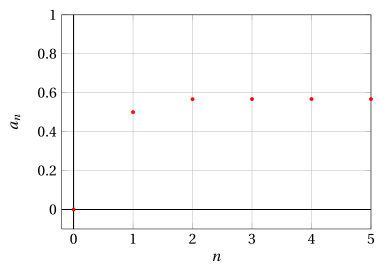
Hypothesis 3 holds, that is \(f(0) \cdot f''(0) >0\), and the sequence becomes:
Since
we therefore have:
Solution
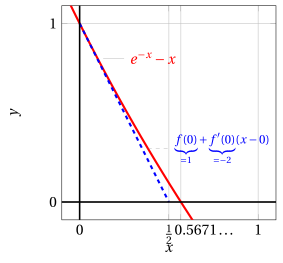
At the first iteration the tangent line is: