Euler's number
Part 3 · Limits of sequences · Chapter 3 · lecture notes by Fabio Furini ·
1. Euler's number \(e\) (Napier's constant)
Theorem 1
The sequence
\[
a_n = \left( 1 + \frac{1}{n}\right)^n {\rm ~~~with~~~} n \ge 1
\]
is convergent.
Proof
We will prove that the sequence \(\{a_n\}\) is monotone increasing (\(a_n \ge a_{n-1}, \forall n \in \N, n\ge 2\) ) and bounded (\(m \le a_n \le M, \forall n \in \N, n \ge 1\) ); hence it is convergent by the monotone sequence theorem.
To prove that \(\{a_n\}\) is monotone increasing, we study, for \(n \ge 2\) , the ratio:
\[\begin{align*}
\frac{a_n}{a_{n-1}} & = \frac{\left(1 + \frac{1}{n}\right)^n}{\left(1 + \frac{1}{n-1}\right)^{n-1}} = \frac{\left( \frac{n+1}{n} \right)^n}{\left( \frac{n}{n-1} \right)^{n-1}}\\[2ex]
& = \left( \frac{\frac{n+1}{n} }{\frac{n}{n-1} } \right)^n \: \frac{1}{\left( \frac{n}{n-1}\right)^{-1}} = \left( \frac{n^2-1}{n^2} \right)^n \: \frac{1}{\left( \frac{n-1}{n}\right)}\\[2ex]
& = \frac{\left( 1 - \frac{1}{n^2}\right)^n}{1 - \frac{1}{n}} \ge \frac{1 - n \cdot \frac{1}{n^2}}{1 - \frac{1}{n}} = 1
\end{align*}\]
where for the “\(\ge\) ” we applied Bernoulli's inequality:
\[
(1 + x)^n \ge 1 + n \: x {\rm ~~with~~} x= -\frac{1}{n^2} \ge -1 {\rm ~~and~~} n \ge 2
\]
Hence we have
\[
\frac{a_n}{a_{n-1}} \ge 1
\]
i.e., \(a_{n} \ge a_{n-1}\) and the sequence is monotone increasing.
To prove that \(\{a_n\}\) is bounded, we observe that, since \(a_1 = 2\) , it follows that \(a_n \ge 2, \forall n \ge 1\) .
Now consider the sequence
\[
b_n = \left( 1 + \frac{1}{n}\right)^{n+1} {\rm~~note~that~~} b_n = a_n \: \left( 1 + \frac{1}{n}\right)
{\rm ~~therefore~~} b_n > a_n, \forall n \in \N, n \ge 1
\]
□
Proof
To prove that \(\{b_n\}\) is monotone decreasing, we study, for \(n \ge 2\) , the ratio:
\[\begin{align*}
\frac{b_n}{b_{n-1}} &
= \frac{\left(1 + \frac{1}{n}\right)^{n+1}}{\left(1 + \frac{1}{n-1}\right)^{n}}
= \frac{\left( \frac{n+1}{n} \right)^{n+1}}{\left( \frac{n}{n-1} \right)^{n}}\\[2ex]
&
= \left( \frac{\frac{n+1}{n} }{\frac{n}{n-1} } \right)^{n} \: {\left( \frac{n+1}{n}\right)}
= \frac{1}{\left( \frac{n^2}{n^2-1} \right)^{n}} \: {\left( \frac{n+1}{n}\right)}\\[2ex]
&
=\frac{1}{\left( 1 + \frac{1}{n^2 -1} \right)^{n}} \: {\left( \frac{n+1}{n}\right)}\le
\frac{1}{\left( 1 + \frac{n}{n^2 -1} \right)} \: {\left( \frac{n+1}{n}\right)}\\[2ex]
&
<
\frac{1}{\left( 1 + \frac{1}{n} \right)} \: \left( 1 + \frac{1}{n} \right)=1
\end{align*}\]
where for the “\(\le\) ” we applied Bernoulli's inequality:
\[
(1 + x)^{n} \ge 1 + n \: x {\rm ~~with~~} x= \frac{1}{n^2-1} \ge -1 {\rm ~~and~~} n \ge 2
\]
and for the “\(<\) ” we applied the inequality
\[
\frac n{n^2-1}>\frac 1n {\rm ~~~~since ~~~~} n^2 > n^2 -1 {\rm ~~for~~} n \ge 2
\]
Hence we have proved that
\[
\frac{b_n}{b_{n-1}} < 1 {\rm ~~hence~~ } b_n < b_{n-1}
\]
and the sequence \(\{b_n\}\) is (strictly) monotone decreasing.
Since \(b_1=4\) , we therefore obtain
\[
a_n < b_n \le b_1 =4, ~\forall n \ge 1
\]
and \(\{a_n\}\) is bounded. □
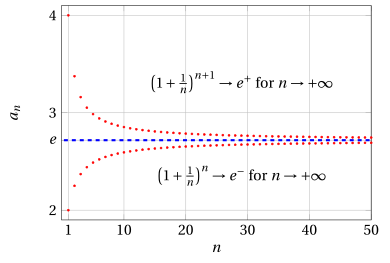
Example 1: Graphs of the sequences \(\{a_n\}\) and \(\{b_n\}\)
The limit of the sequence \(a_n\) just studied is an irrational number that is very important in mathematics. This limit is denoted by the letter \(e\) (Euler's number , or Napier's constant) and its decimal representation begins as follows:
\[
2. 7182818284 \dots
\]
By definition, we have:
\[\begin{equation}
e= \lim_{n \rr \ip } \left( 1 + \frac{1}{n}\right)^n \label{nepero}
\end{equation}\]
This number is very often used as the base of logarithms, which, when this base is used, are called natural or Napierian logarithms (after the mathematician John Napier ) and are denoted simply by the symbol \(\log\) (or \(\ln\) ) without indicating the base.
Consequently, we have:
\[\begin{equation*}
\lim_{n \rr \ip } n \: \log \left( 1 + \frac{1}{n}\right) = \lim_{n \rr \ip } \log \left( 1 + \frac{1}{n}\right)^n = \log e =1
\end{equation*}\]
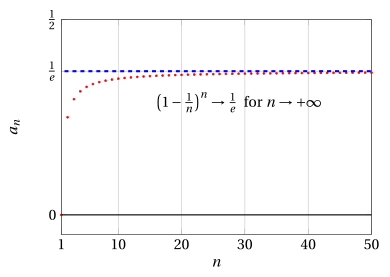
Example 2: Computing limits with the sequence tending to \(e\)
\[\begin{align*}
\lim_{n \rr \ip } \left( 1 - \frac{1}{n}\right)^n = \frac{1}{e}
\end{align*}\]
Since:
\[
\left( \frac{n-1}{n}\right)^n = \frac{1}{\left( \frac{n}{n-1}\right)^n} = \frac{1}{\left( 1+ \frac{1}{n-1}\right)^n} = \frac{1}{\underbrace{\left( 1+ \frac{1}{n-1}\right)^{n-1}}_{\rr e}} \cdot \frac{1}{\underbrace{\left( 1+ \frac{1}{n-1}\right)}_{\rr 1}}
\]
Theorem 2
Let \(\{c_n\}\) be any divergent sequence (to \(\ip\) or \(\im\) ); then
\[\begin{equation}
\lim_{n \rr \ip } \left( 1 + \frac{1}{c_n}\right)^{c_n} = e, \qquad \lim_{n \rr \ip } \left( 1 - \frac{1}{c_n}\right)^{c_n} = \frac{1}{e} \label{nepero_tris}
\end{equation}\]
Proof
Recall that, given \(x \in \R\) , its integer part, denoted by \(\lfloor x \rfloor\) , is the largest integer not exceeding \(x\) .
If \(c_n \rr \ip\) , since \(\lfloor c_n \rfloor > c_n -1\) , by comparison we also have \(\lfloor c_n \rfloor \rr \ip\) . Hence, by \(\eqref{nepero}\) and by the definition of limit we have
\[
\lim_{n \rr \ip } \left( 1 + \frac{1}{\lfloor c_n \rfloor + 1}\right)^{\lfloor c_n \rfloor + 1} = \lim_{n \rr \ip } \left( 1 + \frac{1}{\lfloor c_n \rfloor }\right)^{\lfloor c_n \rfloor } = e
\]
Using:
\[
\lfloor c_n \rfloor \le c_n < \lfloor c_n \rfloor + 1
\]
we obtain
\[
\left( 1 + \frac{1}{ c_n }\right)^{ c_n } < \left( 1 + \frac{1}{\lfloor c_n \rfloor }\right)^{\lfloor c_n \rfloor + 1} = \underbrace{\left( 1 + \frac{1}{\lfloor c_n \rfloor }\right)^{\lfloor c_n \rfloor }}_{\rr e} \cdot \underbrace{\left( 1 + \frac{1}{ \lfloor c_n \rfloor }\right)}_{\rr 1}
\]
and also
\[
\left( 1 + \frac{1}{ c_n }\right)^{ c_n } > \left( 1 + \frac{1}{\lfloor c_n \rfloor +1 }\right)^{\lfloor c_n \rfloor } = \underbrace{\left( 1 + \frac{1}{\lfloor c_n \rfloor +1}\right)^{\lfloor c_n \rfloor +1}}_{\rr e} \cdot \underbrace{\left( 1 + \frac{1}{ \lfloor c_n +1\rfloor }\right)^{-1}}_{\rr 1}
\]
hence the first limit of the theorem follows from the comparison theorem.
If instead \(c_n \rr \im\) , then the sequence \(d_n = -c_n \rr \ip\) , and we have
\[
\left( 1 + \frac{1}{ c_n }\right)^{ c_n } = \left( 1 - \frac{1}{ d_n }\right)^{ -d_n } = \left( \frac{d_n}{d_n-1}\right)^{ d_n } = \left( 1 + \frac{1}{d_n-1}\right)^{ d_n -1} \cdot \left( 1 + \frac{1}{d_n-1}\right)
\]
Since \(d_n-1 \rr \ip\) , the claim follows from the previous case.
The second limit of the theorem is proved analogously. □
This theorem is useful for computing limits involving the indeterminate form \(1^{\infty}\)
Example 3: Computing limits with the sequence tending to \(e\)
We compute
\[
\lim_{n \rr \ip} \left( \frac{n}{3 +n}\right)^{5 \: n+1} = [1^{\infty}]
\]
since:
\[
\lim_{n \rr \ip} \frac{n}{3+n} = \lim_{n \rr \ip} 1 - \frac{3}{3+n} = 1, \qquad\lim_{n \rr \ip} 5\:n +1 =\ip
\]
We rewrite the sequence as follows:
\[\begin{align*}
\left( \frac{n}{3 +n}\right)^{5 \: n +1} &= \left( \frac{3 +n}{n}\right)^{-(5 \: n +1)} = \frac{1}{\left(1 + \frac{3}{n} \right)^{5 \: n +1}} \\[2ex]
&= \frac{1}{\left( \left( 1 + \frac{3}{n} \right)^{\frac{n}{3}} \right)^{\frac{3\:(5\:n+1)}{n}}} = \frac{1}{\left( \left( 1 + \frac{1}{\frac{n}{3}} \right)^{\frac{n}{3}} \right)^{\frac{3\:(5\:n+1)}{n}}}
\end{align*}\]
and we consider the denominator
\[
\left( \underbrace{\left( 1 + \frac{1}{\frac{n}{3}} \right)^{\frac{n}{3}} }_{\rr e}\right)^{\overbrace{\frac{3\:(5\:n+1)}{n}}^{\rr 15}}
\rr e^{15}
\qquad{\rm ~~~since~~~}
\frac{n}{3} \rr \ip {\rm ~for~} n \rr \ip
\]
Summarizing, we have:
\[
\lim_{n \rr \ip} \left( \frac{n}{3 +n}\right)^{5 \: n+1} = \frac{1}{e^{15}}
\]
Alternative method :
\[
\lim_{n \rr \ip} \left( \frac{n}{3 +n}\right)^{5 \: n+1} = \lim_{n \rr \ip} \left( 1- \frac{3}{3 +n}\right)^{5 \: n +1} = \lim_{n \rr \ip} \left( \underbrace{\left( 1- \frac{1}{\frac{3 +n}{3}}\right)^{\frac{3+n}{3}}}_{\rr \frac{1}{e}} \right)^{ \overbrace{\frac{3\:(5\:n+1)}{3+n}}^{\rr 15}} = \frac{1}{e^{15}}
\]
since
\[
\frac{3+n}{3} \rr \ip {\rm ~for~} n \rr \ip
\]
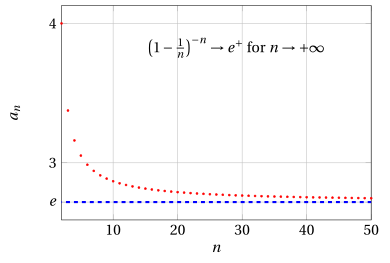
Example 4: Computing limits with the sequence tending to \(e\)
\[\begin{align*}
\lim_{n \rr \ip } \left( 1 - \frac{1}{n}\right)^{-n} = e
\end{align*}\]
Since:
\[
\left( \frac{n-1}{n}\right)^{-n} = \left( \frac{n}{n-1}\right)^{n} = \left( 1+ \frac{1}{n-1}\right)^{n} = \underbrace{\left( 1+ \frac{1}{n-1}\right)^{n-1}}_{\rr e} \cdot \underbrace{\left( 1+ \frac{1}{n-1}\right)}_{\rr 1}
\]
Example 5: Computing limits with the sequence tending to \(e\)
\[\begin{align*}
\lim_{n \rr \ip } \left( 1 + \frac{\alpha}{n}\right)^n = e^\alpha {\rm ~~~with~~~} \alpha \in \R
\end{align*}\]
Since:
\[
\left( 1 + \frac{\alpha}{n}\right)^n = \left(
1 + \frac{1}{\frac{n}{\alpha}}\right)^n = \left( \underbrace{\left( 1 + \frac{1}{\frac{n}{\alpha}}\right)^{\frac{n}{\alpha}}}_{\rr e} \right)^\alpha
\]
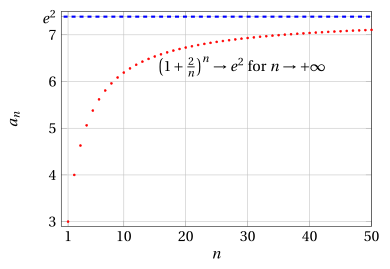
For example, with \(\alpha=2\) we have:
\[\begin{align*}
\lim_{n \rr \ip } \left( 1 + \frac{2}{n}\right)^n = e^2
\end{align*}\]
Try it — the interactive graph below shows what you have just read: move the sliders.
2. Euler's number in finance
Suppose we own a capital of unit value and an annual interest rate \(t\) . If the interest is paid annually, after one year the capital owned will be
\[
1 + t \cdot 1 = 1 + t
\]
If instead the interest is paid monthly, we will have
after the first month, a capital equal to
\[
1+ \frac{t}{12} \cdot 1= \underbrace{1 + \frac{t}{12}}_{\alpha}
\]
after the second month, a capital equal to
\[
\underbrace{1 + \frac{t}{12}}_{\alpha} + \frac{t}{12} \underbrace{\left( 1 + \frac{t}{12} \right)}_{\alpha} = \underbrace{\left(1 + \frac{t}{12}\right)^2}_{\beta}
\]
after the third month, a capital equal to
\[
\underbrace{\left(1 + \frac{t}{12}\right)^2}_{\beta} + \frac{t}{12} \: \underbrace{\left(1 + \frac{t}{12}\right)^2}_{\beta} = \left(1 + \frac{t}{12}\right)^3
\]
at the end of the year we will have a capital equal to
\[
\left(1 + \frac{t}{12}\right)^{12}
\]
If the interest is computed every \(n\) -th of a year, at the end we will have a capital equal to
\[
\left(1 + \frac{t}{n}\right)^{n}
\]
For \(t = 1\) (a 100% return) we obtain exactly the sequence that defines \(e\)
Hence, even if the interest is paid an infinite number of times per year, the capital does not grow to infinity but tends to \(e\) , since:
\[
\lim_{n \rr \ip } \left( 1 + \frac{1}{n}\right)^n= e
\]