Series of functions
Part 5 · Series · Chapter 4 · lecture notes by Fabio Furini · Chapter PDF
1. Series of functions
-
Series of functions are numerical series depending on a parameter \(x\): when these series converge for every value \(x\) belonging to a certain interval, they represent functions of a new kind
-
There are two important classes of series of functions, namely trigonometric series and power series. We will only deal with power series, also called Taylor series, which can be seen as a natural extension of Taylor expansions.
1.1 Taylor series of the elementary transcendental functions
-
Taylor's expansion/formula with Lagrange remainder can be rewritten in the form:
\[\begin{equation} f(x) = \sum_{k=0}^n \frac{f^{(k)}(x_0)}{k!} \; (x-x_0)^k + E_n(x) \end{equation}\]where the Lagrange approximation error is
\[\begin{equation} E_n(x) = \frac{f^{(n+1)}(c)}{(n+1)!} \;(x-x_0)^{n+1} \end{equation}\]and \(c\) is a suitable point between \(x_0\) and \(x\).
Definition 1: Taylor series
If a function \(f\) has derivatives of every order, the series
is called the Taylor series of the function \(f\) centered at \(x_0\).
At a given point \(x \in (a, b)\), if the error
then the Taylor series is convergent and its sum equals \(f(x)\). This is equivalent to saying that the \(n\)-th partial sum of the series has a finite limit and this limit is precisely \(f(x)\). In formulas:
Definition 2: function expandable in Taylor series on an interval
Given a function \(f:D \rr \R\) with derivatives of every order, if
we say that \(f(x)\) is expandable in Taylor series on the interval \(I\).
-
There are (infinitely differentiable) functions that are expandable in Taylor series on the whole real line, others that are expandable only on a bounded interval, and others for which the interval reduces to a single point (the point \(x_0\)).
-
We now deal with the three elementary transcendental functions:
\[ f(x)=e^x,~~~f(x)=\sin x {\rm ~~~and~~~}f(x)=\cos x \]which we will show to be expandable in Taylor series on the whole of \(\R\). They are three transcendental (not algebraic) functions.
-
Real functions of a real variable are classified into algebraic functions and transcendental functions. Algebraic functions are built through a finite number of applications of the four arithmetic operations, of raising to a power and of extracting the \(n\)-th root. Transcendental functions are all the functions that are not algebraic.
The Taylor series of the exponential function
Example 1: Maclaurin formula/expansion of the exponential
Maclaurin formula/expansion of order \(n\) of the exponential with Lagrange remainder:
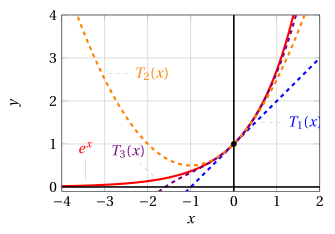
Remark 1: Taylor series of the exponential function
Proof
From the Maclaurin expansion of order \(n\) of \(e^x\) with Lagrange remainder, we have that for every integer \(n\) and \(x \in \R\) there exists a point \(c\), lying between \(0\) and \(x\), such that:
We fix \(x\) and let \(n\) tend to \(\ip\). The point \(c\) may vary with \(n\) but, since it always lies between \(0\) and \(x\), we have:
and \(e^0=1\), hence \(e^c\) stays bounded. From the hierarchy of infinities theorem we have:
hence the error tends to zero, that is:
since it is the product of an infinitesimal sequence and a bounded one. We have therefore proved that the function \(e^x\) can be written as the sum of a power series, its Taylor series, convergent for every \(x \in \R\). □
Remark 2
Proof
It suffices to set \(x\) equal to 1 in the Taylor series of the exponential function. □
-
We have derived a second definition of Euler's number \(e\) (Napier's constant); the first one was:
\[\begin{equation} \label{first} e = \lim_{k \rr \ip} \left(1 + \frac{1}{k} \right)^k \end{equation}\] -
Consequently, we have two methods for computing an approximation of the value of \(e\):
-
The first method is based on formula \(\eqref{first}\), and by fixing \(k=n\) we obtain the approximation:
\[ e \approx \left(1 + \frac{1}{n} \right)^n \] -
The second method is based on formula \(\eqref{second}\), and by computing the \(n\)-th partial sum we obtain the approximation:
\[ e \approx \sum_{k=0}^{n} \frac{1}{k!} \]
\(\left(1 + \frac{1}{n} \right)^n\) \(\sum_{k=0}^{n} \frac{1}{k!}\) \(e\) \(n=1\) \(2.0000000000\dots\) \(2.0000000000\dots\) \(2,7182818284\dots\) \(n=2\) \(2.2500000000\dots\) \(2.5000000000\dots\) \(2,7182818284\dots\) \(n=3\) \(2.3703703704\dots\) \(2.6666666666\dots\) \(2,7182818284\dots\) \(n=4\) \(2.4414062500\dots\) \(2.7083333333\dots\) \(2,7182818284\dots\) \(n=5\) \(2.4883200000\dots\) \(2.7166666666\dots\) \(2,7182818284\dots\) 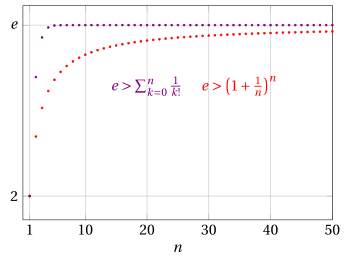
-
-
The second method is therefore much more efficient at approximating the value of \(e\)
The Taylor series of the elementary trigonometric functions
Example 2: Maclaurin formula/expansion of sine and cosine
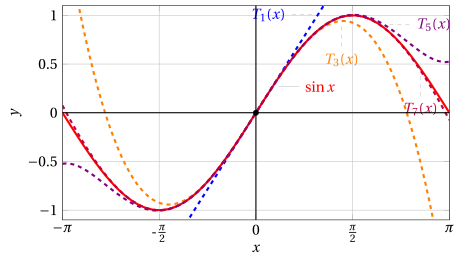
Maclaurin formula/expansion of odd order of the sine with Lagrange remainder:
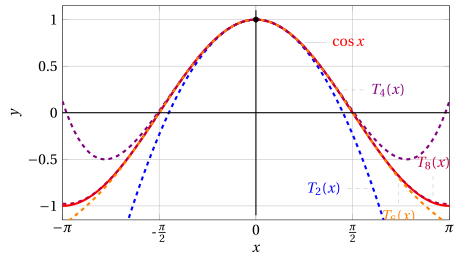
Maclaurin formula/expansion of even order of the cosine with Lagrange remainder:
Remark 3: Taylor series of the elementary trigonometric functions
Proof
□