Exponential and logarithmic functions
Part 2 · Functions · Chapter 4 · lecture notes by Fabio Furini · Chapter PDF
1. Exponential functions
Definition 1: exponential functions
Given \(b \in \R_+\setminus \{1\}\), the function:
is called the exponential function with base \(b\).
-
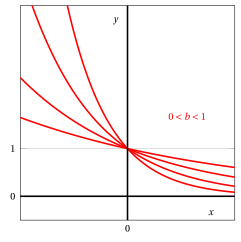
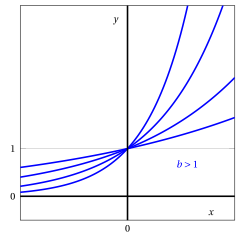
Regarding positivity and monotonicity, we have:
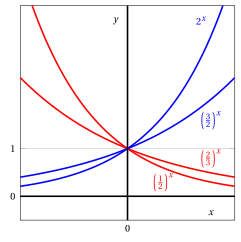
\[ b^x> 0, ~~~\forall x \in \R {\rm ~~~and~~~} \begin{cases} {\rm ~~if~~} 0 < b < 1 {\rm ~~~then~} f {\rm ~~is~decreasing~on~} \R\\[3ex] {\rm ~~if~~} b > 1 {\rm ~~~then~} f {\rm ~~is~increasing~on~} \R \end{cases} \]
2. Logarithmic functions
Definition 2: logarithmic functions
Given \(a \in \R_{>0}\setminus \{1\}\), the function:
is called the logarithmic function with base \(a\).
-
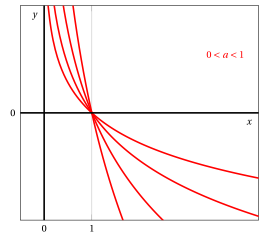
Regarding positivity and monotonicity, we have:
\[ \begin{cases} {\rm ~~if~~} 0 < a < 1 & \log_a x > 0,~~ \forall x \in (0,1),~~\log_a x < 0,~~ \forall x \in (1,\ip){\rm ~~~and~~~} f {\rm ~~is~decreasing~on~} \R_{>0} \\[4ex] {\rm ~~if~~} a > 1 & \log_a x < 0,~~ \forall x \in (0,1),~~\log_a x > 0,~~ \forall x \in (1,\ip) {\rm ~~~and~~~} f {\rm ~~is~increasing~on~} \R_{>0} \end{cases} \]Moreover, we have:
\[ \log_a x = 0 \Longleftrightarrow x=1,~~~ \forall a \in \R_{>0}\setminus \{1\} \]
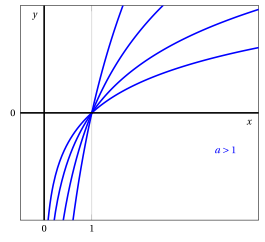
Try it — the interactive graph below shows what you have just read: move the sliders.
3. Change of base
Given any base \(c \in \R_{>0}\setminus \{1\}\), all exponential and logarithmic functions can be rewritten in terms of another base \(d \in \R_{>0} \setminus \{1\}\) as follows:
The logarithmic function with base \(e\) is also written \(\log x\) or \(\ln x\), while the one with base \(2\) is also written \(\lg x\).
Example 1: graphs of exponential and logarithmic functions
Exponential functions:
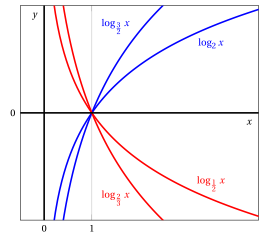
Logarithmic functions: