Corner points, cusps, points with vertical/horizontal tangent
Part 4 · Derivatives · Chapter 3 · lecture notes by Fabio Furini · Chapter PDF
1. Right derivative and left derivative
Definition 1: of right (left) derivative
Let \(f: (a, b) \rr \R\); the function \(f\) is said to be differentiable at \(x_0 \in (a, b)\) from the right (from the left) if the following limit exists and is finite
then \(f\) is differentiable from the right (from the left) and the limit is called the right derivative (left derivative).
- The right derivative is denoted by the symbol \(f'_{+}(x_0)\), while the left derivative is denoted by the symbol \(f'_{-}(x_0)\)
2. Corner points
Definition 2: of corner point
If \(f\) is continuous and differentiable from the right and from the left (but not differentiable) at \(x_0\), we say that \(f\) has a corner point at \(x = x_0\).
Example 1: Corner points
Consider the function \(f(x) = |x|\) and the point \(x_0=0\). We have:
Since the limit of the difference quotient does not exist, \(f\) is not differentiable at \(x =0\). The function is continuous at \(x=0\) (the origin) since
Since the right and left limits of the difference quotient at \(x=0\) exist and are finite, the graph therefore has a corner point at \(x=0\).
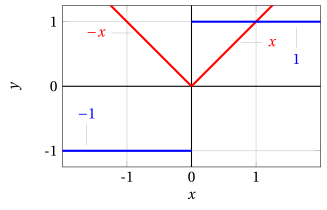
The formula that concisely expresses the derivative of the absolute value function (away from the origin) is the following:
3. Points with vertical/horizontal tangent
-
If \(f\) is continuous at a point \(x_0\) and
\[ \lim_{h \rr 0} \frac{f(x_0 + h) - f(x_0)}{h}= \pm \infty \]then \(f\) is not differentiable at \(x_0\) but, geometrically, the graph of \(f\) has a well-defined tangent line parallel to the \(y\)-axis.
In this case we will allow the notation
\[ f'(x_0) = \ip, ~~~~ f'(x_0) = \im \]and we will speak of a point with vertical tangent.
Definition 3: of point with vertical tangent
If
we say that \(f\) has a point with vertical tangent at \(x = x_0\).
-
Similarly, if \(f\) is continuous at a point \(x_0\) and
\[ \lim_{h \rr 0} \frac{f(x_0 + h) - f(x_0)}{h}= 0 \]the graph of \(f\) has a well-defined tangent line parallel to the \(x\)-axis. In this case we will speak of a point with horizontal tangent.
Definition 4: of point with horizontal tangent
If
we say that \(f\) has a point with horizontal tangent at \(x = x_0\).
Example 2: Point with vertical tangent
Let
then for \(x_0=0\)
and the limits are:
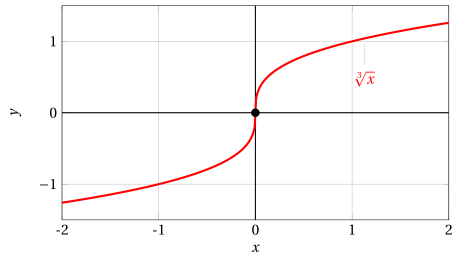
The function has a point with vertical tangent at \(x_0=0\). The function:
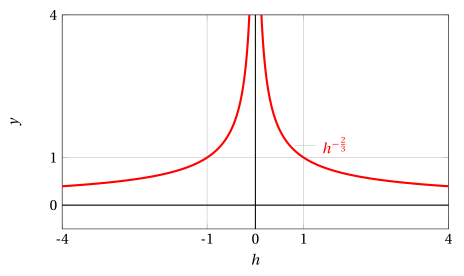
is a power with negative rational exponent \(\frac{m}{n}\) with \(n\) odd (hence defined on \(\R \setminus \{0\}\)) and \(m\) even (hence an even function). Its graph is:
Example 3: Point with vertical tangent
Let
then for \(x_0=2\)
and the limits are
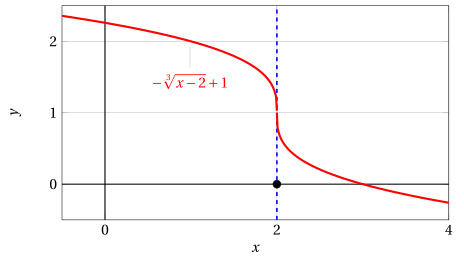
The function has a point with vertical tangent at \(x_0=2\).
4. Cusps
Definition 5: of cusp
Let \(f\) be a function continuous at \(x_0\); if
we say that \(f\) has a cusp at \(x_0\).
Example 4: Cusp
Let
then for \(x_0=0\)
and the limits are:
hence:
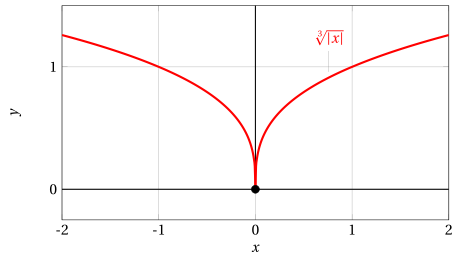
The function has a cusp at \(x_0=0\).
-
In the mixed case where one of the two derivatives is finite and the other is infinite (with \(f\) continuous) we still speak of a corner point.
-
Finally, if the function is defined only for \(x \ge x_0\) and at that point has an infinite (right) derivative, we will simply say that at that point it has a vertical tangent, without speaking of either a cusp or a point with vertical tangent.
Example 5: Point with vertical tangent
Let
then for \(x_0=0\)
we only have the right limit
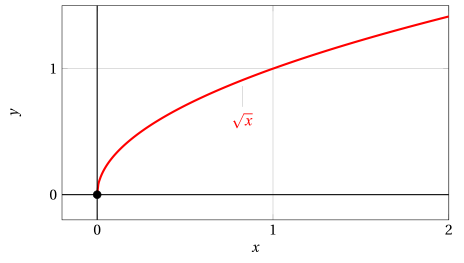
The function has a point with vertical tangent at \(x_0=0\). The function:
is a power with negative rational exponent \(\frac{m}{n}\) with \(n\) even (hence defined only on \(\R_+\)). Its graph is:
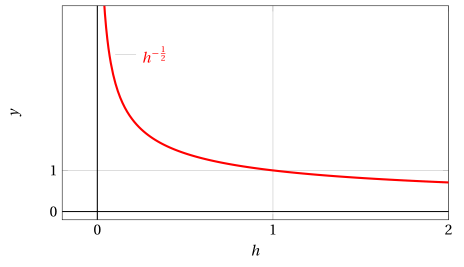
Example 6: Continuous extension from the right and behavior at the origin
Let
hence the function can be extended by continuity from the right at \(x = 0\), by setting:
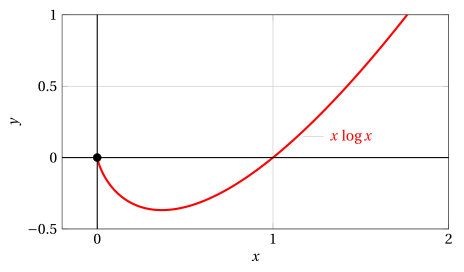
We compute the right derivative at \(x_0=0\) of \(f(x) = x\: \log x\) extended by continuity from the right at \(x=0\). We have, for \(x_0=0\):
and consequently
The function therefore has a point with vertical tangent at \(x_0=0\).
Example 7: Continuous extension from the right and behavior at the origin
Let
hence the function can be extended by continuity from the right at \(x = 0\), by setting:
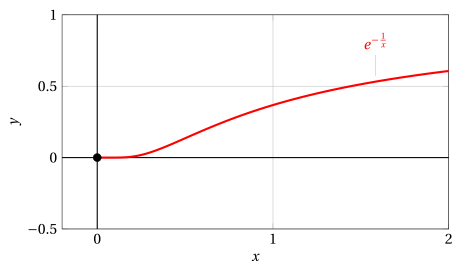
We compute the right derivative at \(x_0=0\) of \(f(x) = e^{-\frac{1}{x}}\) extended by continuity from the right at \(x=0\).
We have:
Changing the variable:
We obtain:
and the function has a point with horizontal tangent (from the right) at \(x_0=0\).