Comparison of infinities
Part 3 · Limits of functions and continuity · Chapter 5 · lecture notes by Fabio Furini · Chapter PDF
1. Comparison of infinities for functions
Theorem 1: Comparison of infinities
Given \(\alpha,\beta, \lambda > 0,~ a,b >1\), we have
\[
\lim_{x \rr \ip} \frac{\log_a^{\beta} x}{x^{\alpha}}=0 {\rm ~~~~~~and~~~~~~} \lim_{x \rr \ip} \frac{x^{\alpha}}{b^{\lambda x}}=0
\]
Proof
The theorem will be proved with the tools of differential calculus. □
-
Any power with positive exponent is an infinity of higher order than any power of logarithms with base \(> 1\), and
-
Any exponential with base \(> 1\) is an infinity of higher order than any power with positive exponent.
Example 1: Comparison of infinities
\[
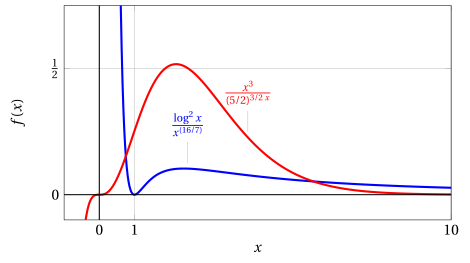
\lim_{x \rr \ip} \frac{\log^2 x}{x^{(16/7)}} = 0, \qquad \lim_{x \rr \ip} \frac{x^3}{(5/2)^{3/2\;x}} = 0
\]
If a function \(\eta(x) \rr \ip\) as \(x \rr c \in \R^*\), we have, from the comparison of infinities theorem:
\[
\lim_{x \rr c} \frac{\bigg(\log_a \big(\eta(x)\big)\bigg)^{\beta}}{\big(\eta(x)\big)^{\alpha}}=0 {\rm ~~~~~~and~~~~~~} \lim_{x \rr c} \frac{\big(\eta(x)\big)^{\alpha}}{b^{\lambda \;\eta(x)}}=0\quad {\rm ~~with~~} \alpha, \beta, \lambda > 0,~ a,b >1
\]
Example 2: Comparison of infinities
\[
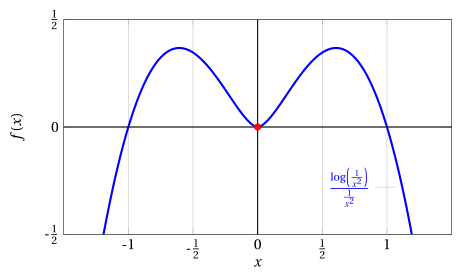
\lim_{x \rr 0} \frac{\log \left( \frac{1}{x^2}\right)}{\frac{1}{x^2}} = 0
\]
since, with \(\eta(x) = \frac{1}{x^2}\), we have \(\eta(x) \rr \ip\) as \(x \rr 0\).
Remark 1
\[
\lim_{x \rr 0^+} x^{\alpha} \; \log^{\beta}_a x =0 \qquad (\alpha >0,\beta = \frac{m}{n}, ~n,m \in \N, ~n {~~\rm odd},~ a>1)
\]
Proof
Given \(\alpha,\beta >0,a>1\) we have:
\[
\lim_{x \rr \ip} \frac{\log_a^{\beta} x}{x^{\alpha}} =0 {\rm ~~~~~and~~~~} \frac{\log_a^{\beta} x}{x^{\alpha}} = \left(\frac{1}{x}\right)^{\alpha} \left( - \log_a \left(\frac{1}{x}\right)\right)^{\beta}
\]
Setting \(t = \frac{1}{x}\), \(x \rr \ip\) is equivalent to \(t \rr 0^{+}\), and substituting we have:
\[
\lim_{x \rr \ip} \frac{\log_a^{\beta} x}{x^{\alpha}}= (-1)^{\beta} \; \lim_{t \rr 0^+} t^{\alpha} \; \log_a^{\beta} t=0
\]
□
Example 3: Comparison of infinities
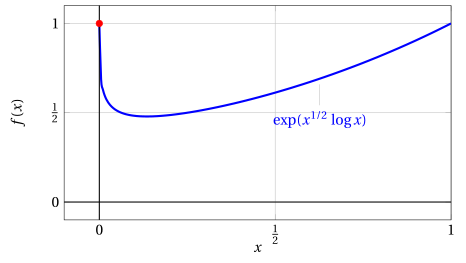
\[
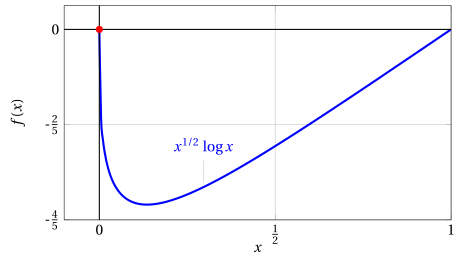
\lim_{x \rr 0^+} x^{1/2} \: \log x = 0^-
\]
since we have \(\alpha=\frac{1}{2}>0, \beta=1>0\) and \(a=e >1\).
\[
\lim_{x \rr 0^+} x^{\sqrt{x}} = 1^{-}
\]
since
\[
\lim_{x \rr 0^+} x^{\sqrt{x}} = \lim_{x \rr 0^+} \underbrace{e^{x^{1/2} \: \log x}}_{=\exp(x^{1/2} \: \log x)} = e^{0^-} = 1^{-}
\]
If a function \(\varepsilon(x)\) tends to \(0^+\) as \(x \rr c \in \R^*\), it follows from the previous remark that:
\[
\lim_{x \rr c} \big(\varepsilon(x)\big)^{\alpha} \; \big( \: \log_a \big(\varepsilon(x)\big)\big)^{\beta} =0 \quad (\alpha>0,\beta = \frac{m}{n}, ~n,m \in \N, ~n {~~\rm odd},~ a>1)
\]
Example 4: Comparison of infinities
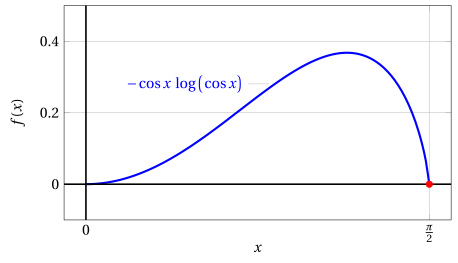
\[
\lim_{x \rr \frac{\pi}{2}^-} - \cos x \; \log \big( \cos x \big) = 0^+
\]
since, with \(\varepsilon(x) = \cos x\), we have \(\varepsilon(x) \rr 0^+\) as \(x \rr \frac{\pi}{2}^-\) and \(\alpha=\beta=1\).
From the comparison of infinities theorem it follows that:
\[
\lim_{x \rr \ip} \frac{x^{\alpha}}{\log_a^{\beta} x}=+\infty {\rm ~~~~and~~~~} \lim_{x \rr \ip} \frac{b^{\lambda \: x}}{x^{\alpha}}=+\infty
{\rm ~~~~with~~~~} \alpha, \beta,\lambda > 0,~~ a,b >1
\]
Remark 2
\[
\lim_{x \rr 0^+} x^{\alpha} \; b^{\lambda/x} = \ip \qquad (\alpha, \lambda >0,~ b>1)
\]
Proof
Given \(\alpha, \lambda >0,b>1\), we have:
\[
\lim_{x \rr \ip} \frac{b^{\lambda \: x}}{x^{\alpha}}=\ip
\]
Setting \(t = \frac{1}{x}\), \(x \rr \ip\) is equivalent to \(t \rr 0^{+}\), and substituting we have:
\[
\lim_{x \rr \ip} \frac{b^{\lambda \: x}}{x^{\alpha}}= \lim_{x \rr \ip} \left(\frac{1}{x}\right)^{\alpha} \; b^{\lambda \: x}= \lim_{t \rr 0^+} t^{\alpha} \; b^{\lambda/t} = \ip
\]
□
Example 5: Comparison of infinities
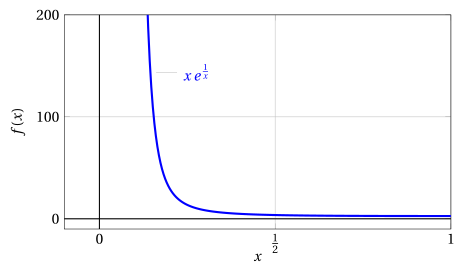
\[
\lim_{x \rr 0^+} x\; e^{\frac{1}{x}} = \ip
\]
since we have \(\alpha=\lambda=1\) and \(b=e>1\)
Remark 3
\[
\lim_{x \rr 0^+} x^{-\alpha} \; b^{-\lambda/x} = 0 \qquad (\alpha, \lambda >0,~ b>1)
\]
Proof
Given \(\alpha, \lambda >0,b>1\) we have:
\[
\lim_{x \rr \ip} \frac{x^{\alpha} }{b^{\lambda \: x}} =0
\]
Setting \(t =\frac{1}{x}\), \(x \rr \ip\) is equivalent to \(t \rr 0^+\), and substituting we have:
\[
\lim_{x \rr \ip}\frac{x^{\alpha} }{b^{\lambda \: x}} = \lim_{x \rr \ip} \left( \frac{1 }{x} \right)^{-\alpha} \frac{1}{b^{\lambda \: x}} = \lim_{t \rr 0^+} t^{-\alpha} \; b^{-\lambda/t} = 0
\]
□
Example 6: Comparison of infinities
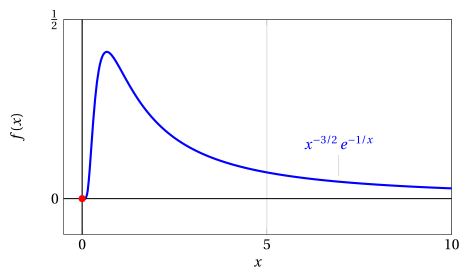
\[
\lim_{x \rr 0^+} x^{-3/2} \: e^{-1/x} = 0
\]
since we have \(\alpha=\frac{3}{2}, \lambda=1\) and \(b=e>1\).
Remark 4
\[
\lim_{x \rr \im} x^{\alpha} \; b^{\lambda \: x} = 0 \qquad \left(\alpha = \frac{m}{n} >0, ~n,m \in \N, ~n {~~\rm odd}, m \neq 0, ~ \lambda >0, ~ b>1 \right)
\]
Proof
Given \(\alpha, \lambda >0,b>1\) we have:
\[
\lim_{x \rr \ip} \frac{x^{\alpha} }{b^{\lambda \: x}} =0
\]
Setting \(t =-x\), \(x \rr \ip\) is equivalent to \(t \rr \im\), and substituting we have:
\[
\lim_{x \rr \ip}\frac{x^{\alpha} }{b^{\lambda \: x}} =\lim_{t \rr \im} \frac{(-t)^{\alpha} }{b^{-\lambda \: t}} = (-1)^\alpha \lim_{t \rr \im} t^{\alpha} \; b^{\lambda \: t} = 0
\]
□
Example 7: Comparison of infinities
\[
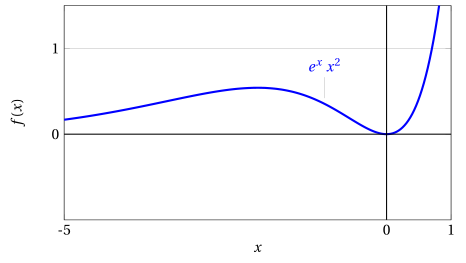
\lim_{x \rr \im} x^2 \; e^{x} = 0
\]
since we have \(\alpha=2, \lambda=1\) and \(b=e>1\).