Computing derivative functions
Exercises · Derivatives · with worked solutions · PDF
Exercise 1
Let \(f:\R\rightarrow\R\), \(f(x)=x^{3}\).
-
Write the difference quotient of \(f\) at the point \(x=1\).
-
Compute \(f'(1)\) as the limit of the difference quotient.
-
Write the equation of the tangent line to the graph of \(f\) at the point \((1,1)\).
Solution
1.
$$
\frac{f(1+h)-f(1)}{h}=\frac{(1+h)^{3}-1}{h}=\frac{3h+3h^{2}+h^{3}}{h}=3+3h+h^{2}
$$
2.
$$
f'(1)=\lim_{h\to0}3+3h+h^{2}=3
$$
-
The tangent line has equation \(y = f(1) + f'(1)(x-1)\), hence
\[ y=1 + 3(x-1) \]from which
\[ y=3x-2 \]
Exercise 2
Compute the derivative of the following function \(f\), specifying the domain of \(f\) and of \(f'\):
Solution
The functions \(f\) and \(f'\) are defined on all of \({\R}\).
Using the rules for the derivative of a product and of composite functions, we have
Exercise 3
Compute the derivative of the following function \(f\), specifying the domain of \(f\) and of \(f'\):
Solution
The functions \(f\) and \(f'\) are defined on all of \({\R}\).
Using the rules for the derivative of a product and of composite functions, we have
Exercise 4
Compute the derivative of the following function \(f\), specifying the domain of \(f\) and of \(f'\):
Solution
Using the rules for the derivative of composite functions, we have
The functions \(f\) and \(f'\) are defined on \({\R}\setminus\{0\}\).
Exercise 5
Compute the derivative of the following function:
Solution
Exercise 6
Compute the derivatives of the following functions:
Solution
1.
$$
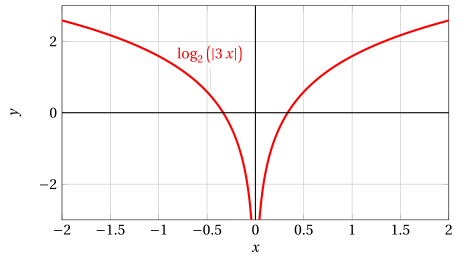
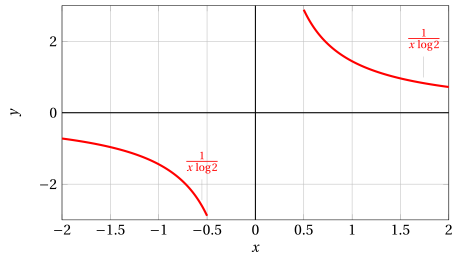
\left(~\log \big(|x|\big)~\right)'=\frac{1}{|x|} \cdot \sgn (x) = \frac{1}{x}
$$
2.
$$
\left(~ \log (3\:x)~\right)' =\big(\log 3 + \log x \big)' = \frac{1}{x}
$$
3.
\begin{align*}
\left(~\log\left(\left|\frac{x+2}{3-x}\right|\right)~\right)' & = \frac{1}{\left|\frac{x+2}{3-x}\right|} \cdot \sgn\left(\frac{x+2}{3-x}\right) \cdot \left(~\left(\frac{x+2}{3-x}\right)~\right)'= \frac{\left(~\left(\frac{x+2}{3-x}\right)~\right)'}{\frac{x+2}{3-x}} \\[2ex]
&={\left(~\left(\frac{x+2}{3-x}\right)~\right)'} \cdot {\frac{3-x}{x+2}}= \frac{3-x+x+2}{(3-x)^2}\cdot {\frac{3-x}{x+2}}\\[2ex]
&= \frac{5}{(3-x)\cdot(x+2)} = \frac{5}{-x^2+x+6}
\end{align*}
Exercise 7
Compute the derivative of the following function:
Solution
Using the rules for the derivative of a product and of composite functions, we have:
Exercise 8
Compute the derivative of the following function:
Solution
Exercise 9
Compute the derivative of the following function:
Solution
Using the rules for the derivative of a product, we have:
Exercise 10
Compute the derivative of the following function:
Solution
Using the rules for the derivative of a quotient and of composite functions, we have:
Exercise 11
Compute the derivative of the following function:
Solution
Using the rules for the derivative of a product and of composite functions, we have
Exercise 12
Compute the derivative of the following function:
Solution
Using the rules for the derivative of composite functions, we have
Exercise 13
Compute the derivative of the following function:
Solution
We compute the derivative of the hyperbolic tangent function
Using the rules for the derivative of a quotient, we have
Moreover, since \(\cosh^2x-\sinh^2x = 1\), we also have
where \(\sech x\) is the hyperbolic secant, defined as \(\sech x = \frac{1}{\cosh x}\).
Exercise 14
Compute the derivative of the following function:
Solution
We compute the derivative of the hyperbolic cotangent function
Using the rules for the derivative of a quotient, we have
Moreover, since \(\cosh^2x-\sinh^2x = 1\), we also have
where \(\csch x\) is the hyperbolic cosecant, defined as \(\csch x = \frac{1}{\sinh x}\).
Exercise 15
Compute the derivative of the following function:
Solution
Using the rules for the derivative of composite functions, we have
Exercise 16
Compute the derivative of the following function:
Solution
For \(x \neq 0\), we have:
Solution
The function is discontinuous at \(x = 0\), hence it is not differentiable.
Exercise 17
Compute the derivative of the following function:
Solution
Using the rules for the derivative of a quotient, we have
Exercise 18
Compute the derivative of the following function:
Solution
Using the rules for the derivative of composite functions, we have
Exercise 19
Compute the derivative of the following function:
Solution
Using the rules for the derivative of composite functions, we have
Exercise 20
Determine whether the function
is invertible and compute the derivative of \(f^{-1}(y)\) for \(y=-2\pi\).
Solution
Since \(f'(x)=-e^{-x+1}-2\pi<0\), for every \(x\in\mathbb{R}\), we immediately obtain that f is strictly monotonically decreasing and hence invertible on \(\mathbb{R}\). We also observe that
i.e., \(f^{-1}(-2\pi)=1\). From the theorem on the derivative of the inverse function we immediately obtain
Remark: We would not have been able to write the analytic expression of \(f^{-1}\), even though it exists since \(f\) is invertible; the theorem on the derivative of the inverse function allows us to overcome this obstacle, without going through the explicit expression of the inverse.
Exercise 21
Determine whether the function
is invertible and compute the derivative of \(f^{-1}(y)\) for \(y=4\pi\).
Solution
Since \(f'(x)=4+\pi \cos x>0\), for every \(x\in\mathbb{R}\), we immediately obtain that f is strictly monotonically increasing and hence invertible on \(\mathbb{R}\). We also observe that
i.e., \(f^{-1}(4\pi)=\pi\). From the theorem on the derivative of the inverse function we immediately obtain
Remark: We would not have been able to write the analytic expression of \(f^{-1}\), even though it exists since \(f\) is invertible; the theorem on the derivative of the inverse function allows us to overcome this obstacle, without going through the explicit expression of the inverse.
Exercise 22
Let \(f \in \mathcal{C}^1(\mathbb{R})\) be such that \(f'(1)=5e\). Setting \(g(x)=f(\log x)\), compute \(g'(e)\).
Solution
We observe that \(g \in \mathcal{C}^1(0,+\infty)\), since it is a composition of functions of class \(\mathcal{C}^1\) on their domains. Therefore, using the theorem on the derivative of composite functions, we obtain
Exercise 23
Compute the derivative of the following function:
Solution
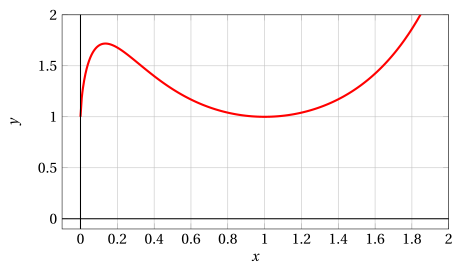
We use the rule for the derivative of a function raised to another function. The two functions are:
Hence:
Exercise 24
Compute the derivative of the following function:
Solution
Using the rules for the derivative of a quotient, we have
Exercise 25
Compute the derivative of the following function:
Solution
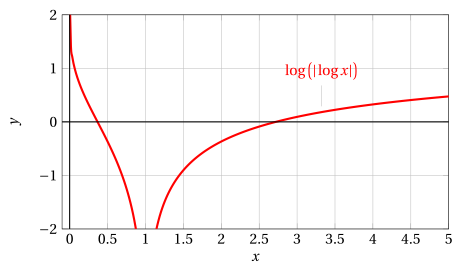
For \(x \neq 1\), we have:
The function is discontinuous at \(x = 1\), hence it is not differentiable.
Exercise 26
Compute the derivative of the following function \(f\), specifying the domain of \(f\) and of \(f'\):
Solution
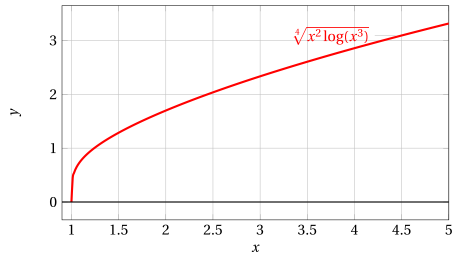
From \(x^{3}>0\) and \(x^{2}\log(x^{3})\geq0\) it follows that \(f\) is defined for \(x\in[1,+\infty)\), and for such \(x\) we have
By the usual differentiation rules, for \(x>1\) the function \(f\) is differentiable and we have:
For \(x=1\), since the usual differentiation rules cannot be applied (the function \(\sqrt[4]{y}\) is not differentiable at \(y=0\)), we directly examine the limit of the difference quotient, where the increment \(h\) makes sense only if \(h>0\):
where we used \(\log^{1/4}(1+h)\sim h^{1/4}\) for \(h\to0^{+}\). The function \(f\) is not differentiable at \(x=1\). At the point \((1,0)\) the graph has a vertical tangent line.
Alternatively, we reach the same conclusion \(f'(1)=+\infty\) by observing that \(f\) is continuous and that
using Lagrange's mean value theorem or, equivalently, L'Hopital's rule for the indeterminate forms \(0/0\).
Exercise 27
Give an example of \(f:\R\rightarrow\R\), continuous at \(x=1\), not differentiable at \(x=1\), and such that \(f(0)=2\).
Solution
For example
The function satisfies \(f(0)=2\) and is continuous on all of \({\R}\).
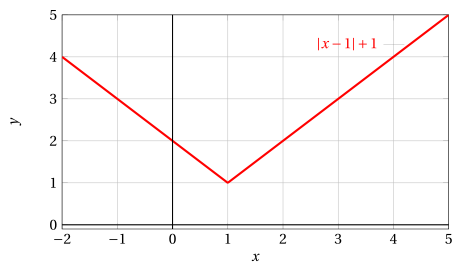
At \(x=1\) we have \(f'_{+}(1)=1\), \(f'_{-}(1)=-1\), hence the function is not differentiable.