Trigonometric functions
Part 2 · Functions · Chapter 5 · lecture notes by Fabio Furini · Chapter PDF
1. Trigonometric functions
Definition 1: sine function and cosine function
The trigonometric functions:
are called sine and cosine.
-
The sine is an odd function, while the cosine is an even function. Hence we have:
\[ \sin(-x)=-\sin x, ~~~\forall x \in \R {\rm ~~~~and~~~~} \cos(-x)=\cos x, ~~~\forall x \in \R \] -
The sine and the cosine are periodic functions with period:
\[ T=2\: \pi {\rm ~~~~and~we~have~the~fundamental~identity~~~} \sin^2 x + \cos^2 x = 1,~~ \forall x \in \mathbb{R} \]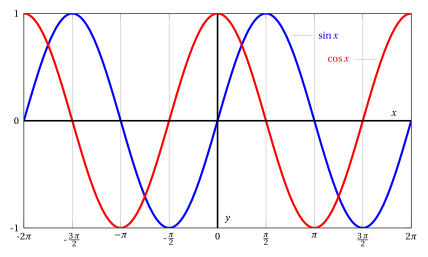
We have
\[ \cos\left(x -\frac{\pi}{2}\right) = \sin x,~~ \forall x \in \mathbb{R} \] -
From the sign and the monotonicity of the sine function we have:
\[ \sin x = 0 \Longleftrightarrow x= k\;\pi,~ \forall k \in \Z \qquad \begin{cases} \sin x > 0 & {\rm if~~~} x \in (2\;k\;\pi~,~ 2\;k\;\pi + \pi),~ \forall k \in \Z \\[3ex] \sin x < 0 & {\rm if~~~} x \in (2\;k\;\pi-\pi~,~ 2\;k\;\pi),~ \forall k \in \Z \end{cases} \]\[ \begin{cases} {\rm if~~~} x \in (2\;k\;\pi- \frac{\pi}{2},~ 2\;k\;\pi + \frac{\pi}{2}),~ \forall k \in \Z & f {\rm ~~is~increasing} \\[3ex] {\rm if~~~} x \in (2\;k\;\pi+ \frac{\pi}{2}~,~ 2\;k\;\pi + \frac{3\;\pi}{2}),~ \forall k \in \Z & f {\rm ~~is~decreasing} \end{cases} \] -
From the sign and the monotonicity of the cosine function we have:
\[ \cos x = 0 \Longleftrightarrow x= k\;\pi-\frac{\pi}{2},~ \forall k \in \Z \qquad \begin{cases} \cos x > 0 & {\rm if~~~} x \in (2\;k\;\pi~-\frac{\pi}{2},~ 2\;k\;\pi + \frac{\pi}{2}),~ \forall k \in \Z \\[3ex] \cos x < 0 & {\rm if~~~} x \in (2\;k\;\pi+\frac{\pi}{2}~,~ 2\;k\;\pi +\frac{3\;\pi}{2}),~ \forall k \in \Z \end{cases} \]\[ \begin{cases} {\rm if~~~} x \in (2\;k\;\pi+ \pi,~ 2\;k\;\pi + 2\; \pi),~ \forall k \in \Z & f {\rm ~~is~increasing} \\[3ex] {\rm if~~~} x \in (2\;k\;\pi ~,~ 2\;k\;\pi + \pi),~ \forall k \in \Z & f {\rm ~~is~decreasing} \end{cases} \]
The trigonometric functions:
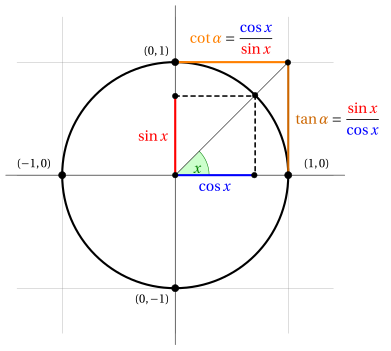
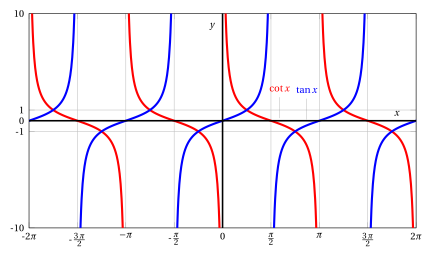
are called tangent and cotangent; they are both odd and periodic with period \(T=\pi\).
The trigonometric functions:
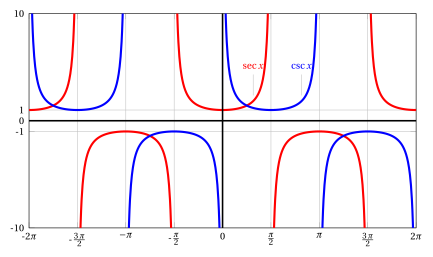
are called secant and cosecant and they are periodic with period \(T=2\;\pi\). The secant function is even, while the cosecant function is odd.
2. Values of the trigonometric functions
| \(\cos\) | \(\sin\) | \(\tan\) | \(\cot\) | \(\sec\) | \(\csc\) | |
| 0 | 1 | 0 | 0 | \(\pm \infty\) | 1 | \(\pm \infty\) |
| \(x=\frac{\pi}{6}\) (\(30^{\circ}\)) | \(\frac{\sqrt{3}}{2}\) | \(\frac{1}{2}\) | \(\frac{\sqrt{3}}{3}\) | \(\sqrt{3}\) | \(\frac{2}{3}\:\sqrt{3}\) | 2 |
| \(x=\frac{\pi}{4}\) (\(45^{\circ}\)) | \(\frac{\sqrt{2}}{2}\) | \(\frac{\sqrt{2}}{2}\) | 1 | 1 | \(\sqrt{2}\) | \(\sqrt{2}\) |
| \(x=\frac{\pi}{3}\) (\(60^{\circ}\)) | \(\frac{1}{2}\) | \(\frac{\sqrt{3}}{2}\) | \(\sqrt{3}\) | \(\frac{\sqrt{3}}{3}\) | 2 | \(\frac{2}{3}\: \sqrt{3}\) |
| \(x=\frac{\pi}{2}\) (\(90^{\circ}\)) | 0 | 1 | \(\pm \infty\) | 0 | \(\pm \infty\) | 1 |
| \(x=\pi\) (\(180^{\circ}\)) | \-1 | 0 | 0 | \(\pm \infty\) | \-1 | \(\pm \infty\) |
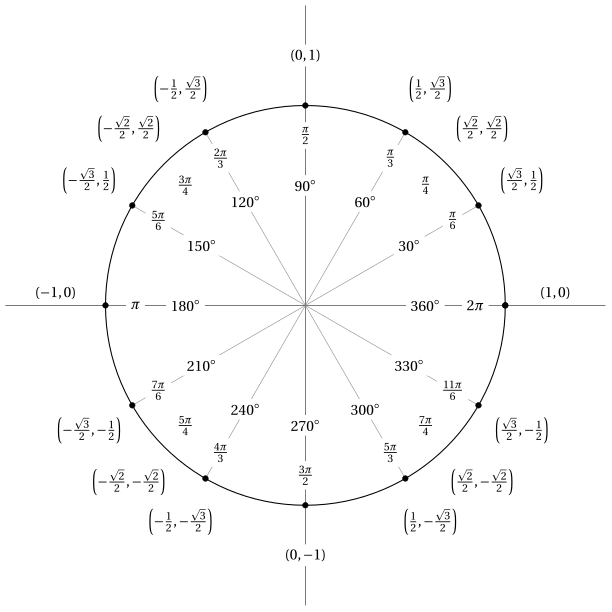
| \(\phantom{-} \cos\) | \(\phantom{-} \sin\) | \(\phantom{-} \tan\) | \(\phantom{-} \cot\) | |
| \(\phantom{-}x\) | \(\phantom{-} \cos x\) | \(\phantom{-} \sin x\) | \(\phantom{-} \tan x\) | \(\phantom{-} \cot x\) |
| \(-x\) | \(\phantom{-} \cos x\) | \(- \sin x\) | \(-\tan x\) | \(-\cot x\) |
| \(\frac{\pi}{2} +x\) | \(-\sin x\) | \(\phantom{-} \cos x\) | \(-\cot x\) | \(-\tan x\) |
| \(\frac{\pi}{2} - x\) | \(\phantom{-} \sin x\) | \(\phantom{-} \cos x\) | \(\phantom{-} \cot x\) | \(\phantom{-} \tan x\) |
| \(\pi+x\) | \(-\cos x\) | \(-\sin x\) | \(\phantom{-} \tan x\) | \(\phantom{-} \cot x\) |
| \(\pi-x\) | \(-\cos x\) | \(\phantom{-} \sin x\) | \(-\tan x\) | \(-\cot x\) |
3. Main trigonometric formulas
Relations among the trigonometric functions
| \(\sin x\) | \(\cos x\) | \(\tan x\) | \(\cot x\) | |
| \(\sin x\) | - | \(\pm \sqrt{1 - \cos^2 x}\) | \(\pm \sqrt{\frac{\tan^2 x}{1 + \tan^2 x}}\) | \(\pm \sqrt{\frac{1}{1 + \cot^2 x}}\) |
| \(\cos x\) | \(\pm \sqrt{1 - \sin^2 x}\) | - | \(\pm \sqrt{\frac{1}{1 + \tan^2 x}}\) | \(\pm \sqrt{\frac{\cot^2 x}{1 + \cot^2 x}}\) |
| \(\tan x\) | \(\pm\sqrt{\frac{\sin^2 x}{1 - \sin^2 x}}\) | \(\pm\sqrt{\frac{1- \cos^2 x}{\cos^2 x}}\) | - | \(\frac{1}{\cot x}\) |
| \(\cot x\) | \(\pm\sqrt{\frac{1- \sin^2 x}{\sin^2 x}}\) | \(\pm\sqrt{\frac{\cos^2 x}{1 - \cos^2 x}}\) | \(\frac{1}{\tan x}\) | - |
where the symbol \(\pm\) means that the sign depends on the quadrant in which \(x\) lies
Addition and subtraction
Double-angle formulas
Triple-angle formulas
Half-angle formulas
Parametric formulas (tangent half-angle substitution)
Sum-to-product formulas (prosthaphaeresis)
Product-to-sum formulas (Werner's formulas)
Additional formulas