Composite functions
Part 2 · Functions · Chapter 10 · lecture notes by Fabio Furini · Chapter PDF
1. Composite functions
Definition 1: of composite function
Given two functions:
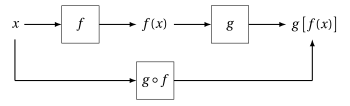
if \(f (E) \subseteq F\) (i.e., if for every \(x \in E\) we have \(f ( x) \in F)\), one can define the function \(h : E \rightarrow \mathbb{R}\), the composite of \(f\) and \(g\) (in this order), denoted by the symbol \(g \circ f\), through the formula
-
The composition scheme is the following:
Example 1: of composite function
The function \(x \mapsto |f(x)|\) is actually “composed” of two functions:
-
given \(x\), we compute \(f(x)\)
-
once \(f(x)\) is computed, we compute \(|f(x)|\)
This amounts to operating in series with two black boxes, the first corresponding to \(f\), the second to its absolute value, according to the following scheme:

-
It may happen that both compositions \((g \circ f)\) and \((f \circ g)\) are well defined, but in general
\[ (f \circ g) \neq (g \circ f) \]In other words, the commutative property does not hold.
Example 2: of composition of functions
Consider the functions:
that is, \(f(x)= x^2\) and \(g(x)= \cos x\).
-
Since \(g\) is defined on all of \(\mathbb{R}\), \(h = g \circ f\) is well defined on \(\mathbb{R}\) and the following formula holds
\[ h(x) = (g \circ f) (x) = g[f(x)] = \cos x^2 \]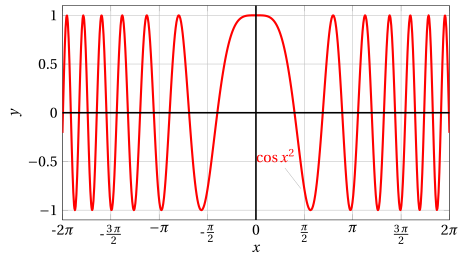
-
Since \(f\) is defined on all of \(\mathbb{R}\), \(k = f \circ g\) is well defined on \(\mathbb{R}\) and the following formula holds
\[ k(x) = (f \circ g) (x) = f[g(x)] = \cos^2 x \]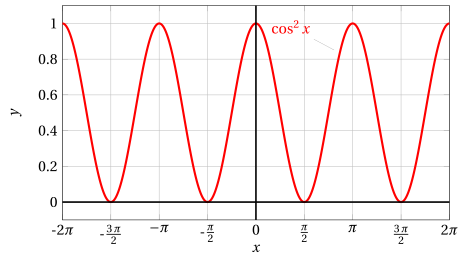
Example 3: of composition of functions
Consider the functions:
that is, \(f(x)= e^x\) and \(g(x)= \sqrt{x}\).
-
Since \(g\) is defined on \([0,+\infty)\) and \(f(x) > 0\) for every \(x \in \mathbb{R}\), \(h = g \circ f\) is well defined on \(\mathbb{R}\) and the following formula holds
\[ h(x) = (g \circ f) (x) = g[f(x)] = \sqrt{e^x} \]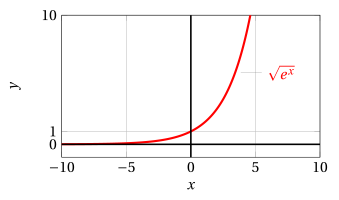
-
Since \(g\) is defined only on \([0,+\infty)\), \(k = f \circ g\) is well defined only on \(\mathbb{R}_+\) and the following formula holds
\[ k(x) = (f \circ g) (x) = f[g(x)] = e^{\sqrt{x}} \]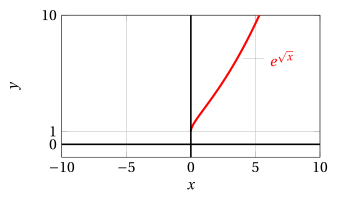
-
The composition operation can be extended to three or more factors. One can verify that if the composition \((f \circ g) \circ r\) exists, then \(f \circ (g \circ r)\) also exists and they are equal
\[ (f \circ g) \circ r = f \circ (g \circ r) \]In other words, the associative property holds.
-
If a function \(f : D \rightarrow \mathbb{R}\) is such that \(f ( D) \subseteq D\), then it can be composed with itself
\[ f^2 = f \circ f {\rm~~that~is~~} f^2(x) = f[f(x)] \]\(f^2\) is called the second iterate of \(f\). Similarly, \(f^n\) is called the \(n\)-th iterate function of \(f\).