Series with terms of variable sign
Part 5 · Series · Chapter 3 · lecture notes by Fabio Furini · Chapter PDF
1. Series with terms of variable sign
Definition 1: absolutely convergent series
A series \(\sum a_k\) is absolutely convergent if the series \(\sum |a_k|\) converges.
Theorem 1
If a series \(\sum a_k\) converges absolutely, then it converges.
Proof
Without loss of generality, let \(n_0=0\) and consider the following series:
It is a series with nonnegative terms since, for every \(k\in\mathbb N\), we have:
Moreover, by the triangle inequality, for every \(k\in\mathbb N\), we have:
Hence, by the comparison test for series with nonnegative terms, we have
Since for every \(k\in\mathbb N\) we have \(a_k=|a_k|-\big(|a_k|-a_k\big)\) and the series \(\sum_{k=0}^\infty |a_k|\) and \(\sum_{k=0}^\infty (|a_k|-a_k)\) converge, we have:
that is, the series is the difference of two convergent series. Consequently, the series \(\sum_{k=0}^\infty a_k\) is convergent as well. □
- The following is an alternative proof.
Proof
Without loss of generality, let \(n_0=0\) and split the sequence \(\{s_n\}\) of partial sums into two sequences, the first containing only the positive terms and the second only the negative terms:
Consequently, it is enough to show that the sequences \(\{s_n^+\}\) and \(\{s_n^-\}\) are convergent to conclude that \(\{s_n\}\) converges, and hence that the series \(\sum a_k\) converges.
We observe that \(\{s_n^+\}\) and \(\{s_n^-\}\) are monotone non-decreasing sequences and moreover, by the triangle inequality, we have:
On the other hand, by hypothesis the series \(\sum a_k\) converges absolutely, i.e., \(\sum |a_k|\) converges, and hence the quantity \(\sum_{k=0}^n |a_k|\) is bounded; therefore the sequences \(\{s_n^+\}\) and \(\{s_n^-\}\) are bounded above and non-decreasing, and hence they converge, by the monotone sequence theorem. □
Example 1: absolute convergence
Let us determine the behavior of the series:
We have:
Therefore the series converges absolutely and hence it converges.
Absolute convergence implies ordinary convergence, also called simple convergence:
but the converse is not true (we will give a counterexample later):
Hence absolute convergence is a sufficient but not necessary condition for ordinary convergence.
1.1 Alternating series and the Leibniz test
- Among series with terms of variable sign, a particularly simple case is given by alternating series, for which the following convergence test holds.
Theorem 2: Leibniz (alternating series) test
Consider the series
If the sequence \(\{a_k\}\) is decreasing and \(a_k \rr 0\) as \(k \rr \ip\), then the series is convergent. Moreover:
-
The partial sums with even index approximate the sum \(s\) from above and those with odd index from below.
-
The Leibniz test can clearly be applied also if the terms eventually have alternating signs and the sequence \(\{a_k\}\) is eventually decreasing.
Example 2: Leibniz test
Let us determine the behavior of the series:
The sequence \(a_k = \frac{1}{k}\) is decreasing and non-negative. Moreover \(\frac{1}{k}\rr 0\) as \(k \rr \ip\), hence it satisfies the two conditions of the Leibniz test theorem. Consequently, the series is convergent.
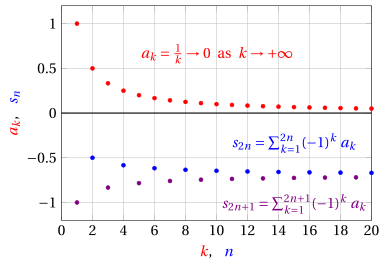
The series \(\sum_{k=1}^{\infty} \frac{(-1)^k}{k}\) converges and is a counterexample to \(\eqref{LLLL}\), that is, a series that converges but does not converge absolutely, since:
Proof
Consider the sequence of partial sums \(\{s_n\}\) with \(n_0=0\) and the two subsequences extracted from it, \(\{ s_{2n}\}\) and \(\{s_{2n+1}\}\).
For \(\{ s_{2n}\}\) we have:
hence the sequence \(\{ s_{2n}\}\) is monotone decreasing.
For \(\{ s_{2n+1}\}\) we have:
hence the sequence \(\{s_{2n+1}\}\) is monotone increasing.
Moreover, we have:
therefore \(\{s_{2n+1}\}\) is bounded above and \(\{ s_{2n}\}\) is bounded below. The two sequences are hence convergent, by the monotone sequence theorem.
The two sequences converge to the same limit, because
Calling \(s\) this limit, since \(\{ s_{2n}\}\) is monotone decreasing and \(\{ s_{2n+1}\}\) is monotone increasing, we have:
Hence the series is convergent since \(s_{2n+1} \rr s~\) and \(s_{2n} \rr s~\) as \(n \rr \ip\), and consequently we have:
□
Corollary 1: of the Leibniz test theorem
Given a series satisfying the hypotheses of the Leibniz test theorem, we have:
- For every \(m\), the error made by approximating \(s\) with \(s_m\) is, in absolute value, bounded above by the value of the first omitted term. In other words, the tail of the series tends to a value less than or equal to \(a_{m+1}\).
Proof
Since
we therefore have, for every \(n \in \N\):
from which we deduce
Therefore, for every \(m\), whether even or odd, we have:
□
Example 3: Leibniz test
Let us determine the behavior of the series:
We have:
hence the series does not converge absolutely. However, the series is decreasing for \(k \ge 2\) since:
hence the series converges by the Leibniz test, since it is eventually decreasing.
Example 4: Leibniz test
Let us determine the behavior of the series:
We have:
moreover
hence the series does not converge absolutely. Proving algebraically that the sequence \(\{a_k\}\) is decreasing is complicated; instead, we pass from the discrete to the continuous setting. We have, for \(x \in \R\) and \(x \ge 2\):
It follows that \(f\) is decreasing for \(x \ge e\); consequently the sequence \(a_k = f ( k)\) is decreasing for \(k \ge 3\) (the first integer \(> e\)). Hence the series converges by the Leibniz test.
This can be checked by viewing the series as the limit of the sequence of partial sums and applying the theorem on the limit of a sum.
Example 5: Leibniz test
Let us determine the behavior of the series:
We split it into the sum of two series:
For the first series we have:
hence it converges by the limit comparison test, since:
The second series converges by the Leibniz test; hence the original series converges.
Example 6: Leibniz test
Let us determine the behavior of the series:
We split it into the sum of two series:
The first series converges by the Leibniz test; the second diverges (harmonic series); hence the original series diverges.
Example 7: Leibniz test
Let us determine the behavior of the series:
We have:
moreover, the sequence \(a_k = \frac{1}{k}\) is decreasing and \(\frac{1}{k}\rr 0\) as \(k \rr \ip\), hence it satisfies the two conditions of the theorem. Consequently, the series \(\sum_{k=1}^{\infty} \frac{(-1)^{k+1}}{k}\) converges.
Try it — the interactive graph below shows what you have just read: move the sliders.