Functions
Part 2 · Functions · Chapter 1 · lecture notes by Fabio Furini · Chapter PDF
1. The concept of function
The existence of a variable quantity implies the existence of a relation between two quantities, that is, the dependence of one quantity on another.
- In each case, this relation follows a certain law or formula.
Example 1: Laws/formulas \(\rightarrow\) functions
If a heavy object is dropped from a certain height, the distance traveled by the object varies with time \(t\) according to the formula:
where \(g \approx 9,8\) is the gravitational acceleration constant.
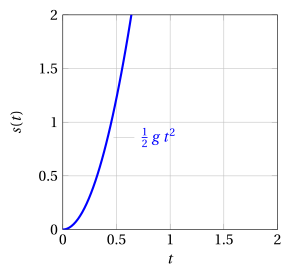
Hence, the time \(t\) is associated with the distance traveled \(s(t)\): \(t \mapsto s(t)\).
Example 2: Laws/formulas \(\rightarrow\) functions
If a unit capital is invested for one year at the annual rate \(i\), with interest paid monthly at a rate \(\frac{i}{12}\), we have:
-
after the first month, a capital equal to:
\[ 1+ \frac{i}{12} \cdot 1= \underbrace{1 + \frac{i}{12}}_{\alpha} \] -
after the second month, a capital equal to:
\[ \underbrace{1 + \frac{i}{12}}_{\alpha} + \frac{i}{12} \underbrace{\left( 1 + \frac{i}{12} \right)}_{\alpha} = \left(1 + \frac{i}{12}\right) \: \left(1 + \frac{i}{12}\right) = \underbrace{\left(1 + \frac{i}{12}\right)^2}_{\beta} \] -
after the third month, a capital equal to:
\[ \underbrace{\left(1 + \frac{i}{12}\right)^2}_{\beta} + \frac{i}{12} \: \underbrace{\left(1 + \frac{i}{12}\right)^2}_{\beta} = \left(1 + \frac{i}{12}\right)^2 \: \left(1 + \frac{i}{12}\right) = \left(1 + \frac{i}{12}\right)^3 \]
Repeating the argument, the capital at the end of the year therefore depends on the rate \(i\) according to the formula:
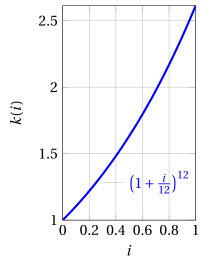
Hence, the rate \(i\) is associated with the capital \(k(i)\) at the end of the year: \(i \mapsto k(i)\)
-
In each of the previous examples, a real number (input) is associated uniquely with another real number (output). It is precisely the uniqueness of the relation that characterizes a function.
-
In general, the admissible inputs for a given relation (function) are subject to natural restrictions, related to the very nature of the relation.
Example 3: Admissible inputs
-
In the first example the “starting” real number has the meaning of time; imagining that the object is dropped at an initial time \(t = 0\), it is clear that we must restrict ourselves to times \(t \ge 0\).
-
In the second example, clearly we must have \(0 \le i \le 1\), where \(1\) corresponds to a rate of 100%.
2. Definition of function, domain, codomain and image
Definition 1: of domain
The set of admissible inputs for a given function is called the domain.
- The expressions independent variable (for a generic input) and dependent variable (for the output) are often used.
Example 4: Other types of relations
Let us consider the set of students of a given course.
-
If \(A\) is the set of students and \(B\) is the set of their names, the relation that associates each student with his or her name is unique (single-valued).
-
In this case neither \(A\) nor \(B\) is a set of numbers, but nevertheless a unique (single-valued) relation between these two sets is well defined.
On the other hand, the converse is not necessarily true: there could be two students with the same name.
Definition 2: of function
Given any two sets \(A\), \(B\), a function \(f\) with domain \(A\) and values in \(B\) (or also “with codomain \(B\)”) is any law that associates with each element of \(A\) one and only one element of \(B\).
-
The notation:
\[\begin{equation*} f: A \rightarrow B \end{equation*}\](which reads “\(f\) defined from \(A\) to \(B\)”), indicates the domain and the codomain of the function \(f\).
-
The notation
\[\begin{equation*} f: x \mapsto f(x) \end{equation*}\](which reads “\(f\) maps \(x\) to \(f(x)\)”) indicates how the function \(f\) acts on the elements.
-
The symbol \(f(x)\) denotes the output or the value that the function \(f\) associates with \(x\), and it must not be confused with the symbol \(f\), which denotes the function itself.
Example 5: Notation for functions
For the function
of the previous example we would have:
-
The notation
\[ y = f (x) \]is also used to indicate that the variable \(y\) is a function of \(x\). In this case \(y\) is the output or the value that \(f\) associates with the input \(x\).
For brevity, sometimes the value of \(f(x)\) is defined directly in terms of \(x\), as for example \(f(x)=x^2+10\).
-
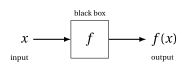
In general, we can think of a function as a black box that associates with each admissible input \(x\) (input) a unique output \(f(x)\) (output):
Definition 3: of image and image of the domain
The output corresponding to \(x\) is called the image of \(x\); the set of possible outputs is called the image of the domain \(A\) under \(f\) and is denoted by the symbol \(f(A)\) or \(\Ima f\).
-
Note that in the notation \(f: A \rightarrow B\), the codomain \(B\) can be larger than the image \(f(A)\), that is, in general we have
\[ f(A) \subseteq B. \] -
If \(f\) is real-valued, we usually write \(f : A \rightarrow \mathbb{R}\) without specifying the actual image of \(f\).
3. Surjections, injections and bijections
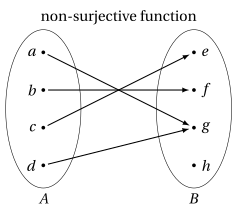
Definition 4: of surjection (surjective function)
A function \(f\) is a surjection if the image of its domain coincides with its codomain.
-
A surjection \(f: A \rightarrow B\) is sometimes also called a mapping onto \(B\) (from \(A\)).
-
Set representation:
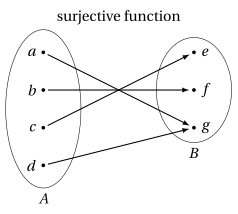
Example 6: surjective and non-surjective functions
-
The function \(f(n)=\lfloor \frac{n}{2} \rfloor\) is a surjective function from \(\mathbb{N}\) to \(\mathbb{N}\), since every element of the codomain \(\mathbb{N}\) is the image of some value of the domain.
-
The function \(f(n)= 2\:n\) is not a surjective function from \(\mathbb{N}\) to \(\mathbb{N}\), since no argument of \(f\) produces \(3\) as a value.
-
The function \(f(n)= 2\:n\) is, however, a surjective function from the natural numbers to the even numbers.
Remark 1
Given two sets \(A\) and \(B\), and a function \(f: A \rightarrow B\), if \(f\) is surjective then \(|A| \ge |B|\).
Proof
We proceed by induction on the number \(n\) of elements in the codomain of the function.
-
Base case
If there is only one element in the codomain (\(|B|=1\)), since the function is surjective, we have \(|A| \ge 1\) (every element of \(B\) is the image of at least one element of \(A\)). Hence \(1 \ge 1\), which is clearly true.
-
Inductive step
Assume then that all functions with codomain of size \(n\) satisfy \(|A_{n}| \ge |B_{n}|\).
Considering codomains of size \(n+1\) we have \(|B_{n+1}|=|B_{n}|+1\). Since the codomain has one more element and the function is surjective, we have \(|A_{n+1}| \ge |A_{n}| +1\). Substituting we obtain:
\[ \underbrace{|A_{n}|}_{\le~|A_{n+1}|-1} \ge \underbrace{|B_{n}|}_{=~|B_{n+1}|-1} {\rm~~hence~~} |A_{n+1}| \ge |B_{n+1}|. \]
□
Definition 5: of injection (injective function)
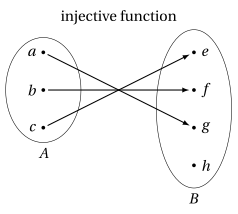
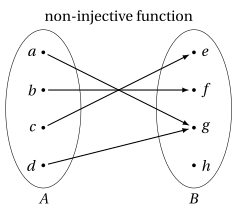
A function \(f\) is an injection if distinct arguments of \(f\) produce distinct values, that is, if \(a \neq b\) implies \(f(a) \neq f(b)\).
- set representation:
Example 7
-
The function \(f(n)= 2\:n\) is an injective function from \(\mathbb{N}\) to \(\mathbb{N}\), since each even number \(b\) is the image under \(f\) of exactly one element of the domain, namely \(n=\frac{b}{2}\)
-
The function \(f(n)=\lfloor \frac{n}{2} \rfloor\) is not an injective function, since the value 1 is obtained from two arguments: \(2\) and \(3\).
- An injection is also called a one-to-one function.
Remark 2
Given two sets \(A\) and \(B\), and a function \(f: A \rightarrow B\), if \(f\) is injective then \(|A| \le |B|\).
Proof
We proceed by induction on the number \(n\) of elements in the domain of the function.
-
Base case
If there is only one element in the domain (\(|A|=1\)), since each element of the domain is associated with one and only one element of the codomain, we have \(|B| \ge 1\). Hence \(1 \le 1\), which is clearly true.
-
Inductive step
Assume then that all functions with domain of size \(n\) satisfy \(|A_{n}| \le |B_{n}|\).
Considering domains of size \(n+1\) we have \(|A_{n+1}|=|A_{n}|+1\) and, since the function is injective, \(|B_{n+1}| \ge |B_{n}| +1\). Substituting we obtain
\[ \underbrace{|A_{n}|}_{=~|A_{n+1}|-1} \le \underbrace{|B_{n}|}_{\le~|B_{n+1}|-1} {\rm~~hence~~} |A_{n+1}| \le |B_{n+1}|. \]
□
Definition 6: of bijection (bijective function or one-to-one correspondence)
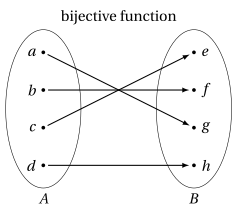
A function \(f\) is a bijection if: \((i)\) it is injective and \((ii)\) it is surjective.
- set representation:
Example 8
-
The function \(f(n)= (-1)^n\:\lceil \frac{n}{2} \rceil\) is a bijection from \(\mathbb{N}\) to \(\mathbb{Z}\). The values of the function are:
\[ f(0)=0,~~~f(1)=-1,~~~f(2)=1,~~~f(3)=-2,~~~f(4)=2 \dots \]The function is injective, since no element of \(\mathbb{Z}\) is the image of more than one element of \(\mathbb{N}\). The function is surjective, since all elements of \(\mathbb{Z}\) are images of some element of \(\mathbb{N}\).
-
A bijection is also called a one-to-one correspondence, since it pairs elements of the domain with elements of the codomain.
-
A bijection from a set \(A\) to itself is also called a permutation.