1.2 Derivatives of elementary trigonometric functions
Remark 4
Given the function \(f(x)=\sin x\), the derivative function is \(f'(x)=\cos x\).
Proof
Using the addition formulas we have:
\[\begin{align*}
\frac{f(x + h) - f(x)}{h} &= \frac{\sin(x + h) - \sin x }{h} = \frac{ \sin x \cos h +\sin h \cos x - \sin x }{h} = \\[2ex]
& = {\sin x \: \frac{\cos h -1}{h}} + {\frac{\sin h}{h}} \cos x
\end{align*}\]
\[
{\frac{\sin h}{h}} \cos x \thicksim \cos x {\rm ~~~for~~~} h \rr 0.
\]
Then
\[\begin{align*}
f'(x) &=\lim_{h \rr 0} \frac{f(x + h) - f(x)}{h} = \lim_{h \rr 0} {\sin x \: \frac{\cos h -1}{h}} + {\frac{\sin h}{h}} \cos x \\[2ex]
& = \lim_{h \rr 0} \sin x \: \left(-\frac{1}{2} \: h\right) + \cos x = \cos x
\end{align*}\]
□
Remark 5
Given the function \(f(x)=\cos x\), the derivative function is \(f'(x)=-\sin x\).
Proof
Using the addition formulas we have:
\[\begin{align*}
\frac{f(x + h) - f(x)}{h} &= \frac{\cos(x + h) - \cos x }{h} = \frac{ \cos x \cos h -\sin x \sin h - \cos x }{h} = \\[2ex]
& = {\cos x \: \frac{\cos h -1}{h}} - {\frac{\sin h}{h}} \sin x
\end{align*}\]
and, using the arguments of the previous proof, we have:
\[\begin{align*}
f'(x) &=\lim_{h \rr 0} \frac{f(x + h) - f(x)}{h} = \lim_{h \rr 0} {\cos x \: \frac{\cos h -1}{h}} - {\frac{\sin h}{h}} \sin x \\[2ex]
& = \lim_{h \rr 0} \cos x \: \left(-\frac{1}{2} \: h\right) - \sin x = -\sin x
\end{align*}\]
□
1.3 Derivatives of the exponential and logarithmic functions with base \(e\)
Remark 6
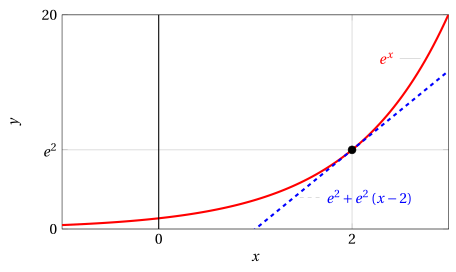
Given the function \(f(x)=e^x\), the derivative function is \(f'(x)=e^x\).