Summations and geometric progressions
Part 1 · Numbers and logic · Chapter 7 · lecture notes by Fabio Furini · Chapter PDF
1. Summations
Definition 1: summation
Let \(a_1 , a_2, \dots, a_n\) be \(n\) real numbers. Their sum
can be written in compact form with the summation symbol:
which is read: “sum for \(k\) from \(1\) to \(n\) of \(a_k\)”. The symbol \(k\) is called the summation index.
- The summation symbol is therefore just a shorthand, which is nevertheless very useful when the terms \(a_k\) are defined explicitly as a function of the index \(k\).
Example 1: summations
- The summation index is a dummy index. This means that if we replace \(k\) with \(i\), \(j\) or any other index (in all its occurrences), the value of the summation does not change.
Example 2: dummy index
We have:
since both symbols denote the sum of the squares of the first \(n\) natural numbers (without zero).
On the other hand, we have:
since the two symbols denote the sum of, respectively, the first \(n\) or the first \(m\) squares (if \(n \neq m\) the result will be different).
1.1 Main properties of summations
Remark 1
Given \(c \in \R\), we have:
Proof
First property \(\eqref{P1}\). By the distributive property we have:
Second property \(\eqref{P2}\):
□
Remark 2
Given two summations \(\sum_{k=1}^n a_k\) and \(\sum_{k=1}^n b_k\), we have:
Proof
We have:
□
Remark 3
Given two natural numbers \(n,m \in \N\), we have:
Proof
The three properties are simply different ways of writing and/or ordering the terms of the summations. □
1.2 Some important summations
Remark 4: sum of the first \(n\) natural numbers (without zero)
For every natural number \(n \ge 1\), we have:
Proof
□
Remark 5: sum of the first \(n\) odd numbers
For every natural number \(n \ge 1\), we have:
Proof
Using the properties of summations we have:
□
Remark 6: sum of the first \(n\) even numbers (without zero)
For every natural number \(n \ge 1\), we have:
Proof
□
2. Geometric progressions
Definition 2: geometric progression
A sequence of real numbers is a geometric progression if the ratio between each term (starting from the second one) and the previous one is constant. This constant is called the common ratio of the progression.
Given the first term \(a \in \R\) and the common ratio \(q \in \R\), the associated geometric progression is:
Each term (starting from the second one) is obtained from the previous one by multiplying it by \(q\). The \(k\)-th term (\(k \in \N\), \(k \ge 1\)) can be written as \(a\: q^{k-1}\) and we have:
Example 3: geometric progressions
-
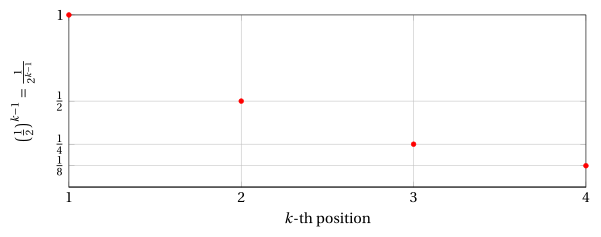
With \(a=1\) and \(q=\frac{1}{2}\), the first 4 terms are:
\[ 1,~~\frac{1}{2},~~\frac{1}{4},~~\frac{1}{8} \]
-
With \(a=1\) and \(q=2\), the first 4 terms are:
\[ 1,~~2,~~4,~~8 \]
2.1 Sums of the terms of geometric progressions
Remark 7: sum of the first \(n\) terms of the geometric progression (\(a=1\))
Given \(q \in\ \R_+\), for every natural number \(n \ge 1\) we have:
Proof
If \(q\neq 1\), we prove the equation in the following equivalent form:
Applying the properties of summations, we get:
If \(q = 1\), we have instead:
□
-
Given \(q \in\ \R_+, n \in \N, n \ge 1\) and \(a \in \R\), formula \(\eqref{GEOM}\) extends as follows:
\[\begin{equation} \sum_{k=1}^{n} a \; q^{k-1} = \begin{cases} a \; \left(\frac{q^{n}-1}{q-1} \right)& {\rm ~~~if~~~~} q \neq 1\\[2ex] a \; n & {\rm ~~~otherwise} \end{cases} \qquad {\rm ~~since~~~~}\sum_{k=1}^{n} a \; q^{k-1} = a \; \sum_{k=1}^{n} q^{k-1} \end{equation}\]clearly:
\[\begin{equation*} \frac{q^n-1}{q-1} = \frac{1-q^n}{1-q} {\rm ~~and~hence~we~also~have~~~~} \sum_{k=1}^{n} a \; q^{k-1} = \begin{cases} a \; \left(\frac{1-q^{n}}{1-q} \right)& {\rm ~~~if~~~~} q \neq 1\\[2ex] a \; n & {\rm ~~~otherwise} \end{cases} \end{equation*}\]
Example 4: sum of the first \(n\) terms of geometric progressions
-
With \(a=1\) and \(q=\frac{1}{2}\), the first 4 terms are:
\[ 1,~~\frac{1}{2},~~\frac{1}{4},~~\frac{1}{8} \qquad {\rm ~~and~~} \qquad 1 + \frac{1}{2} + \frac{1}{4} + \frac{1}{8} = \frac{8+4+2+1}{8} = \frac{15}{8} \]the sum of the first \(n=4\) terms is given by the formula:
\[ \sum_{k=1}^4 \left(\frac{1}{2}\right)^{k-1}= \sum_{k=1}^4\frac{1}{2^{k-1}} = \frac{1-\frac{1}{2^4}}{1-\frac{1}{2}} = \frac{1-\frac{1}{16}}{\frac{1}{2}}= \frac{15}{16} \; 2 = \frac{15}{8} \] -
With \(a=1\) and \(q=2\), the first 4 terms are:
\[ 1,~~2,~~4,~~8 \qquad {\rm ~~and~~} \qquad 1 + 2+ 4 +8= 15 \]the sum of the first \(n=4\) terms is given by the formula:
\[ \sum_{k=1}^4 2^{k-1} = \frac{2^4-1}{2-1} = 16-1 =15 \]