Monotone functions on an interval and invertibility
Part 3 · Limits of functions and continuity · Chapter 10 · lecture notes by Fabio Furini · Chapter PDF
1. Monotone functions on an interval
- We now deal with monotone functions on an interval (and not necessarily continuous), and the next theorem (based on the completeness axiom of \(\R\)) can be seen as an extension to functions of the monotonicity theorem for sequences.
Theorem 1: Monotonicity theorem for functions
Let \(f : (a, b) \rr \R\) be a monotone function. Then for every \(c \in (a, b)\) the right and left limits as \(x \rr c\) exist and are finite; at the two endpoints \(a\), \(b\) the right limit (at \(a\)) and the left limit (at \(b\)) exist, possibly infinite.
Proof
Suppose \(f\) is increasing in \((a, b)\) and let \(c \in (a , b)\), that is, a point inside the interval.
We prove that the following limit exists and is finite:
We set
Note that \(\ell\) exists and is finite by the supremum property, since \(f(c)\) is an upper bound of the set \(\{ f(x): x \in (a,c) \}\).
Hence we need to prove that
So let \(\{x_n\}\) be any sequence in \((a, c)\) such that \(x_n \rr c\), and let us prove that \(f(x_n) \rr \ell\), i.e., that for every \(\varepsilon > 0\) we eventually have
The second inequality is obvious, since \(f (x_n) \le \ell\) by definition of \(\ell\), because \(x_n \in (a, c)\). □
Proof
To prove the first one, we observe that, since \(\ell - \varepsilon\) is less than \(\ell\), i.e., less than the least upper bound of \(\{ f(x): x \in (a,c) \}\), it is not an upper bound of this set; therefore there exists a point
Since \(f\) is increasing, it follows that
On the other hand, by hypothesis
therefore \(x_n \in (\tilde{x}, c)\) eventually. Hence
which is what we needed to prove.
Similarly, one can prove that the following limit exists and is finite:
As for the limits at the two endpoints of the interval, we prove that the following limit exists:
We set (as before)
however, in this case \(\ell\) could also be \(\ip\) (we cannot claim that \(f(b)\) is an upper bound of the set, because the function is not defined at \(b\)). We therefore proceed by cases.
In the case \(\ell < \infty\) the previous proof can be repeated. □
Proof
If instead \(\ell = \infty\), the argument changes. From the hypothesis
it follows that for every \(M > 0\) there exists \(\tilde{x} \in (a, b)\) such that \(f(\tilde{x}) > M\).
By the monotonicity of \(f\), then
hence, taking any sequence \(x_n \rr b\), we have \(x_n \in (\tilde{x},b)\) eventually, and therefore
therefore
In the same way one proves that the following limit exists:
□
A consequence of the monotonicity theorem is that if a function is monotone on an interval \((a, b)\), its possible points of discontinuity in \((a, b)\) are necessarily jump discontinuities, except for the endpoints \(a\), \(b\), where there may also be a vertical asymptote.
2. Continuity and invertibility
-
We have seen the theorem stating that if a generic function with domain \(D\) is strictly monotone, then it is invertible.
-
We also know that the converse is not true in general: there exist functions that are invertible on an interval but not monotone.
Example 1: Invertible but not monotone function
Consider for example
its graph is:
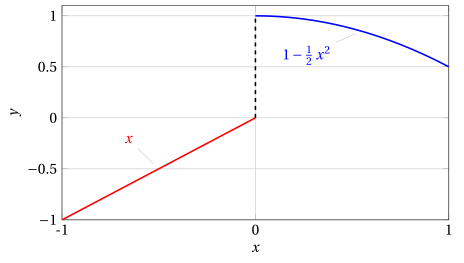
This function satisfies the invertibility condition, which requires the graph of \(f\) to be intersected at most at one point by every line parallel to the \(x\)-axis, but it is not monotone.
- If we add the hypothesis of continuity and require the domain to be an interval, being strictly monotone becomes a necessary and sufficient condition for invertibility, as stated by the following theorem.
Theorem 2: Invertibility of monotone and continuous functions
Let \(f : I \rr \R\) be a function defined on an interval \(I\).
If the function \(f\) is continuous, then it is invertible on the interval \(I\) if and only if it is strictly monotone.
In this case its inverse function is also strictly monotone and continuous.
Proof
We already know that if \(f\) is strictly monotone, it is invertible (regardless of the hypotheses that \(f\) is continuous and that it is defined on an interval).
We show that the converse holds, i.e., that if \(f\) is continuous and invertible, then it is strictly monotone.
Suppose by contradiction that the function is not strictly monotone; then there exist three points
such that
or such that
Suppose the first of the two alternatives holds (the other case is handled similarly). Let us compare the values \(f(x_1)\) and \(f(x_3)\); they cannot be equal because \(f\) is invertible by hypothesis, hence
Again, suppose the first of the two alternatives holds (the other case is handled similarly). So we know that:
Since \(f\) is continuous, by the intermediate value theorem there exists
Since \(x_0 \neq x_3\) (because \(x_1 < x_2 < x_3\)), it follows that \(f\) cannot be invertible, a contradiction. This proves the first part of the theorem.
Now let \(f\) be a continuous, strictly monotone and hence invertible function on \(I\), and let \(g\) be its inverse function, which is also strictly monotone and invertible. We prove that \(g\) is continuous.
-
By what we observed after the monotonicity theorem, the strictly monotone function \(g\) is either continuous or has jump discontinuity points.
-
In the latter case the image of \(g\) is not an interval (but the union of at least two disjoint intervals), which is a contradiction because this image is \(I\). Hence \(g\) is continuous.
□
-
Note that in the proof of the previous theorem we used both the intermediate value theorem and the monotonicity theorem for functions. Moreover, we implicitly used the completeness axiom of \(\R\).
-
The theorem just proved means, in particular, that:
a continuous and invertible function on an interval has a continuous inverse function.
-
This fact completes the proof of the continuity theorem for elementary functions:
-
the continuity of the function \(a^x\) implies the continuity of the function \(\log_a x.\)
-
the continuity of the functions \(\sin x\), \(\cos x\) and \(\tan x\) implies the continuity of the functions \(\arcsin x\), \(\arccos x\) and \(\arctan x.\)
-