The Fibonacci sequence
Part 1 · Numbers and logic · Chapter 10 · lecture notes by Fabio Furini · Chapter PDF
1. The Fibonacci sequence
Definition 1: Fibonacci sequence
-
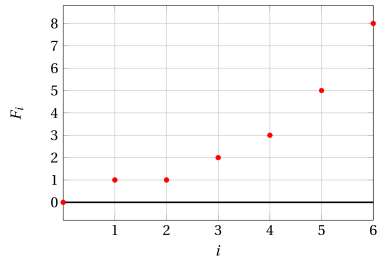
Therefore, each Fibonacci number is the sum of the two previous ones, which gives the sequence
\[ 0, 1, 1, 2, 3, 5, 8, 13, 21, 34, 55, \dots \] -
The Fibonacci sequence is related to the golden ratio \(\phi\) and to the conjugate of the golden ratio \(\hat \phi\),
Definition 2: golden ratio
The golden ratio \(\phi\) and the conjugate of the golden ratio \(\hat \phi\) are the two roots of the equation:
and are given by the formulas:
The following figure shows the graph of the function \(f(x)=x^2-x-1\) on the interval \([-3,3]\); the red dots correspond to the roots of the equation \(x^2 = x +1\).
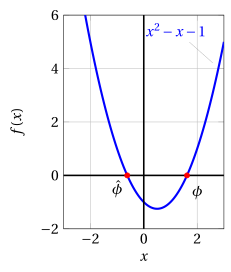
The golden ratio \(\phi\) and the conjugate of the golden ratio \(\hat{\phi}\) clearly satisfy the equation \(x^2 = x +1\) since:
Remark 1
Proof
By induction on \(i\).
-
Base case of the induction
We prove that the formula holds for \(i = 0\) and \(i = 1\):
\[ F_0 = \frac{\phi^0 - \hat{\phi}^0 }{\sqrt{5}} = \frac{1 - 1 }{\sqrt{5}} =0, \qquad F_1 = \frac{\phi^1 - \hat{\phi}^1 }{\sqrt{5}} = \frac{\sqrt{5}}{\sqrt{5}} = 1. \] -
Inductive step
Suppose it is true for \(i = k\) and \(i = k - 1\) with \(k \ge 1\), and let us prove it for \(i = k + 1\). By the inductive hypothesis, we have: \(F_{k+1} = F_{k} + F_{k-1}\), hence we can write
\[\begin{align*} F_{k+1} & = F_{k} + F_{k-1} \\[2ex] & = \frac{\phi^k - \hat{\phi}^k }{\sqrt{5}} + \frac{\phi^{k-1} - \hat{\phi}^{k-1} }{\sqrt{5}} = \frac{\big(\phi^k - \hat{\phi}^k\big) + \big(\phi^{k-1} - \hat{\phi}^{k-1}\big)}{\sqrt{5}}\\[2ex] & = \frac{\big(\phi^k + \phi^{k-1}\big) - \big(\hat{\phi}^k + \hat{\phi}^{k-1}\big)}{\sqrt{5}} = \frac{\phi^{k-1} \big(\phi + 1\big) - \hat{\phi}^{k-1} \big(\hat{\phi} + 1\big)}{\sqrt{5}}\\[2ex] & = \frac{\phi^{k-1} \big(\phi^2\big) - \hat{\phi}^{k-1} \big(\hat{\phi}^2\big)}{\sqrt{5}} = \frac{\phi^{k+1} - \hat{\phi}^{k+1}}{\sqrt{5}} \end{align*}\]which is exactly the desired statement, for \(i= k + 1\).
□
Remark 2
Proof
Since \(|\hat{\phi}| < 1\), we have
Since \(F_i \in \N\) and \(F_i = \frac{\phi^i }{\sqrt{5}} - \frac{ \hat{\phi}^i }{\sqrt{5}}\), the \(i\)-th Fibonacci number \(F_i\) is equal to \(\frac{{\phi}^i}{\sqrt{5}}\) rounded to the nearest integer:
□
-
The values of
\[ \frac{\hat{\phi}^i}{\sqrt{5}} {\rm ~~with~~} i=0,1,\dots,10 {\rm ~~are:~~} \]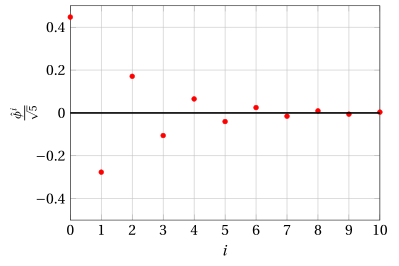
-
The values of
\[ \frac{{\phi}^i}{\sqrt{5}} - \left\lfloor \frac{{\phi}^i}{\sqrt{5}} \right\rfloor {\rm ~~with~~} i=0,1,\dots,10 {\rm ~~are:~~} \]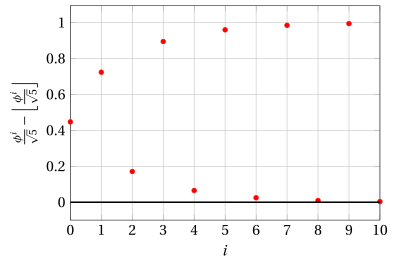
-
Since \(F_i \in \N\), we moreover have:
\[ \left( \frac{{\phi}^i}{\sqrt{5}} - \left\lfloor \frac{{\phi}^i}{\sqrt{5}} \right\rfloor \right) - \frac{\hat{\phi}^i}{\sqrt{5}} \in \{0,1\}, \qquad \qquad i=0,1,2,\dots \] -
The values of \(F_i\), with \(i=0,1,\dots,10\), are: