Integration techniques and applications
Part 7 · Integrals · Chapter 3 · Lecture notes, volume 7 (PDF) · Exercises, volume 7 (PDF) · Exercises: Antiderivatives · Exercises: Integrals · Exercises: Definite integrals, areas and mean value · Slides (PDF)
Prerequisites
-
From this module, «Fundamental theorem of calculus»: antiderivatives, fundamental formula of integral calculus, basic antiderivatives.
-
From this module, «Rules for computing derivatives»: derivative of a product and of a composite function.
-
From this module, «Limits of polynomials and rational functions»: polynomials, roots and rational functions.
-
From this module, «The Riemann integral»: area under a graph and integral mean.
Objectives
At the end of this chapter you will be able to:
-
prove and use the formulas of integration by substitution and by parts, for indefinite and definite integrals;
-
integrate a rational function with polynomial division and partial fraction decomposition;
-
compute the area of a region between two graphs;
-
compute the mean value of a function on an interval and interpret it.
1. Integration by substitution
Theorem 1: integration by substitution
Let \(f\) be continuous on the interval \(I\), let \(F\) be an antiderivative of it and let \(g: J \rr I\) be differentiable with continuous derivative on the interval \(J\). Then
Proof
-
\(i)\) By the chain rule \(\big(F(g(x))\big)' = F'\big(g(x)\big)\,g'(x) = f\big(g(x)\big)\,g'(x)\): the function \(F \circ g\) is an antiderivative of the integrand.
-
\(ii)\) The integrand on the left is continuous. By the fundamental formula of integral calculus and by \(i)\) both sides equal \(F\big(g(b)\big) - F\big(g(a)\big)\).
□
- In practice we set \(t = g(x)\) and formally replace \(dt = g'(x)\,dx\). In definite integrals the limits change too: \(x = a\) becomes \(t = g(a)\), \(x = b\) becomes \(t = g(b)\).
Example 1: substitution
-
\(\displaystyle \int x\,e^{x^2}\,dx\): with \(t = x^2\), \(dt = 2x\,dx\), we get \(\displaystyle \frac12 \int e^{t}\,dt = \frac12\,e^{x^2} + c\).
-
\(\displaystyle \int \cos x\,\sin^3 x\,dx\): with \(t = \sin x\), \(dt = \cos x\,dx\), we get \(\displaystyle \int t^3\,dt = \frac{\sin^4 x}{4} + c\).
-
\(\displaystyle \int_0^1 x\sqrt{1+x^2}\,dx\): with \(t = 1 + x^2\), \(dt = 2x\,dx\), the limits become \(t = 1\) and \(t = 2\):
\[ \int_0^1 x\sqrt{1+x^2}\,dx = \frac12\int_1^2 \sqrt{t}\,dt = \frac12 \left[\frac{2}{3}\,t^{3/2}\right]_1^2 = \frac{2\sqrt2 - 1}{3} \]
Remark 1: change of variable
Formula \(ii)\) is also used from right to left: to compute \(\int_{\alpha}^{\beta} f(x)\,dx\) we set \(x = \varphi(t)\), with \(\varphi\) differentiable with continuous derivative and invertible, and
For an indefinite integral, at the end we go back to the variable \(x\) with \(t = \varphi^{-1}(x)\).
Example 2: change of variable
-
\(\displaystyle \int \frac{\sqrt{x}}{1+x}\,dx\), for \(x > 0\): with \(x = t^2\), \(t = \sqrt{x} > 0\), \(dx = 2t\,dt\),
\[ \int \frac{2t^2}{1+t^2}\,dt = 2\int \left(1 - \frac{1}{1+t^2}\right) dt = 2t - 2\arctan t + c = 2\sqrt{x} - 2\arctan\sqrt{x} + c \] -
\(\displaystyle \int_0^1 \sqrt{1-x^2}\,dx\): with \(x = \sin t\), \(t \in \left[0, \frac{\pi}{2}\right]\), we have \(dx = \cos t\,dt\) and \(\sqrt{1 - \sin^2 t} = \cos t\) (because \(\cos t \ge 0\)). Using \(\cos^2 t = \frac{1 + \cos 2t}{2}\),
\[ \int_0^1 \sqrt{1-x^2}\,dx = \int_0^{\pi/2} \cos^2 t\,dt = \left[\frac{t}{2} + \frac{\sin 2t}{4}\right]_0^{\pi/2} = \frac{\pi}{4} \]This is the area of a quarter of the circle of radius \(1\).
2. Integration by parts
Theorem 2: integration by parts
Let \(f\) and \(g\) be differentiable with continuous derivative on the interval \(I\). Then
Proof
By the product rule \((f\,g)' = f'\,g + f\,g'\): the function \(f\,g\) is an antiderivative of \(f'\,g + f\,g'\). By the linearity of the indefinite integral
which is \(i)\). For \(ii)\) we integrate \((f\,g)' = f'\,g + f\,g'\) between \(a\) and \(b\) with the fundamental formula of integral calculus and linearity. □
- \(f\) is called the finite factor and \(g'\) the differential factor. It is convenient to choose as \(f\) the factor that becomes simpler when differentiated (a polynomial, a logarithm, an arctangent) and as \(g'\) one whose antiderivative is known.
Example 3: by parts
-
\(\displaystyle \int x\,e^{x}\,dx\): with \(f = x\), \(g' = e^x\), we get \(\displaystyle x\,e^{x} - \int e^{x}\,dx = (x - 1)\,e^{x} + c\).
-
\(\displaystyle \int \log x\,dx\), for \(x > 0\): with \(f = \log x\), \(g' = 1\), we get \(\displaystyle x\log x - \int x \cdot \frac{1}{x}\,dx = x\log x - x + c\).
-
\(\displaystyle \int \arctan x\,dx\): with \(f = \arctan x\), \(g' = 1\), we get \(\displaystyle x\arctan x - \int \frac{x}{1+x^2}\,dx = x\arctan x - \frac12\log(1+x^2) + c\).
-
\(\displaystyle \int_0^{\pi} x\sin x\,dx\): with \(f = x\), \(g' = \sin x\),
\[ \int_0^{\pi} x\sin x\,dx = \big[-x\cos x\big]_0^{\pi} + \int_0^{\pi} \cos x\,dx = \pi + \big[\sin x\big]_0^{\pi} = \pi \]
Example 4: an integral that comes back
Let \(I = \int e^{x}\sin x\,dx\). Integrating by parts twice, with \(g' = e^x\) both times,
Solving the equation for \(I\) (up to the constant):
3. Integration of rational functions
-
We want to compute \(\int \frac{P(x)}{Q(x)}\,dx\) with \(P\) and \(Q\) polynomials. If \(\deg P \ge \deg Q\), we divide: \(P = A\,Q + R\) with \(\deg R < \deg Q\), and
\[ \frac{P(x)}{Q(x)} = A(x) + \frac{R(x)}{Q(x)} \]The polynomial \(A\) is integrated at once; what remains is a proper rational function, with the degree of the numerator smaller than that of the denominator.
3.1 Denominator of first and second degree
-
First degree: \(\displaystyle \int \frac{1}{x - x_1}\,dx = \log|x - x_1| + c\).
-
Second degree, \(Q(x) = x^2 + px + q\) with discriminant \(\Delta = p^2 - 4q\):
-
\(\Delta > 0\): \(Q(x) = (x - x_1)(x - x_2)\) and we look for \(A\), \(B\) with \(\displaystyle \frac{R(x)}{Q(x)} = \frac{A}{x - x_1} + \frac{B}{x - x_2}\);
-
\(\Delta = 0\): \(Q(x) = (x - x_1)^2\) and \(\displaystyle \frac{R(x)}{Q(x)} = \frac{A}{x - x_1} + \frac{B}{(x - x_1)^2}\), with \(\displaystyle \int \frac{dx}{(x - x_1)^2} = -\frac{1}{x - x_1} + c\);
-
\(\Delta < 0\): we complete the square, \(Q(x) = \left(x + \frac{p}{2}\right)^2 + k^2\) with \(k^2 = -\frac{\Delta}{4}\), and write the numerator as a multiple of \(Q'(x) = 2x + p\) plus a constant.
-
-
In the case \(\Delta < 0\) we need the two antiderivatives
\[ \int \frac{2x + p}{x^2 + px + q}\,dx = \log(x^2 + px + q) + c, ~~~~~ \int \frac{dx}{(x + p/2)^2 + k^2} = \frac{1}{k}\arctan\frac{x + p/2}{k} + c \]
Remark 2: partial fraction decomposition
One can prove that every real polynomial \(Q\) is the product of a constant, of first-degree factors \((x - a)\) and of second-degree factors \(x^2 + px + q\) with \(\Delta < 0\), possibly repeated. A proper rational function \(\frac{R}{Q}\) is the sum of partial fractions: for every factor \((x - a)^m\) the terms \(\frac{A_1}{x-a} + \dots + \frac{A_m}{(x-a)^m}\), for every (non-repeated) factor \(x^2 + px + q\) one term \(\frac{Mx + N}{x^2 + px + q}\). The constants are found by equating the numerators.
Example 5: rational functions
-
Division. \(x^3 + x + 1 = x\,(x^2 + 1) + 1\), hence \(\displaystyle \int \frac{x^3 + x + 1}{x^2 + 1}\,dx = \int \left(x + \frac{1}{x^2+1}\right) dx = \frac{x^2}{2} + \arctan x + c\).
-
\(\Delta > 0\). \(\displaystyle \frac{1}{x^2 - 1} = \frac{A}{x - 1} + \frac{B}{x + 1}\) gives \(1 = A(x+1) + B(x-1)\): with \(x = 1\) and \(x = -1\) we get \(A = \frac12\), \(B = -\frac12\), and
\[ \int \frac{dx}{x^2 - 1} = \frac12 \log\left|\frac{x-1}{x+1}\right| + c \] -
\(\Delta = 0\). \(2x + 3 = 2(x+1) + 1\), hence \(\displaystyle \int \frac{2x+3}{(x+1)^2}\,dx = \int \left(\frac{2}{x+1} + \frac{1}{(x+1)^2}\right) dx = 2\log|x+1| - \frac{1}{x+1} + c\).
-
\(\Delta < 0\). \(x^2 + 2x + 5 = (x+1)^2 + 4\) and \(x + 3 = \frac12(2x + 2) + 2\), hence
\[ \int \frac{x+3}{x^2+2x+5}\,dx = \frac12\log(x^2 + 2x + 5) + \arctan\frac{x+1}{2} + c \]
Example 6: a repeated factor and a definite integral
-
\(\displaystyle \frac{1}{x(x+1)^2} = \frac{A}{x} + \frac{B}{x+1} + \frac{C}{(x+1)^2}\) gives \(1 = A(x+1)^2 + Bx(x+1) + Cx\). With \(x = 0\): \(A = 1\); with \(x = -1\): \(C = -1\); comparing the coefficients of \(x^2\): \(A + B = 0\), that is, \(B = -1\). Hence
\[ \int \frac{dx}{x(x+1)^2} = \log|x| - \log|x+1| + \frac{1}{x+1} + c \] -
With the antiderivative of the previous example,
\[ \int_2^3 \frac{dx}{x^2-1} = \frac12\left[\log\frac{x-1}{x+1}\right]_2^3 = \frac12\left(\log\frac12 - \log\frac13\right) = \frac12\log\frac32 \]
4. Areas of plane regions
Proposition 1: area between two graphs
Let \(f\) and \(g\) be continuous on \([a,b]\) with \(f(x) \le g(x)\) for every \(x \in [a,b]\). The area of the region
is
Proof
By the Weierstrass theorem \(f\) is bounded below: there is a constant \(c\) with \(f + c \ge 0\) on \([a,b]\). Shifting up by \(c\) does not change the area, and the shifted region is the region under the graph of \(g + c\) minus the region under the graph of \(f + c\). By the geometric interpretation of the integral and by linearity
□
-
The area of the region between the graph of \(f\) and the \(x\)-axis is \(\int_a^b |f(x)|\,dx\): we split \([a,b]\) into the intervals where \(f\) has constant sign.
-
If the two graphs cross, the area between them is \(\int_a^b |g(x) - f(x)|\,dx\): first we look for the intersection points.
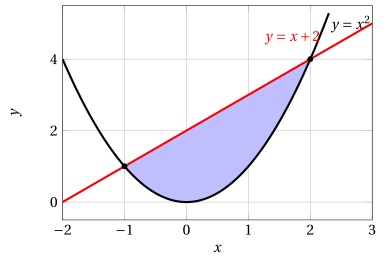
Example 7: area between a parabola and a line
Let us compute the area of the region between \(y = x^2\) and \(y = x + 2\) (blue in the figure). The intersections come from \(x^2 = x + 2\): \(x = -1\) and \(x = 2\). On \([-1, 2]\) the line lies above the parabola, hence
Example 8: graphs that cross
Let us compute the area between \(y = \sin x\) and \(y = \cos x\) for \(x \in \left[0, \frac{\pi}{2}\right]\). The graphs cross at \(x = \frac{\pi}{4}\): first the cosine lies above, then the sine. Hence
Example 9: area under the logarithm
On \([1, e]\) we have \(\log x \ge 0\). With the antiderivative found by parts,
5. Mean value of a function
-
The mean value of \(f\) on \([a,b]\) is the integral mean \(\frac{1}{b-a}\int_a^b f(x)\,dx\): now we can compute it with an antiderivative.
-
It is the natural extension of the arithmetic mean \(\frac1n \sum_{k=1}^n f(x_k)\): with the uniform partition, \(\frac1n\sum_{k=1}^n f(x_k) = \frac{1}{b-a}\sum_{k=1}^n f(x_k)\,\frac{b-a}{n}\) is a Riemann sum divided by \(b - a\).
Example 10: mean values
-
The mean value of \(\sin x\) on \([0, \pi]\) is \(\displaystyle \frac{1}{\pi}\int_0^{\pi} \sin x\,dx = \frac{2}{\pi} \approx 0.64\).
-
The mean value of \(x^2\) on \([0, 3]\) is \(\displaystyle \frac13\left[\frac{x^3}{3}\right]_0^3 = 3\); as the integral mean value theorem predicts, it is taken at \(c = \sqrt3 \in [0,3]\).
-
If a point moves with velocity \(v(t) = 3t^2\) (metres per second) for \(t \in [0, 2]\), the distance covered is \(\int_0^2 3t^2\,dt = 8\) metres and the mean velocity is \(\frac{8}{2} = 4\) metres per second.
6. In summary
In summary
-
Substitution: \(\int_a^b f(g(x))\,g'(x)\,dx = \int_{g(a)}^{g(b)} f(t)\,dt\); with \(t = g(x)\) the integrand, the differential and the limits change. Read backwards it is the change of variable \(x = \varphi(t)\).
-
By parts: \(\int f\,g' = f\,g - \int f'\,g\); we differentiate the factor that becomes simpler. Sometimes the integral comes back and is found from an equation.
-
Rational functions: division if needed, then partial fractions according to the factors of the denominator; second-degree factors with \(\Delta < 0\) give a logarithm and an arctangent.
-
The area between two graphs is \(\int_a^b |g - f|\), after finding the intersections.
-
The mean value \(\frac{1}{b-a}\int_a^b f\) extends the arithmetic mean: it is the mean velocity if \(f\) is a velocity.
Exercises on this chapter: Antiderivatives · Integrals · Definite integrals, areas and mean value