Summations, geometric and arithmetic progressions
Part 2 · Numbers · Chapter 5 · Lecture notes, volume 2 (PDF) · Exercises, volume 2 (PDF) · Exercises: Summations · Slides (PDF)
1. Summations
Definition 1: summation
Let \(a_1 , a_2, \dots, a_n\) be \(n\) real numbers. Their sum
can be written in compact form with the summation symbol:
which is read: “sum for \(k\) from \(1\) to \(n\) of \(a_k\)”. The symbol \(k\) is called the summation index.
- The summation symbol is therefore just a shorthand, which is nevertheless very useful when the terms \(a_k\) are defined explicitly as a function of the index \(k\).
Example 1: summations
- The summation index is a dummy index. This means that if we replace \(k\) with \(i\), \(j\) or any other index (in all its occurrences), the value of the summation does not change.
Example 2: dummy index
We have:
since both symbols denote the sum of the squares of the first \(n\) natural numbers (without zero).
On the other hand, we have:
since the two symbols denote the sum of, respectively, the first \(n\) or the first \(m\) squares (if \(n \neq m\) the result will be different).
1.1 Main properties of summations
Remark 1: product by a constant
Given a summation \(\sum_{k=1}^n a_k\) and a real number \(c \in \R\), we have:
Proof
By the distributive property we have:
□
Remark 2: summation with a constant term
For every natural number \(n \ge 1\) and every real number \(c \in \R\), we have:
Proof
We have:
□
Remark 3: union of summations
Given two summations \(\sum_{k=1}^n a_k\) and \(\sum_{k=1}^n b_k\), we have:
Proof
We have:
□
- The three properties that follow (decomposition, index translation and index reflection) are simply different ways of writing and/or ordering the terms of the summations.
Remark 4: decomposition
Given two natural numbers \(n \ge 1\) and \(m \ge 1\), we have:
Proof
The terms of the summation \(\sum_{k=1}^{n+m} a_k\) can be grouped into the first \(n\) and the last \(m\) ones:
□
Remark 5: index translation
Given a summation \(\sum_{k=1}^{n} a_k\) and a natural number \(m \ge 1\), we have:
Proof
In the summation \(\sum_{k=1+m}^{n+m} a_{k-m}\) the index \(k\) ranges from \(1+m\) to \(n+m\), and therefore the index \(k-m\) ranges from \(1\) to \(n\):
In the same way, in the summation \(\sum_{k=1-m}^{n-m} a_{k+m}\) the index \(k\) ranges from \(1-m\) to \(n-m\), and therefore the index \(k+m\) ranges from \(1\) to \(n\):
□
Remark 6: index reflection
Given a summation \(\sum_{k=1}^{n} a_k\), we have:
Proof
In the summation \(\sum_{k=1}^{n} a_{n-k+1}\) the index \(k\) ranges from \(1\) to \(n\), and therefore the index \(n-k+1\) ranges from \(n\) to \(1\), that is, the terms are the same ones listed in reverse order:
In the same way, in the summation \(\sum_{k=0}^{n-1} a_{n-k}\) the index \(k\) ranges from \(0\) to \(n-1\), and therefore the index \(n-k\) ranges from \(n\) to \(1\):
□
1.2 Some important summations
Remark 7: sum of the first \(n\) natural numbers (without zero)
For every natural number \(n \ge 1\), we have:
Proof
Using the index reflection \(\eqref{P6}\) we have:
□
Remark 8: sum of the first \(n\) odd numbers
For every natural number \(n \ge 1\), we have:
Proof
Using the properties of summations we have:
□
Remark 9: sum of the first \(n\) even numbers (without zero)
For every natural number \(n \ge 1\), we have:
Proof
□
- The three important summations we have just seen can also be proved by induction, in the chapter “Principle of induction” of Part 1.
2. Geometric progressions
Definition 2: geometric progression
A sequence of real numbers is a geometric progression if the ratio between each term (starting from the second one) and the previous one is constant. This constant is called the common ratio of the progression.
Given the first term \(a \in \R\) and the common ratio \(q \in \R\), the associated geometric progression is:
Each term (starting from the second one) is obtained from the previous one by multiplying it by \(q\). The \(k\)-th term (\(k \in \N\), \(k \ge 1\)) can be written as \(a\: q^{k-1}\) and we have:
Remark 10: \(k\)-th term of a geometric progression
Given the first term \(a \in \R\) and the common ratio \(q \in \R\), let \(t_k\) denote the term in position \(k\) of the geometric progression. The recursive relation that defines the progression is:
and the closed formula of the \(k\)-th term is:
Proof
The closed formula \(\eqref{GEOMTERM}\) is obtained by applying repeatedly the recursive relation \(\eqref{GEOMREC}\):
□
Example 3: geometric progressions
-
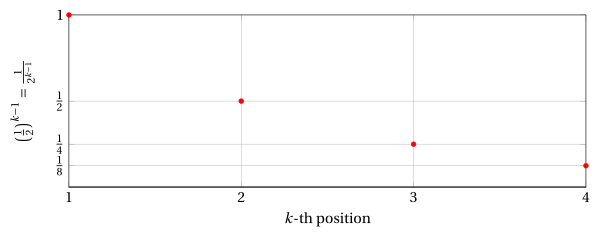
With \(a=1\) and \(q=\frac{1}{2}\), the first 4 terms are:
\[ 1,~~\frac{1}{2},~~\frac{1}{4},~~\frac{1}{8} \]
-
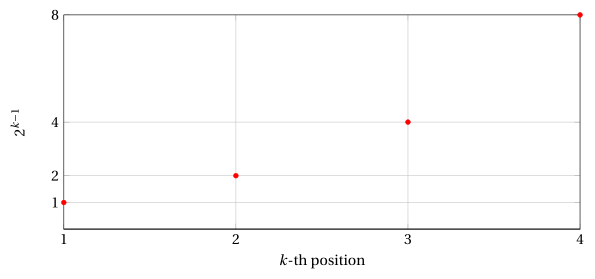
With \(a=1\) and \(q=2\), the first 4 terms are:
\[ 1,~~2,~~4,~~8 \]
Example 4: geometric progression with a negative common ratio
-
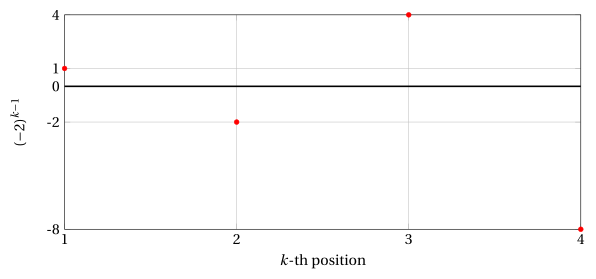
With \(a=1\) and \(q=-2\), the first 4 terms are:
\[ 1,~~-2,~~4,~~-8 \]With a negative common ratio the terms change sign at every step: those in odd positions are positive, those in even positions are negative.
2.1 Sums of the terms of geometric progressions
Remark 11: sum of the first \(n\) terms of the geometric progression (\(a=1\))
Given \(q \in \R\), for every natural number \(n \ge 1\) we have:
Proof
If \(q\neq 1\), we prove the equation in the following equivalent form:
Applying the properties of summations, in particular the product by a constant \(\eqref{P1}\) and the index translation \(\eqref{P5}\), we get:
Dividing by \(q-1 \neq 0\) we obtain:
If \(q = 1\), we have instead:
□
-
The proof never uses the sign of the common ratio: formula \(\eqref{GEOM}\) holds for every \(q \in \R\), positive, zero or negative. The only case to be made precise is \(q=0\): the first term of the summation is \(q^{1-1}=0^0\), which here is understood to be equal to \(1\) (convention \(0^0=1\)). With this convention, for every \(n \ge 1\) we have:
\[ \sum_{k=1}^{n} 0^{k-1} = 1 + 0 + \dots + 0 = 1 \qquad {\rm ~~and~~} \qquad \frac{0^{n}-1}{0-1} = \frac{-1}{-1} = 1 \]and therefore formula \(\eqref{GEOM}\) remains true.
-
Given \(q \in \R, n \in \N, n \ge 1\) and \(a \in \R\), formula \(\eqref{GEOM}\) extends as follows:
\[\begin{equation} \sum_{k=1}^{n} a \; q^{k-1} = \begin{cases} a \; \left(\frac{q^{n}-1}{q-1} \right)& {\rm ~~~if~~~~} q \neq 1\\[2ex] a \; n & {\rm ~~~otherwise} \end{cases} \qquad {\rm ~~since~~~~}\sum_{k=1}^{n} a \; q^{k-1} = a \; \sum_{k=1}^{n} q^{k-1} \end{equation}\]clearly:
\[\begin{equation*} \frac{q^n-1}{q-1} = \frac{1-q^n}{1-q} {\rm ~~and~hence~we~also~have~~~~} \sum_{k=1}^{n} a \; q^{k-1} = \begin{cases} a \; \left(\frac{1-q^{n}}{1-q} \right)& {\rm ~~~if~~~~} q \neq 1\\[2ex] a \; n & {\rm ~~~otherwise} \end{cases} \end{equation*}\] -
Formula \(\eqref{GEOM}\) can also be proved by induction, in the chapter “Principle of induction” of Part 1.
Example 5: sum of the first \(n\) terms of geometric progressions
-
With \(a=2\) and \(q=\frac{1}{2}\), the first 4 terms are:
\[ 2,~~1,~~\frac{1}{2},~~\frac{1}{4} \qquad {\rm ~~and~~} \qquad 2 + 1 + \frac{1}{2} + \frac{1}{4} = \frac{8+4+2+1}{4} = \frac{15}{4} \]the sum of the first \(n=4\) terms is given by the formula:
\[ \sum_{k=1}^4 2 \; \left(\frac{1}{2}\right)^{k-1}= \sum_{k=1}^4 \frac{2}{2^{k-1}} = 2 \; \frac{1-\frac{1}{2^4}}{1-\frac{1}{2}} = 2 \; \frac{1-\frac{1}{16}}{\frac{1}{2}}= \frac{15}{16} \; 4 = \frac{15}{4} \] -
With \(a=1\) and \(q=\frac{1}{2}\), the first 4 terms are:
\[ 1,~~\frac{1}{2},~~\frac{1}{4},~~\frac{1}{8} \qquad {\rm ~~and~~} \qquad 1 + \frac{1}{2} + \frac{1}{4} + \frac{1}{8} = \frac{8+4+2+1}{8} = \frac{15}{8} \]the sum of the first \(n=4\) terms is given by the formula:
\[ \sum_{k=1}^4 \left(\frac{1}{2}\right)^{k-1}= \sum_{k=1}^4\frac{1}{2^{k-1}} = \frac{1-\frac{1}{2^4}}{1-\frac{1}{2}} = \frac{1-\frac{1}{16}}{\frac{1}{2}}= \frac{15}{16} \; 2 = \frac{15}{8} \] -
With \(a=1\) and \(q=2\), the first 4 terms are:
\[ 1,~~2,~~4,~~8 \qquad {\rm ~~and~~} \qquad 1 + 2+ 4 +8= 15 \]the sum of the first \(n=4\) terms is given by the formula:
\[ \sum_{k=1}^4 2^{k-1} = \frac{2^4-1}{2-1} = 16-1 =15 \] -
With \(a=1\) and \(q=-2\), the first 4 terms are:
\[ 1,~~-2,~~4,~~-8 \qquad {\rm ~~and~~} \qquad 1 - 2+ 4 -8= -5 \]the sum of the first \(n=4\) terms is given by the formula:
\[ \sum_{k=1}^4 (-2)^{k-1} = \frac{(-2)^4-1}{-2-1} = \frac{16-1}{-3} = \frac{15}{-3} = -5 \]
3. Arithmetic progressions
Definition 3: arithmetic progression
A sequence of real numbers is an arithmetic progression if the difference between each term (starting from the second one) and the previous one is constant. This constant is called the common difference of the progression.
Given the first term \(a \in \R\) and the common difference \(d \in \R\), the associated arithmetic progression is:
Each term (starting from the second one) is obtained from the previous one by adding \(d\) to it. The \(k\)-th term (\(k \in \N\), \(k \ge 1\)) can be written as \(a + (k-1)\:d\) and we have:
- The arithmetic progression is the additive analogue of the geometric progression: in the geometric progression each term is multiplied by the common ratio \(q\), in the arithmetic progression the common difference \(d\) is added to each term.
Remark 12: \(k\)-th term of an arithmetic progression
Given the first term \(a \in \R\) and the common difference \(d \in \R\), let \(t_k\) denote the term in position \(k\) of the arithmetic progression. The recursive relation that defines the progression is:
and the closed formula of the \(k\)-th term is:
Proof
The closed formula \(\eqref{ARITTERM}\) is obtained by repeatedly applying the recursive relation \(\eqref{ARITREC}\):
□
-
The closed formula \(\eqref{ARITTERM}\) can also be obtained by the following argument, which does not need the dots. We write the recursive relation \(\eqref{ARITREC}\) in the form \(t_j - t_{j-1} = d\) for every position \(j\) from \(2\) to \(k\):
\[\begin{align*} t_2 - t_1 &= d \\[1ex] t_3 - t_2 &= d \\[1ex] t_4 - t_3 &= d \\[1ex] &\vdots\\[1ex] t_k - t_{k-1} &= d \end{align*}\]We now add all these \(k-1\) equalities. On the right-hand side we add \(d\) to itself \(k-1\) times and we obtain \(d \: (k-1)\). On the left-hand side the sum is telescopic: every term appears twice, once with the sign \(+\) and once with the sign \(-\), except \(t_k\) and \(t_1\):
\[ \underbrace{(t_2 - t_1) + (t_3 - t_2) + (t_4 - t_3) + \dots + (t_k - t_{k-1})}_{=\sum_{j=2}^{k} (t_j - t_{j-1})} = t_k - t_1 = t_k - a \]Equating the two sides we get \(t_k - a = d \: (k-1)\), that is, the closed formula:
\[ t_k = a + (k-1) \: d \qquad {\rm for~every~natural~number~} k \ge 1 \]
Example 6: arithmetic progressions
-
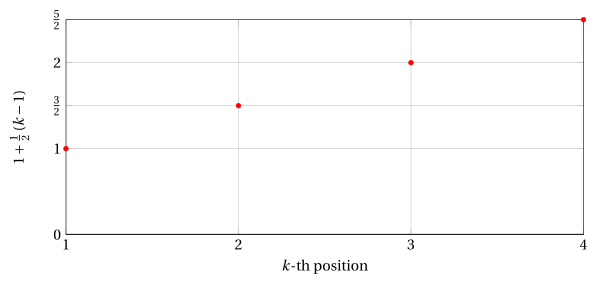
With \(a=1\) and \(d=\frac{1}{2}\), the first 4 terms are:
\[ 1,~~\frac{3}{2},~~2,~~\frac{5}{2} \]
-
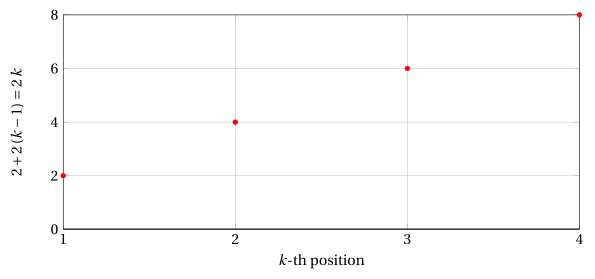
With \(a=2\) and \(d=2\), the first 4 terms are:
\[ 2,~~4,~~6,~~8 \]that is, the first 4 even numbers (without zero).
3.1 Sums of the terms of arithmetic progressions
Remark 13: sum of the first \(n\) terms of the arithmetic progression (\(a=0\))
Given \(d \in \R\), for every natural number \(n \ge 1\) we have:
Proof
Using the product by a constant \(\eqref{P1}\) and the index reflection \(\eqref{P6}\), with the same argument used for the sum of the first \(n\) natural numbers, we have:
where in the second step the index of the second summation has been reflected: the term in position \(k\) is \(a_k = k-1\) and therefore \(a_{n-k+1} = (n-k+1)-1 = n-k\). □
-
Given \(d \in \R, n \in \N, n \ge 1\) and \(a \in \R\), formula \(\eqref{ARIT}\) extends as follows:
\[\begin{equation} \label{ARIT_A} \sum_{k=1}^{n} \big( a + d \: (k-1) \big) = a \: n + d \: \left( \frac{n \: (n-1)}{2} \right) \qquad {\rm ~~since~~~~} \sum_{k=1}^{n} \big( a + d \: (k-1) \big) = \underbrace{\sum_{k=1}^{n} a}_{= a \: n} + \sum_{k=1}^{n} d \: (k-1) \end{equation}\]where the union of summations \(\eqref{P3}\) and the summation with a constant term \(\eqref{P2}\) have been used. This formula computes the sum of the first \(n\) terms of the arithmetic progression with a generic first term \(a\).
-
The same proof by index reflection, applied directly to the summation of the first \(n\) terms, gives the equivalent form:
\[ \sum_{k=1}^{n} \big( a + d \: (k-1) \big) = \frac{n}{2} \: \Big( \underbrace{a}_{=t_1} + \underbrace{a + (n-1) \: d}_{=t_n} \Big) = n \: \left( \frac{t_1 + t_n}{2} \right) \]since, reflecting the index, the term in position \(k\) and the term in position \(n-k+1\) have constant sum \(t_k + t_{n-k+1} = 2\:a + (n-1)\:d = t_1 + t_n\). The sum of the first \(n\) terms of an arithmetic progression is therefore \(n\) times the average of the first and the last term.
-
With \(a=1\) and \(d=1\) the arithmetic progression is \(1, 2, 3, \dots\) and formula \(\eqref{ARIT_A}\) gives \(n + \frac{n \: (n-1)}{2} = \frac{n \: (n+1)}{2}\), that is, the sum of the first \(n\) natural numbers (without zero) already seen in the section “Some important summations”. With \(a=1\) and \(d=2\) the progression is \(1, 3, 5, \dots\) and the formula gives \(n + 2 \: \frac{n \: (n-1)}{2} = n^2\), that is, the sum of the first \(n\) odd numbers.
Example 7: sum of the first \(n\) terms of arithmetic progressions
-
With \(a=1\) and \(d=\frac{1}{2}\), the first 4 terms are:
\[ 1,~~\frac{3}{2},~~2,~~\frac{5}{2} \qquad {\rm ~~and~~} \qquad 1 + \frac{3}{2} + 2 + \frac{5}{2} = \frac{2+3+4+5}{2} = \frac{14}{2} = 7 \]the sum of the first \(n=4\) terms is given by the formula:
\[ \sum_{k=1}^4 \left( 1 + \frac{1}{2} \: (k-1) \right) = 1 \cdot 4 + \frac{1}{2} \: \left( \frac{4 \cdot 3}{2} \right) = 4 + 3 = 7 \] -
With \(a=2\) and \(d=2\), the first 4 terms are:
\[ 2,~~4,~~6,~~8 \qquad {\rm ~~and~~} \qquad 2 + 4 + 6 + 8 = 20 \]the sum of the first \(n=4\) terms is given by the formula:
\[ \sum_{k=1}^4 \big( 2 + 2 \: (k-1) \big) = 2 \cdot 4 + 2 \: \left( \frac{4 \cdot 3}{2} \right) = 8 + 12 = 20 \]and with the equivalent form: \(4 \: \left( \frac{2+8}{2} \right) = 4 \cdot 5 = 20\).
-
With \(a=1\) and \(d=-\frac{1}{2}\), the first 4 terms are:
\[ 1,~~\frac{1}{2},~~0,~~-\frac{1}{2} \qquad {\rm ~~and~~} \qquad 1 + \frac{1}{2} + 0 - \frac{1}{2} = 1 \]the sum of the first \(n=4\) terms is given by the formula:
\[ \sum_{k=1}^4 \left( 1 - \frac{1}{2} \: (k-1) \right) = 1 \cdot 4 - \frac{1}{2} \: \left( \frac{4 \cdot 3}{2} \right) = 4 - 3 = 1 \]
Exercises on this chapter: Summations