Principle of mathematical induction
Part 1 · Logic · Chapter 2 · Lecture notes, volume 1 (PDF) · Exercises, volume 1 (PDF) · Exercises: Principle of mathematical induction · Slides (PDF)
1. The principle of mathematical induction
-
We now present a proof technique called proof by induction. This procedure can be applied to theorems with the following structure:
“ for every \(n \in \N\), \(n \ge n_0\), property \(p (n)\) holds ”
-
The number \(n_0\) is the smallest integer for which we want the property to be true; if \(n_0 = 0\) the theorem simply states that the property is true for every \(n \in \N\).
A proof by induction consists of the following two steps:
-
We prove that \(p (n)\) is true for \(n = n_0\) (base case of the induction).
-
We prove that, if n is an arbitrary natural number \(\ge n_0\), the fact that \(p(n)\) is true implies that \(p( n + 1)\) is true (inductive step).
We can then conclude that for every \(n \ge n_0\), \(p (n)\) is true.
-
-
The validity of this proof technique, intuitively, is based on the following fact:
-
By point 1, we know that \(p (n_0)\) is true. Suppose for example \(n_0 = 1\): we therefore know that \(p(1)\) is true (this must be proved explicitly).
-
By point \(2\), since \(p(1)\) is true, \(p (2)\) will be true: indeed, we have proved that for any \(n\), if \(p ( n)\) is true then \(p ( n + 1)\) is also true. But then, since \(p (2)\) is true, \(p (3)\) will be true; but then \(p (4)\) is true, … and so on, hence \(p (n)\) is true for every \(n \ge 1\).
-
-
In practice, the proof consists of two phases.
-
Prove \(p (n_0)\) directly;
-
Assume \(p (n)\) as a hypothesis (inductive hypothesis) and prove \(p (n + 1)\).
-
-
This is the delicate point, often subject to misunderstandings. “Assuming as a hypothesis” \(p (n)\) does not mean assuming the thesis as a hypothesis. What must be proved is that:
“ for every \(n \ge n_0\), if \(p( n)\) is true then \(p (n + 1)\) is also true ”
and not
“ if \(p (n)\) is true for every \(n\), then \(p (n + 1)\) is also true”
2. Proofs based on the principle of mathematical induction
2.1 Bernoulli's inequality
Remark 1: Bernoulli's inequality
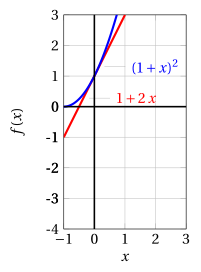
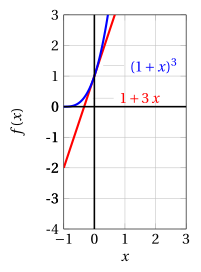
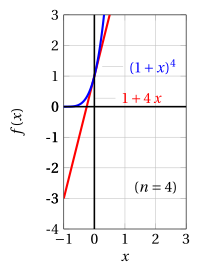
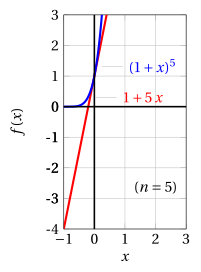
For every integer \(n \ge 0\), \(x \in \R\), \(x \ge -1\), we have:
Proof
By induction on \(n\).
-
Base case of the induction
Let \(n = 0\). Then the statement becomes:
\[ (1+x)^0 \ge 1 + 0\: x \text{ i.e. } 1 \ge 1 \]which is clearly true.
-
Inductive step
Suppose it is true for \(n\), and let us prove it for \((n + 1)\). By the inductive hypothesis, we have:
\[ (1+x)^n \ge 1 + n\: x \]and moreover we have
\[ (1+x) \ge 0 {\rm~~~since~~~} x \ge -1. \]Then we can write:
\[\begin{align*} (1+x)^{n+1} &= (1+x) \cdot (1+x)^{n} \\[2ex] &\ge (1+x) \cdot (1 + n\: x) \\[2ex] &= 1 + (n+1)\: x + n\: x^2 \\[2ex] &\ge 1 + (n+1) \: x \end{align*}\]where in the last inequality we used the fact that \(n\:x^2 \ge 0\).
The chain of inequalities shows that, for \(n + 1\), we have
\[ (1 + x)^{n+1} \ge 1 + (n + 1) \: x \]which is exactly the desired statement, for \(n + 1\).
□
Example 1: Bernoulli's inequality
2.2 Some important summations
Remark 2: sum of the first \(n\) natural numbers
For every integer \(n \ge 1\), we have:
Proof
By induction on \(n\).
-
Base case of the induction
Let \(n = 1\). Then the statement becomes:
\[ \sum_{k=1}^1 k = \frac{1\:(1+1)}{2} \text{ i.e. } 1 = 1 \]which is clearly true.
-
Inductive step
Suppose it is true for \(n\), and let us prove it for \((n + 1)\). By the inductive hypothesis, we have:
\[ \sum_{k=1}^n k = \frac{n\:(n+1)}{2}. \]Hence we can write:
\[\begin{align*} \sum_{k=1}^{n+1} k &= \sum_{k=1}^{n} k + (n+1) \\[2ex] &= \frac{n\:(n+1)}{2} + (n+1) \\[2ex] &= \frac{n\:(n+1) + 2\:(n+1)}{2} \\[2ex] & = \frac{(n+1)\:( n + 2 )}{2} = \frac{(n+1)\:\big(( n+1) +1\big)}{2} \end{align*}\]which is exactly the desired statement, for \(n + 1\).
□
Remark 3: sum of the first \(n\) odd numbers
For every integer \(n \ge 1\), we have:
Proof
By induction on \(n\).
-
Base case of the induction
Let \(n = 1\). Then the statement becomes:
\[ \sum_{k=0}^0 (2\:k+1) = 1^2 \text{ i.e. } 1 = 1 \]which is clearly true.
-
Passo induttivo
Suppose it is true for \(n\), and let us prove it for \((n + 1)\). By the inductive hypothesis, we have:
\[ \sum_{k=0}^{n-1} (2\:k+1) = n^2 \]Hence we can write:
\[\begin{align*} \sum_{k=0}^{(n+1)-1} (2\:k+1)&= \sum_{k=0}^{n-1} (2\:k+1) + 2\:n +1 = n^2 + 2\:n +1 = (n+1)^2 \end{align*}\]which is exactly the desired statement, for \(n + 1\).
The second sum coincides with the first one, by an index shift (\(k \to k+1\)):
□
Remark 4: sum of the first \(n\) even numbers
For every integer \(n \ge 1\), we have:
Proof
By induction on \(n\).
-
Base case of the induction
Let \(n = 1\). Then the statement becomes:
\[ \sum_{k=1}^1 2\:k = 1 \cdot 2 \text{ i.e. } 2 = 2 \]which is clearly true.
-
Passo induttivo
Suppose it is true for \(n\), and let us prove it for \((n + 1)\). By the inductive hypothesis, we have:
\[ \sum_{k=1}^{n} 2\:k = n\: (n+1) \]Hence we can write:
\[\begin{align*} \sum_{k=1}^{n+1} 2\:k&= \sum_{k=1}^{n} 2\:k + 2\: (n+1) = n^2 + n + 2\: (n+1) \\[2ex] & = n^2+2\:n+1+n+1 = (n+1)^2 + (n+1) = (n+1) \:\big((n+1) +1 \big) \end{align*}\]which is exactly the desired statement, for \(n + 1\).
□
2.3 Sum of the terms of the geometric progression
Remark 5: sum of the first \(n\) terms of the geometric progression (\(a=1\))
Given \(q \in \R\), for every integer \(n \ge 1\) we have (with the convention \(0^0=1\) for the case \(q=0\)):
Proof
By induction on \(n\).
-
Base case of the induction
Let \(n = 1\). Then the statement becomes:
\[ \sum_{k=1}^{1} q^{k-1} = \frac{q^1-1}{q-1} \text{ i.e. } 1 = 1 \]which is clearly true.
-
Inductive step
Suppose it is true for \(n\), and let us prove it for \((n + 1)\). By the inductive hypothesis, we have:
\[ \sum_{k=1}^{n} q^{k-1} = \frac{q^n-1}{q-1} \]Hence we can write
\[\begin{align*} \sum_{k=1}^{n+1} q^{k-1}&= \sum_{k=1}^{n} q^{k-1} + q^n = \frac{q^n-1}{q-1} + q^n\\[2ex] & = \frac{q^n-1+q^{n+1}-q^n}{q-1} = \frac{q^{n+1}-1}{q-1} \end{align*}\]which is exactly the desired statement, for \(n + 1\).
□
2.4 Inequality of arithmetic and geometric means
Remark 6: inequality of arithmetic and geometric means
For every integer \(n \ge 2\) and every vector \(\boldsymbol{a}=\begin{pmatrix} a_1, a_2, \dots, a_n \end{pmatrix} \in \R_{\ge 0}^n\), we have:
-
The inequality \(\eqref{AMGM}\) states that the arithmetic mean is greater than or equal to the geometric mean.
-
If \(a_i=a\) for every \(i \in \{1,2,\dots,n\}\), we have:
\[ \frac{\sum_{i=1}^n a_i}{n} ~~=~~ \frac{n\;a}{n} ~~=~~ a \qquad \text{and} \qquad \sqrt[n]{\prod_{i=1}^n a_i} ~~=~~ \sqrt[n]{ a^n} ~~=~~ a \]and the arithmetic mean and the geometric mean are equal (this is the only case in which equality holds).
Proof
By induction on \(n\).
-
Base case of the induction
Let \(n = 2\). Since both sides are non-negative, we can square them:
\[\begin{align*} \frac{a_1 + a_2}{2} ~\geq~ \sqrt{a_1 \: a_2} &~~~~\Longleftrightarrow~~~~ \left(\frac{a_1 + a_2}{2}\right)^2 ~\geq~ a_1 \: a_2 ~~~~\Longleftrightarrow~~~~ \frac{a_1^2 + 2\:a_1 \: a_2 + a_2^2}{4} ~\geq~ a_1 \: a_2\\[2ex] &~~~~\Longleftrightarrow~~~~ a_1^2 - 2\:a_1 \: a_2 + a_2^2 ~\geq~ 0 ~~~~\Longleftrightarrow~~~~ (a_1 - a_2)^2 ~\geq~ 0 \end{align*}\]which is clearly true.
-
Inductive step
Suppose it is true for \(n\), and let us prove it for \((n + 1)\). By the inductive hypothesis, the arithmetic mean of \(n\) non-negative real numbers is greater than or equal to their geometric mean. We need to prove that:
\[\begin{equation} \label{AMGM_A} \tag{A} \frac{\sum_{i=1}^{n+1} a_i}{n+1} ~~\geq~~ \sqrt[n+1]{\prod_{i=1}^{n+1} a_i} \end{equation}\]Let \(\alpha\) be the arithmetic mean of the \(n+1\) non-negative real numbers:
\[\begin{equation} \label{AMGM_B} \tag{B} \alpha = \frac{\sum_{i=1}^{n+1} a_i}{n+1} \end{equation}\]If \( a_i = \alpha \) for every \(i \in \{1,2,\dots,n+1\}\), then \(\eqref{AMGM_A}\) holds with equality. Otherwise, there is at least one value greater than \(\alpha\) and at least one value smaller than \(\alpha\). Without loss of generality, we reorder the values so that:
\[ a_n > \alpha \quad \text{ and } \quad a_{n+1} < \alpha \]Then we have:
\[\begin{equation} \label{AMGM_C} \tag{C} a_n - \alpha > 0 \quad \text{ and } \quad \alpha - a_{n+1} > 0 ~~~\Longrightarrow~~~ (a_n - \alpha) \; (\alpha - a_{n+1}) > 0 \end{equation}\]From \(\eqref{AMGM_B}\) we have:
\[ (n+1) \; \alpha = \sum_{i=1}^{n+1} a_i ~~~~\Longleftrightarrow~~~~ n\; \alpha = \sum_{i=1}^{n-1} a_i + \underbrace{ a_n + a_{n+1} -\alpha}_{=\,y } ~~~~\Longleftrightarrow~~~~ \alpha = \frac{\sum_{i=1}^{n-1} a_i + y}{n} \]where \(y = a_n + a_{n+1} - \alpha \ge a_n - \alpha > 0\), since \(a_{n+1} \ge 0\). Hence \(\alpha\) is also the arithmetic mean of the \(n\) non-negative numbers \(a_1,a_2,\dots,a_{n-1}\) and \(y\). By the inductive hypothesis, \(\alpha^n \ge \left(\prod_{i=1}^{n-1} a_i \right) y\), and therefore:
\[\begin{equation} \label{AMGM_D} \tag{D} \alpha^{n+1} = \alpha^{n} \; \alpha \ge \left(\prod_{i=1}^{n-1} a_i \right) y \; \alpha \end{equation}\]From \(\eqref{AMGM_C}\) it follows that:
\[ (a_n - \alpha) \; (\alpha - a_{n+1}) = (\underbrace{ a_n + a_{n+1} -\alpha}_{=\,y}) \; \alpha - a_{n} \; a_{n+1} > 0 \]and therefore:
\[\begin{equation} \label{AMGM_E} \tag{E} y \; \alpha > a_{n} \; a_{n+1} \end{equation}\]Substituting \(\eqref{AMGM_E}\) into \(\eqref{AMGM_D}\) (the product \(\prod_{i=1}^{n-1} a_i\) is non-negative), we obtain:
\[ \alpha^{n+1} \ge \prod_{i=1}^{n+1} a_i ~~~~\Longleftrightarrow~~~~ \frac{\sum_{i=1}^{n+1} a_i}{n+1} ~~\ge~~ \sqrt[n+1]{\prod_{i=1}^{n+1} a_i} \]that is, \(\eqref{AMGM_A}\), which is exactly the desired statement, for \(n + 1\).
□
2.5 Fibonacci sequence
-
The Fibonacci sequence is defined by the following two initial values and recurrence relation:
\[\begin{equation} \label{FIBONACCI} F_0 = 0, \qquad F_1 = 1, \qquad F_n = F_{n-1} + F_{n-2} \quad \text{for every integer } n \ge 2. \end{equation}\] -
The first terms are \(0,~ 1,~ 1,~ 2,~ 3,~ 5,~ 8,~ 13,~ 21,~ 34, \dots\): each term is the sum of the two preceding ones.
-
The two solutions of the equation \(x^2 - x - 1 = 0\) are called the golden ratio \(\phi\) and the conjugate of the golden ratio \(\hat{\phi}\):
\[ \phi = \frac{1 + \sqrt{5}}{2} \qquad {\rm ~~and~~} \qquad \hat{\phi} = \frac{1 - \sqrt{5}}{2} \]Since they are solutions of \(x^2 = x+1\), the following two equalities hold:
\[\begin{equation} \label{FIBONACCI_PHI} \phi^2 = \phi + 1 \qquad {\rm ~~and~~} \qquad \hat{\phi}^2 = \hat{\phi} + 1 \end{equation}\] -
The following proposition gives a closed formula for \(F_n\): the \(n\)-th term can be computed directly, without going through all the preceding terms.
Remark 7: closed formula of the Fibonacci sequence
For every integer \(n \ge 0\), we have:
Proof
By induction on \(n\). Since the recurrence relation links \(F_{n+1}\) to the two preceding terms, the base case of the induction checks the statement for \(n=0\) and for \(n=1\), and the inductive step assumes it true for \(n\) and for \(n-1\).
-
Base case of the induction
Let \(n = 0\) and \(n = 1\). Then the statement becomes:
\[ F_0 = \frac{\phi^0 - \hat{\phi}^0 }{\sqrt{5}} = \frac{1 - 1 }{\sqrt{5}} = 0 \qquad {\rm ~~and~~} \qquad F_1 = \frac{\phi^1 - \hat{\phi}^1 }{\sqrt{5}} = \frac{\frac{1 + \sqrt{5}}{2} - \frac{1 - \sqrt{5}}{2}}{\sqrt{5}} = \frac{\sqrt{5}}{\sqrt{5}} = 1 \]which is clearly true.
-
Inductive step
Suppose it is true for \(n\) and for \(n-1\), with \(n \ge 1\), and let us prove it for \((n + 1)\). By the definition of the Fibonacci sequence we have \(F_{n+1} = F_{n} + F_{n-1}\), while by the inductive hypothesis we have:
\[ F_{n} = \frac{\phi^n - \hat{\phi}^n }{\sqrt{5}} {\rm ~~~~~and~~~~~} F_{n-1} = \frac{\phi^{n-1} - \hat{\phi}^{n-1} }{\sqrt{5}} \]Hence we can write:
\[\begin{align*} F_{n+1} & = F_{n} + F_{n-1} = \frac{\phi^n - \hat{\phi}^n }{\sqrt{5}} + \frac{\phi^{n-1} - \hat{\phi}^{n-1} }{\sqrt{5}}\\[2ex] & = \frac{\big(\phi^n + \phi^{n-1}\big) - \big(\hat{\phi}^n + \hat{\phi}^{n-1}\big)}{\sqrt{5}} = \frac{\phi^{n-1} \big(\phi + 1\big) - \hat{\phi}^{n-1} \big(\hat{\phi} + 1\big)}{\sqrt{5}}\\[2ex] & = \frac{\phi^{n-1} \; \phi^2 - \hat{\phi}^{n-1} \; \hat{\phi}^2}{\sqrt{5}} = \frac{\phi^{n+1} - \hat{\phi}^{n+1}}{\sqrt{5}} \end{align*}\]where in the second-to-last equality we used the relations \(\eqref{FIBONACCI_PHI}\). This is exactly the desired statement, for \(n + 1\).
□
- The Fibonacci sequence is studied in more detail in the chapter “Fibonacci sequence” of Part 2.
Exercises on this chapter: Principle of mathematical induction