Fundamental theorem of calculus
Part 7 · Integrals · Chapter 2 · Lecture notes, volume 7 (PDF) · Exercises, volume 7 (PDF) · Exercises: Antiderivatives · Exercises: Integral functions and the fundamental theorem · Slides (PDF)
Prerequisites
-
From this module, «The Riemann integral»: definition and properties of the integral, integral mean value theorem.
-
From this module, «The derivative function», «Derivatives of elementary functions» and «Rules for computing derivatives»: derivatives and the chain rule.
-
From this module, «Mean value theorem, maxima and minima»: a function with zero derivative on an interval is constant.
-
From this module, «L'Hôpital's rule and differentiability»: L'Hôpital's rule.
Objectives
At the end of this chapter you will be able to:
-
recognize an antiderivative and describe all the antiderivatives of a function on an interval;
-
state and prove the two parts of the fundamental theorem of calculus;
-
compute definite integrals with an antiderivative and the table of basic antiderivatives;
-
differentiate integral functions with variable limits and use them in limits and in the study of functions.
1. Antiderivatives
Definition 1: antiderivative
Let \(f: I \rr \R\), with \(I\) an interval. A function \(F: I \rr \R\) is called an antiderivative (or primitive) of \(f\) on \(I\) if \(F\) is differentiable on \(I\) and
-
Finding an antiderivative is the inverse process of differentiation: we look for a function knowing its derivative.
-
If \(I\) contains an endpoint, the derivative at that point is one-sided.
Example 1: antiderivatives
-
\(F(x) = \frac{x^3}{3}\) is an antiderivative of \(f(x) = x^2\) on \(\R\), because \(F'(x) = x^2\); so is \(\frac{x^3}{3} + 5\).
-
\(F(x) = \sin x\) is an antiderivative of \(f(x) = \cos x\) on \(\R\).
-
\(F(x) = \log x\) is an antiderivative of \(f(x) = \frac1x\) on \((0, \ip)\); \(F(x) = \log(-x)\) is one on \((\im, 0)\).
Theorem 1: characterization of antiderivatives
Let \(F\) be an antiderivative of \(f\) on the interval \(I\). Then \(G\) is an antiderivative of \(f\) on \(I\) if and only if there exists a constant \(c \in \R\) such that
Proof
-
(\(\Leftarrow\)) If \(G = F + c\), then \(G' = F' + 0 = f\) on \(I\).
-
(\(\Rightarrow\)) The function \(H = G - F\) has derivative \(H' = f - f = 0\) on the whole interval \(I\). By the corollary of Lagrange's theorem, a function with zero derivative on an interval is constant: \(H(x) = c\) for every \(x \in I\).
□
Remark 1
The assumption that \(I\) is an interval is essential. On \(\R \setminus \{0\}\) the functions
both have derivative \(\frac1x\), but \(G - F\) is not constant: it equals \(1\) for \(x > 0\) and \(0\) for \(x < 0\).
Definition 2: indefinite integral
The set of all antiderivatives of \(f\) on an interval \(I\) is called the indefinite integral of \(f\) and is denoted by \(\int f(x)\,dx\). If \(F\) is an antiderivative, we write
-
From the linearity of the derivative follows the linearity of the indefinite integral: \(\int (\alpha f + \beta g)\,dx = \alpha \int f\,dx + \beta \int g\,dx\).
-
The indefinite integral, which is a set of functions, must not be confused with the definite integral \(\int_a^b f(x)\,dx\), which is a number. The fundamental theorem of calculus shows the link between the two.
2. The integral function
Definition 3: integral function
Let \(f\) be integrable on \([a,b]\) and let \(x_0 \in [a,b]\). The function
is called the integral function of \(f\) with initial point \(x_0\).
-
The integration variable is called \(t\) so as not to confuse it with the upper limit \(x\).
-
For \(x < x_0\) the convention \(\int_{x_0}^{x} f = -\int_{x}^{x_0} f\) applies; moreover \(F(x_0) = 0\).
Example 2: an integral function
Let \(f(t) = t\) and \(x_0 = 0\). For \(x > 0\) the integral \(\int_0^x t\,dt\) is the area of the triangle with base and height \(x\), that is, \(\frac{x^2}{2}\). For \(x < 0\)
because between \(x\) and \(0\) the graph lies below the axis. Hence \(F(x) = \frac{x^2}{2}\) for every \(x \in \R\): the integral function of \(f(t) = t\) is an antiderivative of it.
Proposition 1: continuity of the integral function
If \(f\) is integrable on \([a,b]\) and \(|f(t)| \le L\) for every \(t \in [a,b]\), then the integral function \(F\) satisfies
In particular \(F\) is continuous on \([a,b]\).
Proof
Let \(y < x\). By additivity with respect to the interval, \(F(x) - F(y) = \int_y^x f(t)\,dt\). By the inequality for the absolute value and the Corollary on the estimates of the integral
As \(y \rr x\) the right-hand side tends to \(0\), so \(F\) is continuous. □
3. Fundamental theorem of calculus
Theorem 2: fundamental theorem of calculus, first part
Let \(f:[a,b] \rr \R\) be continuous and let \(x_0 \in [a,b]\). The integral function
is differentiable on \([a,b]\) and
that is, \(F\) is an antiderivative of \(f\) on \([a,b]\).
Proof
Let \(x \in [a,b]\) and let \(h \neq 0\) with \(x + h \in [a,b]\). By additivity with respect to the interval
The right-hand side is the integral mean of \(f\) on the interval with endpoints \(x\) and \(x+h\) (also for \(h < 0\), swapping the limits). By the integral mean value theorem there exists \(c_h\) between \(x\) and \(x + h\) such that
As \(h \rr 0\) we have \(c_h \rr x\) and, by the continuity of \(f\), \(f(c_h) \rr f(x)\). The limit of the difference quotient exists and equals \(f(x)\). □
-
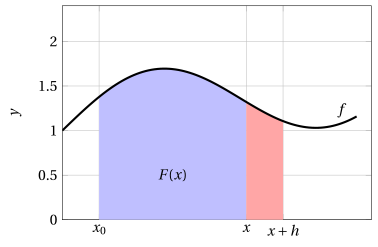
In the figure the blue area is \(F(x)\) and the red strip is \(F(x+h) - F(x)\): for small \(h\) it is almost a rectangle with base \(h\) and height \(f(x)\). Dividing by \(h\) we get about \(f(x)\).
-
Hence every continuous function on an interval has an antiderivative, even when it cannot be written with elementary functions (for example \(e^{-x^2}\)).
Theorem 3: fundamental theorem of calculus, second part
Let \(f:[a,b] \rr \R\) be continuous and let \(G\) be any antiderivative of \(f\) on \([a,b]\). Then
Proof
By the fundamental theorem of calculus, first part, the function \(F(x) = \int_a^x f(t)\,dt\) is an antiderivative of \(f\) on \([a,b]\). By the theorem on the characterization of antiderivatives there exists \(c \in \R\) with \(G = F + c\) on \([a,b]\). Then
□
- We write \(G(b) - G(a) = \big[ G(x) \big]_a^b\). The second part is also called the fundamental formula of integral calculus: to compute a definite integral an antiderivative is enough.
Example 3: definite integrals with an antiderivative
-
\(\displaystyle \int_0^1 x^2\,dx = \left[\frac{x^3}{3}\right]_0^1 = \frac13\), as we found with Riemann sums.
-
\(\displaystyle \int_0^{\pi} \sin x\,dx = \big[-\cos x\big]_0^{\pi} = -\cos\pi + \cos 0 = 2\).
-
\(\displaystyle \int_1^{e} \frac{1}{x}\,dx = \big[\log x\big]_1^{e} = 1 - 0 = 1\).
-
\(\displaystyle \int_0^{2\pi} \sin x\,dx = \big[-\cos x\big]_0^{2\pi} = 0\), while \(\displaystyle \int_0^{2\pi} |\sin x|\,dx = 2\int_0^{\pi} \sin x\,dx = 4\).
4. Basic antiderivatives
- Reading the table of the derivatives of elementary functions backwards we get the basic antiderivatives. Each row is checked by differentiating the right-hand side.
| \(f(x)\) | \(\displaystyle\int f(x)\,dx\) |
| \(x^{\alpha}\), \(\alpha \neq -1\) | \(\displaystyle\frac{x^{\alpha+1}}{\alpha+1} + c\) |
| \(\displaystyle\frac{1}{x}\) | \(\log|x| + c\) |
| \(e^{x}\) | \(e^{x} + c\) |
| \(a^{x}\), \(a > 0\), \(a \neq 1\) | \(\displaystyle\frac{a^{x}}{\log a} + c\) |
| \(\sin x\) | \(-\cos x + c\) |
| \(\cos x\) | \(\sin x + c\) |
| \(\displaystyle\frac{1}{\cos^2 x} = 1 + \tan^2 x\) | \(\tan x + c\) |
| \(\displaystyle\frac{1}{1+x^2}\) | \(\arctan x + c\) |
| \(\displaystyle\frac{1}{\sqrt{1-x^2}}\) | \(\arcsin x + c\) |
| \(\sinH x\) | \(\cosH x + c\) |
| \(\cosH x\) | \(\sinH x + c\) |
-
Each formula holds on an interval where the function is defined: for example \(\int \frac1x\,dx = \log|x| + c\) on \((0,\ip)\) or on \((\im, 0)\).
-
By the chain rule, if \(g\) is differentiable, the table also holds in composite form: for example
\[ \int g'(x)\, g(x)^{\alpha}\,dx = \frac{g(x)^{\alpha+1}}{\alpha+1} + c, ~~~~ \int \frac{g'(x)}{g(x)}\,dx = \log|g(x)| + c, ~~~~ \int g'(x)\, e^{g(x)}\,dx = e^{g(x)} + c \]
Example 4: basic antiderivatives and linearity
-
\(\displaystyle \int \left(3x^2 - \frac{4}{x} + 2e^x\right) dx = x^3 - 4\log|x| + 2e^x + c\).
-
\(\displaystyle \int \sqrt{x}\,dx = \int x^{1/2}\,dx = \frac{2}{3}\,x^{3/2} + c\), on \((0, \ip)\).
-
\(\displaystyle \int \tan x\,dx = -\int \frac{-\sin x}{\cos x}\,dx = -\log|\cos x| + c\), with \(g(x) = \cos x\).
-
\(\displaystyle \int \frac{x}{1+x^2}\,dx = \frac12 \int \frac{2x}{1+x^2}\,dx = \frac12 \log(1+x^2) + c\).
-
\(\displaystyle \int_0^1 \frac{1}{1+x^2}\,dx = \big[\arctan x\big]_0^1 = \frac{\pi}{4}\).
5. Derivative of an integral function
Theorem 4: differentiation of integral functions
Let \(f\) be continuous on the interval \(I\) and let \(\alpha\) and \(\beta\) be differentiable functions on an interval \(J\), with values in \(I\). Then the function
is differentiable on \(J\) and
Proof
Let \(F\) be an antiderivative of \(f\) on \(I\), which exists by the fundamental theorem of calculus, first part. By the second part
The chain rule and \(F' = f\) give the claim. □
Example 5: derivatives of integral functions
-
If \(G(x) = \displaystyle\int_1^{x^2} e^{t^2}\,dt\), then \(G'(x) = e^{(x^2)^2}\cdot 2x = 2x\,e^{x^4}\).
-
If \(G(x) = \displaystyle\int_{x}^{3x} \frac{1}{1+t^2}\,dt\), then \(G'(x) = \frac{3}{1+9x^2} - \frac{1}{1+x^2}\).
Example 6: a limit with an integral function
Let us compute
The function \(\sin(t^2)\) has no elementary antiderivative, but the numerator \(F(x) = \int_0^x \sin(t^2)\,dt\) tends to \(F(0) = 0\) and is differentiable with \(F'(x) = \sin(x^2)\). We have a form \(\frac00\) and, by L'Hôpital's rule and the fundamental limit of the sine,
Example 7: study of an integral function
Let \(F(x) = \displaystyle\int_0^{x} e^{-t^2}\,dt\), \(x \in \R\).
-
Monotonicity. \(F'(x) = e^{-x^2} > 0\): \(F\) is increasing on \(\R\) and \(F(0) = 0\), hence \(F(x) > 0\) for \(x > 0\) and \(F(x) < 0\) for \(x < 0\).
-
Concavity. \(F''(x) = -2x\,e^{-x^2}\): \(F\) is convex on \((\im, 0]\), concave on \([0, \ip)\) and has an inflection point at \(x = 0\), with tangent line \(y = x\).
-
Symmetry. The function \(H(x) = F(x) + F(-x)\) has derivative \(H'(x) = e^{-x^2} - e^{-x^2} = 0\), so it is constant and equals \(H(0) = 0\): \(F\) is odd.
6. In summary
In summary
-
An antiderivative of \(f\) on an interval is a function whose derivative is \(f\); two antiderivatives on the same interval differ by a constant.
-
The integral function \(F(x) = \int_{x_0}^x f(t)\,dt\) is continuous; if \(f\) is continuous, \(F\) is differentiable and \(F' = f\) (first part of the fundamental theorem).
-
If \(G\) is an antiderivative of the continuous function \(f\), then \(\int_a^b f(x)\,dx = G(b) - G(a)\) (second part).
-
Basic antiderivatives are obtained by reading the table of derivatives backwards, also in composite form with \(g'(x)\).
-
\(\frac{d}{dx}\int_{\alpha(x)}^{\beta(x)} f(t)\,dt = f(\beta(x))\,\beta'(x) - f(\alpha(x))\,\alpha'(x)\): it is used in limits (with L'Hôpital's rule) and in the study of integral functions.
Exercises on this chapter: Antiderivatives · Integral functions and the fundamental theorem