30.5 The bin packing problem: first sort, then pack
Part 4 · Heuristic algorithms · Chapter 30 · Chapter 30: Constructive heuristics · Lecture notes, volume 4 (PDF) · Slides (1/2) · Slides (2/2) · Exercises: Constructive heuristics · App: Bin packing heuristics · App: List scheduling and LPT · App: Vertex coloring: greedy and DSATUR · App: TSP: nearest neighbour and 2-opt
-
Four classical greedy heuristics for the BPP process the items in the input order and differ in the rule used to choose the bin: Next Fit (NF) keeps a single open bin, while First Fit (FF), Best Fit (BF) and Worst Fit (WF) keep all the bins and choose, among those in which the item fits, the first opened, the fullest or the emptiest one. On the BPP reference instance (\(c=7\), \(w=(4,4,5,3,2,3)\), \(z(I)=3\)) they give
\[ NF(I)=5, \qquad FF(I)=4, \qquad BF(I)=3, \qquad WF(I)=4 . \] -
In those heuristics the bin is chosen by a criterion, but the item is not: the items arrive in the order of the input, which may be a bad one. When the whole instance is known in advance — the offline setting — nothing forces us to accept that order. The idea of this section is to choose the order of the items too: first sort, then pack.
-
Why the large items first. The difficult items of a BPP instance are the large ones: two items larger than \(\frac{c}{2}\) never share a bin, and a large item fits only into a bin that is still almost empty. Small items, on the contrary, can fill the gaps left in any bin. If the small items come first, they are spread over the bins and occupy the space that the large items will need later; if the large items come first, each of them gets its own bin, and the small items are then used to fill the gaps.
30.5.1 First Fit Decreasing
The First Fit Decreasing Algorithm (denoted by FFD) is a constructive heuristic for the BPP. It first sorts the items by non-increasing weight, and then packs them in this order by First Fit: each item is packed into the first bin, in the order in which the bins were opened, in which it fits; if it fits into no bin, a new bin is opened.
Algorithm: First Fit Decreasing
- The packing loop is exactly the loop of FF: the only difference is the line that computes the order \(\rho\). Sorting costs \(O(n\log n)\), and FFD runs in the same time as FF, \(O(n^2)\) with the simple scan of the bins.
Example 30.2: FF and FFD on the BPP reference instance
FF, in the input order: items \(1\), \(2\) and \(3\) (weights \(4,4,5\)) open one bin each, because no two of them fit together; item \(4\) (weight \(3\)) goes into bin \(1\) (\(rc[1]=0\)); item \(5\) (weight \(2\)) goes into bin \(2\) (\(rc[2]=1\)); item \(6\) (weight \(3\)) fits into no bin, whose residual capacities are \(0,1,2\), and opens bin \(4\). Hence \(FF(I)=4\).
FFD. The weights sorted by non-increasing value are \(5,4,4,3,3,2\), i.e., \(\rho=(3,1,2,4,6,5)\) (ties by index). Then:
-
Item \(3\) (weight \(5\)): no bin is open, FFD opens bin \(1\); \(rc[1]=7-5=2\).
-
Item \(1\) (weight \(4\)): \(4> rc[1]=2\), FFD opens bin \(2\); \(rc[2]=7-4=3\).
-
Item \(2\) (weight \(4\)): \(4>rc[1]=2\), \(4>rc[2]=3\), FFD opens bin \(3\); \(rc[3]=7-4=3\).
-
Item \(4\) (weight \(3\)): \(3>rc[1]=2\), \(3\le rc[2]=3\): bin \(2\); \(rc[2]=0\).
-
Item \(6\) (weight \(3\)): \(3>rc[1]=2\), \(3>rc[2]=0\), \(3\le rc[3]=3\): bin \(3\); \(rc[3]=0\).
-
Item \(5\) (weight \(2\)): \(2\le rc[1]=2\): bin \(1\); \(rc[1]=0\).
Hence \(bin=(2,3,1,2,1,3)\), the packing patterns are
and \(FFD(I)=3=\left\lceil\frac{21}{7}\right\rceil\): the solution is optimal, and all three bins are full.
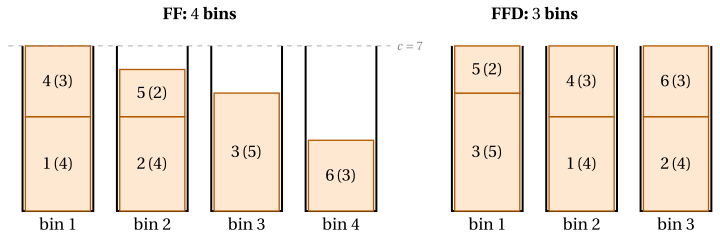
In FF the small item \(5\) arrives before the large item \(6\) and takes the space that item \(6\) would need in bin \(2\); in FFD item \(5\) comes last and fills the gap of bin \(1\).
30.5.2 Best Fit Decreasing
The Best Fit Decreasing Algorithm (denoted by BFD) is a constructive heuristic for the BPP. It first sorts the items by non-increasing weight, and then packs them in this order by Best Fit: each item is packed into the bin with the smallest residual capacity among those in which it fits (in case of ties, the bin opened first); if it fits into no bin, a new bin is opened.
Algorithm: Best Fit Decreasing
- Again, the packing loop is that of BF, preceded by the sorting.
Example 30.3: BFD on the BPP reference instance
The order is \(\rho=(3,1,2,4,6,5)\), as for FFD. Items \(3\), \(1\) and \(2\) open bins \(1\), \(2\), \(3\), with residual capacities \(2,3,3\). Item \(4\) (weight \(3\)) fits into bins \(2\) and \(3\), both with residual capacity \(3\): the tie is broken in favour of bin \(2\), and \(rc[2]=0\). Item \(6\) (weight \(3\)) fits only into bin \(3\), and \(rc[3]=0\). Item \(5\) (weight \(2\)) fits only into bin \(1\), and \(rc[1]=0\). BFD returns the same packing patterns as FFD, \(P_1=\{3,5\}\), \(P_2=\{1,4\}\), \(P_3=\{2,6\}\), and \(BFD(I)=3\).
30.5.3 What sorting gives, and what it does not
-
A better guarantee. Sorting the items improves the worst case. FF and BF have worst-case performance ratio \(\frac{17}{10}\). For FFD it is known that
\[ FFD(I) \;\le\; \frac{11}{9}\, z(I) + \frac{6}{9} \qquad \text{for every BPP instance } I, \]and that the bound is tight. A bound of the form \(\frac{11}{9}z(I)+4\) was first proved for both FFD and BFD by D.S. Johnson, A. Demers, J.D. Ullman, M.R. Garey and R.L. Graham (Worst-case performance bounds for simple one-dimensional packing algorithms, SIAM Journal on Computing 3 (1974) 299–325); the tight additive constant is due to G. Dósa (The tight bound of First Fit Decreasing bin-packing algorithm is \(FFD(I)\le 11/9\,OPT(I)+6/9\), ESCAPE 2007, LNCS 4614, pp. 1–11).
-
Not a better solution on every instance. A worst-case guarantee compares the algorithm with the optimum, not with another algorithm: on some instances the input order is luckier than the sorted one.
Example 30.4: Sorting can hurt
Let \(c=7\) and \(w=(2,2,3,2,2,3)\), with total weight \(14\), so that \(z(I)\ge\left\lceil\frac{14}{7}\right\rceil=2\).
FF packs items \(1,2,3\) into bin \(1\) (\(2+2+3=7\)) and items \(4,5,6\) into bin \(2\) (\(2+2+3=7\)): \(FF(I)=2\), which is optimal.
FFD examines the items in the order \(\rho=(3,6,1,2,4,5)\). Items \(3\) and \(6\) go into bin \(1\) (\(rc[1]=1\)); items \(1\), \(2\), \(4\) do not fit into bin \(1\) and go into bin \(2\) (\(rc[2]=1\)); item \(5\) fits into neither bin and opens bin \(3\): \(FFD(I)=3\).
The two items of weight \(3\), packed together by FFD, waste one unit of capacity in bin \(1\); the input order happened to pair each of them with two items of weight \(2\), filling both bins exactly.
Next: 30.6 Scheduling on parallel machines: longest jobs first