The TSP: the general case and the metric case
Part 5 · Approximation algorithms · Chapter 39 · Lecture notes, volume 5 (PDF) · Slides · Exercises: Travelling salesman (TSP) · App: Metric TSP: double tree and Christofides
Prerequisites
-
From this module, the chapter «Principles of approximation algorithms»: performance ratio, relative performance guarantee, tight guarantee and worst-case performance ratio.
-
From this module, the chapter «Routing problems»: the definition and the reference instance of the TSP.
-
From the module Algorithms (module home page): minimum spanning trees (Kruskal), Eulerian circuits and the notions of NP-completeness and polynomial time.
Objectives
At the end of this chapter you will be able to:
-
prove that no constant guarantee exists for the general TSP, unless \(P=NP\);
-
explain why the triangle inequality is what makes the TSP approximable;
-
execute the double tree and the Christofides algorithms by hand on a metric instance;
-
prove the guarantees \(2\) of the double tree and \(\frac{3}{2}\) of the Christofides algorithm;
-
build the families of instances that make these guarantees tight.
The problem of this chapter is the travelling salesman problem (TSP): its definition and its assumptions are on its page.
39.1 The general TSP is not approximable
-
As on the problem page, an instance has a set \(\mathscr{V}=\{1,2,\dots,n\}\) of cities, \(n\ge 3\), and symmetric distances \(d_{ij}=d_{ji}\in\Z_{\ge 1}\); a tour \(\sigma\) is a permutation of \(\mathscr{V}\), of length \(L(\sigma)=\sum_{k=1}^{n-1} d_{\sigma_k\sigma_{k+1}}+d_{\sigma_n\sigma_1}\), and the length is minimized.
-
Recall. As in the chapter «Principles of approximation algorithms», \(z(I)\) is the optimal value of the instance \(I\) and \(\mathscr{A}(I)\) the value of the solution returned by the algorithm \(\mathscr{A}\). The TSP is a minimization problem, hence
\[ \mathscr{A}(I) \ge z(I) ~~~~~~~\text{and}~~~~~~~ \frac{\mathscr{A}(I)}{z(I)} \ge 1 \]for every instance \(I\), and the worst case performance ratio is \(r(\mathscr{A})=\sup_I \mathscr{A}(I)/z(I)\).
-
For the general TSP no polynomial algorithm has a constant guarantee, unless \(P=NP\). The proof follows the scheme of all such results: an approximation algorithm with a too good guarantee would decide in polynomial time an NP-complete problem.
Proposition 39.1
Let \(\alpha\ge1\) be a constant. If \(P\neq NP\), there is no polynomial algorithm \(\mathscr{A}\) for the TSP such that, for every TSP instance \(I\),
Proof
The Hamiltonian cycle problem asks whether a graph \(G=(V,E)\) has a cycle through all its vertices; it is NP-complete. Suppose that \(\mathscr{A}\) exists, and, given a graph \(G\) with \(n\ge3\) vertices, build the TSP instance \(I_G\) on the cities \(\mathscr{V}=V\) with
If \(G\) has a Hamiltonian cycle, that cycle is a tour of length \(n\), so \(z(I_G)=n\) and \(\mathscr{A}(I_G)\le\alpha n\). If \(G\) has no Hamiltonian cycle, every tour uses at least one pair \(\{i,j\}\notin E\), so
Hence \(G\) is Hamiltonian if and only if \(\mathscr{A}(I_G)\le\alpha n\). Building \(I_G\) and running \(\mathscr{A}\) takes polynomial time, so the Hamiltonian cycle problem would be in \(P\), and \(P=NP\). □
-
The instance \(I_G\) violates the triangle inequality \(d_{ij}\le d_{ik}+d_{kj}\) as soon as \(G\) has a path \(i,k,j\) with \(\{i,j\}\notin E\): \(d_{ij}=\lceil\alpha n\rceil+1>2=d_{ik}+d_{kj}\). The proof needs such huge distances, and it says nothing on the instances that satisfy the inequality.
-
The result and its proof are due to Sahni and Gonzalez (1976), and the NP-completeness of the Hamiltonian cycle problem to Karp (1972).
The general TSP is not approximable: unless \(P=NP\), no polynomial algorithm has a constant performance guarantee. The metric TSP, the special case with the triangle inequality, is approximable, and the rest of the chapter is devoted to it.
39.2 A special case: the metric TSP
Definition 39.2: metric TSP
An instance of the TSP, with cities \(\mathscr{V}=\{1,2,\dots,n\}\) and symmetric distances \(d_{ij}=d_{ji}\in\Z_{\ge 1}\), is metric if the distances satisfy the triangle inequality
-
The metric TSP is the TSP restricted to the metric instances. The instances \(I_G\) of Proposition 39.1 are not metric: the triangle inequality is exactly what makes the TSP approximable, and every guarantee of the next sections uses it.
-
The reference instance has \(5\) cities, it is metric, and its unique optimal tour is \((1,3,5,2,4)\), with \(z(I)=18\). Its distances are:
\[ \begin{array}{c|ccccc} \hline {d_{ij}} & {1} & {2} & {3} & {4} & {5} \\ \hline {1} & --- & {5} & {2} & {2} & {9} \\ {2} & {5} & --- & {4} & {3} & {4} \\ {3} & {2} & {4} & --- & {4} & {7} \\ {4} & {2} & {3} & {4} & --- & {7} \\ {5} & {9} & {4} & {7} & {7} & --- \\ \hline \end{array} \]
39.3 The double tree and the Christofides algorithms
-
The two algorithms of this section build a tour from a minimum spanning tree (MST) of the complete graph on \(\mathscr{V}\), with edge weights \(d_{ij}\). We compute it with Kruskal's algorithm: the edges are examined by non-decreasing distance (ties by the pair of indices) and an edge is taken if it does not close a cycle with the edges already taken. The weight of a tree \(T\) is \(d(T)=\sum_{\{i,j\}\in T}d_{ij}\).
-
Both algorithms first build a closed walk that passes through every city, possibly more than once, and then turn it into a tour by shortcutting: the walk is followed and every city already visited is skipped, i.e., a city is kept only at its first occurrence.
-
A closed walk that uses every edge of a (multi)graph exactly once is an Eulerian circuit. In the examples we build it with Fleury's rule: start from city \(1\) and, at each step, leave the current city along an unused edge towards the neighbour of smallest index, unless that edge is a bridge of the unused edges (its removal disconnects them) and another edge is available.
39.3.1 The double tree algorithm
The Double Tree Algorithm (denoted by \(DT\)) is a constructive heuristic for the metric TSP. It computes a minimum spanning tree \(T\), doubles each of its edges, follows an Eulerian circuit of the doubled tree, and shortcuts it into a tour.
Algorithm: Double Tree
-
In the doubled tree, Fleury's rule never goes back to the parent while a child has still to be visited, because the last copy of the edge towards the parent is a bridge. The Eulerian circuit is therefore a depth-first visit of \(T\) from city \(1\), with the children in increasing order, and the tour \(\sigma\) is the order in which the visit meets the cities for the first time (the preorder).
-
With Kruskal's algorithm and a depth-first visit, \(DT\) runs in \(O(n^2\log n)\) time.
Example 39.1: \(DT\) on the TSP reference instance
Kruskal's algorithm examines \(\{1,3\}\) (\(2\), taken), \(\{1,4\}\) (\(2\), taken), \(\{2,4\}\) (\(3\), taken), \(\{2,3\}\) (\(4\), it closes the cycle \(2,3,1,4\): rejected), \(\{2,5\}\) (\(4\), taken). The tree is \(T=\{\{1,3\},\{1,4\},\{2,4\},\{2,5\}\}\), with \(d(T)=2+2+3+4=11\), and it is the unique MST of the instance.
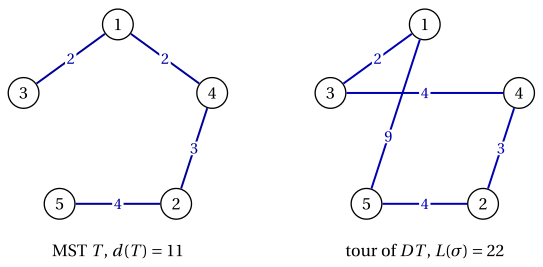
The Eulerian circuit of the doubled tree from city \(1\) is
Keeping each city at its first occurrence gives \(\sigma=(1,3,4,2,5)\), of length
The shortcuts replace \(3\to1\to4\) (\(2+2\)) by \(3\to4\) (\(4\)) and \(5\to2\to4\to1\) (\(4+3+2\)) by \(5\to1\) (\(9\)): on this instance both triangle inequalities used hold with equality, and shortcutting saves nothing. Hence \(DT(I)=22\) and \(\frac{DT(I)}{z(I)}=\frac{22}{18}=\frac{11}{9}\).
39.3.2 The Christofides algorithm
The Christofides Algorithm (denoted by \(CH\)) is a constructive heuristic for the metric TSP. It computes a minimum spanning tree \(T\) and, instead of doubling it, adds to \(T\) a minimum weight perfect matching \(M\) on the cities of odd degree in \(T\); then it follows an Eulerian circuit of \(T\cup M\) and shortcuts it into a tour.
Algorithm: Christofides
-
Why \(|O|\) is even. The degrees of a graph sum up to twice the number of edges, an even number, so the number of vertices of odd degree is even, and a perfect matching of \(O\) exists (the graph is complete).
-
Why \(T\cup M\) has even degrees. Each city of \(O\) gets exactly one more edge from \(M\), and the other cities none. If an edge belongs to both \(T\) and \(M\), \(D\) contains two copies of it.
-
A minimum weight perfect matching can be computed in polynomial time, \(O(n^3)\), with Edmonds' blossom algorithm; in the examples and exercises \(|O|\le 4\) and the matchings are enumerated (\(|O|=4\) gives \(3\) perfect matchings).
Example 39.2: \(CH\) on the TSP reference instance
The MST is the one of Example 39.1, with degrees \(\deg(1)=2\), \(\deg(2)=2\), \(\deg(3)=1\), \(\deg(4)=2\), \(\deg(5)=1\). Hence \(O=\{3,5\}\) and the only perfect matching is \(M=\{\{3,5\}\}\), with \(d(M)=7\).
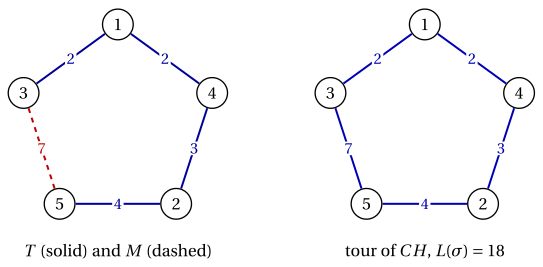
\(T\cup M\) is a cycle through all the cities. Fleury's rule from city \(1\) (neighbours \(3\) and \(4\)) goes to \(3\) and gives \(W=(1,3,5,2,4,1)\), of length \(d(T)+d(M)=11+7=18\), in which no city is repeated: no shortcut is needed and \(\sigma=(1,3,5,2,4)\), with \(CH(I)=18=z(I)\). On the reference instance \(CH\) finds the optimal tour, while \(DT\) is \(4\) units above it.
39.4 Structural properties
- The guarantees of the next section compare the length of a heuristic tour with a lower bound on \(z(I)\). We need three properties: shortcutting does not increase the length, an MST is shorter than any tour, and so is (twice) a minimum perfect matching of an even set of cities.
Observation 39.3
In a metric TSP instance, let \(W\) be a closed walk that visits every city at least once, and let \(\sigma\) be the tour obtained from \(W\) by shortcutting. Then \(L(\sigma)\le\) length of \(W\).
Proof
Each edge \(\{\sigma_k,\sigma_{k+1}\}\) of the tour (and the closing edge \(\{\sigma_n,\sigma_1\}\)) replaces a stretch \(\sigma_k=u_0,u_1,\dots,u_q=\sigma_{k+1}\) of \(W\) whose inner cities are skipped. Applying the triangle inequality \(\eqref{eq:triangle}\) \(q-1\) times,
The stretches are disjoint parts of \(W\), so summing over all the edges of \(\sigma\) gives \(L(\sigma)\le\) length of \(W\). □
Observation 39.4
For every TSP instance (metric or not) and every minimum spanning tree \(T\),
Proof
Removing any edge from an optimal tour leaves a path through all the cities, which is a spanning tree. Its weight is \(z(I)\) minus the removed distance, at most \(z(I)\) since distances are positive, and the MST weighs no more than any spanning tree. □
Observation 39.5
In a metric TSP instance, let \(O\subseteq\mathscr{V}\) with \(|O|\) even and \(|O|\ge 2\), and let \(M\) be a minimum weight perfect matching of \(O\). Then
Proof
Let \(\tilde\sigma\) be an optimal tour and shortcut it to the cities of \(O\): we obtain a cycle \(o_1,o_2,\dots,o_{|O|},o_1\) through the cities of \(O\) which, by Observation 39.3, has length at most \(z(I)\). Since \(|O|\) is even, its edges split into two perfect matchings of \(O\), taking alternately one edge each:
Hence \(d(M_1)+d(M_2)\le z(I)\), one of the two weighs at most \(\frac{z(I)}{2}\), and \(d(M)\le \min\{d(M_1),d(M_2)\}\le\frac{z(I)}{2}\). (For \(|O|=2\) the cycle is the edge \(\{o_1,o_2\}\) travelled twice and \(M_1=M_2\).) □
-
The last property we need is classical: a connected multigraph in which every vertex has even degree has an Eulerian circuit (a classical result of Euler), and Fleury's rule finds one. The doubled tree of \(DT\) and the multigraph \(T\cup M\) of \(CH\) are connected (they contain \(T\)) and have even degrees.
-
On the reference instance: \(d(T)=11\le 18\), and with \(O=\{3,5\}\) the optimal tour shortcut to \(O\) is \(3,5,3\), of length \(14\le18\), so \(d(M)=7\le 9\).
39.5 Performance guarantees
39.5.1 The worst case performance ratio of DT
Proposition 39.6
For every metric TSP instance \(I\),
Proof
The Eulerian circuit \(W\) of the doubled tree uses every edge of \(T\) twice, so its length is \(2\,d(T)\), and it visits every city because \(T\) is spanning. By Observation 39.3 and Observation 39.4,
□
Proposition 39.7
There are metric TSP instances \(I_n\), \(n\ge5\) odd, such that
Proof
Let \(n=2k+1\) with \(k\ge2\), \(a:=n\) and \(b:=n+1\). City \(1\) is a centre and the cities \(2,\dots,n\) are leaves; the leaves are joined by the path
whose consecutive cities never have consecutive indices (the differences are \(2\), and \(2k-1\ge3\) for the edge \(\{2k+1,2\}\)). The distances are
All distances lie between \(a\) and \(2a\), so \(d_{ij}\le 2a\le d_{ik}+d_{kj}\): the instance is metric.
\(DT\). The only distances equal to \(a\) are those from the centre, and a spanning tree has \(n-1\) edges, each of weight at least \(a\): the star centred at \(1\) is the unique MST, with \(d(T)=(n-1)a\). The depth-first visit from city \(1\) meets the leaves in increasing order, \(\sigma=(1,2,3,\dots,n)\), and no pair of consecutive leaves is an edge of \(P\):
Optimum. A tour has exactly two edges at city \(1\) (length \(a\) each) and \(n-2\) edges between leaves (length at least \(b\) each), so \(z(I_n)\ge 2a+(n-2)b\). The tour \((1,3,5,\dots,2k+1,2,4,\dots,2k)\) follows \(P\) and attains this value, hence
Therefore
□
From Proposition 39.6 and Proposition 39.7 it follows that \(DT\) is a \(2\)-approximation algorithm for the metric TSP, and that its worst case performance ratio is
-
For \(n=5\): \(a=5\), \(b=6\), \(P=(3,5,2,4)\), \(DT(I_5)=40\), \(z(I_5)=28\) and the ratio is \(\frac{10}{7}\); for \(n=7\) and \(n=9\) the ratios are \(\frac{14}{9}\) and \(\frac{18}{11}\).
-
On the reference instance \(DT(I)=22=2\,d(T)\): the upper bound of the proof is attained, but \(z(I)=18>d(T)=11\), and the ratio is only \(\frac{11}{9}\).
-
The analysis of \(DT\) is due to Rosenkrantz, Stearns and Lewis (1977).
39.5.2 The worst case performance ratio of CH
Proposition 39.8
For every metric TSP instance \(I\),
Proof
The Eulerian circuit \(W\) of \(T\cup M\) uses every edge once, so its length is \(d(T)+d(M)\), and it visits every city. By Observation 39.3, Observation 39.4 and Observation 39.5 (with the set \(O\) of odd-degree cities, \(|O|\ge2\) because a tree with at least two vertices has at least two leaves),
□
Proposition 39.9
There are metric TSP instances \(I_n\), \(n\ge5\) odd, such that
Proof
Let \(n\ge5\) be odd, \(a:=n\) and \(b:=n+1\), so that \(a<b<2a\). Consider the graph \(H\) on the cities \(1,\dots,n\) with the edges \(\{i,i+1\}\) of length \(a\) and \(\{i,i+2\}\) of length \(b\) (a strip of triangles), and let \(d_{ij}\) be the length of a shortest path from \(i\) to \(j\) in \(H\); shortest path distances always satisfy the triangle inequality. A path from \(i\) to \(j>i\) advances by \(1\) (cost \(a\)) or by \(2\) (cost \(b\)) at each edge, and since \(b<2a\) it is best to advance by \(2\) as much as possible:
\(CH\). The distances equal to \(a\) are exactly those between consecutive cities, so, as in the previous proof, the path \(T=\{\{1,2\},\{2,3\},\dots,\{n-1,n\}\}\) is the unique MST, with \(d(T)=(n-1)a\).
Its odd-degree cities are \(O=\{1,n\}\), so \(M=\{\{1,n\}\}\), with \(d(M)=\frac{n-1}{2}b\). \(T\cup M\) is the cycle \(1,2,\dots,n,1\), Fleury's rule follows it from city \(1\) towards city \(2\), and no shortcut is needed:
An upper bound on the optimum. The tour \((1,3,5,\dots,n,n-1,n-3,\dots,2)\) uses \(n-2\) edges of length \(b\) and the two edges \(\{n,n-1\}\) and \(\{2,1\}\) of length \(a\), so
Together with Proposition 39.8,
□
From Proposition 39.8 and Proposition 39.9 it follows that \(CH\) is a \(\frac32\)-approximation algorithm for the metric TSP, and that its worst case performance ratio is
-
For \(n=5,7,9\) the enumeration of all the tours shows that the upper bound on \(z(I_n)\) is the optimum (\(28\), \(54\), \(88\)), and the ratios are \(\frac{32}{28}=\frac87\), \(\frac{66}{54}=\frac{11}{9}\), \(\frac{112}{88}=\frac{14}{11}\).
-
The algorithm was found independently by Christofides (1976) and Serdyukov (1978). For more than forty years no polynomial algorithm with a better constant was known for the metric TSP; the first improvement, by an extremely small constant, is a randomized algorithm by Karlin, Klein and Oveis Gharan (2021).
39.6 Sources
-
D.J. Rosenkrantz, R.E. Stearns, P.M. Lewis II, An analysis of several heuristics for the traveling salesman problem, SIAM Journal on Computing 6(3):563–581, 1977.
-
N. Christofides, Worst-case analysis of a new heuristic for the travelling salesman problem, Report 388, Carnegie-Mellon University, 1976.
-
A.I. Serdyukov, On some extremal walks in graphs, Upravlyaemye Sistemy 17:76–79, 1978.
-
S. Sahni, T. Gonzalez, P-complete approximation problems, Journal of the ACM 23(3):555–565, 1976.
-
R.M. Karp, Reducibility among combinatorial problems, in Complexity of Computer Computations, Plenum Press, 85–103, 1972.
39.7 Typical mistakes
Warning
-
Applying \(DT\) or \(CH\) to a non-metric instance. The guarantees \(2\) and \(\frac{3}{2}\) use the triangle inequality, in the shortcutting step; without it no constant guarantee exists.
-
Shortcutting a city that is visited for the first time. Following the Eulerian circuit, a city is skipped only if it has already been visited; the first occurrence is kept.
-
Matching the wrong cities in \(CH\). The perfect matching is computed on the cities of odd degree in the spanning tree, whose number is even, and has minimum weight.
39.8 In summary
In summary
-
The general TSP is not approximable: an algorithm with a constant guarantee would decide the Hamiltonian cycle problem in polynomial time.
-
The metric TSP is the special case that approximates. The guarantees of \(DT\) and \(CH\) are proved with lower bounds on \(z(I)\): the minimum spanning tree and half of the minimum perfect matching; shortcutting, which uses the triangle inequality, turns the Eulerian circuit into a tour that is not longer.
-
Both ratios are tight, with families of instances built in this chapter.
| problem | algorithm | worst case ratio |
|---|---|---|
| general TSP | any polynomial | no constant, unless \(P=NP\) |
| metric TSP | \(DT\) | \(2\) (tight) |
| metric TSP | \(CH\) | \(\frac32\) (tight) |
Dashboard of the reference instance. The bounds on \(z(I)\) found so far:
| Instance | Lower bound | Heuristic values | Optimal value |
|---|---|---|---|
| metric TSP, \(5\) cities | \(11\), minimum spanning tree | \(DT\) \(22\), \(CH\) \(18\) | \(18\) |
Exercises on this chapter: Travelling salesman (TSP)
In the interactive lab: Metric TSP: double tree and Christofides.