Maximum clique: limits of approximation
Part 5 · Approximation algorithms · Chapter 38 · Lecture notes, volume 5 (PDF) · Slides · Exercises: Maximum clique (MCP)
Prerequisites
-
From this module, the chapter «Principles of approximation algorithms»: performance ratio for a maximization problem, \(\alpha\)-approximation algorithm, PTAS.
-
From this module, the chapter «Clique problems»: the definitions of the MCP and of the MSSP, the clique number \(\omega(G)\), the complement graph and \(\omega(G)=\alpha(\overline{G})\).
-
From this module, the chapter «Vertex coloring: limits of approximation»: planar graphs and the bound \(m\le 3n-6\).
Objectives
At the end of this chapter you will be able to:
-
build the strong product of two graphs and prove \(\omega(G\boxtimes H)=\omega(G)\,\omega(H)\);
-
prove that a constant-ratio algorithm for the MCP would give one for every constant ratio;
-
state the results of Håstad and Zuckerman, and conclude that the MCP and the MSSP are not approximable;
-
solve the MCP exactly on planar graphs and on graphs of bounded degree, and approximate the MSSP on graphs of bounded degree.
The problem of this chapter is the maximum clique problem (MCP): its definition and its assumptions are on its page.
38.1 Notation
-
As on the problem page, \(G=(V,E)\) is a simple graph with \(n\) vertices and \(m\) edges, \(N(v)\) is the set of the neighbours of \(v\) and \(\Delta(G)\) the maximum degree. The optimal value of the MCP is the clique number, \(z(I)=\omega(G)\), and that of the MSSP is the stability number \(\alpha(G)\).
-
Recall. As in the chapter «Principles of approximation algorithms», \(\mathscr{A}(I)\) is the number of vertices of the clique returned by the algorithm \(\mathscr{A}\). The MCP is a maximization problem, hence
\[ \mathscr{A}(I) \le \omega(G) ~~~~~~~\text{and}~~~~~~~ \frac{\omega(G)}{\mathscr{A}(I)} \ge 1 \]for every instance \(I\).
-
A single vertex is a clique, so the ratio \(n\) is trivial. This chapter shows that a polynomial algorithm cannot do much better on all graphs, and then the classes of graphs on which it can.
38.2 The MCP is not approximable
38.2.1 The strong product
Definition 38.1: strong product
The strong product of two graphs \(G=(V,E)\) and \(H=(W,F)\) is the graph \(G\boxtimes H\) with vertex set \(V\times W\), in which two distinct vertices \((u,x)\) and \((v,y)\) are adjacent if and only if
-
\(G\boxtimes H\) has \(|V|\,|W|\) vertices and is built in time polynomial in the size of \(G\) and \(H\). In particular \(G\boxtimes G\) has \(n^2\) vertices.
-
For a set \(K\subseteq V\times W\), the projection is \(p(K)=\{u\in V:(u,x)\in K \text{ for some } x\}\), and the fibre of \(u\in p(K)\) is \(K_u=\{x\in W:(u,x)\in K\}\).
Proposition 38.2
For every two graphs \(G\) and \(H\):
-
if \(K\subseteq V\times W\) is a clique of \(G\boxtimes H\), then \(p(K)\) is a clique of \(G\), every fibre \(K_u\) is a clique of \(H\), and \(|K|\le|p(K)|\cdot\max_{u}|K_u|\);
-
\(\omega(G\boxtimes H)=\omega(G)\,\omega(H)\).
Proof
Part 1. Let \(u\neq v\) be in \(p(K)\), with \((u,x),(v,y)\in K\). These two vertices are adjacent and \(u\neq v\), so \(\{u,v\}\in E\): \(p(K)\) is a clique. Let \(x\neq y\) be in \(K_u\): \((u,x)\) and \((u,y)\) are adjacent, so \(\{x,y\}\in F\), and \(K_u\) is a clique. The fibres split \(K\), hence
Part 2. If \(K_G\) and \(K_H\) are maximum cliques of \(G\) and \(H\), every two distinct vertices of \(K_G\times K_H\) satisfy the definition, so \(\omega(G\boxtimes H)\ge\omega(G)\,\omega(H)\). Conversely, by Part 1 every clique \(K\) of \(G\boxtimes H\) has \(|K|\le|p(K)|\cdot\max_u|K_u|\le\omega(G)\,\omega(H)\). □
- The lexicographic product also satisfies \(\omega(G[H])=\omega(G)\,\omega(H)\); we use the strong product, whose definition is symmetric in the two graphs.
38.2.2 A constant ratio would give every constant ratio
- Part 1 of Proposition 38.2 is constructive: from a clique \(K\) of \(G\boxtimes G\), either \(p(K)\) or the largest fibre is a clique of \(G\) with at least \(\sqrt{|K|}\) vertices, since the product of their sizes is at least \(|K|\). Both are computed in polynomial time.
Theorem 38.3
If the MCP has a polynomial \(\alpha\)-approximation algorithm for some constant \(\alpha\ge1\), then it has a polynomial \(\beta\)-approximation algorithm for every constant \(\beta>1\).
Proof
Let \(\mathscr{A}\) be a polynomial \(\alpha\)-approximation algorithm, and define the algorithm \(\mathscr{B}\):
-
build \(G\boxtimes G\) and run \(\mathscr{A}\) on it, obtaining a clique \(K\);
-
return the larger of \(p(K)\) and of the largest fibre of \(K\), a clique of \(G\) with at least \(\sqrt{|K|}\) vertices.
By Proposition 38.2, \(\omega(G\boxtimes G)=\omega(G)^2\), so \(|K|\ge\frac{\omega(G)^2}{\alpha}\) and
\(\mathscr{B}\) is a polynomial \(\sqrt{\alpha}\)-approximation algorithm. Applying the construction \(t\) times gives the ratio \(\alpha^{1/2^t}\), with \(\mathscr{A}\) run on a graph with \(n^{2^t}\) vertices. Choose the constant \(t\) with \(2^t\ge\frac{\ln\alpha}{\ln\beta}\): then \(\alpha^{1/2^t}\le\beta\), and \(n^{2^t}\) is a polynomial. □
- In other words, the MCP has a constant-ratio algorithm if and only if it has a PTAS: the strong product amplifies any constant ratio. The running time grows like a power \(n^{2^t}\), which is polynomial only because \(t\) is a constant.
38.2.3 The results of Håstad and Zuckerman
- The negative side is known, and we state it without proof: it uses probabilistically checkable proofs.
Theorem 38.4: Håstad, 1999; Zuckerman, 2007
For every \(\varepsilon>0\), if \(P\neq NP\), no polynomial algorithm \(\mathscr{A}\) for the MCP satisfies, for every graph \(G\) with \(n\) vertices,
-
Håstad (1999) proved the theorem under the assumption that NP problems cannot be solved in randomized polynomial time (\(NP\neq ZPP\)); Zuckerman (2007) proved it under \(P\neq NP\).
-
As for the VCP, the theorem excludes every constant ratio: an \(\alpha\)-approximation algorithm has ratio at most \(\alpha<n^{1/2}\) on the graphs with \(n>\alpha^2\) vertices, and the smaller graphs are solved by enumeration in constant time. Combined with Theorem 38.3: unless \(P=NP\), the MCP has neither a constant ratio nor a PTAS.
The MCP is not approximable: unless \(P=NP\), no polynomial algorithm has a constant performance guarantee, not even a guarantee of the form \(n^{1-\varepsilon}\). Positive results exist only on special classes of graphs.
38.3 Special cases
38.3.1 Planar graphs
Proposition 38.5
Every planar graph has \(\omega(G)\le 4\), and on planar graphs the MCP is solved exactly in \(O(n^4)\) time.
Proof
A subgraph of a planar graph is planar. The complete graph with \(5\) vertices has \(10\) edges, more than \(3\cdot5-6=9\), so it is not planar, and a planar graph has no clique with \(5\) vertices. The subsets of at most \(4\) vertices are \(O(n^4)\), and each one is checked in constant time. □
38.3.2 Graphs of bounded maximum degree
Proposition 38.6
Every graph has \(\omega(G)\le\Delta(G)+1\), and the MCP is solved exactly in \(O(n\,2^{\Delta}\,\Delta^2)\) time, with \(\Delta=\Delta(G)\).
Proof
A clique that contains the vertex \(v\) is contained in \(\{v\}\cup N(v)\), which has at most \(\Delta+1\) vertices. For every vertex \(v\), enumerate the \(2^{\deg(v)}\le 2^\Delta\) subsets \(S\subseteq N(v)\) and keep the largest \(\{v\}\cup S\) that is a clique; checking the pairs of \(S\) takes \(O(\Delta^2)\) time. Every maximum clique is found from any of its vertices. □
- The time is polynomial for every fixed \(\Delta\), and even when \(\Delta\le\log_2 n\), since then \(2^\Delta\le n\).
38.3.3 The maximum stable set problem
-
By \(\omega(G)=\alpha(\overline{G})\) (chapter «Clique problems»), a stable set of \(G\) is a clique of \(\overline{G}\), which is built in \(O(n^2)\) time and has the same \(n\).
-
An algorithm with ratio \(\rho(n)\) for one of the two problems, applied to the complement graph, has the same ratio \(\rho(n)\) for the other one.
Corollary 38.7
For every \(\varepsilon>0\), if \(P\neq NP\), no polynomial algorithm for the MSSP has ratio \(\frac{\alpha(G)}{\mathscr{A}(I)}\le n^{1-\varepsilon}\) on every graph. In particular, the MSSP has no constant ratio.
- The special cases do not transfer: the complement of a planar graph, or of a graph of bounded degree, is dense. On those classes the MSSP remains NP-hard, but it is approximable.
Proposition 38.8
On every graph, a maximal stable set \(S\) (no vertex can be added to it) has \(|S|\ge\frac{n}{\Delta(G)+1}\). Hence the greedy algorithm that adds vertices while possible satisfies
Proof
Every vertex outside \(S\) has a neighbour in \(S\), otherwise it could be added. Hence \(V=\bigcup_{v\in S}\big(\{v\}\cup N(v)\big)\), and \(n\le|S|\,(\Delta(G)+1)\). Since \(\alpha(G)\le n\), the ratio is at most \(\frac{n}{|S|}\le\Delta(G)+1\). □
- On graphs of maximum degree at most a fixed \(\Delta\) this is a constant ratio. On planar graphs the MSSP even has a PTAS (Baker, 1994).
38.4 Example
Example 38.1: Strong product and enumeration on the MCP reference instance
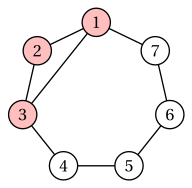
The reference instance of the MCP is the cycle \(1,2,\dots,7,1\) with the chord \(\{1,3\}\): \(n=7\), \(m=8\), \(\Delta(G)=3\) and \(\omega(G)=3\), with the unique maximum clique \(\{1,2,3\}\) (in red).
-
Strong product. \(G\boxtimes G\) has \(7^2=49\) vertices and \(240\) edges, and \(\omega(G\boxtimes G)=3^2=9\), attained by \(\{1,2,3\}\times\{1,2,3\}\).
-
Suppose an algorithm returns on \(G\boxtimes G\) the clique \(K=\{1,2,3\}\times\{4,5\}\), with \(|K|=6\). Its projection \(p(K)=\{1,2,3\}\) and its fibres \(K_u=\{4,5\}\) are cliques of \(G\); the larger one has \(3\ge\sqrt6\) vertices.
-
Bounded degree. The enumeration of Proposition 38.6 examines \(\sum_v 2^{\deg(v)}=2^3+2^2+2^3+4\cdot 2^2=36\) subsets, and finds \(\{1,2,3\}\) from the vertices \(1\), \(2\) and \(3\).
-
Planarity. The graph is planar, as the figure shows, and \(\omega(G)=3\le 4\).
38.5 Sources
-
M.R. Garey, D.S. Johnson, Computers and Intractability: A Guide to the Theory of NP-Completeness, W.H. Freeman, 1979 (the self-improvement of the MCP by graph products).
-
J. Håstad, Clique is hard to approximate within \(n^{1-\varepsilon}\), Acta Mathematica 182(1):105–142, 1999.
-
D. Zuckerman, Linear degree extractors and the inapproximability of max clique and chromatic number, Theory of Computing 3:103–128, 2007.
-
B.S. Baker, Approximation algorithms for NP-complete problems on planar graphs, Journal of the ACM 41(1):153–180, 1994.
38.6 Typical mistakes
Warning
-
Inverting the ratio. The MCP is a maximization problem: the ratio is \(\frac{\omega(G)}{\mathscr{A}(I)}\), at least \(1\).
-
Iterating the product a number of times that grows with \(n\). The graph after \(t\) products has \(n^{2^t}\) vertices: polynomial only for a constant \(t\), so the amplification gives every constant ratio, not the ratio \(1\).
-
Transferring the special cases to the MSSP. The complement of a planar graph is not planar: the MCP is easy on planar graphs, the MSSP is NP-hard there.
-
Confusing the bound \(\Delta(G)+1\) of the MCP with that of the MSSP. For the MCP, \(\omega(G)\le\Delta(G)+1\) bounds the optimum and makes enumeration fast; for the MSSP, \(\Delta(G)+1\) bounds the ratio of a maximal stable set.
38.7 In summary
In summary
-
The strong product squares the clique number, and a clique of the product gives back a clique of \(G\) of at least the square root of its size: a constant ratio for the MCP would give every constant ratio.
-
By the results of Håstad and Zuckerman, unless \(P=NP\) not even the ratio \(n^{1-\varepsilon}\) is possible: the MCP is not approximable, and neither is the MSSP, through the complement graph.
-
On planar graphs and on graphs of bounded degree the MCP is solved exactly by enumeration; on graphs of bounded degree a maximal stable set has ratio at most \(\Delta(G)+1\) for the MSSP.
| problem and graphs | algorithm | result |
|---|---|---|
| MCP, all graphs | any polynomial | no constant ratio, unless \(P=NP\) |
| MCP, planar | enumeration | exact, \(\omega(G)\le4\) |
| MCP, maximum degree \(\le\Delta\) | enumeration | exact, \(O(n\,2^\Delta\Delta^2)\) |
| MSSP, all graphs | any polynomial | no constant ratio, unless \(P=NP\) |
| MSSP, maximum degree \(\le\Delta\) | maximal stable set | ratio \(\le\Delta+1\) |
Dashboard of the reference instance.
| Instance | Upper bound | Value found | Optimal value |
|---|---|---|---|
| cycle with a chord | \(\Delta(G)+1=4\) | \(3\), enumeration | \(3\) |
Exercises on this chapter: Maximum clique (MCP)