Exercises · Formulations of clique problems
Exercises · Chapter 12 · each solution opens with a click · Chapter 12: Clique problems · Exercises, volume 2 (PDF)
Formulations used in these exercises. The models of the chapter Formulations of clique problems, where \(\overline{E}\) is the set of non-edges of \(G\) and \(\mathcal{Q}\) the set of the maximal stable sets of \(G\) (the maximal cliques of the complement graph). The edge formulation \(\mathrm{ILP}_{\mathrm{MCP}}\):
The clique formulation \(\mathrm{ILP}^{\mathrm{CL}}_{\mathrm{MCP}}\):
The relaxation \(\mathrm{LP}_{\mathrm{MCP}}\) relaxes (M2) into \(0\le x_v\le 1\); the relaxation \(\mathrm{LP}^{\mathrm{CL}}_{\mathrm{MCP}}\) relaxes (M5) into \(x_v\ge 0\), since (M4) gives \(x_v\le 1\). The models \(\mathrm{ILP}_{\mathrm{MSSP}}\) and \(\mathrm{ILP}^{\mathrm{CL}}_{\mathrm{MSSP}}\) of the MSSP are (M0)–(M2) with (M1) written on the edges of \(G\), and (M3)–(M5) with (M4) written on the maximal cliques of \(G\). The model \(\mathrm{ILP}^{\mathrm{VW}}_{\mathrm{MCP}}\) of the VWMCP is (M0)–(M2) with the objective function \(\max \sum_{v\in V} w_v\,x_v\). The model \(\mathrm{ILP}^{\mathrm{EW}}_{\mathrm{MCP}}\) of the EWMCP adds a binary variable \(y_{uv}\) for each edge \(\{u,v\}\in E\):
Exercise 12.1: ILP model of the Maximum Clique Problem (MCP)
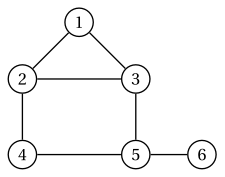
We consider the graph \(G=(V,E)\) with \(V=\{1,\dots,6\}\) and the \(7\) edges
Questions
-
Write the non-edges of \(G\). How many variables and constraints does the \(\mathrm{ILP}_{\mathrm{MCP}}\) model have?
-
Write the \(\mathrm{ILP}_{\mathrm{MCP}}\) model of \(G\).
-
Solve the model with Gurobi: give \(z(\mathrm{ILP}_{\mathrm{MCP}})\) and the optimal solution. Is it unique?
-
Which ILP model of the Maximum Stable Set Problem on \(\overline{G}\) do you obtain? Explain.
Solution
-
\(G\) has \(\binom{6}{2}-7=8\) non-edges:
\[ \overline{E}=\{\{1,4\},~\{1,5\},~\{1,6\},~\{2,5\},~\{2,6\},~\{3,4\},~\{3,6\},~\{4,6\}\}. \]The model has \(n=6\) binary variables and one constraint per non-edge: \(8\) linear constraints.
-
The \(\mathrm{ILP}_{\mathrm{MCP}}\) model is:
\[ \begin{array}{rrrrrrrcl} {\max} & {x_1} & {+\,x_2} & {+\,x_3} & {+\,x_4} & {+\,x_5} & {+\,x_6} \\[1ex] \text{subject to} & {x_1} & & & {+\,x_4} & & & {\le} & {1} \\ & {x_1} & & & & {+\,x_5} & & {\le} & {1} \\ & {x_1} & & & & & {+\,x_6} & {\le} & {1} \\ & & {x_2} & & & {+\,x_5} & & {\le} & {1} \\ & & {x_2} & & & & {+\,x_6} & {\le} & {1} \\ & & & {x_3} & {+\,x_4} & & & {\le} & {1} \\ & & & {x_3} & & & {+\,x_6} & {\le} & {1} \\ & & & & {x_4} & & {+\,x_6} & {\le} & {1} \\[1ex] & {x_1}, & {x_2}, & {x_3}, & {x_4}, & {x_5}, & {x_6} & {\in} & {\{0,1\}} \end{array} \] -
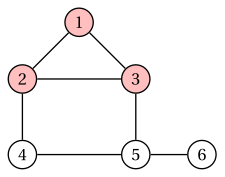
Gurobi returns \(z(\mathrm{ILP}_{\mathrm{MCP}})=3\) with \(\tilde x_1=\tilde x_2=\tilde x_3=1\) and \(\tilde x_4=\tilde x_5=\tilde x_6=0\): the clique \(\{1,2,3\}\). The enumeration of the cliques shows that it is the only triangle, and no clique has \(4\) vertices (only vertices \(2\), \(3\) and \(5\) have degree \(3\)). The optimal solution is unique.
-
The same model: its constraints are written on the edges of \(\overline{G}\), whose edge set is \(\overline{E}\), and \(x_u+x_v\le 1\) says that at most one endpoint of every edge of \(\overline{G}\) is selected. It is the edge formulation of the MSSP on \(\overline{G}\), and \(\alpha(\overline{G})=\omega(G)=3\).
Exercise 12.2: The complement graph and the clique formulation (MCP)
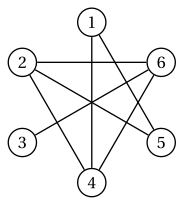
We consider the graph \(G=(V,E)\) with \(V=\{1,\dots,6\}\) and the \(7\) edges
Questions
-
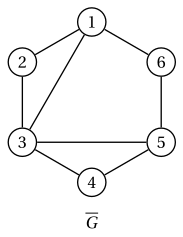
Write the edges of the complement graph \(\overline{G}\) and draw it next to \(G\).
-
List the maximal cliques of \(\overline{G}\).
-
Write the clique formulation \(\mathrm{ILP}^{\mathrm{CL}}_{\mathrm{MCP}}\) and compare its number of constraints with the \(\mathrm{ILP}_{\mathrm{MCP}}\) model.
-
Show that every constraint of \(\mathrm{ILP}_{\mathrm{MCP}}\) is implied by a constraint of \(\mathrm{ILP}^{\mathrm{CL}}_{\mathrm{MCP}}\).
-
Solve both models with Gurobi and give a maximum clique of \(G\).
Solution
-
\(\overline{G}\) has the \(\binom{6}{2}-7=8\) non-edges of \(G\):
\[ \overline{E}=\{\{1,2\},~\{1,3\},~\{1,6\},~\{2,3\},~\{3,4\},~\{3,5\},~\{4,5\},~\{5,6\}\}. \]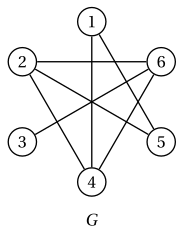
-
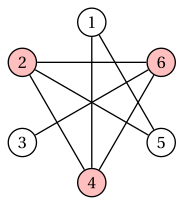
The maximal cliques of \(\overline{G}\) are the two triangles \(\{1,2,3\}\) and \(\{3,4,5\}\), which share vertex \(3\), and the two edges \(\{1,6\}\) and \(\{5,6\}\): vertex \(6\) is adjacent in \(\overline{G}\) only to \(1\) and \(5\), which are not adjacent there.
-
The clique formulation has one constraint per maximal clique of \(\overline{G}\):
\[ \begin{array}{rrrrrrrcl} {\max} & {x_1} & {+\,x_2} & {+\,x_3} & {+\,x_4} & {+\,x_5} & {+\,x_6} \\[1ex] \text{subject to} & {x_1} & {+\,x_2} & {+\,x_3} & & & & {\le} & {1} \\ & & & {x_3} & {+\,x_4} & {+\,x_5} & & {\le} & {1} \\ & {x_1} & & & & & {+\,x_6} & {\le} & {1} \\ & & & & & {x_5} & {+\,x_6} & {\le} & {1} \\[1ex] & {x_1}, & {x_2}, & {x_3}, & {x_4}, & {x_5}, & {x_6} & {\in} & {\{0,1\}} \end{array} \]It has \(4\) constraints, against the \(8\) constraints of \(\mathrm{ILP}_{\mathrm{MCP}}\) (one per edge of \(\overline{G}\)).
-
Every edge of \(\overline{G}\) lies in a maximal clique, and the variables are non-negative:
constraint of \(\mathrm{ILP}_{\mathrm{MCP}}\) implied by \(x_1+x_2\le 1\) \(x_1+x_2+x_3\le 1\) \(x_1+x_3\le 1\) \(x_1+x_2+x_3\le 1\) \(x_1+x_6\le 1\) \(x_1+x_6\le 1\) \(x_2+x_3\le 1\) \(x_1+x_2+x_3\le 1\) \(x_3+x_4\le 1\) \(x_3+x_4+x_5\le 1\) \(x_3+x_5\le 1\) \(x_3+x_4+x_5\le 1\) \(x_4+x_5\le 1\) \(x_3+x_4+x_5\le 1\) \(x_5+x_6\le 1\) \(x_5+x_6\le 1\) -
Both models give the optimal value \(3\), with the clique \(\{2,4,6\}\) of \(G\): it is a stable set of \(\overline{G}\), and it is the unique maximum clique (enumeration).
Exercise 12.3: LP bounds: edge versus clique formulation (MCP)
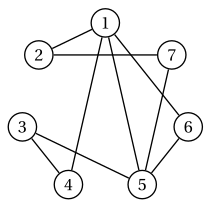
We consider the graph \(G=(V,E)\) with \(V=\{1,\dots,7\}\) and the \(9\) edges
Questions
-
Write the \(\mathrm{LP}_{\mathrm{MCP}}\) model (edge formulation with \(0\le x_v\le 1\)). Show that \(\bar x_v=\frac{1}{2}\) for every vertex is feasible, and compute \(z(\mathrm{LP}_{\mathrm{MCP}})\) with Gurobi.
-
List the maximal cliques of \(\overline{G}\) and write the \(\mathrm{LP}^{\mathrm{CL}}_{\mathrm{MCP}}\) model.
-
Is the point \(\bar x_v=\frac{1}{2}\) feasible for \(\mathrm{LP}^{\mathrm{CL}}_{\mathrm{MCP}}\)? Compute \(z(\mathrm{LP}^{\mathrm{CL}}_{\mathrm{MCP}})\) with Gurobi, and prove the value by summing some constraints.
-
Find \(\omega(G)\) and compare the two LP bounds.
Solution
-
The \(12\) non-edges give the model
\[ \begin{array}{rrrrrrrrcl} {\max} & {x_1} & {+\,x_2} & {+\,x_3} & {+\,x_4} & {+\,x_5} & {+\,x_6} & {+\,x_7} \\[1ex] \text{subject to} & {x_1} & & {+\,x_3} & & & & & {\le} & {1} \\ & {x_1} & & & & & & {+\,x_7} & {\le} & {1} \\ & & {x_2} & {+\,x_3} & & & & & {\le} & {1} \\ & & {x_2} & & {+\,x_4} & & & & {\le} & {1} \\ & & {x_2} & & & {+\,x_5} & & & {\le} & {1} \\ & & {x_2} & & & & {+\,x_6} & & {\le} & {1} \\ & & & {x_3} & & & {+\,x_6} & & {\le} & {1} \\ & & & {x_3} & & & & {+\,x_7} & {\le} & {1} \\ & & & & {x_4} & {+\,x_5} & & & {\le} & {1} \\ & & & & {x_4} & & {+\,x_6} & & {\le} & {1} \\ & & & & {x_4} & & & {+\,x_7} & {\le} & {1} \\ & & & & & & {x_6} & {+\,x_7} & {\le} & {1} \\ & {x_1} & & & & & & & {\le} & {1} \\ & & {x_2} & & & & & & {\le} & {1} \\ & & & {x_3} & & & & & {\le} & {1} \\ & & & & {x_4} & & & & {\le} & {1} \\ & & & & & {x_5} & & & {\le} & {1} \\ & & & & & & {x_6} & & {\le} & {1} \\ & & & & & & & {x_7} & {\le} & {1} \\[1ex] & {x_1}, & {x_2}, & {x_3}, & {x_4}, & {x_5}, & {x_6}, & {x_7} & {\ge} & {0} \end{array} \]With \(\bar x_v=\frac{1}{2}\) every constraint reads \(\frac{1}{2}+\frac{1}{2}=1\le 1\), and the value is \(\frac{7}{2}\). Gurobi returns \(z(\mathrm{LP}_{\mathrm{MCP}})=\frac{7}{2}\): the point is optimal.
-
The \(6\) maximal cliques of \(\overline{G}\) (maximal stable sets of \(G\)) are \(\{1,3,7\}\), \(\{2,3,6\}\), \(\{2,4,5\}\), \(\{2,4,6\}\), \(\{3,6,7\}\), \(\{4,6,7\}\), and the model is
\[ \begin{array}{rrrrrrrrcl} {\max} & {x_1} & {+\,x_2} & {+\,x_3} & {+\,x_4} & {+\,x_5} & {+\,x_6} & {+\,x_7} \\[1ex] \text{subject to} & {x_1} & & {+\,x_3} & & & & {+\,x_7} & {\le} & {1} \\ & & {x_2} & {+\,x_3} & & & {+\,x_6} & & {\le} & {1} \\ & & {x_2} & & {+\,x_4} & {+\,x_5} & & & {\le} & {1} \\ & & {x_2} & & {+\,x_4} & & {+\,x_6} & & {\le} & {1} \\ & & & {x_3} & & & {+\,x_6} & {+\,x_7} & {\le} & {1} \\ & & & & {x_4} & & {+\,x_6} & {+\,x_7} & {\le} & {1} \\[1ex] & {x_1}, & {x_2}, & {x_3}, & {x_4}, & {x_5}, & {x_6}, & {x_7} & {\ge} & {0} \end{array} \] -
No: \(\bar x_1+\bar x_3+\bar x_7=\frac{3}{2}>1\). Gurobi returns \(z(\mathrm{LP}^{\mathrm{CL}}_{\mathrm{MCP}})=3\). The three constraints of \(\{1,3,7\}\), \(\{2,3,6\}\), \(\{2,4,5\}\) cover every vertex at least once; summing them, every variable appears with coefficient at least \(1\), so \(\sum_{v=1}^{7}x_v\le 3\) for every feasible point.
-
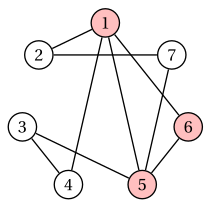
The triangle \(\{1,5,6\}\) is the unique maximum clique (enumeration), so \(\omega(G)=3\).
The edge formulation gives \(\frac{7}{2}\) (and \(\lfloor\frac{7}{2}\rfloor=3\) after rounding down, since \(\omega(G)\) is an integer); the clique formulation gives \(3\) directly, with no gap.
Exercise 12.4: Clique number, LP bound and chromatic number (MCP)
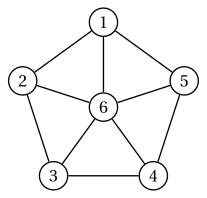
The wheel \(W_5\) has the vertices \(V=\{1,\dots,6\}\): the vertices \(1,\dots,5\) form a cycle, and vertex \(6\) is adjacent to all of them.
Questions
-
List the maximal stable sets of \(W_5\), that is, the maximal cliques of \(\overline{W_5}\).
-
Write the \(\mathrm{LP}^{\mathrm{CL}}_{\mathrm{MCP}}\) model and its dual \(D(\mathrm{LP}^{\mathrm{CL}}_{\mathrm{MCP}})\), and say which coloring formulation the dual relaxes.
-
Find a primal solution and a dual solution of value \(\frac{7}{2}\). What can you conclude?
-
Deduce \(\omega(W_5)\) and \(\chi(W_5)\) from the integrality of the two numbers, and write the chain of the chapter.
Solution
-
A stable set contains at most \(2\) vertices of the cycle, never two consecutive ones, and vertex \(6\) is adjacent to all the others. The maximal stable sets are \(\{1,3\}\), \(\{1,4\}\), \(\{2,4\}\), \(\{2,5\}\), \(\{3,5\}\), \(\{6\}\).
-
With one constraint per maximal stable set:
\[ \begin{array}{rrrrrrrcl} {\max} & {x_1} & {+\,x_2} & {+\,x_3} & {+\,x_4} & {+\,x_5} & {+\,x_6} \\[1ex] \text{subject to} & {x_1} & & {+\,x_3} & & & & {\le} & {1} \\ & {x_1} & & & {+\,x_4} & & & {\le} & {1} \\ & & {x_2} & & {+\,x_4} & & & {\le} & {1} \\ & & {x_2} & & & {+\,x_5} & & {\le} & {1} \\ & & & {x_3} & & {+\,x_5} & & {\le} & {1} \\ & & & & & & {x_6} & {\le} & {1} \\[1ex] & {x_1}, & {x_2}, & {x_3}, & {x_4}, & {x_5}, & {x_6} & {\ge} & {0} \end{array} \]With a non-negative dual variable \(\pi_Q\) per constraint (index \(Q\) written as its vertices), the dual \(D(\mathrm{LP}^{\mathrm{CL}}_{\mathrm{MCP}})\) is
\[ \begin{array}{rrrrrrrcl} {\min} & {\pi_{13}} & {+\,\pi_{14}} & {+\,\pi_{24}} & {+\,\pi_{25}} & {+\,\pi_{35}} & {+\,\pi_{6}} \\[1ex] \text{subject to} & {\pi_{13}} & {+\,\pi_{14}} & & & & & {\ge} & {1} \\ & & & {\pi_{24}} & {+\,\pi_{25}} & & & {\ge} & {1} \\ & {\pi_{13}} & & & & {+\,\pi_{35}} & & {\ge} & {1} \\ & & {\pi_{14}} & {+\,\pi_{24}} & & & & {\ge} & {1} \\ & & & & {\pi_{25}} & {+\,\pi_{35}} & & {\ge} & {1} \\ & & & & & & {\pi_{6}} & {\ge} & {1} \\[1ex] & {\pi_{13}}, & {\pi_{14}}, & {\pi_{24}}, & {\pi_{25}}, & {\pi_{35}}, & {\pi_{6}} & {\ge} & {0} \end{array} \]It is the LP relaxation of the stable set formulation \(\mathrm{ILP}^{\mathrm{ST}}_{\mathrm{VCP}}\) of the VCP, with the maximal stable sets: every vertex must be covered by a chosen stable set.
-
The primal point \(\bar x_1=\dots=\bar x_5=\frac{1}{2}\), \(\bar x_6=1\) satisfies all the constraints and has value \(\frac{5}{2}+1=\frac{7}{2}\). The dual point \(\bar\pi_Q=\frac{1}{2}\) for the five pairs and \(\bar\pi_{6}=1\) covers every vertex of the cycle with \(\frac{1}{2}+\frac{1}{2}=1\) and vertex \(6\) with \(1\), and has value \(\frac{7}{2}\). Equal values: by weak duality both are optimal, and \(z(\mathrm{LP}^{\mathrm{CL}}_{\mathrm{MCP}})=\frac{7}{2}\) (Gurobi agrees).
-
\(\omega(W_5)\le\frac{7}{2}\) and \(\omega(W_5)\) is an integer, so \(\omega(W_5)\le 3\); the triangle \(\{1,2,6\}\) gives \(\omega(W_5)=3\). \(\chi(W_5)\ge\frac{7}{2}\), so \(\chi(W_5)\ge 4\); the coloring \(\{1,3\},\{2,4\},\{5\},\{6\}\) gives \(\chi(W_5)=4\). The chain reads
\[ \omega(W_5)=3\;<\;z(\mathrm{LP}^{\mathrm{CL}}_{\mathrm{MCP}})=\frac{7}{2}\;<\;\chi(W_5)=4 . \]
Exercise 12.5: Feasibility in the two formulations (MCP)
We consider the cycle \(C_6\) with the vertices \(V=\{1,\dots,6\}\) and the edges \(\{1,2\},\{2,3\},\{3,4\},\{4,5\},\{5,6\},\{1,6\}\),
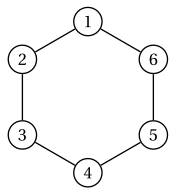
and the five points \(\vet{x}=(x_1,\dots,x_6)\):
Questions
-
Write the constraints of \(\mathrm{LP}_{\mathrm{MCP}}\) and of \(\mathrm{LP}^{\mathrm{CL}}_{\mathrm{MCP}}\) for \(C_6\).
-
For each point, decide whether it is feasible for \(\mathrm{LP}_{\mathrm{MCP}}\), for \(\mathrm{LP}^{\mathrm{CL}}_{\mathrm{MCP}}\) and for \(\mathrm{ILP}_{\mathrm{MCP}}\).
-
What do the values of the feasible points say about the two LP bounds?
-
Compute the two LP bounds with Gurobi and compare them with \(\omega(C_6)\).
Solution
-
With the \(9\) non-edge constraints, the \(\mathrm{LP}_{\mathrm{MCP}}\) model is
\[ \begin{array}{rrrrrrrcl} {\max} & {x_1} & {+\,x_2} & {+\,x_3} & {+\,x_4} & {+\,x_5} & {+\,x_6} \\[1ex] \text{subject to} & {x_1} & & {+\,x_3} & & & & {\le} & {1} \\ & {x_1} & & & {+\,x_4} & & & {\le} & {1} \\ & {x_1} & & & & {+\,x_5} & & {\le} & {1} \\ & & {x_2} & & {+\,x_4} & & & {\le} & {1} \\ & & {x_2} & & & {+\,x_5} & & {\le} & {1} \\ & & {x_2} & & & & {+\,x_6} & {\le} & {1} \\ & & & {x_3} & & {+\,x_5} & & {\le} & {1} \\ & & & {x_3} & & & {+\,x_6} & {\le} & {1} \\ & & & & {x_4} & & {+\,x_6} & {\le} & {1} \\ & {x_1} & & & & & & {\le} & {1} \\ & & {x_2} & & & & & {\le} & {1} \\ & & & {x_3} & & & & {\le} & {1} \\ & & & & {x_4} & & & {\le} & {1} \\ & & & & & {x_5} & & {\le} & {1} \\ & & & & & & {x_6} & {\le} & {1} \\[1ex] & {x_1}, & {x_2}, & {x_3}, & {x_4}, & {x_5}, & {x_6} & {\ge} & {0} \end{array} \]With one constraint per maximal stable set of \(C_6\), the \(\mathrm{LP}^{\mathrm{CL}}_{\mathrm{MCP}}\) model is
\[ \begin{array}{rrrrrrrcl} {\max} & {x_1} & {+\,x_2} & {+\,x_3} & {+\,x_4} & {+\,x_5} & {+\,x_6} \\[1ex] \text{subject to} & {x_1} & & {+\,x_3} & & {+\,x_5} & & {\le} & {1} \\ & & {x_2} & & {+\,x_4} & & {+\,x_6} & {\le} & {1} \\ & {x_1} & & & {+\,x_4} & & & {\le} & {1} \\ & & {x_2} & & & {+\,x_5} & & {\le} & {1} \\ & & & {x_3} & & & {+\,x_6} & {\le} & {1} \\[1ex] & {x_1}, & {x_2}, & {x_3}, & {x_4}, & {x_5}, & {x_6} & {\ge} & {0} \end{array} \] -
-
\(\bar{\vet x}^{a}\): feasible for \(\mathrm{LP}_{\mathrm{MCP}}\); the clique inequality of \(\{1,3,5\}\) gives \(\frac{3}{2}>1\), so infeasible for \(\mathrm{LP}^{\mathrm{CL}}_{\mathrm{MCP}}\) and \(\mathrm{ILP}_{\mathrm{MCP}}\).
-
\(\bar{\vet x}^{b}\): feasible for all three models: it is the clique \(\{1,2\}\).
-
\(\bar{\vet x}^{c}\): \(x_1+x_3=2>1\) violates a non-edge constraint: infeasible for all three models (every constraint of \(\mathrm{LP}_{\mathrm{MCP}}\) is implied by \(\mathrm{LP}^{\mathrm{CL}}_{\mathrm{MCP}}\)).
-
\(\bar{\vet x}^{d}\): feasible for \(\mathrm{LP}_{\mathrm{MCP}}\) and \(\mathrm{LP}^{\mathrm{CL}}_{\mathrm{MCP}}\), not for \(\mathrm{ILP}_{\mathrm{MCP}}\) (fractional).
-
\(\bar{\vet x}^{e}\): feasible for \(\mathrm{LP}_{\mathrm{MCP}}\) and \(\mathrm{LP}^{\mathrm{CL}}_{\mathrm{MCP}}\), not for \(\mathrm{ILP}_{\mathrm{MCP}}\) (fractional).
-
-
\(\bar{\vet x}^{a}\) has value \(3\), so \(z(\mathrm{LP}_{\mathrm{MCP}})\ge 3\). In \(\mathrm{LP}^{\mathrm{CL}}_{\mathrm{MCP}}\) the best feasible point among the five is \(\bar{\vet x}^{e}\), of value \(2\); \(\bar{\vet x}^{d}\) has value \(\frac{3}{2}\) and \(\bar{\vet x}^{b}\) has value \(2\).
-
Gurobi returns \(z(\mathrm{LP}_{\mathrm{MCP}})=3\) and \(z(\mathrm{LP}^{\mathrm{CL}}_{\mathrm{MCP}})=2\). The second value is proved by summing the constraints of \(\{1,3,5\}\) and \(\{2,4,6\}\), which give \(\sum_{v=1}^{6}x_v\le 2\). \(C_6\) has no triangle, so \(\omega(C_6)=2\): the clique formulation closes the gap, the edge formulation leaves \(3\) against \(2\).
Exercise 12.6: ILP models of the Maximum Stable Set Problem (MSSP)
We consider the graph \(G=(V,E)\) with \(V=\{1,\dots,6\}\) and the \(7\) edges
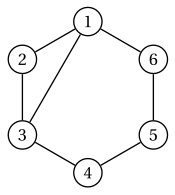
We look for a maximum stable set of \(G\).
Questions
-
How many variables and constraints does the edge formulation \(\mathrm{ILP}_{\mathrm{MSSP}}\) of \(G\) have? Write it.
-
Solve the model with Gurobi: give \(z(\mathrm{ILP}_{\mathrm{MSSP}})\) and an optimal solution. Is it unique?
-
Write the maximal cliques of \(G\) and the clique formulation \(\mathrm{ILP}^{\mathrm{CL}}_{\mathrm{MSSP}}\).
-
Compare the optimal values of the LP relaxations of the two formulations (Gurobi).
Solution
-
There are \(n=6\) binary variables and one constraint \(x_u+x_v\le 1\) per edge of \(G\): \(7\) linear constraints. The \(\mathrm{ILP}_{\mathrm{MSSP}}\) model is:
\[ \begin{array}{rrrrrrrcl} {\max} & {x_1} & {+\,x_2} & {+\,x_3} & {+\,x_4} & {+\,x_5} & {+\,x_6} \\[1ex] \text{subject to} & {x_1} & {+\,x_2} & & & & & {\le} & {1} \\ & {x_1} & & {+\,x_3} & & & & {\le} & {1} \\ & {x_1} & & & & & {+\,x_6} & {\le} & {1} \\ & & {x_2} & {+\,x_3} & & & & {\le} & {1} \\ & & & {x_3} & {+\,x_4} & & & {\le} & {1} \\ & & & & {x_4} & {+\,x_5} & & {\le} & {1} \\ & & & & & {x_5} & {+\,x_6} & {\le} & {1} \\[1ex] & {x_1}, & {x_2}, & {x_3}, & {x_4}, & {x_5}, & {x_6} & {\in} & {\{0,1\}} \end{array} \] -
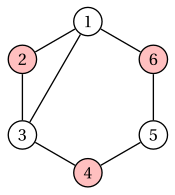
Gurobi returns \(z(\mathrm{ILP}_{\mathrm{MSSP}})=3\) with the stable set \(\{2,4,6\}\). The optimal solution is unique.
-
The maximal cliques of \(G\) are the triangle \(\{1,2,3\}\) and the edges \(\{1,6\}\), \(\{3,4\}\), \(\{4,5\}\), \(\{5,6\}\): \(5\) cliques instead of \(7\) edges, since the three edges of the triangle are replaced by \(x_1+x_2+x_3\le 1\). The \(\mathrm{ILP}^{\mathrm{CL}}_{\mathrm{MSSP}}\) model is:
\[ \begin{array}{rrrrrrrcl} {\max} & {x_1} & {+\,x_2} & {+\,x_3} & {+\,x_4} & {+\,x_5} & {+\,x_6} \\[1ex] \text{subject to} & {x_1} & {+\,x_2} & {+\,x_3} & & & & {\le} & {1} \\ & {x_1} & & & & & {+\,x_6} & {\le} & {1} \\ & & & {x_3} & {+\,x_4} & & & {\le} & {1} \\ & & & & {x_4} & {+\,x_5} & & {\le} & {1} \\ & & & & & {x_5} & {+\,x_6} & {\le} & {1} \\[1ex] & {x_1}, & {x_2}, & {x_3}, & {x_4}, & {x_5}, & {x_6} & {\in} & {\{0,1\}} \end{array} \]Its optimal value is again \(3\).
-
The LP relaxation of the edge formulation, with \(0\le x_v\le 1\), has optimal value \(3\); the LP relaxation of the clique formulation has optimal value \(3\). On this graph both bounds are equal to \(\alpha(G)=3\): the point \(x_v=\frac{1}{2}\), of value \(3\), is feasible for the edge formulation but violates \(x_1+x_2+x_3\le 1\), and the bound does not change because the integer optimum also has value \(3\).
Exercise 12.7: ILP model of the vertex-weighted maximum clique problem
We consider the graph \(G=(V,E)\) with \(V=\{1,\dots,6\}\) and the \(7\) edges
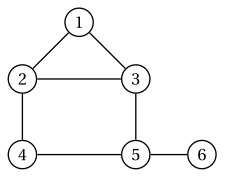
and the vertex weights
Questions
-
Write the \(\mathrm{ILP}^{\mathrm{VW}}_{\mathrm{MCP}}\) model of the vertex-weighted maximum clique problem on this instance.
-
Solve the model with Gurobi: give the optimal value and the optimal clique. Is it unique?
-
Compare the optimal clique with the maximum clique of \(G\), and explain the difference.
Solution
-
\(G\) has \(\binom{6}{2}-7=8\) non-edges, one constraint each:
\[ \begin{array}{rrrrrrrcl} {\max} & {2\,x_1} & {+\,3\,x_2} & {+\,4\,x_3} & {+\,6\,x_4} & {+\,5\,x_5} & {+\,7\,x_6} \\[1ex] \text{subject to} & {x_1} & & & {+\,x_4} & & & {\le} & {1} \\ & {x_1} & & & & {+\,x_5} & & {\le} & {1} \\ & {x_1} & & & & & {+\,x_6} & {\le} & {1} \\ & & {x_2} & & & {+\,x_5} & & {\le} & {1} \\ & & {x_2} & & & & {+\,x_6} & {\le} & {1} \\ & & & {x_3} & {+\,x_4} & & & {\le} & {1} \\ & & & {x_3} & & & {+\,x_6} & {\le} & {1} \\ & & & & {x_4} & & {+\,x_6} & {\le} & {1} \\[1ex] & {x_1}, & {x_2}, & {x_3}, & {x_4}, & {x_5}, & {x_6} & {\in} & {\{0,1\}} \end{array} \] -
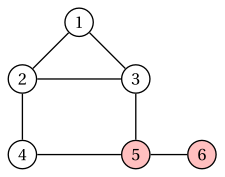
Gurobi returns the optimal value \(12\) with \(\tilde x_5=\tilde x_6=1\): the clique \(\{5,6\}\), of weight \(5+7=12\). The enumeration of the cliques gives the second best value \(11\) (clique \(\{4,5\}\)): the optimal solution is unique.
-
The maximum clique of \(G\) is the triangle \(\{1,2,3\}\), with \(3\) vertices but weight only \(2+3+4=9\). The two models have the same constraints, hence the same feasible solutions (the cliques of \(G\)); only the objective function changes, and the light vertices of the triangle lose against the heavy edge \(\{5,6\}\).
Exercise 12.8: ILP model of the edge-weighted maximum clique problem
We consider the graph \(G=(V,E)\) with \(V=\{1,\dots,5\}\) and the \(7\) edges
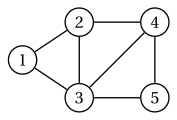
and the edge weights
| edge | \(\{1,2\}\) | \(\{1,3\}\) | \(\{2,3\}\) | \(\{2,4\}\) | \(\{3,4\}\) | \(\{3,5\}\) | \(\{4,5\}\) |
|---|---|---|---|---|---|---|---|
| \(r_{uv}\) | \(2\) | \(3\) | \(1\) | \(4\) | \(2\) | \(5\) | \(6\) |
Questions
-
Count the variables and the constraints of the \(\mathrm{ILP}^{\mathrm{EW}}_{\mathrm{MCP}}\) model of the edge-weighted maximum clique problem on this instance, and write it.
-
Solve the model with Gurobi: give the optimal value, the optimal clique and the variables \(y_{uv}\) equal to \(1\).
-
Verify the result by listing the maximal cliques of \(G\) with their total edge weight.
-
Explain why the constraints \(y_{uv}\ge x_u+x_v-1\) are not needed in the model.
Solution
-
There are \(n=5\) variables \(x_v\) and \(m=7\) variables \(y_{uv}\), so \(12\) binary variables. There are \(2m=14\) constraints \(y_{uv}\le x_u\), \(y_{uv}\le x_v\) and one constraint per non-edge, \(3\) of them: \(17\) linear constraints. The model is:
\[ \begin{array}{rlcl} {\max} & {2\,y_{12}+3\,y_{13}+y_{23}+4\,y_{24}+2\,y_{34}+5\,y_{35}+6\,y_{45}} & & \\[1ex] \text{subject to} & {y_{12}-x_1} & {\le} & {0} \\ & {y_{12}-x_2} & {\le} & {0} \\ & {y_{13}-x_1} & {\le} & {0} \\ & {y_{13}-x_3} & {\le} & {0} \\ & {y_{23}-x_2} & {\le} & {0} \\ & {y_{23}-x_3} & {\le} & {0} \\ & {y_{24}-x_2} & {\le} & {0} \\ & {y_{24}-x_4} & {\le} & {0} \\ & {y_{34}-x_3} & {\le} & {0} \\ & {y_{34}-x_4} & {\le} & {0} \\ & {y_{35}-x_3} & {\le} & {0} \\ & {y_{35}-x_5} & {\le} & {0} \\ & {y_{45}-x_4} & {\le} & {0} \\ & {y_{45}-x_5} & {\le} & {0} \\ & {x_1+x_4} & {\le} & {1} \\ & {x_1+x_5} & {\le} & {1} \\ & {x_2+x_5} & {\le} & {1} \\[1ex] & {x_1,~x_2,~x_3,~x_4,~x_5} & {\in} & {\{0,1\}} \\ & {y_{12},~y_{13},~y_{23},~y_{24},~y_{34},~y_{35},~y_{45}} & {\in} & {\{0,1\}} \end{array} \] -
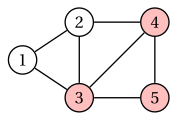
Gurobi returns the optimal value \(13\) with \(\tilde x_3=\tilde x_4=\tilde x_5=1\) and \(\tilde y_{34}=\tilde y_{35}=\tilde y_{45}=1\), all the other variables equal to \(0\): the clique \(\{3,4,5\}\), of weight \(2+5+6=13\).
-
The maximal cliques of \(G\) and their weights are:
-
\(\{1,2,3\}\): \(2+3+1=6\);
-
\(\{2,3,4\}\): \(1+4+2=7\);
-
\(\{3,4,5\}\): \(2+5+6=13\);
Every clique is contained in one of them and the weights are positive, so the optimal value is \(13\), attained only by \(\{3,4,5\}\).
-
-
If both endpoints of \(\{u,v\}\) are selected, the constraints allow \(y_{uv}=1\), and since \(r_{uv}>0\) the objective function prefers \(y_{uv}=1\) to \(y_{uv}=0\): every optimal solution has \(y_{uv}=\min\{x_u,x_v\}\). The constraint \(y_{uv}\ge x_u+x_v-1\) would be needed only with negative weights.