6.6 Variants: metric and asymmetric TSP
Part 1 · Combinatorial optimization problems · Chapter 6 · Chapter 6: Routing problems · Lecture notes, volume 1 (PDF) · Slides · Exercises: Routing problems
6.6.1 The metric travelling salesman problem
Definition 6.4: Metric TSP
A TSP instance is metric if its distances satisfy the triangle inequality
The metric travelling salesman problem (metric TSP) is the TSP restricted to metric instances.
-
The triangle inequality says that going directly from \(i\) to \(j\) is never longer than going through a third city \(k\).
-
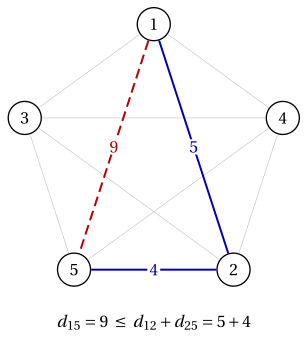
The instance of Example 6.1 is metric: all the \(5\cdot4\cdot3=60\) triangle inequalities hold, some of them with equality, e.g., \(d_{15}=9=d_{12}+d_{25}=5+4\). In the drawing, the direct edge \(\{1,5\}\) (dashed) is as long as the path from \(1\) to \(5\) through city \(2\).
-
Instances obtained from points in the plane, with \(d_{ij}\) equal to the Euclidean distance between the points, are metric (when the distances are not rounded).
-
Several heuristic algorithms for the TSP behave well, and some of them have a performance guarantee, only on metric instances.
6.6.2 The asymmetric travelling salesman problem
Definition 6.5: Asymmetric travelling salesman problem
Given:
-
a set \(\mathscr{V} = \{1,2,\dots,n\}\) of \(n\) cities,
-
for each ordered pair of distinct cities \(i,j \in \mathscr{V}\), a distance \(d_{ij} \in \Z_{\ge 1}\) from city \(i\) to city \(j\), where \(d_{ij}\) may differ from \(d_{ji}\),
the asymmetric travelling salesman problem (ATSP) asks to find a closed route that starts from a city, visits every other city exactly once and returns to the starting city, so that the total distance travelled is minimized.
-
Asymmetric distances arise, for example, when travelling along one-way streets or uphill and downhill.
-
The definition of tour and of its length \(L(\sigma)\) is unchanged, but the direction now matters: a tour and the same tour travelled backwards are different solutions.
-
The TSP is the special case of the ATSP in which \(d_{ij}=d_{ji}\) for all \(i,j\).
-
An ATSP instance has \(\frac{n!}{n}=(n-1)!\) distinct tours, twice the count of Proposition 6.2: the starting city still does not change the tour, but the direction does, so we do not divide by \(2\).
-
The instance of Example 6.1, read as an ATSP instance, has \(4!=24\) tours instead of \(12\).
6.7 Remarks
-
The largest instance solved to optimality, pla85900, has \(85\,900\) points from a chip design problem. It was solved in 2005–2006 with the Concorde code; the optimal tour, of length \(142\,382\,641\), was certified in 2009 by Applegate, Bixby, Chvátal, Cook, Espinoza, Goycoolea and Helsgaun.
-
On the road maps of real countries, the record of 2025 is the instance korea81998, with \(81\,998\) bars of South Korea.
-
The TSP is strongly NP-hard (Chapter 1 «Combinatorial optimization problems»). Christofides (1976) gave an approximation algorithm with ratio \(\frac32\) for the metric TSP.
6.8 Typical mistakes
Warning
-
Counting \(n!\) tours. The starting city does not change the tour, and in the symmetric case neither does the direction: the number of tours is \((n-1)!/2\).
-
Forgetting the return edge. The length of a tour includes the last distance \(d_{\sigma_n \sigma_1}\), from the last city back to the first one.
-
Taking two cycles for a tour. Two disjoint cycles that together visit every city once are not a tour: a tour is a single cycle through all the cities.
-
Reading the bound as a tour. The value \(17\) of the two-shortest-edges bound is not the length of a tour; it only says that no tour is shorter.
-
Using the triangle inequality without checking it. The guarantees of the heuristic algorithms hold only for metric instances.
6.9 In summary
In summary
-
The TSP asks for a shortest closed route through all the cities; a solution is a cyclic ordering of the cities, called a tour.
-
A symmetric instance with \(n\) cities has \((n-1)!/2\) tours, an asymmetric one \((n-1)!\); listing them is possible only for very small \(n\).
-
The nearest neighbour rule gives a tour quickly, with no guarantee; the two shortest edges of every city give a lower bound on the optimal length.
-
The metric TSP, with the triangle inequality, is the case where approximation guarantees exist.
Dashboard of the TSP instance (minimization: the lower bound is a dual bound, the upper bound is the length of a tour):
| Chapter | Lower bound | Upper bound | From |
|---|---|---|---|
| This chapter | \(17\) | \(25\) | two shortest edges; nearest neighbour from city \(1\) |
| This chapter, enumeration | \(18\) | \(18\) | the \(12\) tours |
Exercises on this chapter: Routing problems
In depth: what the course does on this problem