Exercises · Packing problems
Exercises · Chapter 3 · each solution opens with a click · Chapter 3: Packing problems · Exercises, volume 1 (PDF)
Exercise 3.1: Checking a packing (BPP)
We consider the bin packing instance with capacity \(c=12\) and \(n=8\) items with weights
and the three proposed solutions
Questions
-
Check the assumptions of the BPP.
-
For each proposed solution, compute the weight of every bin and decide whether it is feasible.
-
Compute the weight bound. Is one of the proposed solutions optimal?
-
Draw the feasible solution.
Solution
-
The total weight is \(39>12\) and the heaviest item weighs \(8\le 12\): both assumptions hold.
-
-
\(\mathcal{P}_a\): the bins weigh \(7+5=12\), \(4+8=12\), \(6+3+2=11\), \(4=4\). It is a partition and every bin weighs at most \(12\): feasible, with \(4\) bins.
-
\(\mathcal{P}_b\): the bins weigh \(7+6=13\), \(5+4+3=12\), \(8+4=12\), \(2=2\). It is a partition, but the bin \(\{1,4\}\) weighs \(13>12\). Not feasible.
-
\(\mathcal{P}_c\): the bins weigh \(7+5=12\), \(4+8=12\), \(6+3=9\), \(4=4\). It is not a partition of \(\mathscr{I}\): item \(7\) is in no bin. Not feasible.
-
-
\(\mathrm{LB}=\lceil 39/12\rceil=4\). The feasible solution \(\mathcal{P}_a\) uses \(4\) bins, so it attains the bound: it is optimal and \(z(I)=4\).
-
The four bins of \(\mathcal{P}_a\), with the dashed line at the capacity:
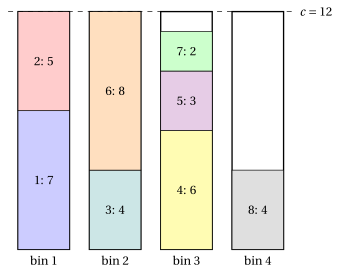
Only \(\mathcal{P}_a\) is feasible; it uses \(4=\lceil 39/12\rceil\) bins and is therefore optimal.
Exercise 3.2: When the weight bound is not tight (BPP)
We consider the bin packing instance with capacity \(c=10\) and \(n=6\) items with weights
Questions
-
Compute the weight bound.
-
Show that no two of the items \(1,2,3,4\) fit together in a bin. What lower bound on \(z(I)\) follows?
-
Find an optimal solution. Is it unique?
-
What is the gap between the weight bound and \(z(I)\)?
Solution
-
\(\sum_j w_j=7+6+6+5+3+3=30\), hence \(\lceil 30/10\rceil=3\).
-
The pairs give \(w_1+w_2=13\), \(w_1+w_3=13\), \(w_1+w_4=12\), \(w_2+w_3=12\), \(w_2+w_4=11\), \(w_3+w_4=11\), all larger than \(10\). Hence items \(1,2,3,4\) are in four different bins in every feasible solution, and \(z(I)\ge 4\).
-
The solution \(\{\{1\},\{2\},\{3,6\},\{4,5\}\}\) has bins of weight \(7, 6, 9, 8\), all at most \(10\): it uses \(4\) bins and attains the bound of Question 2, so it is optimal, \(z(I)=4\).
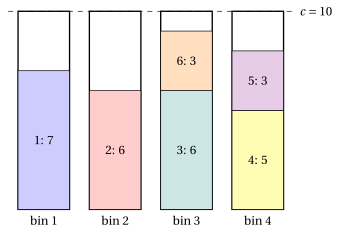
It is not unique: the enumeration gives \(12\) optimal partitions, since items \(5\) and \(6\) can go with any of the four large items that has room for them.
-
The weight bound gives \(3\) and \(z(I)=4\): an absolute gap of \(1\). The weight bound does not see that the large items cannot share a bin.
\(z(I)=4\), while the weight bound gives only \(3\): the four items of weight greater than \(c/2\) pairwise conflict and need four bins.
Exercise 3.3: Counting the packings (BPP)
We consider the bin packing instance with capacity \(c=12\) and \(n=5\) items with weights
Questions
-
How many candidate solutions does the instance have?
-
Which pairs of items fit together in a bin? Which triples?
-
Count the feasible solutions, grouped by number of bins.
-
Compute the weight bound and list all the optimal solutions.
Solution
-
The candidates are the partitions of the \(5\) items: \(B(5)=52\).
-
The pairs that fit are \(\{1,3\}\) (\(12\)), \(\{1,4\}\) (\(11\)), \(\{1,5\}\) (\(9\)), \(\{2,3\}\) (\(11\)), \(\{2,4\}\) (\(10\)), \(\{2,5\}\) (\(8\)), \(\{3,4\}\) (\(9\)), \(\{3,5\}\) (\(7\)), \(\{4,5\}\) (\(6\)); the triples that fit are \(\{2,4,5\}\) (\(12\)), \(\{3,4,5\}\) (\(11\)). No four items fit together, since the four lightest weigh \(17>12\).
-
A feasible partition uses only singletons and the pairs and triples above. The enumeration gives:
bins feasible partitions \(2\) \(1\) \(3\) \(14\) \(4\) \(9\) \(5\) \(1\) total \(25\) -
\(\mathrm{LB}=\lceil 24/12\rceil=2\), and there are partitions with \(2\) bins: \(z(I)=2\). The optimal solution is unique, \(\{\{1,3\},\{2,4,5\}\}\): both bins are filled exactly.
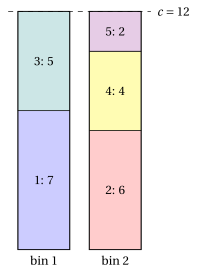
Of the \(52\) partitions, \(25\) are feasible and only one is optimal, with \(z(I)=2=\lceil 24/12\rceil\).
Exercise 3.4: Copies of the items (CSP)
We consider the cutting stock instance with capacity \(c=10\) and \(n=3\) items, with the following weights and required copies:
Questions
-
Write the extended set of items \(\hat{\mathscr{I}}\) and check the assumptions.
-
Is the family \(\{\{(1,1),(2,1)\},\{(1,2),(2,2)\},\{(3,1),(3,2)\}\}\) a feasible solution? How many bins does it use?
-
Compute the weight bound, with the weights of all the copies.
-
Find an optimal solution.
Solution
-
The extended set has \(\sum_j d_j=7\) copies:
\[ \hat{\mathscr{I}}=\{(1,1),(1,2),(2,1),(2,2),(2,3),(3,1),(3,2)\}. \]The total weight is \(\sum_j d_jw_j=2\cdot 5+3\cdot 4+2\cdot 3=28>10\) and every item fits in a bin, \(w_j\le 10\): both assumptions hold.
-
The bins weigh \(9\), \(9\), \(6\), all at most \(10\), but the copy \((2,3)\) is in no bin: the family is not a partition of \(\hat{\mathscr{I}}\) and it is not feasible.
-
\(\mathrm{LB}=\left\lceil \sum_j d_jw_j/c\right\rceil=\lceil 28/10\rceil=3\).
-
The two copies of item \(1\) fill a bin (\(10\)); one copy of item \(2\) and the two copies of item \(3\) fill another one (\(4+3+3=10\)); the last two copies of item \(2\) weigh \(8\). The solution
\[ \mathcal{P}=\{\{(1,1),(1,2)\},\{(2,1),(3,1),(3,2)\},\{(2,2),(2,3)\}\} \]uses \(3\) bins and attains the bound: it is optimal, \(z(I)=3\).
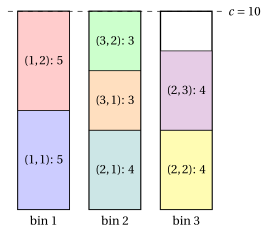
With the weights of the \(7\) copies the weight bound is \(3\), and the packing found by pairing the copies attains it: \(z(I)=3\).
Exercise 3.5: Filling every bin exactly (BPP)
We consider the bin packing instance with capacity \(c=10\) and \(n=8\) items with weights
Questions
-
Compute the weight bound.
-
Show that a solution with \(3\) bins must fill every bin exactly.
-
List the ways to obtain a total weight of exactly \(10\) with the weights of the instance, and use them to find a solution with \(3\) bins.
-
If item \(8\) weighed \(3\) instead of \(2\), how many bins would be needed?
Solution
-
\(\sum_j w_j=30\), hence \(\mathrm{LB}=\lceil 30/10\rceil=3\).
-
\(3\) bins hold at most \(3\cdot 10=30\), and the items weigh exactly \(30\): if a bin weighed less than \(10\), the others could not hold the rest.
-
As multisets of weights, a total of exactly \(10\) is obtained as
\[ \{5,5\},\quad \{5,3,2\},\quad \{4,4,2\},\quad \{4,3,3\}. \]Each item of weight \(5\) must be in a full bin, and the only multisets with a \(5\) are \(\{5,5\}\), \(\{5,3,2\}\). There is only one item of weight \(2\), so the two items of weight \(5\) cannot both be in a bin \(\{5,3,2\}\): they share the bin \(\{5,5\}\). Then the remaining weights \(4,4,4,3,3,2\) must form two full bins: \(\{4,4,2\}\) and \(\{4,3,3\}\). The solution is \(\{\{1,2\},\{3,4,8\},\{5,6,7\}\}\):
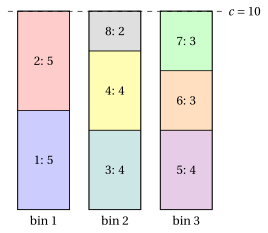
It attains the bound, so \(z(I)=3\).
-
The total weight would be \(31\), and \(\lceil 31/10\rceil=4\): at least \(4\) bins. A solution with \(4\) bins is obtained from the one above by moving item \(8\) to a bin of its own, so \(z(I)=4\).
When \(\sum_j w_j=\mathrm{LB}\cdot c\), a solution with \(\mathrm{LB}\) bins fills every bin exactly; here the bins \(\{5,5\}\), \(\{4,4,2\}\), \(\{4,3,3\}\) give \(z(I)=3\).
Exercise 3.6: A greedy choice that is not optimal (BPP)
We consider the bin packing instance with capacity \(c=10\) and \(n=6\) items, with weights
Questions
-
Apply First Fit: take the items in the order \(1,2,\dots,n\) and put each one into the first open bin where it fits, opening a new bin when it fits nowhere. How many bins does it use?
-
Compute the weight bound \(\left\lceil \sum_j w_j / c \right\rceil\).
-
Find a solution that attains the bound. What can you conclude on the solution of First Fit?
-
Compute the absolute and the relative gap between the First Fit solution and the dual bound.
Solution
-
The loads of the open bins after each item are:
item \(j\) \(w_j\) placed in loads \(1\) \(5\) new bin 1 \((5)\) \(2\) \(4\) bin 1 \((9)\) \(3\) \(5\) new bin 2 \((9,5)\) \(4\) \(6\) new bin 3 \((9,5,6)\) \(5\) \(8\) new bin 4 \((9,5,6,8)\) \(6\) \(2\) bin 2 \((9,7,6,8)\) First Fit returns \(\{\{1,2\},\{3,6\},\{4\},\{5\}\}\), with \(4\) bins: a primal bound \(\mathrm{UB}=4\).
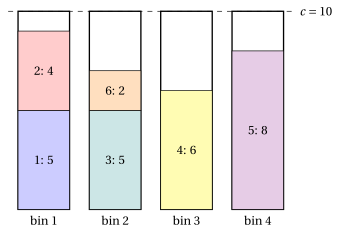
-
\(\sum_j w_j=5+4+5+6+8+2=30\), hence \(\mathrm{LB}=\lceil 30/10\rceil=3\).
-
The partition \(\{\{1,3\},\{2,4\},\{5,6\}\}\) has bins of weight \(10, 10, 10\), all at most \(10\): it is feasible and uses \(3\) bins.
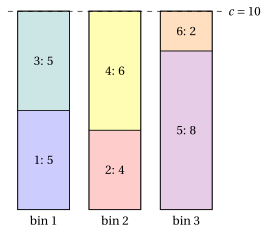
It attains the dual bound, so it is optimal and \(z(I)=3\); the solution of First Fit is not optimal. First Fit puts item \(2\) (weight \(4\)) with item \(1\) (load \(9\)) and wastes the residual capacity \(1\); the optimal packing puts item \(1\) with item \(3\) and item \(2\) with item \(4\), two bins filled exactly.
-
The absolute gap is \(4-3=1\) and the relative gap is \(\frac{1}{3}\approx 33.3\%\).
First Fit, a greedy choice, uses \(4\) bins, while the weight bound gives \(3\) and the partition \(\{\{1,3\},\{2,4\},\{5,6\}\}\) attains it: \(z(I)=3\).