31.9 Flat landscapes and auxiliary objectives
Part 4 · Heuristic algorithms · Chapter 31 · Chapter 31: Local search · Lecture notes, volume 4 (PDF) · Slides (1/2) · Slides (2/2) · Exercises: Local search · App: TSP: nearest neighbour and 2-opt
31.9.1 Plateaus
-
The objectives of the BPP and of \(P\,||\,C_{\max}\) are very “coarse”: the number of bins takes few values, and the makespan depends only on the critical machines. Many solutions have the same value, and most moves do not change it: the landscape is made of large plateaus.
-
On a plateau a local search that accepts only strictly improving moves stops, even if a sequence of moves of value zero would lead to a better solution. The search is blind: the objective does not say which neighbours are closer to an improvement.
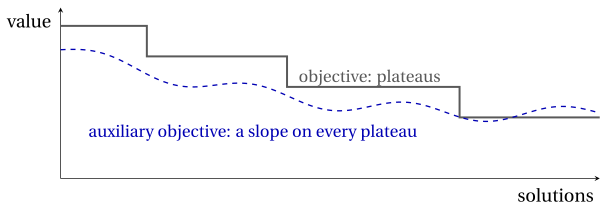
- How flat? On the \(P\,||\,C_{\max}\) instance with \(m=4\) and \(12\) jobs of the previous section, we generate \(100\) random assignments (seed \(1\)) and examine their \(100\cdot 12\cdot 3=3600\) move neighbours: \(1290\) of them (\(35.8\%\)) have the same makespan as the current solution. For the BPP the situation is extreme: on the instance with \(c=10\) and weights \(w=(7,6,6,5,5,4,4,4,3,3,2,1)\), for which \(z(I)=5=\lceil 50/10\rceil\), the \(100\) solutions computed by \(FF\) on random orders of the items (seed \(1\)) have \(2374\) move and swap neighbours, and all of them have the same number of bins as the current solution.
31.9.2 The auxiliary objective
- The remedy is to guide the search with an auxiliary objective, which distinguishes the solutions with the same value and rewards those that are “closer” to an improvement. For both problems it is a function of the loads:
- Both problems redistribute a fixed total, \(\sum_j w_j\) or \(\sum_j t_j\), among the bins or the machines. For a fixed total, the sum of the squares is small when the loads are balanced and large when they are unbalanced. For \(P\,||\,C_{\max}\) balanced loads are exactly what we want; for the BPP we want the opposite: a few full bins and the others empty.
Proposition 31.4
If the amount \(\delta\) is transferred from the load \(L_a\) to the load \(L_b\) (\(a\ne b\)), the sum of the squared loads changes by
Proof
Expanding the squares, \((L_a-\delta)^2-L_a^2=-2\delta L_a+\delta^2\) and \((L_b+\delta)^2-L_b^2=2\delta L_b+\delta^2\); the sum is \(2\delta(L_b-L_a+\delta)\). The other loads do not change. □
- The change is computed in \(O(1)\) time: the auxiliary objective is also cheaper to evaluate than the makespan. For a move, \(\delta>0\) is the weight (or time) of the moved element, and the sum of the squares increases if and only if \(L_b+\delta>L_a\): the element goes to a load that, after the move, is larger than the load it left.
31.9.3 The move local search for the BPP
The move local search for the BPP examines the moves of one item into another non-empty bin where it fits, applies an improving one chosen by the first- or the best-improvement rule, and stops when no move improves. The objective is either the number of bins, \(f=nb\), or the auxiliary objective \(f=SQ=\sum_bL_b^2\); the gain \(G\) of a move is the improvement of \(f\).
Algorithm: Move step for the BPP
31.9.4 The swap local search for the BPP
The swap local search for the BPP examines the exchanges of two items of different weight in different bins that keep both bins feasible, applies an improving one chosen by the first- or the best-improvement rule, and stops when no exchange improves. A swap never changes the number of bins, so it is used only with the auxiliary objective \(SQ\).
Algorithm: Swap step for the BPP
31.9.5 Properties of the auxiliary objective
Proposition 31.5
For the BPP, with the neighbourhoods move and swap:
-
a move that empties a bin increases \(\sum_b L_b^2\);
-
a swap does not change the number of bins.
Hence every move or swap that decreases the number of bins also increases \(\sum_b L_b^2\).
Proof
If the move of item \(j\) from bin \(a\) to bin \(b\) empties bin \(a\), then \(L_a=w_j\), and bin \(b\) is not empty, so \(L_b>0\). By Proposition 31.4 with \(\delta=w_j\) the change is \(2w_j(L_b-w_j+w_j)=2w_jL_b>0\). A swap exchanges one item of bin \(a\) with one item of bin \(b\), so both bins remain non-empty and no bin is created. □
Proposition 31.6
For \(P\,||\,C_{\max}\), with the neighbourhoods move and swap:
-
a move or a swap that decreases \(\sum_h L_h^2\) does not increase the makespan;
-
a move or a swap that decreases the makespan decreases \(\sum_h L_h^2\).
Proof
Let \(\delta\) be transferred from machine \(a\) to machine \(b\); exchanging the names of \(a\) and \(b\) if necessary, \(\delta>0\). Only \(L_a\) and \(L_b\) change. (1) By Proposition 31.4, \(\sum_hL_h^2\) decreases if and only if \(L_b+\delta<L_a\); then both new loads \(L_a-\delta\) and \(L_b+\delta\) are smaller than \(L_a\le C_{\max}\), and the makespan does not increase. (2) If the makespan decreases, machine \(b\), whose load increases, is not critical after the move, so \(L_b+\delta<C_{\max}\); machine \(a\) must have been the unique critical machine, \(L_a=C_{\max}\). Hence \(L_b+\delta<L_a\), and \(\sum_hL_h^2\) decreases. □
-
The two propositions say that, for the auxiliary objective, every move that improves the original objective is improving, and so are some moves that the original objective sees as neutral; for \(P\,||\,C_{\max}\), no move that worsens the makespan is improving. For the BPP a move that increases \(\sum_bL_b^2\) never increases the number of bins, since no bin is created.
-
The auxiliary objective is a guide, not the objective: a solution with more bins can have a larger \(\sum_bL_b^2\). With \(c=7\), the loads \((5,5)\) use \(2\) bins and give \(25+25=50\), while the loads \((7,2,1)\) use \(3\) bins and give \(49+4+1=54\). The quality of the solution returned is always measured with the original objective.
31.9.6 Examples
Example 31.6: The number of bins is blind, the auxiliary objective is not
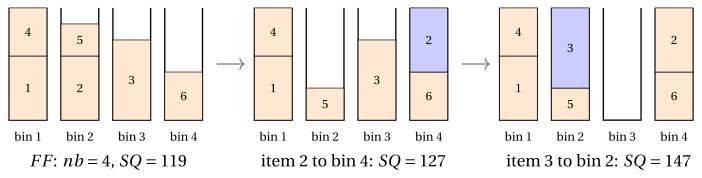
The solution of \(FF\) on the BPP reference instance (\(c=7\)) has the packing patterns \(P_1=\{1,4\}\), \(P_2=\{2,5\}\), \(P_3=\{3\}\), \(P_4=\{6\}\), with loads \((7,6,5,3)\), \(nb=4\) and \(SQ=49+36+25+9=119\). Its feasible moves are
| move | loads | \(nb\) | gain \(2w_j(L_b-L_a+w_j)\) | \(SQ\) |
|---|---|---|---|---|
| item \(1\) (\(w_1=4\)): bin \(1\to 4\) | \((3,6,5,7)\) | \(4\) | \(2\cdot4\cdot(3-7+4)=0\) | \(119\) |
| item \(2\) (\(w_2=4\)): bin \(2\to 4\) | \((7,2,5,7)\) | \(4\) | \(2\cdot4\cdot(3-6+4)=8\) | \(127\) |
| item \(4\) (\(w_4=3\)): bin \(1\to 4\) | \((4,6,5,6)\) | \(4\) | \(2\cdot3\cdot(3-7+3)=-6\) | \(113\) |
| item \(5\) (\(w_5=2\)): bin \(2\to 3\) | \((7,4,7,3)\) | \(4\) | \(2\cdot2\cdot(5-6+2)=4\) | \(123\) |
| item \(5\) (\(w_5=2\)): bin \(2\to 4\) | \((7,4,5,5)\) | \(4\) | \(2\cdot2\cdot(3-6+2)=-4\) | \(115\) |
With \(f=nb\), no move empties a bin: items \(3\) and \(6\), alone in their bins, fit nowhere else. The solution of \(FF\) is a local optimum with \(4\) bins, and so it is for the swap neighbourhood, by Proposition 31.5.
With \(f=SQ\), both rules accept the move of item \(2\) into bin \(4\) (gain \(8\), \(SQ=127\)), which leaves item \(5\) alone in bin \(2\). In the next iteration, two moves have the largest gain, \(20\): item \(3\) into bin \(2\), with gain \(2\cdot5\cdot(2-5+5)=20\), and item \(5\) into bin \(3\), with gain \(2\cdot2\cdot(5-2+2)=20\). Item \(3\) is examined first, so both rules choose it. It empties bin \(3\): the loads become \((7,7,7)\), \(SQ=147\), and the packing patterns \(\{1,4\}\), \(\{3,5\}\), \(\{2,6\}\) use \(3\) bins, which is optimal. The first move did not change the number of bins: it prepared the second one.
Example 31.7: Starting from \(NF\)
The solution of \(NF\) on the BPP reference instance has the packing patterns \(\{1\}\), \(\{2\}\), \(\{3\}\), \(\{4,5\}\), \(\{6\}\) (bins \(1,\dots,5\)), loads \((4,4,5,5,3)\), \(nb=5\) and \(SQ=91\).
With \(f=nb\), the first move examined, item \(1\) into bin \(5\) (\(3+4=7\)), empties bin \(1\): the solution has \(4\) bins, \(\{2\},\{3\},\{4,5\},\{1,6\}\). It is a local optimum: items \(2\) and \(3\) fit in no other bin, and bins \(4\) and \(5\) contain two items each. Both rules stop with \(4\) bins.
With \(f=SQ\), best improvement makes three moves:
| move | packing patterns | gain | \(SQ\) |
|---|---|---|---|
| item \(1\) into bin \(5\) | \(\{2\},\{3\},\{4,5\},\{1,6\}\) | \(2\cdot4\cdot(3-4+4)=24\) | \(115\) |
| item \(4\) into bin \(2\) | \(\{2,4\},\{3\},\{5\},\{1,6\}\) | \(2\cdot3\cdot(4-5+3)=12\) | \(127\) |
| item \(3\) into bin \(4\) | \(\{2,4\},\{3,5\},\{1,6\}\) | \(2\cdot5\cdot(2-5+5)=20\) | \(147\) |
and reaches an optimal solution with \(3\) bins, through a move (the second) that does not change the number of bins. First improvement makes the same three moves.
31.9.7 Experiments on two medium instances
-
On a single small instance anything can happen; the following experiments repeat the local searches from \(100\) random starting solutions (seed \(1\)), with best improvement.
-
\(P\,||\,C_{\max}\) with \(m=4\) and \(t=(11,10,9,8,7,7,6,5,4,4,3,2)\), \(z(I)=19\). The \(100\) random assignments have an average makespan of \(33.32\). The table gives the average makespan of the local optima, and the number of runs that end in an optimal solution:
| \(f=C_{\max}\) | \(f=\sum_h L_h^2\) | |||
|---|---|---|---|---|
| neighbourhood | average | optimal | average | optimal |
| move | \(20.94\) | \(3\) | \(20.39\) | \(4\) |
| swap | \(24.31\) | \(7\) | \(23.09\) | \(20\) |
-
The auxiliary objective improves both neighbourhoods. Swap alone is poor because it cannot change the number of jobs on the machines, which in a random assignment is often far from balanced.
-
BPP with \(c=10\) and \(w=(7,6,6,5,5,4,4,4,3,3,2,1)\), \(z(I)=5\). The \(100\) solutions of \(FF\) on random orders of the items use \(5\) bins in \(14\) cases, \(6\) bins in \(85\) cases and \(7\) bins in \(1\) case. The table gives the number of runs that end with \(5\) bins:
| neighbourhood | \(f=nb\) | \(f=\sum_b L_b^2\) |
|---|---|---|
| none (the solutions of \(FF\)) | \(14\) | \(14\) |
| move | \(14\) | \(76\) |
| swap | — | \(14\) |
- With \(f=nb\) the move local search does not improve any of the \(100\) solutions: they are all on a plateau. With the auxiliary objective, \(62\) more runs reach the optimum. Swap alone cannot change the number of bins, but it can prepare moves that do.