Exercises · Knapsack: branch-and-bound on the critical item
Exercises · Chapter 41 · each solution opens with a click · Chapter 41: 0/1 knapsack (KP) · Exercises, volume 6 (PDF)
Exercise 41.1: Branch-and-Bound Algorithm for the 0/1 Knapsack Problem (P1)
We consider a knapsack capacity \(c=11\) and a set \(\mathscr{I}=\{1,2,3,4,5\}\) of \(5\) items (\(n=5\)) with the following profits and weights:
Questions
-
Check if the items are sorted by non-increasing efficiency otherwise sort them in this order. Write the \(\mathrm{ILP}_{\mathrm{KP}}\) model and the \(\mathrm{LP}_{\mathrm{KP}}\) model for the KP instance.
-
Execute the branch-and-bound algorithm to solve the \(\mathrm{ILP}_{\mathrm{KP}}\) model for the 0/1 knapsack problem (KP) using:
-
the split-item rule as branching-variable selection strategy;
-
the LIFO rule as branching-node selection strategy;
-
solve first the down-branching node and then the up-branching node;
-
set the incumbent solution \({\bar{\boldsymbol x}}(\,\mathrm{ILP}_{\mathrm{KP}}\,)\) to the following heuristic solution :
\[ \bar{x}_1=1, ~~~ \bar{x}_2=1,~~~ \bar{x}_3= 0,~~\bar{x}_4=1,~~\bar{x}_5=0 \]and set the lower bound \(\LB\) accordingly.
-
-
Determine and comment the correspondent branch-and-bound tree showing the reason why the branching nodes can be pruned.
Solution
-
The items are sorted by non-increasing efficiency since we have:
\[ \frac{8}{3} ~~\ge~~ \frac{6}{3} ~~\ge~~ \frac{14}{9} ~~\ge~~ \frac{6}{5} ~~\ge~~ \frac{2}{2} \]This is the \(\mathrm{ILP}_{\mathrm{KP}}\) model for the KP instance:
\[ \begin{array}{rrrrrrrrrrrrr} {\max} & 8 \, {x_1} & + 6 \, {x_2} & + 14 \, {x_3} & + 6 \, {x_4} & + 2 \, {x_5} \\[2ex] & 3 \, {x_1} & + 3 \, {x_2} & + 9 \, {x_3} & + 5 \, {x_4} & + 2 \, {x_5} & {\le} & 11 \\[2ex] & {x_1}, & {x_2}, & {x_3}, & {x_4}, & {x_5} & { \in} & { \{0,1\}} \end{array} \]This is the \(\mathrm{LP}_{\mathrm{KP}}\) model for the KP instance:
\[ \begin{array}{rrrrrrrrrrrrr} {\max} & 8 \, {x_1} & + 6 \, {x_2} & + 14 \, {x_3} & + 6 \, {x_4} & + 2 \, {x_5} \\[2ex] & 3 \, {x_1} & + 3 \, {x_2} & + 9 \, {x_3} & + 5 \, {x_4} & + 2 \, {x_5} & {\le} & 11 \\[2ex] & {x_1} & & & & & {\le} & 1 \\[1ex] & & {x_2} & & & & {\le} & 1 \\[1ex] & & & {x_3} & & & {\le} & 1 \\[1ex] & & & & {x_4} & & {\le} & 1 \\[1ex] & & & & & {x_5} & {\le} & 1 \\[1ex] & {x_1}, & {x_2}, & {x_3}, & {x_4}, & {x_5} & { \ge} & { 0} \end{array} \] -
Execution of the branch-and-bound algorithm to solve the \(\mathrm{ILP}_{\mathrm{KP}}\) model.
-
Initialization
For the \(\mathrm{LP}^1_{\mathrm{KP}}\) problem, the split item is \(s=3\) and the residual capacity is \(\mathit{rc} = 5\). An optimal solution \({ \tilde{ \boldsymbol x}}(\,\mathrm{LP}^1_{\mathrm{KP}}\,)\) is:
\[ \tilde{x}_1=1,~~\tilde{x}_2=1,~~\tilde{x}_3=\frac{5}{9},~~\tilde{x}_4=0,~~\tilde{x}_5=0 \]the optimal value is:
\[ z(~\mathrm{LP}^1_{\mathrm{KP}}~) = 8 \cdot 1 + 6 \cdot 1 + 14 \cdot \frac{5}{9} = \frac{196}{9} \]The optimal solution \({ \tilde{ \boldsymbol x}}(\,\mathrm{LP}^1_{\mathrm{KP}}\,)\) is fractional and the \(\mathrm{LP}^1_{\mathrm{KP}}\) problem is feasible, so the \(\mathrm{LP}^1_{\mathrm{KP}}\) problem is inserted in the problem list \(L\) and the lower bound \(\LB\) is set to \(20\) (\(\LB(\bar{\boldsymbol x})= 20\)).
Due to the current lower bound \(\LB\) and upper bound \(\UB\), we have:
\[ 20 ~~\le~~ z(\mathrm{ILP}_{\mathrm{KP}}) ~~\le~~ \underbrace{\left\lfloor \dfrac{196}{9} \right\rfloor}_{=21} \] -
Iteration 1
The \(\mathrm{LP}^1_{\mathrm{KP}}\) problem is extracted and deleted from the problem list \(L\).
The branching variable is \(x_3\). The \(\mathrm{LP}^2_{\mathrm{KP}}\) and \(\mathrm{LP}^3_{\mathrm{KP}}\) problems are created by unselecting (\(x_3 \le 0\)) and selecting (\(x_3 \ge 1\)) item \(3\).
-
Solution of the \(\mathrm{LP}^2_{\mathrm{KP}}\) problem
We have
\[ \mathscr{I}^2 = \{1,2,4,5\},~~~\mathscr{I}^2_\text{out} = \{3\}, ~~~\mathscr{I}^2_\text{in} = \emptyset \]The capacity is \(c(2)=11\) and the objective-function constant is \(p(2)=0\). The split item is \(s=5\) and the residual capacity is \(\mathit{rc} = 0\). An optimal solution \({ \tilde{ \boldsymbol x}}(\,\mathrm{LP}^2_{\mathrm{KP}}\,)\) is:
\[ \tilde{x}_1=1,~~\tilde{x}_2=1,~~\tilde{x}_4=1,~~\tilde{x}_5=0, \text{ and } z(~\mathrm{LP}^2_{\mathrm{KP}}~)= 20 \]The \(\mathrm{LP}^2_{\mathrm{KP}}\) problem is feasible and its optimal solution \({ \tilde{ \boldsymbol x}}(\,\mathrm{LP}^2_{\mathrm{KP}}\,)\) is integer. It does not improve the incumbent solution, since \(z(\mathrm{LP}^2_{\mathrm{KP}})=20 \le 20=\LB\), accordingly, the branching node is pruned by integrality (when both criteria hold, the integrality comes first).
-
Solution of the \(\mathrm{LP}^3_{\mathrm{KP}}\) problem
We have
\[ \mathscr{I}^3 = \{1,2,4,5\},~~~\mathscr{I}^3_\text{out} = \emptyset, ~~~\mathscr{I}^3_\text{in} = \{3\} \]The capacity is \(c(3)=2\) and the objective-function constant is \(p(3)=14\). The split item is \(s=1\) and the residual capacity is \(\mathit{rc} = 2\). An optimal solution \({ \tilde{ \boldsymbol x}}(\,\mathrm{LP}^3_{\mathrm{KP}}\,)\) is:
\[ \tilde{x}_1=\frac{2}{3},~~\tilde{x}_2=0,~~\tilde{x}_4=0,~~\tilde{x}_5=0, \text{ and } z(~\mathrm{LP}^3_{\mathrm{KP}}~)= 14 + 8 \cdot \frac{2}{3}= \frac{58}{3} \]The \(\mathrm{LP}^3_{\mathrm{KP}}\) problem is feasible and we have:
\[ \left\lfloor z(\mathrm{LP}^3_{\mathrm{KP}}) \right\rfloor \le \LB \qquad \text{since} \qquad \underbrace{\left\lfloor\frac{58}{3} \right\rfloor}_{ = 19} \le 20 \]accordingly, the branching node is pruned by upper bound.
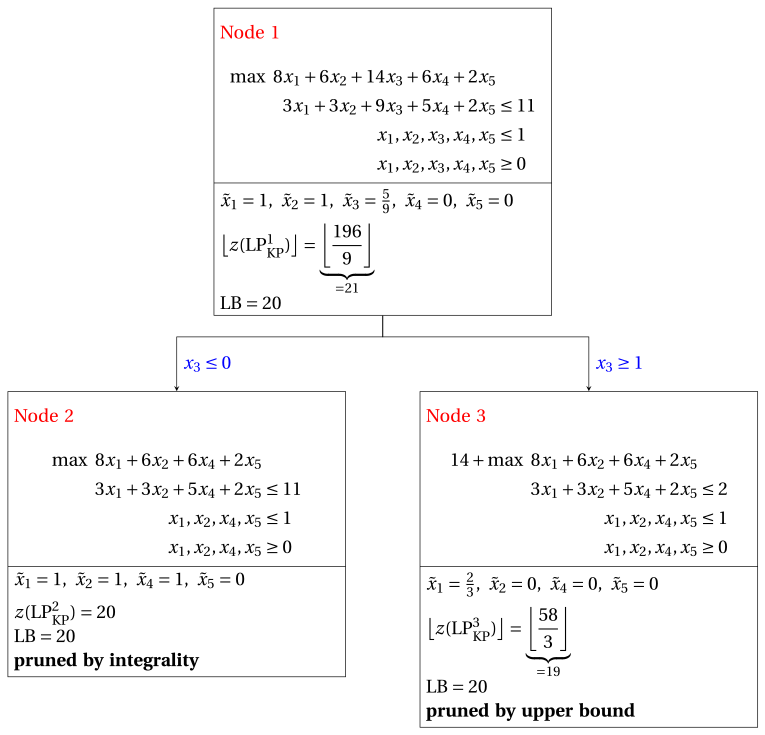
At the end of the first iteration, Node 2 is pruned by integrality and Node 3 is pruned by upper bound. The corresponding branch-and-bound tree is:
-
-
Termination
Since the problem list \(L\) is empty, the \(\mathrm{ILP}_{\mathrm{KP}}\) problem is solved to optimality.
The optimal value is \(z(~\mathrm{ILP}_{\mathrm{KP}}~)=20\) (the value of the lower bound \(\LB\)) and an optimal solution \({\tilde {\boldsymbol x}}(\,\mathrm{ILP}_{\mathrm{KP}}\,)\) is \(\tilde x_1=1,\tilde x_2=1,\tilde x_3=0,\tilde x_4=1,\tilde x_5=0\) (the incumbent solution \({\bar{\boldsymbol x}}(\mathrm{ILP}_{\mathrm{KP}})\)).
-
-
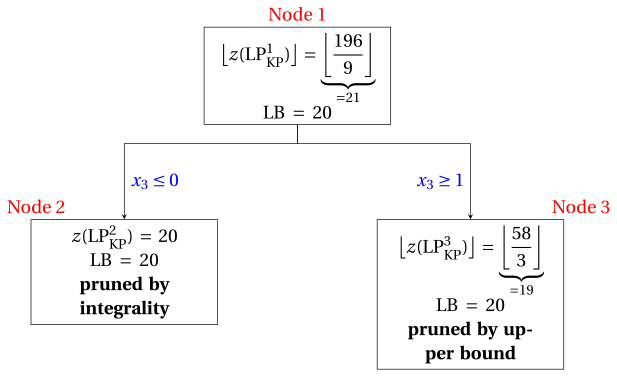
This is the branch-and-bound tree of the previous execution of the branch-and-bound algorithm, showing for each solved branching node the optimal value of the associated \(\mathrm{LP}_{\mathrm{KP}}\) problem, the current lower bound \(\LB\), and the pruning criteria.
Exercise 41.2: Branch-and-Bound Algorithm for the 0/1 Knapsack Problem (P2)
We consider a knapsack capacity \(c=8\) and a set \(\mathscr{I}=\{1,2,3,4\}\) of \(4\) items (\(n=4\)) with the following profits and weights:
Questions
-
Check if the items are sorted by non-increasing efficiency otherwise sort them in this order. Write the \(\mathrm{ILP}_{\mathrm{KP}}\) model and the \(\mathrm{LP}_{\mathrm{KP}}\) model for the KP instance.
-
Execute the branch-and-bound algorithm to solve the \(\mathrm{ILP}_{\mathrm{KP}}\) model for the 0/1 knapsack problem (KP) using:
-
the split-item rule as branching-variable selection strategy;
-
the LIFO rule as branching-node selection strategy;
-
solve first the down-branching node and then the up-branching node;
-
set the incumbent solution \({\bar{\boldsymbol x}}(\,\mathrm{ILP}_{\mathrm{KP}}\,)\) to the following heuristic solution :
\[ \bar{x}_1=1, ~~~ \bar{x}_2=0,~~~ \bar{x}_3= 0,~~\bar{x}_4=1 \]and set the lower bound \(\LB\) accordingly.
-
-
Determine and comment the correspondent branch-and-bound tree showing the reason why the branching nodes can be pruned.
Solution
-
The items are sorted by non-increasing efficiency since we have:
\[ \frac{40}{4} ~~\ge~~ \frac{42}{7} ~~\ge~~ \frac{25}{5} ~~\ge~~ \frac{12}{3} \]This is the \(\mathrm{ILP}_{\mathrm{KP}}\) model for the KP instance:
\[ \begin{array}{rrrrrrrrrrrrr} {\max} & 40 \, {x_1} & + 42 \, {x_2} & + 25 \, {x_3} & + 12 \, {x_4} \\[1ex] & 4 \, {x_1} & + 7 \, {x_2} & + 5 \, {x_3} & + 3 \, {x_4} & {\le} & 8 \\[1ex] & {x_1}, & {x_2}, & {x_3}, & {x_4} & { \in} & { \{0,1\}} \end{array} \]This is the \(\mathrm{LP}_{\mathrm{KP}}\) model for the KP instance:
\[ \begin{array}{rrrrrrrrrrrrr} {\max} & 40 \, {x_1} & + 42 \, {x_2} & + 25 \, {x_3} & + 12 \, {x_4} \\[1ex] & 4 \, {x_1} & + 7 \, {x_2} & + 5 \, {x_3} & + 3 \, {x_4} & {\le} & 8 \\[1ex] & {x_1} & & & & {\le} & 1 \\[1ex] & & {x_2} & & & {\le} & 1 \\[1ex] & & & {x_3} & & {\le} & 1 \\[1ex] & & & & {x_4} & {\le} & 1 \\[1ex] & {x_1}, & {x_2}, & {x_3}, & {x_4} & { \ge} & { 0} \end{array} \] -
Execution of the branch-and-bound algorithm to solve the \(\mathrm{ILP}_{\mathrm{KP}}\) model.
-
Initialization
For the \(\mathrm{LP}^1_{\mathrm{KP}}\) problem, the split item is \(s=2\) and the residual capacity is \(\mathit{rc} = 4\). An optimal solution \({ \tilde{ \boldsymbol x}}(\,\mathrm{LP}^1_{\mathrm{KP}}\,)\) is:
\[ \tilde{x}_1=1,~~\tilde{x}_2=\frac{4}{7},~~\tilde{x}_3=0,~~\tilde{x}_4=0 \]the optimal value is:
\[ z(~\mathrm{LP}^1_{\mathrm{KP}}~) = 40 \cdot 1 + 42 \cdot \frac{4}{7} =64 \]The optimal solution \({ \tilde{ \boldsymbol x}}(\,\mathrm{LP}^1_{\mathrm{KP}}\,)\) is fractional and the \(\mathrm{LP}^1_{\mathrm{KP}}\) problem is feasible, so the \(\mathrm{LP}^1_{\mathrm{KP}}\) problem is inserted in the problem list \(L\) and the lower bound \(\LB\) is set to \(52\) (\(\LB(\bar{\boldsymbol x})= 52\)).
Due to the current lower bound \(\LB\) and upper bound \(\UB\), we have:
\[ 52 ~~\le~~ z(\mathrm{ILP}_{\mathrm{KP}}) ~~\le~~ 64 \] -
Iteration 1
The \(\mathrm{LP}^1_{\mathrm{KP}}\) problem is extracted and deleted from the problem list \(L\).
The branching variable is \(x_2\). The \(\mathrm{LP}^2_{\mathrm{KP}}\) and \(\mathrm{LP}^3_{\mathrm{KP}}\) problems are created by unselecting (\(x_2 \le 0\)) and selecting (\(x_2 \ge 1\)) item \(2\).
-
Solution of the \(\mathrm{LP}^2_{\mathrm{KP}}\) problem
We have
\[ \mathscr{I}^2 = \{1,3,4\},~~~\mathscr{I}^2_\text{out} = \{2\}, ~~~\mathscr{I}^2_\text{in} = \emptyset \]The capacity is \(c(2)=8\) and the objective-function constant is \(p(2)=0\). The split item is \(s=3\) and the residual capacity is \(\mathit{rc} = 4\). An optimal solution \({ \tilde{ \boldsymbol x}}(\,\mathrm{LP}^2_{\mathrm{KP}}\,)\) is:
\[ \tilde{x}_1=1,~~\tilde{x}_3=\frac{4}{5},~~\tilde{x}_4=0 \text{ and } z(~\mathrm{LP}^2_{\mathrm{KP}}~)= 40\cdot 1 + 25 \cdot \frac{4}{5}= 60 \]The \(\mathrm{LP}^2_{\mathrm{KP}}\) problem is feasible and we have:
\[ \left\lfloor z(\mathrm{LP}^2_{\mathrm{KP}}) \right\rfloor > \LB \qquad \text{since} \qquad 60 > 52 \]The optimal solution \({ \tilde{ \boldsymbol x}}(\,\mathrm{LP}^2_{\mathrm{KP}}\,)\) is fractional, accordingly, the \(\mathrm{LP}^2_{\mathrm{KP}}\) problem is inserted in the problem list \(L\).
-
Solution of the \(\mathrm{LP}^3_{\mathrm{KP}}\) problem
We have
\[ \mathscr{I}^3 = \{1,3,4\},~~~\mathscr{I}^3_\text{out} = \emptyset, ~~~\mathscr{I}^3_\text{in} = \{2\} \]The capacity is \(c(3)=1\) and the objective-function constant is \(p(3)=42\). The split item is \(s=1\) and the residual capacity is \(\mathit{rc} = 1\). An optimal solution \({ \tilde{ \boldsymbol x}}(\,\mathrm{LP}^3_{\mathrm{KP}}\,)\) is:
\[ \tilde{x}_1=\frac{1}{4},~~\tilde{x}_3=0,~~\tilde{x}_4=0 \text{ and } z(~\mathrm{LP}^3_{\mathrm{KP}}~)= 42 + 40 \cdot \frac{1}{4}= 52 \]The \(\mathrm{LP}^3_{\mathrm{KP}}\) problem is feasible and we have:
\[ \left\lfloor z(\mathrm{LP}^3_{\mathrm{KP}}) \right\rfloor \le \LB \qquad \text{since} \qquad 52 \le 52 \]accordingly, the branching node is pruned by upper bound.
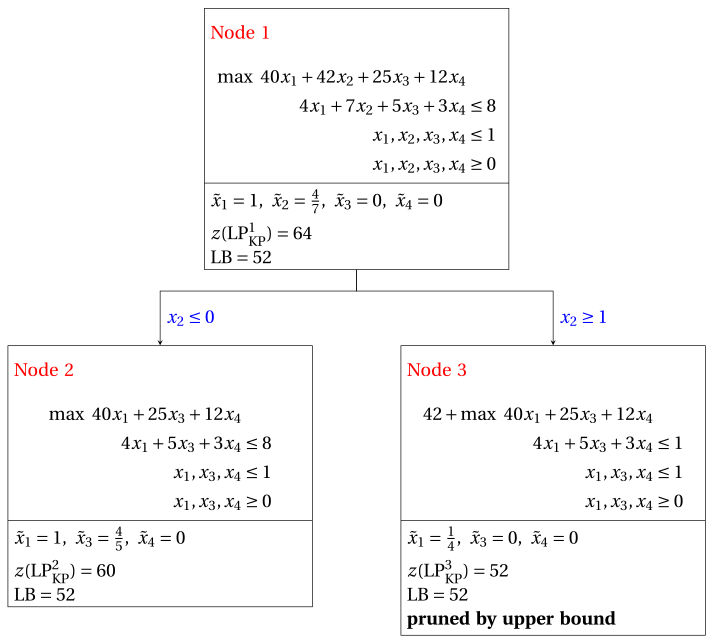
At the end of the first iteration, Node 2 is inserted in the problem list \(L\), while Node 3 is pruned by upper bound. The corresponding branch-and-bound tree is:
Due to the current lower bound \(\LB\) and upper bound \(\UB\), we have:
\[ 52 ~~\le~~ z(\mathrm{ILP}_{\mathrm{KP}}) ~~\le~~ 60 \] -
-
Iteration 2
The \(\mathrm{LP}^2_{\mathrm{KP}}\) problem is extracted and deleted from the problem list \(L\).
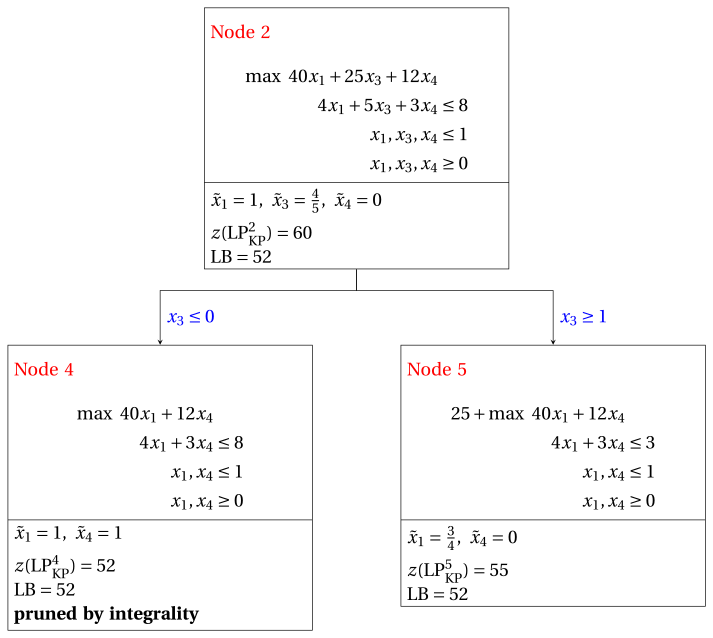
The branching variable is \(x_3\). The \(\mathrm{LP}^4_{\mathrm{KP}}\) and \(\mathrm{LP}^5_{\mathrm{KP}}\) problems are created by unselecting (\(x_3 \le 0\)) and selecting (\(x_3 \ge 1\)) item \(3\).
-
Solution of the \(\mathrm{LP}^4_{\mathrm{KP}}\) problem
We have
\[ \mathscr{I}^4 = \{1,4\},~~~\mathscr{I}^4_\text{out} = \{2,3\}, ~~~\mathscr{I}^4_\text{in} = \emptyset \]The capacity is \(c(4)=8\) and the objective-function constant is \(p(4)=0\). All items fit into the knapsack. An optimal solution \({ \tilde{ \boldsymbol x}}(\,\mathrm{LP}^4_{\mathrm{KP}}\,)\) is:
\[ \tilde{x}_1=1,~~\tilde{x}_4=1 \text{ and } z(~\mathrm{LP}^4_{\mathrm{KP}}~) = 40 \cdot 1 + 12 \cdot 1 = 52 \]The \(\mathrm{LP}^4_{\mathrm{KP}}\) problem is feasible and its optimal solution \({ \tilde{ \boldsymbol x}}(\,\mathrm{LP}^4_{\mathrm{KP}}\,)\) is integer. It does not improve the incumbent solution, since \(z(\mathrm{LP}^4_{\mathrm{KP}})=52 \le 52=\LB\), accordingly, the branching node is pruned by integrality (when both criteria hold, the integrality comes first).
-
Solution of the \(\mathrm{LP}^5_{\mathrm{KP}}\) problem
We have
\[ \mathscr{I}^5 = \{1,4\},~~~\mathscr{I}^5_\text{out} = \{2\}, ~~~\mathscr{I}^5_\text{in}= \{3\} \]The capacity is \(c(5)=3\) and the objective-function constant is \(p(5)=25\). The split item is \(s=1\) and the residual capacity is \(\mathit{rc} = 3\). An optimal solution \({ \tilde{ \boldsymbol x}}(\,\mathrm{LP}^5_{\mathrm{KP}}\,)\) is:
\[ \tilde{x}_1=\frac{3}{4},~~\tilde{x}_2=0,~~\tilde{x}_3=1,~~\tilde{x}_4=0 \text{ and } z(~\mathrm{LP}^5_{\mathrm{KP}}~)= 25 + 40 \cdot \frac{3}{4} = 55 \]The \(\mathrm{LP}^5_{\mathrm{KP}}\) problem is feasible and we have:
\[ \left\lfloor z(\mathrm{LP}^5_{\mathrm{KP}}) \right\rfloor > \LB \qquad \text{since} \qquad 55 > 52 \]The optimal solution \({ \tilde{ \boldsymbol x}}(\,\mathrm{LP}^5_{\mathrm{KP}}\,)\) is fractional, accordingly, the \(\mathrm{LP}^5_{\mathrm{KP}}\) problem is inserted in the problem list \(L\).
At the end of the second iteration, Node 5 is inserted in the problem list \(L\), while Node 4 is pruned by integrality. The corresponding branch-and-bound tree is:
Due to the current lower bound \(\LB\) and upper bound \(\UB\), we have:
\[ 52 ~~\le~~ z(\mathrm{ILP}_{\mathrm{KP}}) ~~\le~~ 55 \] -
-
Iteration 3
The \(\mathrm{LP}^5_{\mathrm{KP}}\) problem is extracted and deleted from the problem list \(L\).
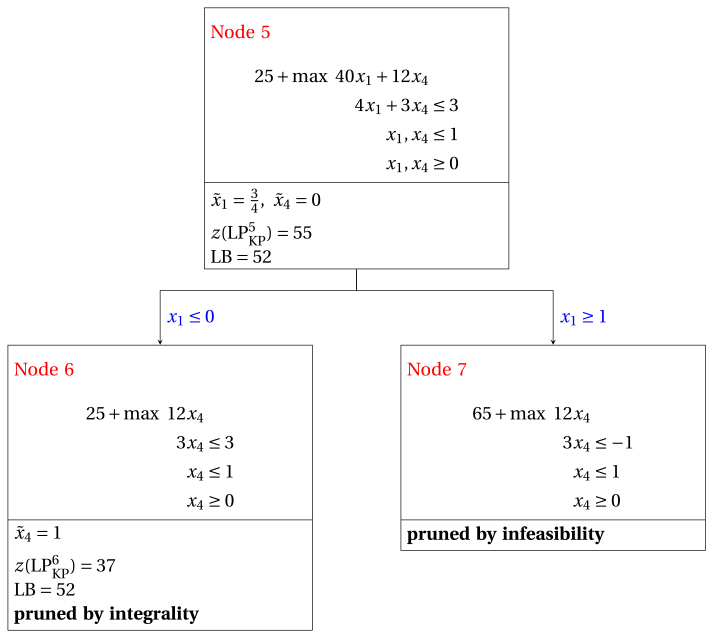
The branching variable is \(x_1\). The \(\mathrm{LP}^6_{\mathrm{KP}}\) and \(\mathrm{LP}^7_{\mathrm{KP}}\) problems are created by unselecting (\(x_1 \le 0\)) and selecting (\(x_1 \ge 1\)) item \(1\).
-
Solution of the \(\mathrm{LP}^6_{\mathrm{KP}}\) problem
We have
\[ \mathscr{I}^6 = \{4\},~~~\mathscr{I}^6_\text{out} = \{1,2\}, ~~~\mathscr{I}^6_\text{in} = \{3\} \]The capacity is \(c(6)=3\) and the objective-function constant is \(p(6)=25\). All items fit into the knapsack. An optimal solution \({ \tilde{ \boldsymbol x}}(\,\mathrm{LP}^6_{\mathrm{KP}}\,)\) is:
\[ \tilde{x}_4=1 \text{ and } z(~\mathrm{LP}^6_{\mathrm{KP}}~)= 25+12 \cdot 1=37 \]The \(\mathrm{LP}^6_{\mathrm{KP}}\) problem is feasible and its optimal solution \({ \tilde{ \boldsymbol x}}(\,\mathrm{LP}^6_{\mathrm{KP}}\,)\) is integer. It does not improve the incumbent solution, since \(z(\mathrm{LP}^6_{\mathrm{KP}})=37 < 52=\LB\), accordingly, the branching node is pruned by integrality (when both criteria hold, the integrality comes first).
-
Solution of the \(\mathrm{LP}^7_{\mathrm{KP}}\) problem
The \(\mathrm{LP}^7_{\mathrm{KP}}\) problem is infeasible, accordingly the branching node is pruned by infeasibility.
At the end of the third iteration, Node 6 is pruned by integrality and Node 7 is pruned by infeasibility. The corresponding branch-and-bound tree is:
-
-
Termination
Since the problem list \(L\) is empty, the \(\mathrm{ILP}_{\mathrm{KP}}\) problem is solved to optimality.
The optimal value is \(z(~\mathrm{ILP}_{\mathrm{KP}}~)=52\) (the value of the lower bound \(\LB\)) and an optimal solution \({\tilde {\boldsymbol x}}(\,\mathrm{ILP}_{\mathrm{KP}}\,)\) is \(\tilde x_1=1,\tilde x_2=0,\tilde x_3=0,\tilde x_4=1\) (the incumbent solution \({\bar{\boldsymbol x}}(\mathrm{ILP}_{\mathrm{KP}})\)).
-
-
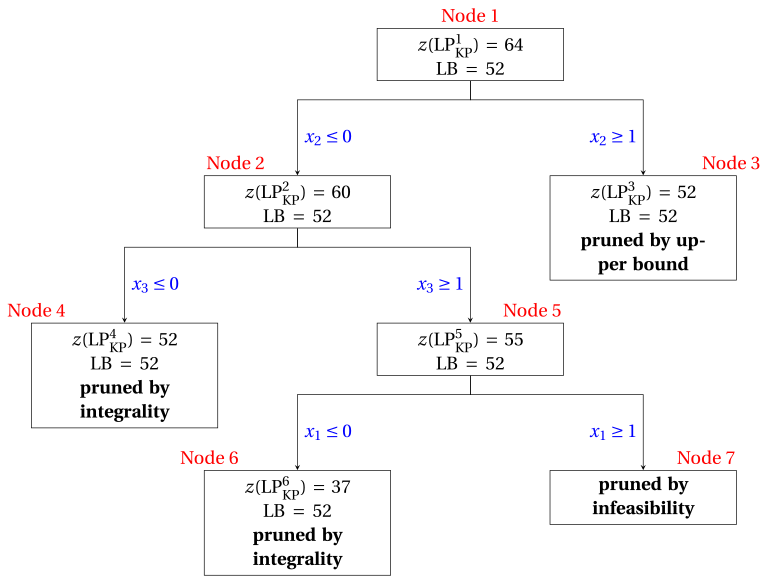
This is the branch-and-bound tree of the previous execution of the branch-and-bound algorithm, showing for each solved branching node the optimal value of the associated \(\mathrm{LP}_{\mathrm{KP}}\) problem, the current lower bound \(\LB\), and the pruning criteria.
Exercise 41.3: Branch-and-Bound Algorithm for the 0/1 Knapsack Problem (P3)
We consider a knapsack capacity \(c=15\) and a set \(\mathscr{I}=\{1,2,3,4\}\) of \(4\) items (\(n=4\)) with the following profits and weights:
Questions
-
Check if the items are sorted by non-increasing efficiency otherwise sort them in this order. Write the \(\mathrm{ILP}_{\mathrm{KP}}\) model and the \(\mathrm{LP}_{\mathrm{KP}}\) model for the KP instance.
-
Execute the branch-and-bound algorithm to solve the \(\mathrm{ILP}_{\mathrm{KP}}\) model for the 0/1 knapsack problem (KP) using:
-
the split-item rule as branching-variable selection strategy;
-
the LIFO rule as branching-node selection strategy;
-
solve first the down-branching node and then the up-branching node;
-
set the incumbent solution \({\bar{\boldsymbol x}}(\,\mathrm{ILP}_{\mathrm{KP}}\,)\) to the following heuristic solution :
\[ \bar{x}_1=1, ~~~ \bar{x}_2=0,~~~ \bar{x}_3= 0,~~\bar{x}_4=1 \]and set the lower bound \(\LB\) accordingly.
-
-
Determine and comment the correspondent branch-and-bound tree showing the reason why the branching nodes can be pruned.
Solution
-
The items are sorted by non-increasing efficiency since we have:
\[ \frac{24}{10} ~~\ge~~\frac{17}{8} ~~\ge~~\frac{12}{6} ~~\ge~~\frac{6}{5} \]This is the \(\mathrm{ILP}_{\mathrm{KP}}\) model for the KP instance:
\[ \begin{array}{rrrrrrrrrrrrr} {\max} & 24 \, {x_1} & + 17 \, {x_2} & + 12 \, {x_3} & + 6 \, {x_4} \\[1ex] & 10 \, {x_1} & + 8 \, {x_2} & + 6 \, {x_3} & + 5 \, {x_4} & {\le} & 15 \\[1ex] & {x_1}, & {x_2}, & {x_3}, & {x_4} & { \in} & { \{0,1\}} \end{array} \]This is the \(\mathrm{LP}_{\mathrm{KP}}\) model for the KP instance:
\[ \begin{array}{rrrrrrrrrrrrr} {\max} & 24 \, {x_1} & + 17 \, {x_2} & + 12 \, {x_3} & + 6 \, {x_4} \\[1ex] & 10 \, {x_1} & + 8 \, {x_2} & + 6 \, {x_3} & + 5 \, {x_4} & {\le} & 15 \\[1ex] & {x_1} & & & & {\le} & 1 \\[1ex] & & {x_2} & & & {\le} & 1 \\[1ex] & & & {x_3} & & {\le} & 1 \\[1ex] & & & & {x_4} & {\le} & 1 \\[1ex] & {x_1}, & {x_2}, & {x_3}, & {x_4} & { \ge} & { 0} \end{array} \] -
Execution of the branch-and-bound algorithm to solve the \(\mathrm{ILP}_{\mathrm{KP}}\) model.
-
Initialization
For the \(\mathrm{LP}^1_{\mathrm{KP}}\) problem, the split item is \(s=2\) and the residual capacity is \(\mathit{rc} = 5\). An optimal solution \({ \tilde{ \boldsymbol x}}(\,\mathrm{LP}^1_{\mathrm{KP}}\,)\) is:
\[ \tilde{x}_1=1,~~\tilde{x}_2=\frac{5}{8},~~\tilde{x}_3=0,~~\tilde{x}_4=0 \]the optimal value is:
\[ z(~\mathrm{LP}^1_{\mathrm{KP}}~) = 24 \cdot 1 + 17 \cdot \frac{5}{8} =\frac{277}{8} \]The optimal solution \({ \tilde{ \boldsymbol x}}(\,\mathrm{LP}^1_{\mathrm{KP}}\,)\) is fractional and the \(\mathrm{LP}^1_{\mathrm{KP}}\) problem is feasible, so the \(\mathrm{LP}^1_{\mathrm{KP}}\) problem is inserted in the problem list \(L\) and the lower bound \(\LB\) is set to \(30\) (\(\LB(\bar{\boldsymbol x})= 30\)).
Due to the current lower bound \(\LB\) and upper bound \(\UB\), we have:
\[ 30 ~~\le~~ z(\mathrm{ILP}_{\mathrm{KP}}) ~~\le~~ \underbrace{\left\lfloor \dfrac{277}{8} \right\rfloor}_{=34} \] -
Iteration 1
The \(\mathrm{LP}^1_{\mathrm{KP}}\) problem is extracted and deleted from the problem list \(L\).
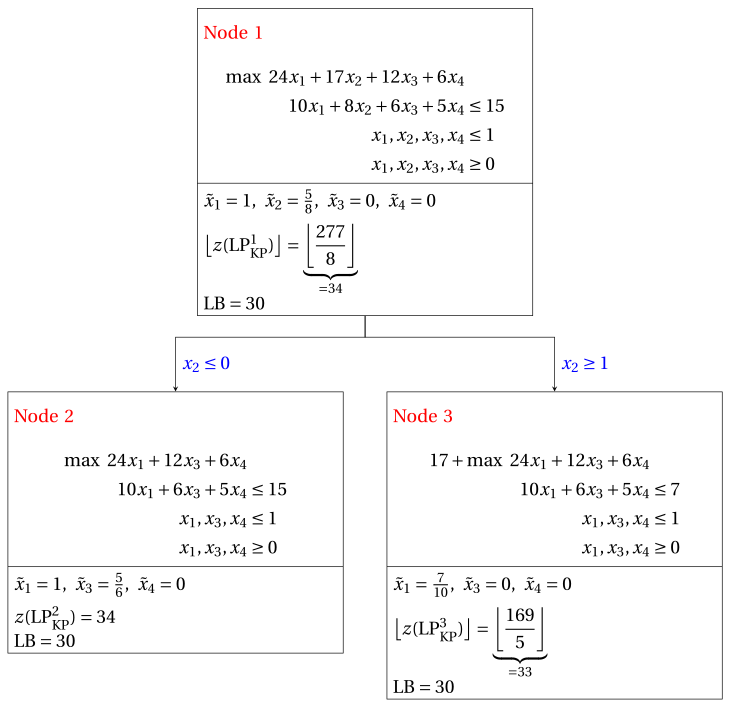
The branching variable is \(x_2\). The \(\mathrm{LP}^2_{\mathrm{KP}}\) and \(\mathrm{LP}^3_{\mathrm{KP}}\) problems are created by unselecting (\(x_2 \le 0\)) and selecting (\(x_2 \ge 1\)) item \(2\).
-
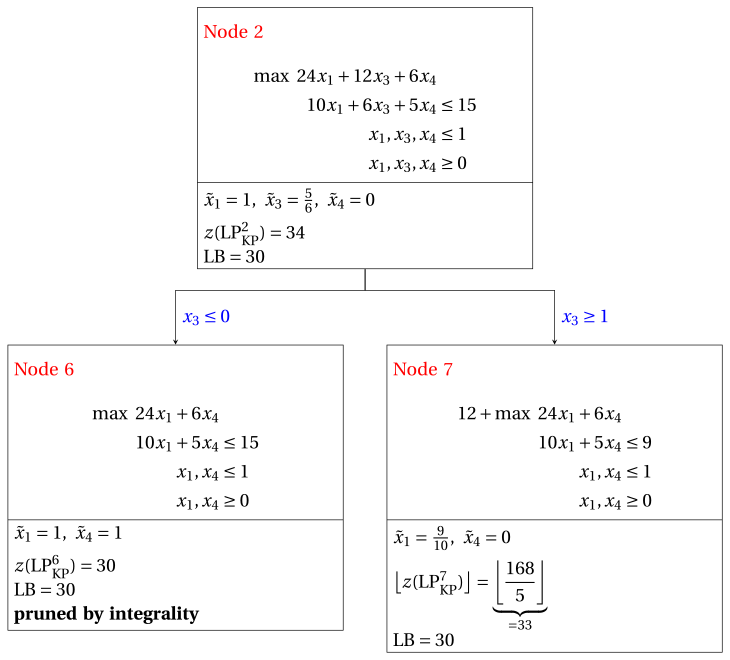
Solution of the \(\mathrm{LP}^2_{\mathrm{KP}}\) problem
We have
\[ \mathscr{I}^2 = \{1,3,4\},~~~\mathscr{I}^2_\text{out} = \{2\}, ~~~\mathscr{I}^2_\text{in} = \emptyset \]The capacity is \(c(2)=15\) and the objective-function constant is \(p(2)=0\). The split item is \(s=3\) and the residual capacity is \(\mathit{rc} = 5\). An optimal solution \({ \tilde{ \boldsymbol x}}(\,\mathrm{LP}^2_{\mathrm{KP}}\,)\) is:
\[ \tilde{x}_1=1,~~\tilde{x}_3=\frac{5}{6},~~\tilde{x}_4=0 \text{ and } z(~\mathrm{LP}^2_{\mathrm{KP}}~)= 24\cdot 1 + 12 \cdot \frac{5}{6}= 34 \]The \(\mathrm{LP}^2_{\mathrm{KP}}\) problem is feasible and we have:
\[ \left\lfloor z(\mathrm{LP}^2_{\mathrm{KP}}) \right\rfloor > \LB \qquad \text{since} \qquad 34 > 30 \]The optimal solution \({ \tilde{ \boldsymbol x}}(\,\mathrm{LP}^2_{\mathrm{KP}}\,)\) is fractional, accordingly, the \(\mathrm{LP}^2_{\mathrm{KP}}\) problem is inserted in the problem list \(L\).
-
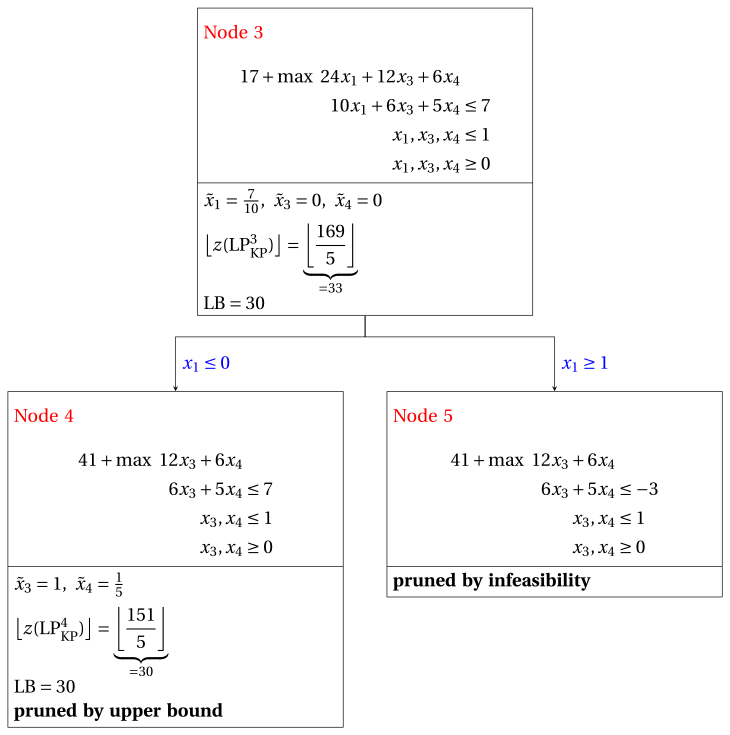
Solution of the \(\mathrm{LP}^3_{\mathrm{KP}}\) problem
We have
\[ \mathscr{I}^3 = \{1,3,4\},~~~\mathscr{I}^3_\text{out} = \emptyset, ~~~\mathscr{I}^3_\text{in} = \{2\} \]The capacity is \(c(3)=7\) and the objective-function constant is \(p(3)=17\). The split item is \(s=1\) and the residual capacity is \(\mathit{rc} = 7\). An optimal solution \({ \tilde{ \boldsymbol x}}(\,\mathrm{LP}^3_{\mathrm{KP}}\,)\) is:
\[ \tilde{x}_1=\frac{7}{10},~~\tilde{x}_3=0,~~\tilde{x}_4=0 \text{ and } z(~\mathrm{LP}^3_{\mathrm{KP}}~)= 17 + 24 \cdot \frac{7}{10}= \frac{169}{5} \]The \(\mathrm{LP}^3_{\mathrm{KP}}\) problem is feasible and we have:
\[ \left\lfloor z(\mathrm{LP}^3_{\mathrm{KP}}) \right\rfloor > \LB \qquad \text{since} \qquad \underbrace{\left\lfloor \frac{169}{5} \right\rfloor}_{=33} > 30 \]The optimal solution \({ \tilde{ \boldsymbol x}}(\,\mathrm{LP}^3_{\mathrm{KP}}\,)\) is fractional, accordingly, the \(\mathrm{LP}^3_{\mathrm{KP}}\) problem is inserted in the problem list \(L\).
At the end of the first iteration, Node 2 and Node 3 are both inserted in the problem list \(L\). The corresponding branch-and-bound tree is:
Due to the current lower bound \(\LB\) and upper bound \(\UB\), we have:
\[ 30 ~~\le~~ z(\mathrm{ILP}_{\mathrm{KP}}) ~~\le~~ \underbrace{\max \left\{ 34,~~ \underbrace{\left\lfloor \frac{169}{5} \right\rfloor}_{=33} \right\}}_{=34} \] -
-
Iteration 2
The \(\mathrm{LP}^3_{\mathrm{KP}}\) problem is extracted and deleted from the problem list \(L\).
The branching variable is \(x_1\). The \(\mathrm{LP}^4_{\mathrm{KP}}\) and \(\mathrm{LP}^5_{\mathrm{KP}}\) problems are created by unselecting (\(x_1 \le 0\)) and selecting (\(x_1 \ge 1\)) item \(1\).
-
Solution of the \(\mathrm{LP}^4_{\mathrm{KP}}\) problem
We have
\[ \mathscr{I}^4 = \{3,4\},~~~\mathscr{I}^4_\text{out} = \{1\}, ~~~\mathscr{I}^4_\text{in} = \{2\} \]The capacity is \(c(4)=7\) and the objective-function constant is \(p(4)=17\). The split item is \(s=4\) and the residual capacity is \(\mathit{rc} = 1\). An optimal solution \({ \tilde{ \boldsymbol x}}(\,\mathrm{LP}^4_{\mathrm{KP}}\,)\) is:
\[ \tilde{x}_3=1,~~\tilde{x}_4=\frac{1}{5} \text{ and } z(~\mathrm{LP}^4_{\mathrm{KP}}~) = 17+ 12 \cdot 1 + 6 \cdot \frac{1}{5} = \frac{151}{5} \]The \(\mathrm{LP}^4_{\mathrm{KP}}\) problem is feasible and we have:
\[ \left\lfloor z(\mathrm{LP}^4_{\mathrm{KP}}) \right\rfloor \le \LB \qquad \text{since} \qquad \underbrace{\left\lfloor \frac{151}{5} \right\rfloor}_{=30} \le 30 \]accordingly, the branching node is pruned by upper bound.
-
Solution of the \(\mathrm{LP}^5_{\mathrm{KP}}\) problem
The \(\mathrm{LP}^5_{\mathrm{KP}}\) problem is infeasible, accordingly the branching node is pruned by infeasibility.
At the end of the second iteration, Node 4 is pruned by upper bound and Node 5 is pruned by infeasibility. The corresponding branch-and-bound tree is:
Due to the current lower bound \(\LB\) and upper bound \(\UB\), we have:
\[ 30 ~~\le~~ z(\mathrm{ILP}_{\mathrm{KP}}) ~~\le~~ 34 \] -
-
Iteration 3
The \(\mathrm{LP}^2_{\mathrm{KP}}\) problem is extracted and deleted from the problem list \(L\).
The branching variable is \(x_3\). The \(\mathrm{LP}^6_{\mathrm{KP}}\) and \(\mathrm{LP}^7_{\mathrm{KP}}\) problems are created by unselecting (\(x_3 \le 0\)) and selecting (\(x_3 \ge 1\)) item \(3\).
-
Solution of the \(\mathrm{LP}^6_{\mathrm{KP}}\) problem
We have
\[ \mathscr{I}^6 = \{1,4\},~~~\mathscr{I}^6_\text{out} = \{2,3\}, ~~~\mathscr{I}^6_\text{in} = \emptyset \]The capacity is \(c(6)=15\) and the objective-function constant is \(p(6)=0\). All items fit into the knapsack. An optimal solution \({ \tilde{ \boldsymbol x}}(\,\mathrm{LP}^6_{\mathrm{KP}}\,)\) is:
\[ \tilde{x}_1=1,\tilde{x}_4=1 \text{ and } z(~\mathrm{LP}^6_{\mathrm{KP}}~)= 24 \cdot 1+6 \cdot 1=30 \]The \(\mathrm{LP}^6_{\mathrm{KP}}\) problem is feasible and its optimal solution \({ \tilde{ \boldsymbol x}}(\,\mathrm{LP}^6_{\mathrm{KP}}\,)\) is integer. It does not improve the incumbent solution, since \(z(\mathrm{LP}^6_{\mathrm{KP}})=30 \le 30=\LB\), accordingly, the branching node is pruned by integrality (when both criteria hold, the integrality comes first).
-
Solution of the \(\mathrm{LP}^7_{\mathrm{KP}}\) problem
We have
\[ \mathscr{I}^7 = \{1,4\},~~~\mathscr{I}^7_\text{out} = \{2\}, ~~~\mathscr{I}^7_\text{in} = \{3\} \]The capacity is \(c(7)=9\) and the objective-function constant is \(p(7)=12\). The split item is \(s=1\) and the residual capacity is \(\mathit{rc} = 9\). An optimal solution \({ \tilde{ \boldsymbol x}}(\,\mathrm{LP}^7_{\mathrm{KP}}\,)\) is:
\[ \tilde{x}_1=\frac{9}{10},~~\tilde{x}_4=0 \text{ and } z(~\mathrm{LP}^7_{\mathrm{KP}}~)= 12 + 24 \cdot \frac{9}{10}= \frac{168}{5} \]The \(\mathrm{LP}^7_{\mathrm{KP}}\) problem is feasible and we have:
\[ \left\lfloor z(\mathrm{LP}^7_{\mathrm{KP}}) \right\rfloor > \LB \qquad \text{since} \qquad \underbrace{\left\lfloor \frac{168}{5} \right\rfloor}_{=33} > 30 \]The optimal solution \({ \tilde{ \boldsymbol x}}(\,\mathrm{LP}^7_{\mathrm{KP}}\,)\) is fractional, accordingly, the \(\mathrm{LP}^7_{\mathrm{KP}}\) problem is inserted in the problem list \(L\).
At the end of the third iteration, Node 6 is pruned by integrality and Node 7 is inserted in the problem list \(L\). The corresponding branch-and-bound tree is:
-
-
Iteration 4
The \(\mathrm{LP}^7_{\mathrm{KP}}\) problem is extracted and deleted from the problem list \(L\).
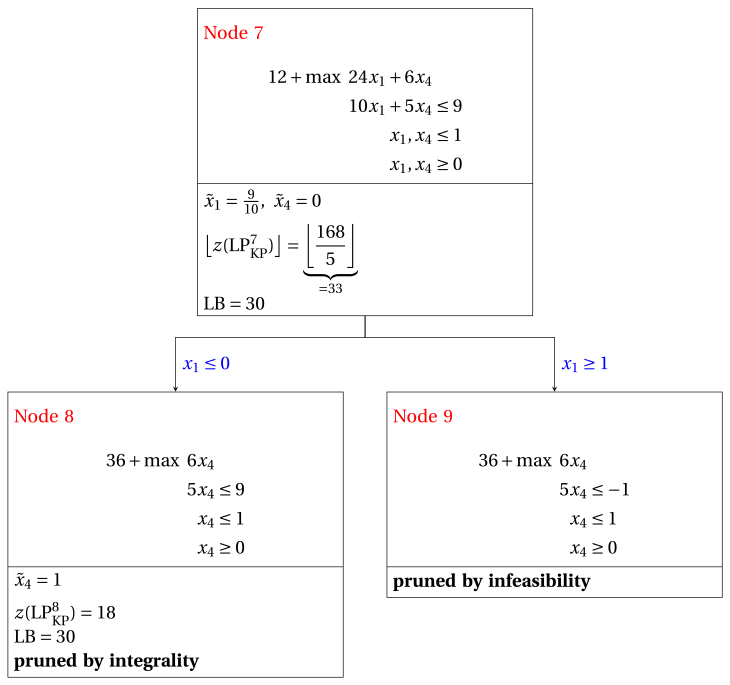
The branching variable is \(x_1\). The \(\mathrm{LP}^8_{\mathrm{KP}}\) and \(\mathrm{LP}^9_{\mathrm{KP}}\) problems are created by unselecting (\(x_1 \le 0\)) and selecting (\(x_1 \ge 1\)) item \(1\).
-
Solution of the \(\mathrm{LP}^8_{\mathrm{KP}}\) problem
We have
\[ \mathscr{I}^8 = \{4\},~~~\mathscr{I}^8_\text{out} = \{1,2\}, ~~~\mathscr{I}^8_\text{in} = \{3\} \]The capacity is \(c(8)=9\) and the objective-function constant is \(p(8)=12\). All items fit into the knapsack. An optimal solution \({ \tilde{ \boldsymbol x}}(\,\mathrm{LP}^8_{\mathrm{KP}}\,)\) is:
\[ \tilde{x}_4=1 \text{ and } z(~\mathrm{LP}^8_{\mathrm{KP}}~)= 12+6 \cdot 1=18 \]The \(\mathrm{LP}^8_{\mathrm{KP}}\) problem is feasible and its optimal solution \({ \tilde{ \boldsymbol x}}(\,\mathrm{LP}^8_{\mathrm{KP}}\,)\) is integer. It does not improve the incumbent solution, since \(z(\mathrm{LP}^8_{\mathrm{KP}})=18 < 30=\LB\), accordingly, the branching node is pruned by integrality (when both criteria hold, the integrality comes first).
-
Solution of the \(\mathrm{LP}^9_{\mathrm{KP}}\) problem
The \(\mathrm{LP}^9_{\mathrm{KP}}\) problem is infeasible, accordingly the branching node is pruned by infeasibility.
At the end of the fourth iteration, Node 8 is pruned by integrality and Node 9 is pruned by infeasibility. The corresponding branch-and-bound tree is:
-
-
Termination
Since the problem list \(L\) is empty, the \(\mathrm{ILP}_{\mathrm{KP}}\) problem is solved to optimality.
The optimal value is \(z(~\mathrm{ILP}_{\mathrm{KP}}~)=30\) (the value of the lower bound \(\LB\)) and an optimal solution \({\tilde {\boldsymbol x}}(\,\mathrm{ILP}_{\mathrm{KP}}\,)\) is \(\tilde x_1=1,\tilde x_2=0,\tilde x_3=0,\tilde x_4=1\) (the incumbent solution \({\bar{\boldsymbol x}}(\mathrm{ILP}_{\mathrm{KP}})\)).
-
-
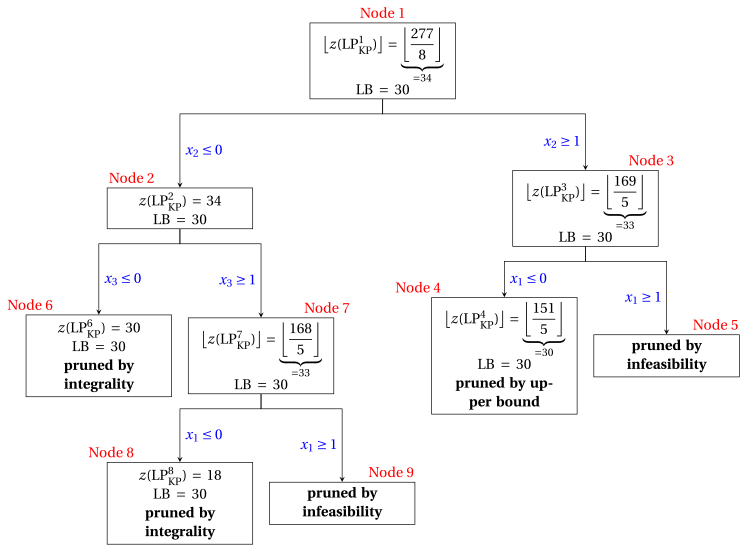
This is the branch-and-bound tree of the previous execution of the branch-and-bound algorithm, showing for each solved branching node the optimal value of the associated \(\mathrm{LP}_{\mathrm{KP}}\) problem, the current lower bound \(\LB\), and the pruning criteria.
Exercise 41.4: Branch-and-Bound Algorithm for the 0/1 Knapsack Problem (P4)
We consider a knapsack capacity \(c=9\) and a set \(\mathscr{I}=\{1,2,3,4,5,6\}\) of \(6\) items (\(n=6\)) with the following profits and weights:
Questions
-
Check if the items are sorted by non-increasing efficiency otherwise sort them in this order. Write the \(\mathrm{ILP}_{\mathrm{KP}}\) model and the \(\mathrm{LP}_{\mathrm{KP}}\) model for the KP instance.
-
Execute the branch-and-bound algorithm to solve the \(\mathrm{ILP}_{\mathrm{KP}}\) model for the 0/1 knapsack problem (KP) using:
-
the split-item rule as branching-variable selection strategy;
-
the FIFO rule as branching-node selection strategy;
-
solve first the down-branching node and then the up-branching node;
-
set the incumbent solution \({\bar{\boldsymbol x}}(\,\mathrm{ILP}_{\mathrm{KP}}\,)\) to the following heuristic solution :
\[ \bar{x}_1=1, ~~~ \bar{x}_2=1,~~~ \bar{x}_3= 0,~~\bar{x}_4=0,~~\bar{x}_5=0,~~\bar{x}_6=0 \]and set the lower bound \(\LB\) accordingly.
-
-
Determine and comment the correspondent branch-and-bound tree showing the reason why the branching nodes can be pruned.
Solution
-
The items are sorted by non-increasing efficiency since we have:
\[ \frac{6}{2} ~~\ge~~ \frac{5}{3} ~~\ge~~ \frac{8}{6} ~~\ge~~ \frac{9}{7} ~~\ge~~ \frac{6}{5} ~~\ge~~ \frac{7}{9} \]This is the \(\mathrm{ILP}_{\mathrm{KP}}\) model for the KP instance:
\[ \begin{array}{rrrrrrrrrrrrr} {\max} & 6 \, {x_1} & + 5 \, {x_2} & + 8 \, {x_3} & + 9 \, {x_4} & + 6 \, {x_5} & + 7 \, {x_6} \\[1.5ex] & 2 \, {x_1} & + 3 \, {x_2} & + 6 \, {x_3} & + 7 \, {x_4} & + 5 \, {x_5} & + 9 \, {x_6} & {\le} & 9 \\[1.5ex] & {x_1}, & {x_2}, & {x_3}, & {x_4}, & {x_5}, & {x_6} & { \in} & { \{0,1\}} \end{array} \]This is the \(\mathrm{LP}_{\mathrm{KP}}\) model for the KP instance:
\[ \begin{array}{rrrrrrrrrrrrr} {\max} & 6 \, {x_1} & + 5 \, {x_2} & + 8 \, {x_3} & + 9 \, {x_4} & + 6 \, {x_5} & + 7 \, {x_6} \\[1ex] & 2 \, {x_1} & + 3 \, {x_2} & + 6 \, {x_3} & + 7 \, {x_4} & + 5 \, {x_5} & + 9 \, {x_6} & {\le} & 9 \\[1ex] & {x_1} & & & & & & {\le} & 1 \\ & & {x_2} & & & & & {\le} & 1 \\ & & & {x_3} & & & & {\le} & 1 \\ & & & & {x_4} & & & {\le} & 1 \\ & & & & & {x_5} & & {\le} & 1 \\ & & & & & & {x_6} & {\le} & 1 \\[1ex] & {x_1}, & {x_2}, & {x_3}, & {x_4}, & {x_5}, & {x_6} & { \ge} & { 0} \end{array} \] -
Execution of the branch-and-bound algorithm to solve the \(\mathrm{ILP}_{\mathrm{KP}}\) model.
-
Initialization
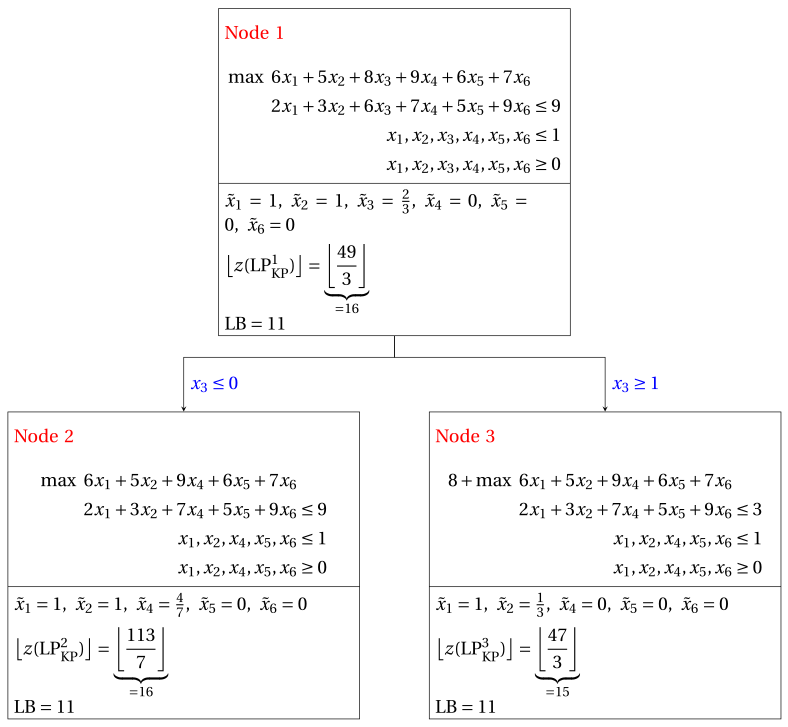
For the \(\mathrm{LP}^1_{\mathrm{KP}}\) problem, the split item is \(s=3\) and the residual capacity is \(\mathit{rc} = 4\). An optimal solution \({ \tilde{ \boldsymbol x}}(\,\mathrm{LP}^1_{\mathrm{KP}}\,)\) is:
\[ \tilde{x}_1=1,~~\tilde{x}_2=1,~~\tilde{x}_3=\frac{2}{3},~~\tilde{x}_4=0,~~\tilde{x}_5=0,~~\tilde{x}_6=0 \]the optimal value is:
\[ z(~\mathrm{LP}^1_{\mathrm{KP}}~) = 6 \cdot 1 + 5 \cdot 1 + 8 \cdot \frac{2}{3} =\frac{49}{3} \]The optimal solution \({ \tilde{ \boldsymbol x}}(\,\mathrm{LP}^1_{\mathrm{KP}}\,)\) is fractional and the \(\mathrm{LP}^1_{\mathrm{KP}}\) problem is feasible, so the \(\mathrm{LP}^1_{\mathrm{KP}}\) problem is inserted in the problem list \(L\) and the lower bound \(\LB\) is set to \(11\) (\(\LB(\bar{\boldsymbol x})= 11\)).
Due to the current lower bound \(\LB\) and upper bound \(\UB\), we have:
\[ 11 ~~\le~~ z(\mathrm{ILP}_{\mathrm{KP}}) ~~\le~~ \underbrace{\left\lfloor \dfrac{49}{3} \right\rfloor}_{=16} \] -
Iteration 1
The \(\mathrm{LP}^1_{\mathrm{KP}}\) problem is extracted and deleted from the problem list \(L\).
The branching variable is \(x_3\). The \(\mathrm{LP}^2_{\mathrm{KP}}\) and \(\mathrm{LP}^3_{\mathrm{KP}}\) problems are created by unselecting (\(x_3 \le 0\)) and selecting (\(x_3 \ge 1\)) item \(3\).
-
Solution of the \(\mathrm{LP}^2_{\mathrm{KP}}\) problem
We have
\[ \mathscr{I}^2 = \{1,2,4,5,6\},~~~\mathscr{I}^2_\text{out} = \{3\}, ~~~\mathscr{I}^2_\text{in} = \emptyset \]The capacity is \(c(2)=9\) and the objective-function constant is \(p(2)=0\). The split item is \(s=4\) and the residual capacity is \(\mathit{rc} = 4\). An optimal solution \({ \tilde{ \boldsymbol x}}(\,\mathrm{LP}^2_{\mathrm{KP}}\,)\) is:
\[ \begin{gathered}\tilde{x}_1=1,~~\tilde{x}_2=1,~~\tilde{x}_4=\frac{4}{7},~~\tilde{x}_5=0,~~\tilde{x}_6=0 \qquad \text{and} \\ z(~\mathrm{LP}^2_{\mathrm{KP}}~) = 6 \cdot 1 + 5 \cdot 1 + 9 \cdot \frac{4}{7} = \frac{113}{7}\end{gathered} \]The \(\mathrm{LP}^2_{\mathrm{KP}}\) problem is feasible and we have:
\[ \left\lfloor z(\mathrm{LP}^2_{\mathrm{KP}}) \right\rfloor > \LB \qquad \text{since} \qquad \underbrace{\left\lfloor\frac{113}{7} \right\rfloor}_{ = 16} >11 \]The optimal solution \({ \tilde{ \boldsymbol x}}(\,\mathrm{LP}^2_{\mathrm{KP}}\,)\) is fractional, accordingly, the \(\mathrm{LP}^2_{\mathrm{KP}}\) problem is inserted in the problem list \(L\).
-
Solution of the \(\mathrm{LP}^3_{\mathrm{KP}}\) problem
We have
\[ \mathscr{I}^3 = \{1,2,4,5,6\},~~~\mathscr{I}^3_\text{out} = \emptyset, ~~~\mathscr{I}^3_\text{in} = \{3\} \]The capacity is \(c(3)=3\) and the objective-function constant is \(p(3)=8\). The split item is \(s=2\) and the residual capacity is \(\mathit{rc} = 1\). An optimal solution \({ \tilde{ \boldsymbol x}}(\,\mathrm{LP}^3_{\mathrm{KP}}\,)\) is:
\[ \begin{gathered} \tilde{x}_1=1,~~\tilde{x}_2=\frac{1}{3},~~\tilde{x}_4=0,~~\tilde{x}_5=0,~~\tilde{x}_6=0 \qquad \text{and} \\ z(~\mathrm{LP}^3_{\mathrm{KP}}~) = 8 + 6 \cdot 1 + 5 \cdot \frac{1}{3} = \frac{47}{3}\end{gathered} \]The \(\mathrm{LP}^3_{\mathrm{KP}}\) problem is feasible and we have:
\[ \left\lfloor z(\mathrm{LP}^3_{\mathrm{KP}}) \right\rfloor > \LB \qquad \text{since} \qquad \underbrace{\left\lfloor\frac{47}{3} \right\rfloor}_{ = 15} > 11 \]The optimal solution \({ \tilde{ \boldsymbol x}}(\,\mathrm{LP}^3_{\mathrm{KP}}\,)\) is fractional, accordingly, the \(\mathrm{LP}^3_{\mathrm{KP}}\) problem is inserted in the problem list \(L\).
At the end of the first iteration, Node 2 and Node 3 are both inserted in the problem list \(L\). The corresponding branch-and-bound tree is:
Due to the current lower bound \(\LB\) and upper bound \(\UB\), we have:
\[ 11 ~~\le~~ z(\mathrm{ILP}_{\mathrm{KP}}) ~~\le~~ \underbrace{\max \left\{ \underbrace{\left\lfloor \frac{113}{7} \right\rfloor}_{=16},~~ \underbrace{\left\lfloor \frac{47}{3} \right\rfloor}_{=15} \right\}}_{=16} \] -
-
Iteration 2
The \(\mathrm{LP}^2_{\mathrm{KP}}\) problem is extracted and deleted from the problem list \(L\).
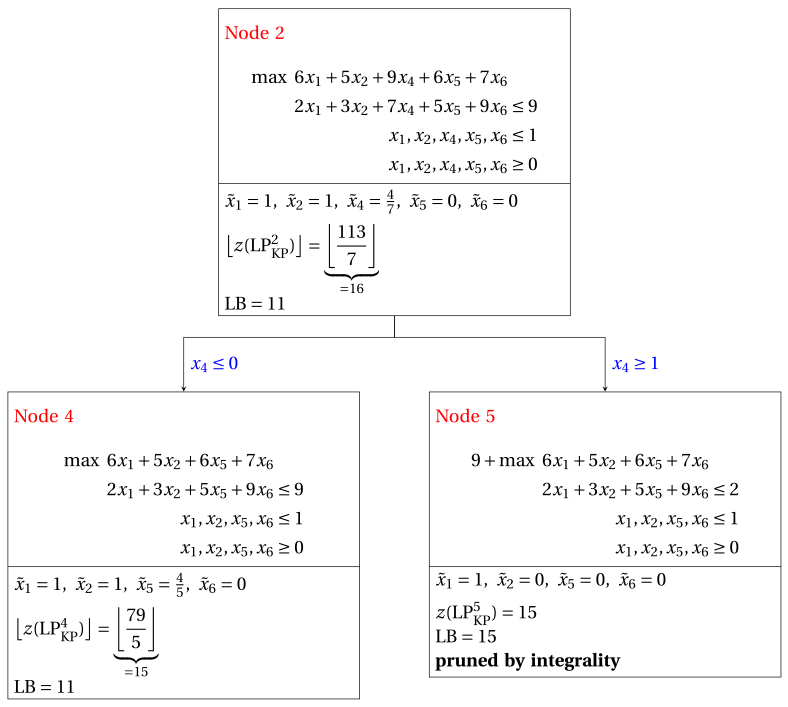
The branching variable is \(x_4\). The \(\mathrm{LP}^4_{\mathrm{KP}}\) and \(\mathrm{LP}^5_{\mathrm{KP}}\) problems are created by unselecting (\(x_4 \le 0\)) and selecting (\(x_4 \ge 1\)) item \(4\).
-
Solution of the \(\mathrm{LP}^4_{\mathrm{KP}}\) problem
We have
\[ \mathscr{I}^4 = \{1,2,5,6\},~~~\mathscr{I}^4_\text{out} = \{3,4\}, ~~~\mathscr{I}^4_\text{in} = \emptyset \]The capacity is \(c(4)=9\) and the objective-function constant is \(p(4)=0\). The split item is \(s=5\) and the residual capacity is \(\mathit{rc} = 4\). An optimal solution \({ \tilde{ \boldsymbol x}}(\,\mathrm{LP}^4_{\mathrm{KP}}\,)\) is:
\[ \tilde{x}_1=1,~~\tilde{x}_2=1,~~\tilde{x}_5=\frac{4}{5},~~\tilde{x}_6=0 \text{ and } z(~\mathrm{LP}^4_{\mathrm{KP}}~) = 6 \cdot 1 + 5 \cdot 1 + 6 \cdot \frac{4}{5} = \frac{79}{5} \]The \(\mathrm{LP}^4_{\mathrm{KP}}\) problem is feasible and we have:
\[ \left\lfloor z(\mathrm{LP}^4_{\mathrm{KP}}) \right\rfloor > \LB \qquad \text{since} \qquad \underbrace{\left\lfloor\frac{79}{5} \right\rfloor}_{ = 15} > 11 \]The optimal solution \({ \tilde{ \boldsymbol x}}(\,\mathrm{LP}^4_{\mathrm{KP}}\,)\) is fractional, accordingly, the \(\mathrm{LP}^4_{\mathrm{KP}}\) problem is inserted in the problem list \(L\).
-
Solution of the \(\mathrm{LP}^5_{\mathrm{KP}}\) problem
We have
\[ \mathscr{I}^5 = \{1,2,5,6\},~~~\mathscr{I}^5_\text{out} = \{3\}, ~~~ \mathscr{I}^5_\text{in}= \{4\} \]The capacity is \(c(5)=2\) and the objective-function constant is \(p(5)=9\). The split item is \(s=2\) and the residual capacity is \(\mathit{rc} = 0\). An optimal solution \({ \tilde{ \boldsymbol x}}(\,\mathrm{LP}^5_{\mathrm{KP}}\,)\) is:
\[ \tilde{x}_1=1,~~\tilde{x}_2=0,~~\tilde{x}_5=0,~~\tilde{x}_6=0 \text{ and } z(~\mathrm{LP}^5_{\mathrm{KP}}~) = 9 + 6 \cdot 1 = 15 \]The \(\mathrm{LP}^5_{\mathrm{KP}}\) problem is feasible and we have:
\[ \left\lfloor z(\mathrm{LP}^5_{\mathrm{KP}}) \right\rfloor > \LB \qquad \text{since} \qquad 15 > 11 \]The optimal solution \({ \tilde{ \boldsymbol x}}(\,\mathrm{LP}^5_{\mathrm{KP}}\,)\) is integer, accordingly, the lower bound \(\LB\) becomes \(15\) and the incumbent solution \({\bar{\boldsymbol x}}(\mathrm{ILP}_{\mathrm{KP}})\) becomes \(\bar x_1=1,\bar x_2=0,\bar x_3=0,\bar x_4=1,\bar x_5=0,\bar x_6=0\).
Accordingly, the branching node is pruned by integrality.
Since the lower bound is improved, the \(\mathrm{LP}^3_{\mathrm{KP}}\) problem and the \(\mathrm{LP}^4_{\mathrm{KP}}\) problem are pruned by upper bound and removed from the problem list \(L\). We have:
\[ \left\lfloor z(\mathrm{LP}^3_{\mathrm{KP}}) \right\rfloor \le \LB \qquad \text{since} \qquad \underbrace{\left\lfloor\frac{47}{3} \right\rfloor}_{ = 15} \le 15 \]\[ \left\lfloor z(\mathrm{LP}^4_{\mathrm{KP}}) \right\rfloor \le \LB \qquad \text{since} \qquad \underbrace{\left\lfloor\frac{79}{5} \right\rfloor}_{ = 15} \le 15 \]
At the end of the second iteration, Node 5 improves the lower bound to \(\LB=15\) and is pruned by integrality; Node 3 and Node 4 are then pruned by upper bound. The corresponding branch-and-bound tree is:
-
-
Termination
Since the problem list \(L\) is empty, the \(\mathrm{ILP}_{\mathrm{KP}}\) problem is solved to optimality.
The optimal value is \(z(~\mathrm{ILP}_{\mathrm{KP}}~)=15\) (the value of the lower bound \(\LB\)) and an optimal solution \({\tilde {\boldsymbol x}}(\,\mathrm{ILP}_{\mathrm{KP}}\,)\) is \(\tilde x_1=1,\tilde x_2=0,\tilde x_3=0,\tilde x_4=1,\tilde x_5=0,\tilde x_6=0\) (the incumbent solution \({\bar{\boldsymbol x}}(\mathrm{ILP}_{\mathrm{KP}})\)).
-
-
This is the branch-and-bound tree of the previous execution of the branch-and-bound algorithm, showing for each solved branching node the optimal value of the associated \(\mathrm{LP}_{\mathrm{KP}}\) problem, the current lower bound \(\LB\), and the pruning criteria.