Exercises · Vertex coloring: the DSATUR branch-and-bound
Exercises · Chapter 42 · each solution opens with a click · Chapter 42: Vertex coloring (VCP) · Exercises, volume 6 (PDF)
Rules used in these exercises
The DSATUR branch-and-bound algorithm of the chapter Vertex coloring: the DSATUR branch-and-bound. At a node \(k\), with \(q(k)\) colors used, colored vertices \(V^k\) and uncolored vertices \(U^k\):
-
(D2) Bounds. \(\UB\) = colors of the \(DSATUR\) heuristic; \(K\) = greedy clique (vertices by non-increasing degree, ties by smallest index; a vertex enters if adjacent to all of \(K\)), \(\LB=|K|\), and \(K\)'s \(i\)-th vertex is pre-colored with color \(i\).
-
(D3) Branching. The vertex \(v\in U^k\) of maximum \(\mathit{sat}_k(v)\), then maximum \(\mathit{du}_k(v)\), then smallest index; one child for each \(c\in F_k(v)\) and one for the new color \(q(k)+1\), in increasing order of color.
-
(D4) Pruning. A node with \(q\ge\UB\) is pruned by bound. A complete coloring with \(q<\UB\) is a new incumbent: \(\UB\leftarrow q\), the nodes of the list with \(q\ge\UB\) are removed, and the algorithm stops if \(\UB=\LB\).
-
(D5) Search. Depth first: the list is a stack and the child with the smallest color is extracted first; the nodes are numbered in the order of evaluation.
Exercise 42.1: The root node of the DSATUR branch-and-bound (P1)
We consider two graphs. The graph \(G_a\) of an exam calendar, with \(V=\{1,\dots,6\}\) and the edges
and the cycle \(G_b=C_5\), with \(V=\{1,\dots,5\}\) and the edges
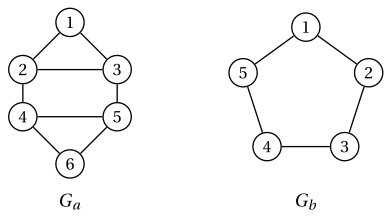
Questions
-
Run the \(DSATUR\) heuristic on \(G_a\) and give the upper bound \(\UB\).
-
Find the greedy clique of \(G_a\) and the lower bound \(\LB\). Does the DSATUR branch-and-bound algorithm branch?
-
Answer the same two questions for \(G_b\).
-
For \(G_b\), write the root node and execute the first iteration of the algorithm: the branching vertex, its feasible colors and the children.
Solution
We use the rules (D1)–(D5) of the box at the beginning of the chapter.
-
The steps of \(DSATUR\) on \(G_a\) are:
step \(1\) \(2\) \(3\) \(4\) \(5\) \(6\) \(v\) \(2\) \(3\) \(1\) \(4\) \(5\) \(6\) \(\mathit{sat}(v)\) \(0\) \(1\) \(2\) \(1\) \(1\) \(2\) \(\mathit{du}(v)\) \(3\) \(2\) \(0\) \(2\) \(1\) \(0\) \(\mathit{col}(v)\) \(1\) \(2\) \(3\) \(2\) \(1\) \(3\) At step \(3\) vertex \(1\) sees the colors \(1\) and \(2\), so it is chosen before the vertices with \(\mathit{sat}=1\). \(DSATUR\) gives \(\big\{\{2,5\},~\{3,4\},~\{1,6\}\big\}\), hence \(\UB=3\).
-
The degrees are \(\deg(1)=2\), \(\deg(2)=3\), \(\deg(3)=3\), \(\deg(4)=3\), \(\deg(5)=3\), \(\deg(6)=2\), so the vertices are scanned in the order \(2,3,4,5,1,6\). The vertices \(2,3,1\) enter, in this order; every other vertex misses an edge to a vertex already in \(K\). Hence \(K=\{1,2,3\}\) (in the order of entry: \(k_1=2\), \(k_2=3\), \(k_3=1\)) and \(\LB=3\). Since \(\LB=\UB=3\), the coloring of \(DSATUR\) is optimal and the algorithm stops in Step 0, without branching: \(\chi(G_a)=3\).
-
The steps of \(DSATUR\) on \(G_b\) are:
step \(1\) \(2\) \(3\) \(4\) \(5\) \(v\) \(1\) \(2\) \(3\) \(4\) \(5\) \(\mathit{sat}(v)\) \(0\) \(1\) \(1\) \(1\) \(2\) \(\mathit{du}(v)\) \(2\) \(1\) \(1\) \(1\) \(0\) \(\mathit{col}(v)\) \(1\) \(2\) \(1\) \(2\) \(3\) \(DSATUR\) gives \(\big\{\{1,3\},~\{2,4\},~\{5\}\big\}\), hence \(\UB=3\). All the degrees are equal, so the vertices are scanned in the order \(1,2,3,4,5\). The vertices \(1,2\) enter, in this order; every other vertex misses an edge to a vertex already in \(K\). Hence \(K=\{1,2\}\) (in the order of entry: \(k_1=1\), \(k_2=2\)) and \(\LB=2\). Now \(\LB=2<3=\UB\): the algorithm branches.
-
Node \(1\) colors \(\mathit{col}^1(1)=1\), \(\mathit{col}^1(2)=2\), with \(q(1)=2\). The vertices \(3,5\) have \(\mathit{sat}=1\) and the same \(\mathit{du}=1\): the smallest index wins, and the branching vertex is \(3\). Its neighbour \(2\) has color \(2\), so \(F_1(3)=\{1\}\).
-
Node \(2\): \(\mathit{col}(3)=1\), with \(q(2)=2<\UB=3\): the node survives.
-
Node \(3\): \(\mathit{col}(3)=3\), the new color, with \(q(3)=3\ge\UB=3\): pruned by bound.
The search continues from node \(2\): it is the same search as on the outer cycle of the Petersen graph, and it ends with \(6\) nodes and \(\chi(G_b)=3\).
-
On \(G_a\) the clique \(\{2,3,1\}\) meets the \(DSATUR\) bound: no branching. On \(G_b\) the clique bound is \(2\) and the tree is needed to prove \(\chi(C_5)=3\).
Exercise 42.2: Proving a lower bound: the wheel \(W_5\) (P2)
We consider the wheel \(W_5\) (a cycle on \(1,\dots,5\) and the hub \(6\)), the graph \(G=(V,E)\) with \(V=\{1,\dots,6\}\) and the edges
drawn below:
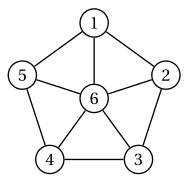
Questions
-
Run the \(DSATUR\) heuristic: give the order of the vertices, the coloring and the upper bound \(\UB\).
-
Find the greedy clique \(K\), the lower bound \(\LB\) and the root node of the DSATUR branch-and-bound algorithm.
-
Execute the DSATUR branch-and-bound algorithm, iteration by iteration.
-
Draw the branch-and-bound tree and give the chromatic number of \(G\) with an optimal coloring.
Solution
We use the rules (D1)–(D5) of the box at the beginning of the chapter.
-
The vertex chosen at each step, its saturation degree, its degree among the uncolored vertices and its color are:
step \(1\) \(2\) \(3\) \(4\) \(5\) \(6\) \(v\) \(6\) \(1\) \(2\) \(3\) \(4\) \(5\) \(\mathit{sat}(v)\) \(0\) \(1\) \(2\) \(2\) \(2\) \(3\) \(\mathit{du}(v)\) \(5\) \(2\) \(1\) \(1\) \(1\) \(0\) \(\mathit{col}(v)\) \(1\) \(2\) \(3\) \(2\) \(3\) \(4\) \(DSATUR\) gives \(\big\{\{6\},~\{1,3\},~\{2,4\},~\{5\}\big\}\), hence \(\UB=4\).
-
The degrees are \(\deg(1)=3\), \(\deg(2)=3\), \(\deg(3)=3\), \(\deg(4)=3\), \(\deg(5)=3\), \(\deg(6)=5\), so the vertices are scanned in the order \(6,1,2,3,4,5\). The vertices \(6,1,2\) enter, in this order; every other vertex misses an edge to a vertex already in \(K\). Hence \(K=\{1,2,6\}\) (in the order of entry: \(k_1=6\), \(k_2=1\), \(k_3=2\)) and \(\LB=3\). Since \(\LB=3<4=\UB\), the algorithm branches. Node \(1\) colors \(\mathit{col}^1(6)=1\), \(\mathit{col}^1(1)=2\), \(\mathit{col}^1(2)=3\), with \(q(1)=3\):
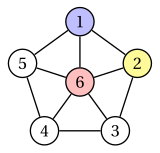
-
**Iteration 1**
Node \(1\) is extracted from the list, with \(Q_1=\{6\}\), \(Q_2=\{1\}\), \(Q_3=\{2\}\) and \(q(1)=3\). The vertices \(3,5\) have \(\mathit{sat}=2\) and the same \(\mathit{du}=1\): the smallest index wins, and the branching vertex is \(3\). Its feasible colors are \(F_{1}(3)=\{2\}\).-
Node \(2\): \(\mathit{col}(3)=2\), with \(q(2)=3<\UB=4\): the node survives.
-
Node \(3\): \(\mathit{col}(3)=4\), the new color, with \(q(3)=4\ge\UB=4\): pruned by bound.
**Iteration 2**
Node \(2\) is extracted from the list, with \(Q_1=\{6\}\), \(Q_2=\{1,3\}\), \(Q_3=\{2\}\) and \(q(2)=3\). The vertices \(4,5\) have \(\mathit{sat}=2\) and the same \(\mathit{du}=1\): the smallest index wins, and the branching vertex is \(4\). Its feasible colors are \(F_{2}(4)=\{3\}\).-
Node \(4\): \(\mathit{col}(4)=3\), with \(q(4)=3<\UB=4\): the node survives.
-
Node \(5\): \(\mathit{col}(4)=4\), the new color, with \(q(5)=4\ge\UB=4\): pruned by bound.
**Iteration 3**
Node \(4\) is extracted from the list, with \(Q_1=\{6\}\), \(Q_2=\{1,3\}\), \(Q_3=\{2,4\}\) and \(q(4)=3\). Vertex \(5\) is the only one with \(\mathit{sat}=3\): it is the branching vertex. Its feasible colors are \(F_{4}(5)=\emptyset\).- Node \(6\): \(\mathit{col}(5)=4\), the new color, with \(q(6)=4\ge\UB=4\): pruned by bound.
Termination The list is empty: the incumbent solution of \(DSATUR\) is optimal.
-
-
The tree has \(6\) nodes; the pruned nodes are dashed.
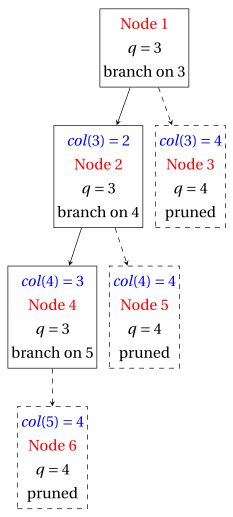
Node Parent Child \(q\) \(\UB\) Branching vertex Outcome \(1\) – root \(3\) \(4\) \(3\) branched \(2\) \(1\) \(\mathit{col}(3)=2\) \(3\) \(4\) \(4\) branched \(3\) \(1\) \(\mathit{col}(3)=4\) \(4\) \(4\) – pruned by bound \(4\) \(2\) \(\mathit{col}(4)=3\) \(3\) \(4\) \(5\) branched \(5\) \(2\) \(\mathit{col}(4)=4\) \(4\) \(4\) – pruned by bound \(6\) \(4\) \(\mathit{col}(5)=4\) \(4\) \(4\) – pruned by bound Hence \(\chi(G)=4\), with the optimal coloring \(\big\{\{6\},~\{1,3\},~\{2,4\},~\{5\}\big\}\):
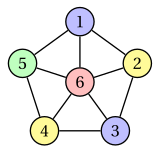
The clique bound gives only \(3\): the tree proves that the odd cycle and the hub need a fourth color.
Exercise 42.3: The complement of the cycle \(C_7\) (P3)
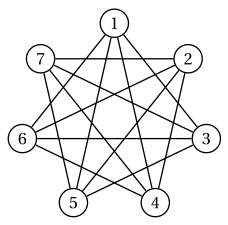
We consider the complement of the cycle \(C_7\) (two vertices are adjacent if they are not consecutive on the cycle \(1,2,\dots,7\)), the graph \(G=(V,E)\) with \(V=\{1,\dots,7\}\) and the edges
drawn below:
Questions
-
Run the \(DSATUR\) heuristic: give the order of the vertices, the coloring and the upper bound \(\UB\).
-
Find the greedy clique \(K\), the lower bound \(\LB\) and the root node of the DSATUR branch-and-bound algorithm.
-
Execute the DSATUR branch-and-bound algorithm, iteration by iteration.
-
Draw the branch-and-bound tree and give the chromatic number of \(G\) with an optimal coloring.
Solution
We use the rules (D1)–(D5) of the box at the beginning of the chapter.
-
The vertex chosen at each step, its saturation degree, its degree among the uncolored vertices and its color are:
step \(1\) \(2\) \(3\) \(4\) \(5\) \(6\) \(7\) \(v\) \(1\) \(3\) \(5\) \(6\) \(4\) \(2\) \(7\) \(\mathit{sat}(v)\) \(0\) \(1\) \(2\) \(2\) \(2\) \(2\) \(3\) \(\mathit{du}(v)\) \(4\) \(3\) \(2\) \(2\) \(2\) \(1\) \(0\) \(\mathit{col}(v)\) \(1\) \(2\) \(3\) \(3\) \(2\) \(1\) \(4\) \(DSATUR\) gives \(\big\{\{1,2\},~\{3,4\},~\{5,6\},~\{7\}\big\}\), hence \(\UB=4\).
-
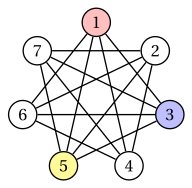
All the degrees are equal, so the vertices are scanned in the order \(1,2,3,4,5,6,7\). The vertices \(1,3,5\) enter, in this order; every other vertex misses an edge to a vertex already in \(K\). Hence \(K=\{1,3,5\}\) (in the order of entry: \(k_1=1\), \(k_2=3\), \(k_3=5\)) and \(\LB=3\). Since \(\LB=3<4=\UB\), the algorithm branches. Node \(1\) colors \(\mathit{col}^1(1)=1\), \(\mathit{col}^1(3)=2\), \(\mathit{col}^1(5)=3\), with \(q(1)=3\):
-
**Iteration 1**
Node \(1\) is extracted from the list, with \(Q_1=\{1\}\), \(Q_2=\{3\}\), \(Q_3=\{5\}\) and \(q(1)=3\). The vertices \(6,7\) have \(\mathit{sat}=2\) and the same \(\mathit{du}=2\): the smallest index wins, and the branching vertex is \(6\). Its feasible colors are \(F_{1}(6)=\{3\}\).-
Node \(2\): \(\mathit{col}(6)=3\), with \(q(2)=3<\UB=4\): the node survives.
-
Node \(3\): \(\mathit{col}(6)=4\), the new color, with \(q(3)=4\ge\UB=4\): pruned by bound.
**Iteration 2**
Node \(2\) is extracted from the list, with \(Q_1=\{1\}\), \(Q_2=\{3\}\), \(Q_3=\{5,6\}\) and \(q(2)=3\). The vertices \(4,7\) have \(\mathit{sat}=2\) and the same \(\mathit{du}=2\): the smallest index wins, and the branching vertex is \(4\). Its feasible colors are \(F_{2}(4)=\{2\}\).-
Node \(4\): \(\mathit{col}(4)=2\), with \(q(4)=3<\UB=4\): the node survives.
-
Node \(5\): \(\mathit{col}(4)=4\), the new color, with \(q(5)=4\ge\UB=4\): pruned by bound.
**Iteration 3**
Node \(4\) is extracted from the list, with \(Q_1=\{1\}\), \(Q_2=\{3,4\}\), \(Q_3=\{5,6\}\) and \(q(4)=3\). The vertices \(2,7\) have \(\mathit{sat}=2\) and the same \(\mathit{du}=1\): the smallest index wins, and the branching vertex is \(2\). Its feasible colors are \(F_{4}(2)=\{1\}\).-
Node \(6\): \(\mathit{col}(2)=1\), with \(q(6)=3<\UB=4\): the node survives.
-
Node \(7\): \(\mathit{col}(2)=4\), the new color, with \(q(7)=4\ge\UB=4\): pruned by bound.
**Iteration 4**
Node \(6\) is extracted from the list, with \(Q_1=\{1,2\}\), \(Q_2=\{3,4\}\), \(Q_3=\{5,6\}\) and \(q(6)=3\). Vertex \(7\) is the only one with \(\mathit{sat}=3\): it is the branching vertex. Its feasible colors are \(F_{6}(7)=\emptyset\).- Node \(8\): \(\mathit{col}(7)=4\), the new color, with \(q(8)=4\ge\UB=4\): pruned by bound.
Termination The list is empty: the incumbent solution of \(DSATUR\) is optimal.
-
-
The tree has \(8\) nodes; the pruned nodes are dashed.
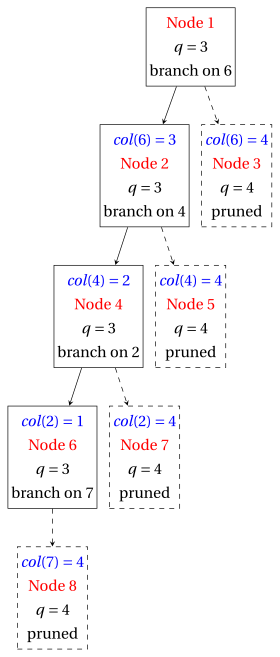
Node Parent Child \(q\) \(\UB\) Branching vertex Outcome \(1\) – root \(3\) \(4\) \(6\) branched \(2\) \(1\) \(\mathit{col}(6)=3\) \(3\) \(4\) \(4\) branched \(3\) \(1\) \(\mathit{col}(6)=4\) \(4\) \(4\) – pruned by bound \(4\) \(2\) \(\mathit{col}(4)=2\) \(3\) \(4\) \(2\) branched \(5\) \(2\) \(\mathit{col}(4)=4\) \(4\) \(4\) – pruned by bound \(6\) \(4\) \(\mathit{col}(2)=1\) \(3\) \(4\) \(7\) branched \(7\) \(4\) \(\mathit{col}(2)=4\) \(4\) \(4\) – pruned by bound \(8\) \(6\) \(\mathit{col}(7)=4\) \(4\) \(4\) – pruned by bound Hence \(\chi(G)=4\), with the optimal coloring \(\big\{\{1,2\},~\{3,4\},~\{5,6\},~\{7\}\big\}\):
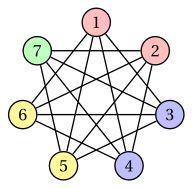
Every stable set of \(G\) has at most \(2\) vertices, so the stable set bound \(\lceil 7/2\rceil=4\) of Chapter 4 confirms the result.
Exercise 42.4: Improving the incumbent solution (P4)
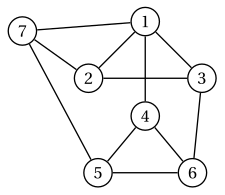
We consider a graph with \(7\) vertices and \(11\) edges, the graph \(G=(V,E)\) with \(V=\{1,\dots,7\}\) and the edges
drawn below:
Questions
-
Run the \(DSATUR\) heuristic: give the order of the vertices, the coloring and the upper bound \(\UB\).
-
Find the greedy clique \(K\), the lower bound \(\LB\) and the root node of the DSATUR branch-and-bound algorithm.
-
Execute the DSATUR branch-and-bound algorithm, iteration by iteration.
-
Draw the branch-and-bound tree and give the chromatic number of \(G\) with an optimal coloring.
Solution
We use the rules (D1)–(D5) of the box at the beginning of the chapter.
-
The vertex chosen at each step, its saturation degree, its degree among the uncolored vertices and its color are:
step \(1\) \(2\) \(3\) \(4\) \(5\) \(6\) \(7\) \(v\) \(1\) \(2\) \(3\) \(7\) \(4\) \(5\) \(6\) \(\mathit{sat}(v)\) \(0\) \(1\) \(2\) \(2\) \(1\) \(2\) \(3\) \(\mathit{du}(v)\) \(4\) \(2\) \(1\) \(1\) \(2\) \(1\) \(0\) \(\mathit{col}(v)\) \(1\) \(2\) \(3\) \(3\) \(2\) \(1\) \(4\) \(DSATUR\) gives \(\big\{\{1,5\},~\{2,4\},~\{3,7\},~\{6\}\big\}\), hence \(\UB=4\).
-
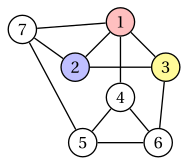
The degrees are \(\deg(1)=4\), \(\deg(2)=3\), \(\deg(3)=3\), \(\deg(4)=3\), \(\deg(5)=3\), \(\deg(6)=3\), \(\deg(7)=3\), so the vertices are scanned in the order \(1,2,3,4,5,6,7\). The vertices \(1,2,3\) enter, in this order; every other vertex misses an edge to a vertex already in \(K\). Hence \(K=\{1,2,3\}\) (in the order of entry: \(k_1=1\), \(k_2=2\), \(k_3=3\)) and \(\LB=3\). Since \(\LB=3<4=\UB\), the algorithm branches. Node \(1\) colors \(\mathit{col}^1(1)=1\), \(\mathit{col}^1(2)=2\), \(\mathit{col}^1(3)=3\), with \(q(1)=3\):
-
**Iteration 1**
Node \(1\) is extracted from the list, with \(Q_1=\{1\}\), \(Q_2=\{2\}\), \(Q_3=\{3\}\) and \(q(1)=3\). Vertex \(7\) is the only one with \(\mathit{sat}=2\): it is the branching vertex. Its feasible colors are \(F_{1}(7)=\{3\}\).-
Node \(2\): \(\mathit{col}(7)=3\), with \(q(2)=3<\UB=4\): the node survives.
-
Node \(3\): \(\mathit{col}(7)=4\), the new color, with \(q(3)=4\ge\UB=4\): pruned by bound.
**Iteration 2**
Node \(2\) is extracted from the list, with \(Q_1=\{1\}\), \(Q_2=\{2\}\), \(Q_3=\{3,7\}\) and \(q(2)=3\). The vertices \(4,5,6\) have \(\mathit{sat}=1\) and the same \(\mathit{du}=2\): the smallest index wins, and the branching vertex is \(4\). Its feasible colors are \(F_{2}(4)=\{2,3\}\).-
Node \(4\): \(\mathit{col}(4)=2\), with \(q(4)=3<\UB=4\): the node survives.
-
Node \(5\): \(\mathit{col}(4)=3\), with \(q(5)=3<\UB=4\): the node survives.
-
Node \(6\): \(\mathit{col}(4)=4\), the new color, with \(q(6)=4\ge\UB=4\): pruned by bound.
**Iteration 3**
Node \(4\) is extracted from the list, with \(Q_1=\{1\}\), \(Q_2=\{2,4\}\), \(Q_3=\{3,7\}\) and \(q(4)=3\). The vertices \(5,6\) have \(\mathit{sat}=2\) and the same \(\mathit{du}=1\): the smallest index wins, and the branching vertex is \(5\). Its feasible colors are \(F_{4}(5)=\{1\}\).-
Node \(7\): \(\mathit{col}(5)=1\), with \(q(7)=3<\UB=4\): the node survives.
-
Node \(8\): \(\mathit{col}(5)=4\), the new color, with \(q(8)=4\ge\UB=4\): pruned by bound.
**Iteration 4**
Node \(7\) is extracted from the list, with \(Q_1=\{1,5\}\), \(Q_2=\{2,4\}\), \(Q_3=\{3,7\}\) and \(q(7)=3\). Vertex \(6\) is the only one with \(\mathit{sat}=3\): it is the branching vertex. Its feasible colors are \(F_{7}(6)=\emptyset\).- Node \(9\): \(\mathit{col}(6)=4\), the new color, with \(q(9)=4\ge\UB=4\): pruned by bound.
**Iteration 5**
Node \(5\) is extracted from the list, with \(Q_1=\{1\}\), \(Q_2=\{2\}\), \(Q_3=\{3,4,7\}\) and \(q(5)=3\). The vertices \(5,6\) have \(\mathit{sat}=1\) and the same \(\mathit{du}=1\): the smallest index wins, and the branching vertex is \(5\). Its feasible colors are \(F_{5}(5)=\{1,2\}\).-
Node \(10\): \(\mathit{col}(5)=1\), with \(q(10)=3<\UB=4\): the node survives.
-
Node \(11\): \(\mathit{col}(5)=2\), with \(q(11)=3<\UB=4\): the node survives.
-
Node \(12\): \(\mathit{col}(5)=4\), the new color, with \(q(12)=4\ge\UB=4\): pruned by bound.
**Iteration 6**
Node \(10\) is extracted from the list, with \(Q_1=\{1,5\}\), \(Q_2=\{2\}\), \(Q_3=\{3,4,7\}\) and \(q(10)=3\). Vertex \(6\) is the only one with \(\mathit{sat}=2\): it is the branching vertex. Its feasible colors are \(F_{10}(6)=\{2\}\).- Node \(13\): \(\mathit{col}(6)=2\), with \(q(13)=3<\UB=4\): a complete coloring with fewer colors: new incumbent solution, with \(\big\{\{1,5\},~\{2,6\},~\{3,4,7\}\big\}\) and \(\UB=3\).
Termination The new incumbent solution gives \(\UB=3\). The nodes of the list with \(q\ge\UB\) are removed: node \(11\). Since \(\UB=\LB=3\), the incumbent solution is optimal:
STOP. -
-
The tree has \(13\) nodes; the pruned nodes are dashed.
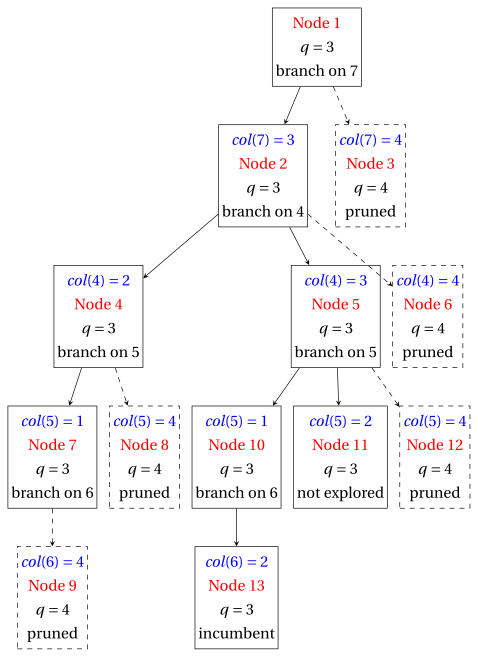
Node Parent Child \(q\) \(\UB\) Branching vertex Outcome \(1\) – root \(3\) \(4\) \(7\) branched \(2\) \(1\) \(\mathit{col}(7)=3\) \(3\) \(4\) \(4\) branched \(3\) \(1\) \(\mathit{col}(7)=4\) \(4\) \(4\) – pruned by bound \(4\) \(2\) \(\mathit{col}(4)=2\) \(3\) \(4\) \(5\) branched \(5\) \(2\) \(\mathit{col}(4)=3\) \(3\) \(4\) \(5\) branched \(6\) \(2\) \(\mathit{col}(4)=4\) \(4\) \(4\) – pruned by bound \(7\) \(4\) \(\mathit{col}(5)=1\) \(3\) \(4\) \(6\) branched \(8\) \(4\) \(\mathit{col}(5)=4\) \(4\) \(4\) – pruned by bound \(9\) \(7\) \(\mathit{col}(6)=4\) \(4\) \(4\) – pruned by bound \(10\) \(5\) \(\mathit{col}(5)=1\) \(3\) \(4\) \(6\) branched \(11\) \(5\) \(\mathit{col}(5)=2\) \(3\) \(4\) – not explored \(12\) \(5\) \(\mathit{col}(5)=4\) \(4\) \(4\) – pruned by bound \(13\) \(10\) \(\mathit{col}(6)=2\) \(3\) \(3\) – new incumbent Hence \(\chi(G)=3\), with the optimal coloring \(\big\{\{1,5\},~\{2,6\},~\{3,4,7\}\big\}\):
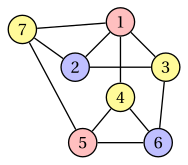
Here \(DSATUR\) is not optimal: the branch-and-bound algorithm improves the incumbent solution from \(4\) to \(3\) colors and stops as soon as \(\UB\) meets the clique bound.
Exercise 42.5: The no-symmetry branching (P5)
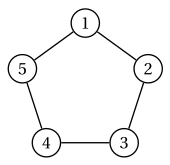
We consider the cycle \(C_5\), with \(V=\{1,\dots,5\}\) and the edges
drawn below. Its greedy clique is \(K=\{1,2\}\), so the root node colors \(\mathit{col}^1(1)=1\) and \(\mathit{col}^1(2)=2\).
Questions
-
Draw the tree of the DSATUR branch-and-bound algorithm without pruning (no upper bound): at every node, the branching vertex and one child for each feasible color and for the new color. How many nodes and how many leaves does it have?
-
List the partitions of \(V\) given by the leaves, by number of colors. Are they all the partitions of \(V\) into stable sets?
-
How many assignments of the five colors \(1,\dots,5\) to the vertices have no edge with equal colors? Explain the difference with the number of leaves.
-
With the upper bound \(\UB=3\) of \(DSATUR\) and the pruning rule, how many nodes does the tree have?
Solution
We use the rules (D1)–(D5) of the box at the beginning of the chapter.
-
Each internal node shows its branching vertex, each edge the color given to it (blue), each leaf its color classes, one per line:
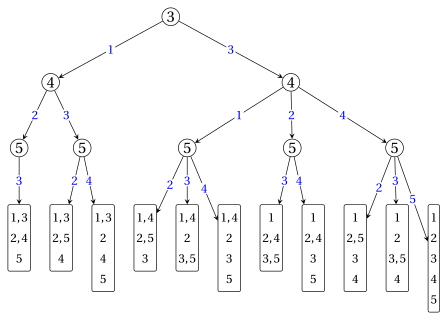
The tree has \(19\) nodes and \(11\) leaves.
-
The leaves, by number of colors:
colors leaves partitions \(3\) \(5\) \(\{\{1\},\{2,4\},\{3,5\}\}\) \(\{\{1,3\},\{2,4\},\{5\}\}\) \(\{\{1,3\},\{2,5\},\{4\}\}\) \(\{\{1,4\},\{2\},\{3,5\}\}\) \(\{\{1,4\},\{2,5\},\{3\}\}\) \(4\) \(5\) \(\{\{1\},\{2\},\{3,5\},\{4\}\}\) \(\{\{1\},\{2,4\},\{3\},\{5\}\}\) \(\{\{1\},\{2,5\},\{3\},\{4\}\}\) \(\{\{1,3\},\{2\},\{4\},\{5\}\}\) \(\{\{1,4\},\{2\},\{3\},\{5\}\}\) \(5\) \(1\) \(\{\{1\},\{2\},\{3\},\{4\},\{5\}\}\) The \(11\) leaves give \(11\) different partitions, and the enumeration of all the partitions of \(V\) into stable sets gives the same \(11\): each feasible solution appears exactly once, as the proposition on the no-symmetry branching states.
-
By enumeration, \(1020\) assignments. A partition with \(q\) classes can be named with \(5\cdot4\cdots(5-q+1)\) ordered choices of colors, so
\[ 5\cdot60+5\cdot120+1\cdot120=1020. \]The labelled colorings contain each partition many times, with the colors renamed; the tree contains each one once.
-
The pruning leaves \(6\) nodes instead of \(19\): every node with \(q=3\) is pruned, and the search proves \(\chi(C_5)=3\) along a single path, as in the first exercise of this chapter.
Without pruning, the tree of \(C_5\) has \(11\) leaves, one per partition into stable sets, against \(1020\) labelled colorings; with \(\UB=3\) only \(6\) nodes remain.