Exercises · Principles of dynamic programming
Exercises · Chapter 16 · each solution opens with a click · Chapter 16: Principles · Exercises, volume 3 (PDF)
Exercise 16.1: Optimal substructure and overlapping subproblems: the 0/1 knapsack problem
Consider the 0/1 knapsack problem with \(n=4\) items and capacity \(c=8\):
with the data
For \(j\in\{0,\dots,n\}\) and \(k\in\{0,\dots,c\}\), let \(v(j,k)\) be the optimal value with the items \(1,\dots,j\) only and capacity \(k\).
Questions
-
Check the optimal substructure: if an optimal solution of the subproblem \((j,k)\) takes item \(j\), what can be said about its restriction to the items \(1,\dots,j-1\)? Write the recurrence for \(v(j,k)\) and the base cases.
-
Evaluate \(v(4,8)\) top-down and list, for each \(j\), the subproblems \((j,k)\) that the recursion generates. Which of them are generated more than once? What property does this show?
-
Fill the lookup table of \(v(j,k)\) row by row, storing in \(s(j,k)\) whether item \(j\) is taken (\(1\)) or not (\(0\)); a tie is broken in favour of not taking it.
-
Reconstruct an optimal solution from the table \(s\).
Solution
-
Its restriction is a solution of the subproblem \((j-1,k-w_j)\), and it must be optimal: a better one, plus item \(j\), would beat the optimal solution of \((j,k)\). If item \(j\) is not taken, the restriction is optimal for \((j-1,k)\). Hence:
\[ v(j,k)=\left\{\begin{array}{ll} \max\{v(j-1,k),\;p_j+v(j-1,k-w_j)\} & \textrm{if } j\ge 1,\ w_j\le k,\\[1ex] v(j-1,k) & \textrm{if } j\ge 1,\ w_j>k,\\[1ex] 0 & \textrm{if } j=0. \end{array}\right. \] -
Each call \((j,k)\) generates \((j-1,k)\) and, if \(w_j\le k\), \((j-1,k-w_j)\):
-
\(j=4\): \((4,8)\);
-
\(j=3\): \((3,8)\), \((3,5)\);
-
\(j=2\): \((2,8)\), \((2,5)\), \((2,5)\), \((2,2)\) (repeated: \((2,5)\));
-
\(j=1\): \((1,8)\), \((1,4)\), \((1,5)\), \((1,1)\), \((1,5)\), \((1,1)\), \((1,2)\) (repeated: \((1,1)\), \((1,5)\));
-
\(j=0\): \((0,8)\), \((0,6)\), \((0,4)\), \((0,2)\), \((0,5)\), \((0,3)\), \((0,1)\), \((0,5)\), \((0,3)\), \((0,1)\), \((0,2)\), \((0,0)\) (repeated: \((0,1)\), \((0,2)\), \((0,3)\), \((0,5)\));
The recursion makes \(26\) calls for \(19\) distinct subproblems: the subproblems overlap (items \(3\) and \(4\) have the same weight). A lookup table computes each value once.
-
-
The tables \(v\) and \(s\) are:
\[ \begin{array}{c|ccccccccc} \hline {v(j,k)} & {k=0} & {1} & {2} & {3} & {4} & {5} & {6} & {7} & {8} \\ \hline {j=0} & {0} & {0} & {0} & {0} & {0} & {0} & {0} & {0} & {0} \\ {j=1} & {0} & {0} & {3} & {3} & {3} & {3} & {3} & {3} & {3} \\ {j=2} & {0} & {0} & {3} & {3} & {5} & {5} & {8} & {8} & {8} \\ {j=3} & {0} & {0} & {3} & {4} & {5} & {7} & {8} & {9} & {9} \\ {j=4} & {0} & {0} & {3} & {5} & {5} & {8} & {9} & {10} & {12} \\ \hline \end{array} \]\[ \begin{array}{c|ccccccccc} \hline {s(j,k)} & {k=0} & {1} & {2} & {3} & {4} & {5} & {6} & {7} & {8} \\ \hline {j=0} & -- & -- & -- & -- & -- & -- & -- & -- & -- \\ {j=1} & {0} & {0} & {1} & {1} & {1} & {1} & {1} & {1} & {1} \\ {j=2} & {0} & {0} & {0} & {0} & {1} & {1} & {1} & {1} & {1} \\ {j=3} & {0} & {0} & {0} & {1} & {0} & {1} & {0} & {1} & {1} \\ {j=4} & {0} & {0} & {0} & {1} & {0} & {1} & {1} & {1} & {1} \\ \hline \end{array} \]For example \(v(3,7)=\max\{v(2,7),\,4+v(2,4)\}=\max\{8,9\}=9\).
-
Starting from \((4,8)\):
-
\(s(4,8)=1\): item \(4\) is taken, go to \((3,8-3)=(3,5)\);
-
\(s(3,5)=1\): item \(3\) is taken, go to \((2,5-3)=(2,2)\);
-
\(s(2,2)=0\): item \(2\) is not taken, go to \((1,2)\);
-
\(s(1,2)=1\): item \(1\) is taken, go to \((0,2-2)=(0,0)\);
The optimal solution is \(\{1,3,4\}\), of weight \(2+3+3=8\le 8\) and profit \(3+4+5=12=v(4,8)\). The visited cells:
\[ \begin{array}{c|ccccccccc} \hline {v(j,k)} & {k=0} & {1} & {2} & {3} & {4} & {5} & {6} & {7} & {8} \\ \hline {j=0} & \bbox[#9999ff]{{0}} & {0} & {0} & {0} & {0} & {0} & {0} & {0} & {0} \\ {j=1} & {0} & {0} & \bbox[#9999ff]{{3}} & {3} & {3} & {3} & {3} & {3} & {3} \\ {j=2} & {0} & {0} & \bbox[#9999ff]{{3}} & {3} & {5} & {5} & {8} & {8} & {8} \\ {j=3} & {0} & {0} & {3} & {4} & {5} & \bbox[#9999ff]{{7}} & {8} & {9} & {9} \\ {j=4} & {0} & {0} & {3} & {5} & {5} & {8} & {9} & {10} & \bbox[#9999ff]{{12}} \\ \hline \end{array} \] -
\(v(4,8)=12\) with the items \(\{1,3,4\}\); the top-down recursion makes \(26\) calls for \(19\) distinct subproblems, the lookup table has \((n+1)(c+1)=45\) cells.
Exercise 16.2: Writing a recurrence: subset sum via reachable sums
Given \(n=5\) items with integer weights \(w_j\) and a capacity \(c=30\), the optimization version of the subset sum problem asks for a subset of items of maximum total weight not exceeding \(c\):
The data are
For \(j\in\{0,\dots,n\}\), let \(R_j\) be the set of the reachable sums: the totals \(k\le c\) of the subsets of \(\{1,\dots,j\}\).
Questions
-
Write a recurrence for \(R_j\), distinguishing whether item \(j\) is used, with the base case. How is the optimal value \(z\) read from \(R_n\)?
-
Compute \(R_1,\dots,R_n\). For every reachable sum, store the first index \(j\) such that it belongs to \(R_j\).
-
Reconstruct an optimal solution.
-
Take the items greedily by non-increasing weight, as long as they fit. Is the result optimal?
Solution
-
A subset of \(\{1,\dots,j\}\) either avoids item \(j\), and then its total is in \(R_{j-1}\), or uses it, and then its total is \(k+w_j\) with \(k\in R_{j-1}\). Hence:
\[ R_j=\left\{\begin{array}{ll} R_{j-1}\,\cup\,\{k+w_j:\ k\in R_{j-1},\ k+w_j\le c\} & \textrm{if } 1\le j\le n,\\[1ex] \{0\} & \textrm{if } j=0, \end{array}\right. \]\[ z=\max\{k:\ k\in R_n\}. \]It is the KP with \(p_j=w_j\), written with sets of reachable values.
-
The row \(j\) lists only the new sums; a sum belongs to \(R_j\) if it appears in a row \(\le j\):
\(j\) \(w_j\) sums of \(R_j\) that are not in \(R_{j-1}\) \(0\) — \(0\) \(1\) \(6\) \(6\) \(2\) \(9\) \(9, 15\) \(3\) \(11\) \(11, 17, 20, 26\) \(4\) \(14\) \(14, 23, 25, 29\) \(5\) \(17\) \(28\) So \(|R_5|=13\) and \(z=\max R_5=29\).
-
A sum \(k\) appearing first in \(R_j\) uses item \(j\), and \(k-w_j\) lies in \(R_{j-1}\):
-
\(29\) first appears in \(R_{4}\): item \(4\) is taken, go to \(29-14=15\);
-
\(15\) first appears in \(R_{2}\): item \(2\) is taken, go to \(15-9=6\);
-
\(6\) first appears in \(R_{1}\): item \(1\) is taken, go to \(6-6=0\);
The optimal solution is \(\{1,2,4\}\), of total \(6+9+14=29\le 30\).
-
-
The greedy choice takes the items \(5, 3\), of total \(11+17=28<29\): it is not optimal.
\(z=29\) with the items \(\{1,2,4\}\); there are \(13\) reachable sums, while the subsets are \(2^5=32\). The greedy choice by weight gives only \(28\).
Exercise 16.3: Reusing a recurrence: two parallel machines via subset sum
In the problem \(P2\|C_{\max}\), \(n=6\) jobs with integer processing times \(p_j\) are assigned to \(2\) identical machines, and the makespan \(C_{\max}\), the largest load of a machine, is minimized:
Let \(P=\sum_j p_j=46\), and let \(L\) be the load of machine \(1\).
Questions
-
Express \(C_{\max}\) as a function of \(L\). Show that minimizing \(C_{\max}\) amounts to the optimization version of the subset sum problem, with capacity \(\lfloor P/2\rfloor\), and write the recurrence of its reachable sums.
-
Compute the reachable sums \(R_1,\dots,R_n\).
-
Reconstruct an optimal assignment and its makespan.
-
Compare with the LPT rule: jobs by non-increasing \(p_j\), each on the least loaded machine.
Solution
-
Machine \(2\) gets \(P-L\), so \(C_{\max}=\max\{L,\,P-L\}\ge P/2\). Up to swapping the machines we may assume \(L\le P/2\), and then \(C_{\max}=P-L\) is minimum when \(L\) is maximum: a subset sum problem with capacity \(c=\lfloor 46/2\rfloor=23\) and weights \(p_j\):
\[ R_j=\left\{\begin{array}{ll} R_{j-1}\,\cup\,\{k+p_j:\ k\in R_{j-1},\ k+p_j\le c\} & \textrm{if } 1\le j\le n,\\[1ex] \{0\} & \textrm{if } j=0, \end{array}\right. \]\[ z=P-\max\{k:\ k\in R_n\}. \] -
The row \(j\) lists only the new sums:
\(j\) \(p_j\) sums of \(R_j\) that are not in \(R_{j-1}\) \(0\) — \(0\) \(1\) \(13\) \(13\) \(2\) \(11\) \(11\) \(3\) \(10\) \(10, 21, 23\) \(4\) \(5\) \(5, 15, 16, 18\) \(5\) \(4\) \(4, 9, 14, 17, 19, 20, 22\) \(6\) \(3\) \(3, 7, 8, 12\) The largest reachable sum is \(L=23\), and the optimal makespan is \(z=46-23=23\), equal to the lower bound \(\lceil P/2\rceil=23\).
-
-
\(23\) first appears in \(R_{3}\): item \(3\) is taken, go to \(23-10=13\);
-
\(13\) first appears in \(R_{1}\): item \(1\) is taken, go to \(13-13=0\);
Machine \(1\) gets the jobs \(\{1,3\}\) (load \(13+10=23\)), machine \(2\) the jobs \(\{2,4,5,6\}\) (load \(11+5+4+3=23\)).
-
-
LPT gives the machines the jobs \(\{1,4,5\}\) and \(\{2,3,6\}\), with loads \(22\) and \(24\): makespan \(24>23\), not optimal.
The optimal makespan is \(z=23\), with the jobs \(\{1,3\}\) on machine \(1\) and \(\{2,4,5,6\}\) on machine \(2\); LPT gives \(24\).
Exercise 16.4: Shortest path in a layered network
We look for a shortest path from \(s\) to \(t\) in the directed network \(G=(N,A)\) below, where every arc \((i,j)\in A\) has a cost \(c_{ij}\):
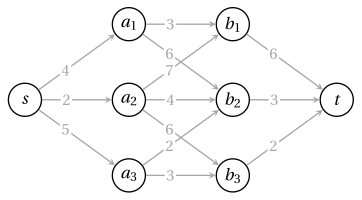
For every node \(i\), let \(v(i)\) be the cost of a shortest path from \(i\) to \(t\).
Questions
-
Check the optimal substructure: if a shortest path from \(s\) to \(t\) passes through node \(i\), what can be said about its part from \(i\) to \(t\)? Write the recurrence for \(v(i)\) and the base case.
-
Which values \(v(i)\) are needed by more than one node? What property of DP does this show?
-
Compute the values \(v(i)\) backwards, from \(t\) to \(s\), storing in \(s(i)\) the successor of \(i\) on the best path (ties broken by the node listed first).
-
Reconstruct the shortest path and compare its cost with the enumeration of all the paths.
Solution
-
The part from \(i\) to \(t\) must be a shortest path from \(i\) to \(t\): a shorter one would give a shorter path from \(s\) to \(t\). The first arc out of \(i\) goes to some successor \(j\), hence:
\[ v(i)=\left\{\begin{array}{ll} \min\{c_{ij}+v(j):(i,j)\in A\} & \textrm{if } i\neq t,\\[1ex] 0 & \textrm{if } i=t. \end{array}\right. \] -
The values \(v(b_1)\), \(v(b_2)\), \(v(b_3)\) are needed by the nodes \(a_1,a_2,a_3\) that point to them: \(v(b_1)\) by \(2\) nodes, \(v(b_2)\) by \(3\) and \(v(b_3)\) by \(2\). The subproblems overlap: with a lookup table each value is computed once.
-
The values, from \(t\) backwards:
node \(i\) \(c_{ij}+v(j)\) for \((i,j)\in A\) \(v(i)\) \(s(i)\) \(t\) — \(0\) — \(b_3\) \(2+0=2\) \(2\) \(t\) \(b_2\) \(3+0=3\) \(3\) \(t\) \(b_1\) \(6+0=6\) \(6\) \(t\) \(a_3\) \(2+3=5\), \(3+2=5\) \(5\) \(b_2\) \(a_2\) \(7+6=13\), \(4+3=7\), \(6+2=8\) \(7\) \(b_2\) \(a_1\) \(3+6=9\), \(6+3=9\) \(9\) \(b_1\) \(s\) \(4+9=13\), \(2+7=9\), \(5+5=10\) \(9\) \(a_2\) -
Following \(s\) from \(s\): \(s\to a_2\to b_2\to t\), of cost \(2+4+3=9=v(s)\):
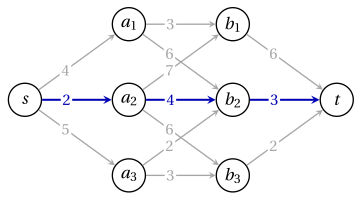
The network has \(7\) paths from \(s\) to \(t\); their enumeration gives the same optimal path, the only one of cost \(9\).
\(v(s)=9\), with the shortest path \(s\to a_2\to b_2\to t\); the values of the nodes \(b_k\) are computed once and used several times.
Exercise 16.5: A two-index table: the multiple-choice knapsack problem
In the multiple-choice knapsack problem the items are partitioned into classes \(\mathscr J_1,\dots,\mathscr J_q\), and exactly one item per class is chosen, with total weight at most \(c\) and maximum total profit:
Here \(q=3\), \(c=10\) and
| class | \(\mathscr J_1\) | \(\mathscr J_2\) | \(\mathscr J_3\) | ||||||
|---|---|---|---|---|---|---|---|---|---|
| \(j\) | \(1\) | \(2\) | \(3\) | \(4\) | \(5\) | \(6\) | \(7\) | \(8\) | \(9\) |
| \(w_j\) | \(2\) | \(3\) | \(5\) | \(1\) | \(4\) | \(6\) | \(2\) | \(3\) | \(4\) |
| \(p_j\) | \(3\) | \(5\) | \(8\) | \(2\) | \(6\) | \(9\) | \(4\) | \(5\) | \(7\) |
For \(h\in\{0,\dots,q\}\) and \(k\in\{0,\dots,c\}\), let \(v(h,k)\) be the optimal value with the classes \(\mathscr J_1,\dots,\mathscr J_h\) only and capacity \(k\) (\(v(h,k)=-\infty\) if there is no feasible choice).
Questions
-
Write the recurrence for \(v(h,k)\), deciding which item of class \(\mathscr J_h\) is chosen, and the base cases. Why does the optimal substructure hold?
-
Fill the table of \(v(h,k)\) row by row, storing in \(s(h,k)\) the item chosen in class \(\mathscr J_h\).
-
Reconstruct an optimal solution.
-
Without new computations, give the optimal value for every capacity \(k\le 10\). What is the smallest capacity with a feasible solution?
Solution
-
If item \(j\in \mathscr J_h\) is chosen in an optimal solution of \((h,k)\), the items of \(\mathscr J_1,\dots,\mathscr J_{h-1}\) form an optimal solution of \((h-1,k-w_j)\): a better one would improve the whole. Hence:
\[ v(h,k)=\left\{\begin{array}{ll} \max\{p_j+v(h-1,k-w_j):\ j\in \mathscr J_h,\ w_j\le k\} & \textrm{if } h\ge 1,\\[1ex] 0 & \textrm{if } h=0, \end{array}\right. \]where the maximum of an empty set is \(-\infty\).
-
The tables \(v\) and \(s\) are:
\[ \begin{array}{c|ccccccccccc} \hline {v(h,k)} & {k=0} & {1} & {2} & {3} & {4} & {5} & {6} & {7} & {8} & {9} & {10} \\ \hline {h=0} & {0} & {0} & {0} & {0} & {0} & {0} & {0} & {0} & {0} & {0} & {0} \\ {h=1} & {-\infty} & {-\infty} & {3} & {5} & {5} & {8} & {8} & {8} & {8} & {8} & {8} \\ {h=2} & {-\infty} & {-\infty} & {-\infty} & {5} & {7} & {7} & {10} & {11} & {12} & {14} & {14} \\ {h=3} & {-\infty} & {-\infty} & {-\infty} & {-\infty} & {-\infty} & {9} & {11} & {12} & {14} & {15} & {17} \\ \hline \end{array} \]\[ \begin{array}{c|ccccccccccc} \hline {s(h,k)} & {k=0} & {1} & {2} & {3} & {4} & {5} & {6} & {7} & {8} & {9} & {10} \\ \hline {h=0} & -- & -- & -- & -- & -- & -- & -- & -- & -- & -- & -- \\ {h=1} & -- & -- & {1} & {2} & {2} & {3} & {3} & {3} & {3} & {3} & {3} \\ {h=2} & -- & -- & -- & {4} & {4} & {4} & {4} & {5} & {6} & {5} & {5} \\ {h=3} & -- & -- & -- & -- & -- & {7} & {7} & {8} & {7} & {7} & {9} \\ \hline \end{array} \]For example \(v(2,7)=\max\{2+v(1,6),\,6+v(1,3),\,9+v(1,1)\}=11\).
-
Starting from \((3,10)\):
-
\(s(3,10)=9\): item \(9\) of class \(\mathscr J_3\), go to \((2,10-4)=(2,6)\);
-
\(s(2,6)=4\): item \(4\) of class \(\mathscr J_2\), go to \((1,6-1)=(1,5)\);
-
\(s(1,5)=3\): item \(3\) of class \(\mathscr J_1\), go to \((0,5-5)=(0,0)\);
The optimal solution is \(\{3,4,9\}\), of weight \(5+1+4=10\le 10\) and profit \(8+2+7=17=v(3,10)\). The visited cells:
\[ \begin{array}{c|ccccccccccc} \hline {v(h,k)} & {k=0} & {1} & {2} & {3} & {4} & {5} & {6} & {7} & {8} & {9} & {10} \\ \hline {h=0} & \bbox[#9999ff]{{0}} & {0} & {0} & {0} & {0} & {0} & {0} & {0} & {0} & {0} & {0} \\ {h=1} & {-\infty} & {-\infty} & {3} & {5} & {5} & \bbox[#9999ff]{{8}} & {8} & {8} & {8} & {8} & {8} \\ {h=2} & {-\infty} & {-\infty} & {-\infty} & {5} & {7} & {7} & \bbox[#9999ff]{{10}} & {11} & {12} & {14} & {14} \\ {h=3} & {-\infty} & {-\infty} & {-\infty} & {-\infty} & {-\infty} & {9} & {11} & {12} & {14} & {15} & \bbox[#9999ff]{{17}} \\ \hline \end{array} \] -
-
The row \(h=3\) gives the optimal value for every capacity \(k\le 10\): it is \(-\infty\) for \(k<5\), and the smallest feasible capacity is \(5\), the sum of the lightest weights of the classes.
\(v(3,10)=17\) with the items \(\{3,4,9\}\), one per class; the table has \((q+1)(c+1)=44\) cells, while the choices are \(27\).