32.10 Population-based methods: genetic and memetic algorithms
Part 4 · Heuristic algorithms · Chapter 32 · Chapter 32: Metaheuristics · Lecture notes, volume 4 (PDF) · Slides (1/2) · Slides (2/2) · Exercises: Metaheuristics · App: TSP: simulated annealing and tabu search
A genetic algorithm (denoted by \(GA\)) keeps a population of solutions, encoded as strings (chromosomes). At every iteration it selects two parents, preferring the fitter ones, recombines them into a child (crossover), changes a few random genes of the child (mutation), repairs it if it is infeasible, and inserts it into the population in place of a worse individual. A memetic algorithm also applies a local search to every child.
- The pseudo-code of a steady-state \(GA\) for the KP with binary encoding reads as follows; with \(memetic=\mathrm{true}\) it is a memetic algorithm.
Algorithm: Genetic and memetic algorithm for the KP
-
Genetic algorithms were introduced by Holland (1975) as a model of natural evolution, and made popular as optimization methods by Goldberg (1989). Memetic algorithms, in which every individual is improved by a local search, were proposed by Moscato (1989).
-
Encoding. For the KP the binary vector \(x\) is a natural chromosome: the gene \(j\) says whether item \(j\) is selected. The fitness of an individual is its profit.
-
Selection. A binary tournament draws two individuals at random and keeps the fitter one: good individuals are more likely to become parents, but every individual has a chance.
-
Crossover. One-point crossover takes the genes \(1,\dots,cut\) from the first parent and the genes \(cut+1,\dots,n\) from the second one. The idea is that good solutions share good building blocks, and recombining two good parents can put the good blocks of both into one child.
-
Mutation. Each gene is flipped with a small probability \(p_m\), typically \(\frac1n\): it brings back into the population genes that selection may have lost.
-
Repair. The child can be infeasible. REPAIRKP removes the selected item of minimum efficiency until the capacity is respected (ties: the item of largest index). Alternatives are penalties, as in Section 32.4.3, or encodings in which every chromosome is feasible.
-
Replacement. In the steady-state version of the pseudo-code, the child replaces the worst individual if it is better and not already in the population; duplicates would make the population lose its diversity.
-
Selection and replacement intensify (the population concentrates on good solutions); crossover and mutation diversify. Without local search, a \(GA\) is good at finding promising regions but slow at reaching their local optima: the memetic algorithm adds the missing intensification.
Example 32.11: \(GA\) on the KP reference instance
With \(P=4\), \(p_m=\frac14\) and \(seed=36\). The first \(16\) random numbers build the initial population (gene \(1\) if the number is smaller than \(0.5\)):
All four individuals are feasible: \(pop[1]=(1,0,1,0)\), \(pop[2]=(1,0,0,1)\), \(pop[3]=(1,0,0,0)\), \(pop[4]=(0,1,0,1)\), with fitness \((16,14,10,11)\).
Iteration 1 (random numbers \(0.1614\), \(0.2771\), \(0.8030\), \(0.4063\), \(0.0295\), \(0.7238\), \(0.2032\), \(0.4957\), \(0.4620\)). The first tournament draws individuals \(1+\lfloor 4\cdot 0.1614\rfloor=1\) and \(1+\lfloor 4\cdot 0.2771\rfloor=2\), and selects \(a=1\) (fitness \(16>14\)); the second draws \(4\) and \(2\) and selects \(b=2\) (fitness \(14>11\)). The cut is \(1+\lfloor 3\cdot 0.0295\rfloor=1\): the child takes gene \(1\) from \(pop[1]\) and genes \(2\), \(3\), \(4\) from \(pop[2]\), \(child=(1,0,0,1)\). Only the second mutation number, \(0.2032\), is smaller than \(p_m=0.25\): gene \(2\) flips, \(child=(1,1,0,1)\), of weight \(12>9\). The repair removes item \(4\), the selected item of minimum efficiency: \(child=(1,1,0,0)\), of weight \(9\) and profit \(17\). It replaces the worst individual, \(pop[3]\) of fitness \(10\).
Iteration 2 selects \(a=2\) and \(b=3\), cuts after gene \(1\) and builds \((1,1,0,0)\), with no mutation: it is already in the population, and it is discarded. Iteration 3 selects \(a=2\) and \(b=1\), cuts after gene \(3\), builds \((1,0,0,0)\), and the mutation flips genes \(1\) and \(4\): \((0,0,0,1)\), of profit \(4\), worse than every individual, discarded.
The best individual is \((1,1,0,0)\): \(GA(I)=17=z(I)\), found by crossover, mutation and repair together.
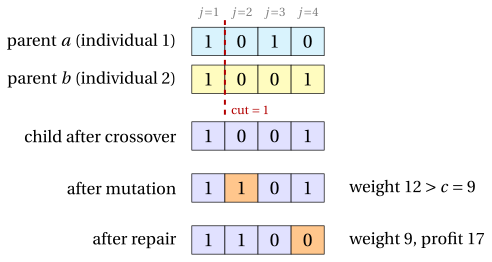
- On KP20, with \(P=10\), \(p_m=0.05\) and \(300\) iterations, for \(seed=1,\dots,10\):
| min | average | max | optimal | best profit per seed | |
|---|---|---|---|---|---|
| \(GA\) | \(508\) | \(516.9\) | \(521\) | \(4\) | \(521,519,521,508,514,521,510,519,521,515\) |
| memetic | \(521\) | \(521.0\) | \(521\) | \(10\) | \(521,521,521,521,521,521,521,521,521,521\) |
- The plain \(GA\) reaches the optimum \(521\) in \(4\) runs out of \(10\); the memetic algorithm in every run. The local search makes every individual a local optimum, and the crossover then recombines local optima instead of arbitrary solutions.