5.5 Weighted variants
Part 1 · Combinatorial optimization problems · Chapter 5 · Chapter 5: Clique problems · Lecture notes, volume 1 (PDF) · Slides · Exercises: Clique problems
-
Let \(\vet{w} \in \Z_{\ge 1}^n\) be a vertex-weight vector, with a weight \(w_v\) for each vertex \(v \in V\), and let \(\vet{r} \in \Z_{\ge 1}^m\) be an edge-weight vector, with a weight \(r_{uv}\) for each edge \(\{u,v\} \in E\). For a clique \(K\) we define
\[ w(K) = \sum_{v \in K} w_v \qquad\text{and}\qquad r(K) = \sum_{\{u,v\} \in E[K]} r_{uv}, \]where \(E[K]\) is the set of the edges with both endpoints in \(K\).
Definition 5.10: weighted maximum clique problems
-
Given a graph \(G\) and a vertex-weight vector \(\vet{w}\), the vertex-weighted maximum clique problem (VWMCP) asks to find a clique \(K\) of \(G\) with maximum total vertex weight \(w(K)\).
-
Given a graph \(G\) and an edge-weight vector \(\vet{r}\), the edge-weighted maximum clique problem (EWMCP) asks to find a clique \(K\) of \(G\) with maximum total edge weight \(r(K)\).
- With all the weights \(w_v=1\) the first problem is the MCP. The edge-weighted problem rewards the cliques with many heavy edges, and with \(r_{uv}=1\) it is again the MCP, since \(r(K)=\binom{|K|}{2}\) grows with \(|K|\).
Example 5.3: vertex-weighted maximum clique problem
We add to the graph of Example 5.2 the vertex weights in blue. The vertex-weighted maximum clique is \(\{2,3,5,8\}\), with weight \(8+9+6+9=32\): it is unique, and it is not the maximum clique in red of Example 5.2, whose weight is \(5+9+5+5=24\).
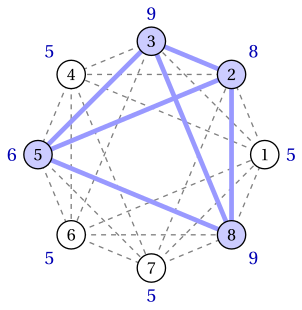
A clique takes at most one vertex from each pair \(\{1,5\},\{2,6\},\{3,7\},\{4,8\}\); taking the heavier one of each pair gives \(6+8+9+9=32\), and these four vertices form a clique.
Example 5.4: edge-weighted maximum clique problem
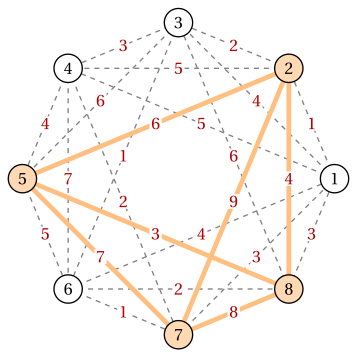
We add to the graph of Example 5.2 the edge weights in red. The edge-weighted maximum clique is \(\{2,5,7,8\}\), in orange: its six edges weigh \(6+4+9+7+3+8=37\), and the enumeration of the \(16\) maximum cliques shows that it is the unique optimal solution.
5.6 Remarks
-
In a coloring, every color class is a stable set: the MSSP is the problem of the largest color class, and the clique number is the dual bound of Chapter 4 «Coloring problems».
-
Applications of cliques and stable sets:
-
groups of pairwise connected members in social networks;
-
groups of pairwise compatible tasks or exams, in scheduling and in the planning of timetables;
-
common substructures of two molecules, in chemistry and in biology;
-
codes that correct errors, as large sets of words pairwise far apart.
-
5.7 Typical mistakes
Warning
-
Confusing a maximal clique with a maximum clique. A clique is maximal when no vertex can be added to it; it is maximum when no clique is larger. In Example 5.1, \(\{4,5\}\) is maximal but not maximum.
-
Building the complement graph with the edges of \(G\). The edges of \(\overline{G}\) are exactly the pairs that are not edges of \(G\): there are \(\binom{n}{2}-m\) of them.
-
Using a lower bound as an upper bound. A clique found by hand gives \(\LB \le \omega(G)\); the degree bounds and a coloring give \(\UB \ge \omega(G)\). In this chapter the problem is a maximization.
-
Believing that the coloring bound is tight. On the cycle with \(5\) vertices \(\omega(G)=2\) and \(\chi(G)=3\).
5.8 In summary
In summary
-
The MCP looks for the largest set of pairwise adjacent vertices; its optimal value is the clique number \(\omega(G)\).
-
A clique of \(G\) is a stable set of \(\overline{G}\): the MCP on \(G\) is the MSSP on \(\overline{G}\), and \(\omega(G)=\alpha(\overline{G})\).
-
A clique found by hand is a primal bound; the degree bound, the edge bound, the degree count bound and the number of colors of a coloring are dual bounds.
-
The MCP is NP-hard and hard to approximate; its weighted variants weigh the vertices or the edges.
Dashboard of the reference instances.
| instance (max) | lower bound | upper bound | from |
|---|---|---|---|
| Example 5.1 (cycle with a chord) | \(3\) (by hand) | \(3\) (degree count, coloring) | this chapter |
| Example 5.2 (dense graph) | \(4\) (by hand) | \(4\) (coloring) | this chapter |
Exercises on this chapter: Clique problems
In depth: what the course does on this problem