5.2 The maximum clique problem
Part 1 · Combinatorial optimization problems · Chapter 5 · Chapter 5: Clique problems · Lecture notes, volume 1 (PDF) · Slides · Exercises: Clique problems
Definition 5.2: Maximum Clique Problem
Given:
-
a simple graph \(G = (V,E)\), where
\[ V = \{1,2,\dots,n\} \]is the set of \(n\) vertices, and
\[ E \subseteq \big\{\, \{u,v\} : u,v \in V,~ u \neq v \,\big\} \]is the set of \(m\) edges,
the Maximum Clique Problem (MCP) asks to find a clique \(K \subseteq V\) of \(G\) whose number of vertices is maximum. Its optimal value is the clique number \(\omega(G)\).
Definition 5.3: stable set and Maximum Stable Set Problem
Let \(G=(V,E)\) be a graph.
-
A stable set (also called independent set) is a subset \(Q \subseteq V\) of pairwise non-adjacent vertices: \(\{u,v\} \notin E\) for all \(u,v \in Q\) with \(u \neq v\).
-
The Maximum Stable Set Problem (MSSP) asks to find a stable set of \(G\) whose number of vertices is maximum. Its optimal value is the stability number \(\alpha(G)\).
Definition 5.4: complement graph
The complement graph of \(G=(V,E)\) is the graph \(\overline{G}=(V,\overline{E})\) with the same vertices and the edge set
The pairs in \(\overline{E}\) are the non-edges of \(G\), and \(|\overline{E}| = \binom{n}{2} - m\).
Proposition 5.5: clique number and stability number
A subset \(K \subseteq V\) is a clique of \(G\) if and only if it is a stable set of \(\overline{G}\). Hence
Proof
Two distinct vertices \(u,v\) are adjacent in \(G\) if and only if they are not adjacent in \(\overline{G}\). So all the pairs of \(K\) are edges of \(G\) exactly when no pair of \(K\) is an edge of \(\overline{G}\). The two problems have the same feasible solutions, hence the same optimal value. The second equality follows since \(\overline{\overline{G}} = G\). □
The MCP on \(G\) and the MSSP on \(\overline{G}\) are the same problem: a maximum clique of \(G\) is a maximum stable set of \(\overline{G}\). Whatever we learn on one of the two problems holds for the other one.
-
An MCP instance is specified by:
-
two integer numbers: the number of vertices \(n \in \Z_{\ge 1}\) and the number of edges \(m \in \Z_{\ge 1}\);
-
two vectors of integer numbers of length \(m\): \(\vet{u} \in \Z_{\ge 1}^m\) and \(\vet{v} \in \Z_{\ge 1}^m\), with the two endpoints of the edges.
-
-
An MCP feasible solution is a clique \(K \subseteq V\). The empty set and a single vertex are cliques, so every instance has feasible solutions.
Given an MCP instance, the MCP can be formally stated as:
Example 5.1: MCP instance: a cycle with a chord
We consider the graph \(G=(V,E)\) with \(7\) vertices (\(n=7\)) and \(8\) edges (\(m=8\)): the cycle \(1,2,\dots,7,1\) and the chord \(\{1,3\}\). On the right, its complement graph \(\overline{G}\), with the \(\binom{7}{2}-8=13\) non-edges of \(G\).
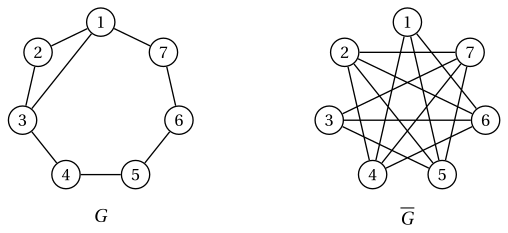
The vertex set and the edge set are:
We call this MCP instance Example 5.1: it is the reference instance of the chapter.
Example 5.2: MCP instance: a dense graph with \(8\) vertices
We consider the graph \(G=(V,E)\) with \(8\) vertices placed on a circle, where every vertex is adjacent to all the others except the opposite one. It has \(m=\binom{8}{2}-4=24\) edges, and its complement has only the \(4\) edges \(\{1,5\},\{2,6\},\{3,7\},\{4,8\}\). A maximum clique \(\tilde K=\{1,3,4,6\}\) is in red.
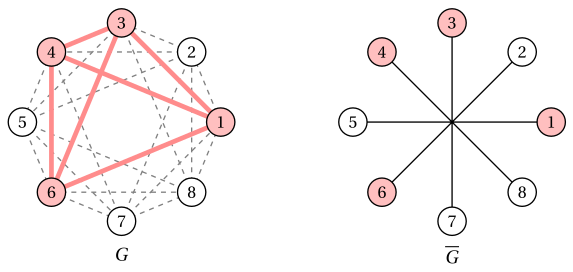
In \(\overline{G}\) the red vertices form a stable set: they take one vertex from each of the \(4\) edges. We call this MCP instance Example 5.2.
- The Petersen graph of Chapter 4 «Coloring problems» has no triangle, so its largest cliques are its edges and \(\omega(G)=2\).
5.2.1 Assumptions
-
We consider nontrivial instances: the graph has at least one edge and at least one non-edge. Formally:
\[ 1 \le m < \binom{n}{2}. \] -
The assumption can be made without loss of generality: if the graph has no edge, every single vertex is a maximum clique and \(\omega(G)=1\); if the graph is complete, \(V\) itself is a clique and \(\omega(G)=n\).
5.3 Counting the solutions, a first solution and the bounds
-
Candidate solutions. The candidate solutions are the subsets of \(V\): there are \(2^n\) of them. For Example 5.1 we have \(2^7=128\) subsets, and only \(17\) of them are cliques:
number of vertices \(0\) \(1\) \(2\) \(3\) total cliques \(1\) \(7\) \(8\) \(1\) \(17\) The only clique with \(3\) vertices is \(\{1,2,3\}\), so the optimal solution is unique and \(\omega(G)=3\).
-
For Example 5.2 we have \(2^8=256\) subsets and \(81\) cliques. A clique takes at most one vertex from each pair \(\{1,5\},\{2,6\},\{3,7\},\{4,8\}\): the maximum cliques take exactly one, so there are \(2^4=16\) of them and \(\omega(G)=4\).
-
A first solution, by hand. We start from a vertex of maximum degree and add, one at a time, a vertex adjacent to all the vertices already chosen. In Example 5.1, vertex \(1\) has degree \(3\); we add its neighbour \(2\), and then \(3\), which is adjacent to both.
-
No other vertex is adjacent to \(1\), \(2\) and \(3\), so we stop with \(K=\{1,2,3\}\). It is a primal bound: \(\LB = 3 \le \omega(G)\).
5.3.1 Simple upper bounds
- The MCP is a maximization problem: a dual bound is an upper bound on \(\omega(G)\). We denote by \(\deg(v)\) the degree of a vertex and by \(\Delta\) the maximum degree of the graph.
Observation 5.6: degree bound
For every graph \(G=(V,E)\) we have \(\omega(G) \le \Delta + 1\).
Proof
In a clique \(K\), every vertex is adjacent to the other \(|K|-1\) vertices of \(K\), so its degree is at least \(|K|-1\). Hence \(|K|-1 \le \Delta\) for every clique. □
Observation 5.7: edge bound
For every graph \(G=(V,E)\) we have \(\omega(G)\,(\omega(G)-1)/2 \le m\).
Proof
A clique with \(k\) vertices contains all the \(\binom{k}{2} = k(k-1)/2\) pairs of its vertices as edges, and these are edges of \(G\). □
Observation 5.8: degree count bound
Let \(k^{\max}\) be the largest integer \(k\) such that at least \(k\) vertices of \(G\) have degree at least \(k-1\). Then \(\omega(G) \le k^{\max}\).
Proof
A clique with \(k\) vertices has \(k\) vertices, each of degree at least \(k-1\) (proof of the degree bound). So \(k=\omega(G)\) satisfies the condition, and \(\omega(G)\le k^{\max}\). □
Observation 5.9: coloring bound
For every graph \(G=(V,E)\) we have \(\omega(G) \le \chi(G)\). In particular, the number of colors of any feasible coloring of \(G\) is an upper bound on \(\omega(G)\).
Proof
The vertices of a clique are pairwise adjacent, so they take pairwise different colors: a coloring with \(k\) colors has \(k \ge |K|\) for every clique \(K\). This is the clique bound of Chapter 4 «Coloring problems», read from the side of the clique. □
-
Bounds on Example 5.1. Vertices \(1\) and \(3\) have degree \(3\), the other five have degree \(2\). The degree bound gives \(\Delta+1=4\), and the edge bound gives \(4\) too, since \(4\cdot 3/2 = 6 \le 8 < 10 = 5 \cdot 4/2\).
-
Only \(2\) vertices have degree at least \(3\), so \(k=4\) fails the condition of the degree count bound, while \(k=3\) satisfies it: \(k^{\max}=3\). The coloring \(\{1,4,6\},\{2,5,7\},\{3\}\) gives \(3\) as well. The gap with \(\LB=3\) is zero.
-
Bounds on Example 5.2. Every vertex has degree \(6\): the degree bound and the degree count bound give \(7\), and the edge bound gives \(7\), since \(7 \cdot 6/2 = 21 \le 24 < 28\).
-
The four pairs \(\{1,5\},\{2,6\},\{3,7\},\{4,8\}\) are stable sets, so they color the graph with \(4\) colors: the coloring bound gives \(4 = \omega(G)\). On dense graphs the bounds based on degrees are weak, and a good coloring is much better.
5.4 Complexity
-
The decision version of the MCP asks, for a graph \(G\) and an integer \(k\), whether \(G\) has a clique with \(k\) vertices. Karp (1972) included it among his \(21\) NP-complete problems, so the MCP is NP-hard. By Proposition 5.5, the same holds for the MSSP.
-
Listing all the subsets of \(V\) and checking the pairs of each one takes \(O(2^n\, n^2)\) steps. For a fixed \(k\), the \(\binom{n}{k}\) subsets with \(k\) vertices are checked in \(O(n^k\, k^2)\) steps: a polynomial for every fixed \(k\), but the exponent grows with the size of the clique.
-
The MCP is also hard to approximate: Håstad (1999) proved that, for every \(\varepsilon>0\), no polynomial algorithm guarantees a clique with at least \(\omega(G)/n^{1-\varepsilon}\) vertices, unless every problem in NP can be solved in randomized polynomial time.
Next: 5.5 Weighted variants