3.5 The Bellman–Ford algorithm
Part 2 · Trees and paths · Chapter 3 · Chapter 3: Shortest paths · Lecture notes, volume 2 (PDF) · Exercises: Shortest paths · App: Shortest paths: Dijkstra, Bellman–Ford, acyclic graphs
Definition 3.16: labels with at most \(k\) arcs
For \(k \ge 0\) and \(j \in N\), \(d^k(j)\) is the minimum length of a walk from \(s\) to \(j\) with at most \(k\) arcs, and \(d^k(j)=+\infty\) if there is none.
Lemma 3.17: recursion of the labels
\(d^0(s)=0\), \(d^0(j)=+\infty\) for \(j \neq s\), and for every \(k \ge 1\)
Proof
The only walk with \(0\) arcs is the walk \(s\). For \(k \ge 1\), a walk to \(j\) with at most \(k\) arcs either has at most \(k-1\) arcs, with minimum length \(d^{k-1}(j)\), or has exactly \(k\) arcs and last arc \((i,j)\): it is a walk to \(i\) with \(k-1\) arcs followed by \((i,j)\), and its minimum length is \(\min_{(i,j)}\big(d^{k-1}(i)+d_{ij}\big)\). □
Algorithm: Bellman–Ford algorithm
STOP: \(\tilde{d}=d^k\).STOP: a negative cycle is reachable from \(s\). Otherwise set \(k:=k+1\) and go to Step 1.-
Each pass depends only on the labels of the previous pass: if \(d^k=d^{k-1}\), all the following passes repeat the same labels, and the algorithm can stop.
-
In the examples, ties in the minimum are broken by the smallest tail \(i\), and the predecessor changes only when the label strictly decreases.
Theorem 3.18: correctness of Bellman–Ford
If no negative cycle is reachable from \(s\), then \(d^{n-1}(j)=\tilde{d}(j)\) for every \(j \in N\), and the algorithm stops at a pass \(k \le n\) with \(d^k=d^{k-1}=\tilde{d}\).
Proof
A path has at most \(n-1\) arcs, so \(d^{n-1}(j) \le \tilde{d}(j)\). By Lemma 3.3 (which needs only the cycles reachable from \(s\)) every walk from \(s\) to \(j\) contains a path not longer, so \(d^k(j) \ge \tilde{d}(j)\) for every \(k\).
-
Hence \(d^{n-1}=d^{n}=\tilde{d}\).
-
The labels never increase, and the algorithm stops at the first pass \(k\) with \(d^k=d^{k-1}\), which is at most \(n\); from that pass on the labels no longer change, so \(d^k=d^{n-1}=\tilde{d}\).
□
Theorem 3.19: detection of a negative cycle
A negative cycle is reachable from \(s\) if and only if \(d^n \neq d^{n-1}\). In that case, let \(d^n(j)<d^{n-1}(j)\); reading the predecessors backwards from \(j\), one row per pass, starting from row \(n\) of the table, gives a walk from \(s\) to \(j\) with \(n\) arcs that contains a negative cycle.
Proof
If no negative cycle is reachable from \(s\), then \(d^n=d^{n-1}\) by Theorem 3.18. Conversely, let \(d^n(j)<d^{n-1}(j)\).
-
Every walk to \(j\) of length \(d^n(j)\) with at most \(n\) arcs has exactly \(n\) arcs, otherwise \(d^{n-1}(j) \le d^n(j)\).
-
Let \(i\) be the predecessor of \(j\) in row \(n\), so \(d^n(j)=d^{n-1}(i)+d_{ij}\). A walk realizing \(d^{n-1}(i)\) followed by \((i,j)\) realizes \(d^n(j)\), so it has exactly \(n-1\) arcs: \(d^{n-1}(i)<d^{n-2}(i)\), and \(i\) has a predecessor in row \(n-1\).
-
Repeating the argument down to row \(1\), whose predecessor is \(s\), gives a walk \(W\) from \(s\) to \(j\) with \(n\) arcs and \(d(W)=d^n(j)\).
-
\(W\) has \(n+1\) nodes, so it repeats a node and contains a cycle \(C\). Deleting \(C\) gives a walk to \(j\) with fewer than \(n\) arcs, of length \(d(W)-d(C) \ge d^{n-1}(j)>d^n(j)=d(W)\). Hence \(d(C)<0\), and \(C\) is reachable from \(s\) along \(W\). □
Proposition 3.20: the predecessor tree of Bellman–Ford
If no negative cycle is reachable from \(s\), at the stop the arcs \((\mathit{pred}(j),j)\), for the nodes \(j \neq s\) with finite label, form a shortest path tree of the reachable nodes.
Proof
Let \(d=\tilde{d}\) be the final labels, and let \(t(j)\) be the last pass in which the label of \(j\) decreased; \(t(s)=0\), since \(d^k(s)=0\) for all \(k\). Let \(p=\mathit{pred}(j)\).
-
In pass \(t(j)\), \(d(j)=d^{t(j)-1}(p)+d_{pj} \ge d(p)+d_{pj}\), since labels never increase.
-
By Theorem 3.5, \(d(j) \le d(p)+d_{pj}\). Hence \(d(j)=d(p)+d_{pj}\) and \(d(p)=d^{t(j)-1}(p)\): the label of \(p\) did not change after pass \(t(j)-1\), so \(t(p)<t(j)\).
-
Moving to the predecessor \(t\) strictly decreases, so the sequence ends in \(s\), along tight arcs: the tree path from \(s\) to \(j\) has length \(d(j)\). □
Theorem 3.21: running time of Bellman–Ford
The Bellman–Ford algorithm runs in \(O(n\,m)\) time.
Proof
A pass computes \(d^k(j)\) for every \(j\) by scanning the backward star \(\delta^-(j)\), so it scans every arc once: \(O(n+m)\) time. There are at most \(n\) passes, and the total is \(O(n(n+m))\), which is \(O(n\,m)\) when \(m \ge n-1\), as under (A1). □
3.5.1 Bellman–Ford on the reference graph
Example 3.7: Bellman–Ford with a negative arc
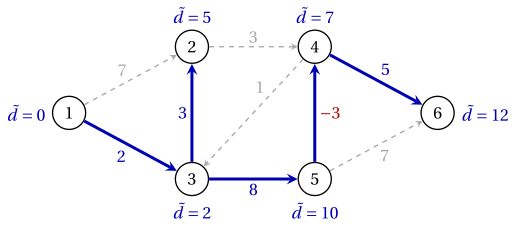
We use the lengths \(d'\) of Example 3.1 with \(d'_{54}=-3\) in place of \(2\). The two cycles have lengths \(7\) and \(8-3+1=6\), so there is no negative cycle. Each row is a pass \(k\); next to a label that decreased, the new predecessor in brackets:
-
In pass \(3\), \(d^3(4)=\min\{10,\; d^2(2)+3,\; d^2(5)-3\}=\min\{10,8,7\}=7\), with predecessor \(5\).
-
Pass \(5\) repeats the labels of pass \(4\): the algorithm stops with \(\tilde{d}=(0,5,2,7,10,12)\), after \(5\) passes instead of the \(n=6\) allowed.
-
The shortest path tree has the arcs \((1,3)\), \((3,2)\), \((3,5)\), \((5,4)\), \((4,6)\), and the shortest path to \(6\) is \(1,3,5,4,6\), of length \(2+8-3+5=12\).
Example 3.8: Bellman–Ford detects a negative cycle
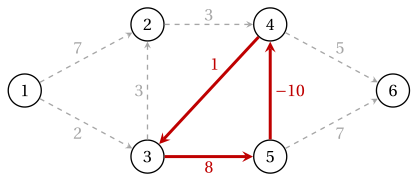
With the lengths \(d''\) of Example 3.2 (\(d''_{54}=-10\)) the algorithm runs all the \(n=6\) passes:
-
In pass \(6\) the label of node \(4\) decreases from \(0\) to \(-1\): \(d^6 \neq d^5\), and a negative cycle is reachable from \(1\).
-
Reading backwards from node \(4\) (bold entries): row \(6\) gives \(\mathit{pred}=5\), row \(5\) for node \(5\) gives \(3\), row \(4\) for node \(3\) gives \(4\), then \(5\), \(3\), \(1\). The walk is
\[ 1,\;3,\;5,\;4,\;3,\;5,\;4, \qquad\text{of length } 2+8-10+1+8-10=-1=d^6(4). \] -
Node \(3\) repeats: the walk contains the cycle \(3,5,4,3\), of length \(-1\) (red).
The Bellman–Ford algorithm computes \(d^k\), the shortest walks with at most \(k\) arcs, in \(O(n\,m)\) time. Without negative cycles reachable from \(s\) it stops within \(n\) passes with the distances; a change in pass \(n\) reveals a negative cycle, found by reading the predecessors backwards.
Next: 3.6 Dijkstra's algorithm