5.3 The residual network
Part 3 · Flows · Chapter 5 · Chapter 5: Maximum flow · Lecture notes, volume 3 (PDF) · Exercises: Maximum flow · App: Maximum flow: Ford–Fulkerson and Edmonds–Karp
- In the rest of the chapter \(G\) has no pair of opposite arcs \((i,j)\) and \((j,i)\), as the reference graph. An arc \((j,i)\) opposite to \((i,j)\) can be replaced by the arcs \((j,k)\) and \((k,i)\) through a new node \(k\), both with capacity \(u_{ji}\): conservation at \(k\) gives \(x_{jk}=x_{ki}\), and the flows of the two networks correspond, with the same value.
Definition 5.5: residual network
Let \(\vet{x}\) be a feasible flow. The residual network \(G(\vet{x})=(N,A(\vet{x}))\) has, for every arc \((i,j) \in A\):
-
the forward arc \((i,j)\), with residual capacity \(r_{ij}=u_{ij}-x_{ij}\), if \(x_{ij}<u_{ij}\);
-
the backward arc \((j,i)\), with residual capacity \(r_{ji}=x_{ij}\), if \(x_{ij}>0\).
-
The residual capacity \(r_{ij}\) is how much flow can still be sent from \(i\) to \(j\): by raising \(x_{ij}\) on a forward arc, or by lowering \(x_{ji}\) on a backward arc.
-
An empty arc gives only its forward arc, a saturated arc only its backward arc, and an arc with \(0<x_{ij}<u_{ij}\) both. Hence \(G(\vet{x})\) has at most \(2m\) arcs, all with positive residual capacity.
-
Without opposite arcs in \(G\), every ordered pair of nodes carries at most one residual arc.
Definition 5.6: augmenting path
Let \(\vet{x}\) be a feasible flow. An augmenting path is a directed path \(P\) from \(s\) to \(t\) in \(G(\vet{x})\). Its bottleneck is
Augmenting \(\vet{x}\) along \(P\) means sending \(\delta\) units along \(P\): for every arc of \(P\),
-
if it is a forward arc \((i,j)\), then \(x_{ij}:=x_{ij}+\delta\);
-
if it is a backward arc \((j,i)\), with \((i,j) \in A\), then \(x_{ij}:=x_{ij}-\delta\).
Lemma 5.7: augmentation
Augmenting a feasible flow \(\vet{x}\) of value \(v\) along an augmenting path \(P\) with bottleneck \(\delta\) gives a feasible flow \(\vet{x}'\) of value \(v+\delta\).
Proof
The nodes of \(P\) are distinct and \(G\) has no opposite arcs, so every arc of \(A\) changes at most once.
-
Bounds. On a forward arc, \(x_{ij}+\delta \le x_{ij}+r_{ij}=u_{ij}\); on a backward arc, \(x_{ij}-\delta \ge x_{ij}-r_{ji}=0\).
-
Conservation. Let \(k \notin \{s,t\}\) be a node of \(P\). The arc of \(P\) entering \(k\) raises the net inflow of \(k\) by \(\delta\): a forward arc \((h,k)\) raises \(x_{hk}\), a backward arc \((h,k)\) lowers \(x_{kh}\). In the same way, the arc of \(P\) leaving \(k\) raises the net outflow of \(k\) by \(\delta\). The two changes cancel, and the nodes outside \(P\) are not touched.
-
Value. The path \(P\) leaves \(s\) once and never enters it again, so the net outflow of \(s\) grows by \(\delta\). □
Example 5.3: the residual network of \(\bar{\vet{x}}\)
For the flow \(\bar{\vet{x}}\) of Example 5.1, of value \(3\), the residual network \(G(\bar{\vet{x}})\) has \(13\) arcs. The six backward arcs, dashed in the figure, are \((2,1)\), \((3,4)\), \((4,2)\), \((5,3)\), \((6,4)\), \((6,5)\).
-
The arc \((2,4)\) is saturated, so it gives only the backward arc \((4,2)\), with \(r_{42}=\bar{x}_{24}=3\).
-
The arc \((1,2)\) has \(0<\bar{x}_{12}=3<5\), so it gives the forward arc \((1,2)\), with \(r_{12}=2\), and the backward arc \((2,1)\), with \(r_{21}=3\).
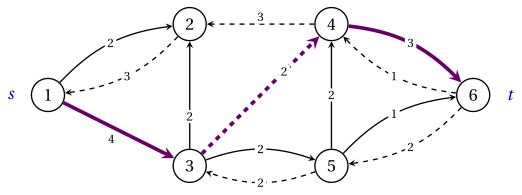
The depth-first search of Chapter 1 from node \(1\), with the residual arcs of each node by increasing index of the head, labels the nodes \(1,2,3,4,6\): from \(2\) the only residual arc goes back to \(1\), from \(3\) the search takes the backward arc \((3,4)\) (\(2\) is labelled), and from \(4\) the arc \((4,6)\). The augmenting path is \(P=1,3,4,6\) (violet), with bottleneck
Augmenting gives \(x_{13}=0+2=2\), \(x_{43}=2-2=0\) (backward arc) and \(x_{46}=1+2=3\), with value \(3+2=5\). The two units that went from \(4\) to \(3\) now go from \(4\) to \(6\), and node \(3\) receives two new units from \(1\), which continue along \(3,5,6\).
Example 5.4: why the backward arcs are needed
Suppose that from \(\bar{\vet{x}}\) we use only the forward arcs of the residual network, so that flows can only grow.
-
The depth-first search on the forward arcs finds the path \(1,3,5,4,6\), with \(\delta=\min\{4,2,2,3\}=2\), and the value becomes \(5\) with the flow \(\vet{x}=(3,2,3,0,4,2,3,2,2)\).
-
Now the forward arcs \((2,4)\) and \((3,5)\) leaving \(\{1,2,3\}\) are saturated: the search labels only \(1,2,3\), and the method stops with value \(5\).
-
The value is not maximum: for \(S=\{1,2,3\}\), Lemma 5.3 gives \(v=x(\delta^+(S))-x(\delta^-(S))=7-2=5\). The two units on the backward arc \((4,3)\) of the cut, sent there by the first choices, come back into \(S\).
Only the backward arc \((3,4)\) of the residual network can cancel them: from this flow, the augmenting paths \(1,3,4,5,6\) (with the backward arcs \((3,4)\) and \((4,5)\)) and \(1,3,4,6\), with \(\delta=1\) each, reach the value \(7\).
The residual network has a forward arc where the flow can grow and a backward arc where it can shrink. Sending the bottleneck \(\delta\) along a path from \(s\) to \(t\) of the residual network keeps the flow feasible and raises its value by \(\delta\); the backward arcs undo earlier choices.