3.1 Shortest path problems
Part 2 · Trees and paths · Chapter 3 · Chapter 3: Shortest paths · Lecture notes, volume 2 (PDF) · Exercises: Shortest paths · App: Shortest paths: Dijkstra, Bellman–Ford, acyclic graphs
Definition 3.1: shortest path problems
Let \(G=(N,A)\) be a directed graph with a length \(d_{ij} \in \R\) for every arc \((i,j) \in A\), of any sign.
-
The length of a directed walk \(W=i_0,i_1,\dots,i_k\) is the sum of the lengths of its arcs, \(d(W)=\sum_{t=1}^{k} d_{i_{t-1}i_t}\).
-
Given two nodes \(s\) and \(t\), the \(s\)–\(t\) shortest path problem asks for a directed path from \(s\) to \(t\) of minimum length.
-
Given a node \(s\), the source, the single-source shortest path problem asks for a shortest directed path from \(s\) to every node \(j \in N\).
The minimum length of a directed path from \(s\) to \(j\) is the distance \(\tilde{d}(j)\) of \(j\); we set \(\tilde{d}(j)=+\infty\) if \(j\) is not reachable from \(s\).
-
In this chapter we write \(n=|N|\), \(m=|A|\), and “path” and “cycle” always mean directed path and directed cycle.
-
An algorithm for the single-source problem also solves the \(s\)–\(t\) problem, for every \(t\) at once.
Example 3.1: the reference graph with lengths
We give the reference graph of Chapter 1 «Graphs» the lengths \(d_{ij}\) written on the arcs, all non-negative; the source is \(s=1\).
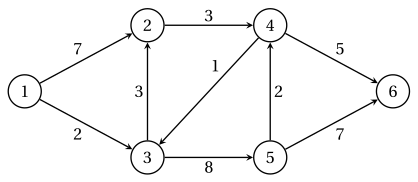
Three of the paths from \(1\) to \(6\) and their lengths are:
The distances from node \(1\), computed in Section 3.6, are
so \(1,3,2,4,6\) is a shortest path from \(1\) to \(6\).
3.1.1 Negative cycles
Definition 3.2: negative cycle
A negative cycle is a directed cycle \(C\) with \(d(C)<0\). In the rest of the chapter we refer to two assumptions:
-
(A1) every node of \(G\) is reachable from \(s\);
-
(A2) no negative cycle of \(G\) is reachable from \(s\).
Lemma 3.3: walks and paths
Under (A2), for every directed walk \(W\) from \(s\) to \(j\) there is a directed path \(P\) from \(s\) to \(j\), with arcs of \(W\), such that \(d(P) \le d(W)\).
Proof
By induction on the number of arcs of \(W\). If \(W\) has distinct nodes, \(P=W\).
-
Otherwise \(W\) repeats a node: \(W=s,\dots,i_a,\dots,i_b,\dots,j\) with \(i_a=i_b\), \(a<b\), and \(b-a\) minimum. The piece \(C=i_a,\dots,i_b\) is a cycle, reachable from \(s\) along \(W\).
-
By (A2), \(d(C) \ge 0\). Deleting \(C\) from \(W\) gives a walk \(W'\) from \(s\) to \(j\) with fewer arcs and \(d(W')=d(W)-d(C) \le d(W)\).
-
By induction \(W'\) contains a path \(P\) with \(d(P) \le d(W') \le d(W)\). □
-
Under (A2) the minimum length of a walk from \(s\) to \(j\) equals the distance \(\tilde{d}(j)\): the algorithms of this chapter compute lengths of walks, and the lemma turns them into paths.
-
With a negative cycle \(C\) reachable from \(s\) and from which \(j\) is reachable, going around \(C\) again and again gives walks from \(s\) to \(j\) of arbitrarily negative length. The algorithms of this chapter then detect \(C\) instead of computing the distances.
Example 3.2: a negative cycle
The reference graph has two cycles, \(2,4,3,2\) and \(3,5,4,3\). With the lengths of Example 3.1 their lengths are \(7\) and \(11\). If the length of the arc \((5,4)\) drops from \(2\) to \(d''_{54}=-10\), the cycle \(3,5,4,3\) has length
and the walks \(1,3,5,6\), \(1,3,5,4,3,5,6\), \(1,3,5,4,3,5,4,3,5,6\), … from \(1\) to \(6\) have lengths \(17,16,15,\dots\): no walk is shortest. We use these lengths \(d''\) again in Section 3.5.
3.1.2 Optimality of subpaths
Lemma 3.4: optimality of subpaths
Under (A2), let \(P\) be a shortest path from \(s\) to \(j\), and let \(i\) be a node of \(P\). Then the subpath \(P_{si}\) of \(P\) from \(s\) to \(i\) is a shortest path from \(s\) to \(i\).
Proof
Write \(P\) as \(P_{si}\) followed by the subpath \(P_{ij}\) from \(i\) to \(j\), so \(d(P)=d(P_{si})+d(P_{ij})\). Assume by contradiction that a path \(Q\) from \(s\) to \(i\) has \(d(Q)<d(P_{si})\).
-
\(Q\) followed by \(P_{ij}\) is a walk from \(s\) to \(j\) of length \(d(Q)+d(P_{ij})<d(P)\).
-
By Lemma 3.3 it contains a path from \(s\) to \(j\) shorter than \(P\): a contradiction. □
Theorem 3.5: Bellman's equations
Under (A1) and (A2), the distances satisfy
and \(\tilde{d}(j) \le \tilde{d}(i)+d_{ij}\) for every arc \((i,j) \in A\).
Proof
All distances are finite by (A1), and \(\tilde{d}(s)=0\): the path \(s\) has length \(0\), and a path from \(s\) to \(s\) with arcs would be a cycle, of length \(\ge 0\) by (A2).
-
Inequality. A shortest path from \(s\) to \(i\) followed by the arc \((i,j)\) is a walk of length \(\tilde{d}(i)+d_{ij}\); by Lemma 3.3, \(\tilde{d}(j) \le \tilde{d}(i)+d_{ij}\).
-
Equation. For \(j \neq s\), let \(P\) be a shortest path from \(s\) to \(j\) and \((i,j)\) its last arc. By Lemma 3.4, \(\tilde{d}(j)=d(P)=\tilde{d}(i)+d_{ij}\), so the minimum is attained.
□
Proposition 3.6: shortest path tree
Under (A1) and (A2), there is a spanning tree \(T\) of \(G\), the shortest path tree, such that for every \(j \in N\) the path from \(s\) to \(j\) in \(T\) is directed and is a shortest path.
Proof
For every \(j\), let \(k(j)\) be the minimum number of arcs of a shortest path from \(s\) to \(j\); \(k(s)=0\).
-
For \(j \neq s\), choose a shortest path \(P\) from \(s\) to \(j\) with \(k(j)\) arcs, and let \(\mathit{pred}(j)\) be the node before \(j\) on \(P\).
-
The subpath of \(P\) from \(s\) to \(\mathit{pred}(j)\) is shortest (Lemma 3.4) with \(k(j)-1\) arcs, so \(k(\mathit{pred}(j)) \le k(j)-1\), and \(\tilde{d}(j)=\tilde{d}(\mathit{pred}(j))+d_{\mathit{pred}(j)\,j}\).
-
Moving from \(j\) to \(\mathit{pred}(j)\), the number \(k\) strictly decreases, so the sequence ends in \(s\). The arcs \((\mathit{pred}(j),j)\) are \(n-1\) and connect every node to \(s\): they form a spanning tree (Chapter 1, Theorem «characterizations of a tree»).
-
Along the tree path \(s=i_0,i_1,\dots,i_r=j\) every arc satisfies \(\tilde{d}(i_t)=\tilde{d}(i_{t-1})+d_{i_{t-1}i_t}\); adding up, its length is \(\tilde{d}(j)\). □
Example 3.3: Bellman's equations on the reference graph
With the distances \(\tilde{d}=(0,5,2,8,10,13)\) of Example 3.1:
-
node \(4\) has the entering arcs \((2,4)\) and \((5,4)\), and \(\tilde{d}(4)=\min\{5+3,\;10+2\}=8\);
-
node \(6\) has the entering arcs \((4,6)\) and \((5,6)\), and \(\tilde{d}(6)=\min\{8+5,\;10+7\}=13\).
The arcs attaining the minimum form the shortest path tree \((1,3)\), \((3,2)\), \((2,4)\), \((3,5)\), \((4,6)\), in blue; next to each node its distance.
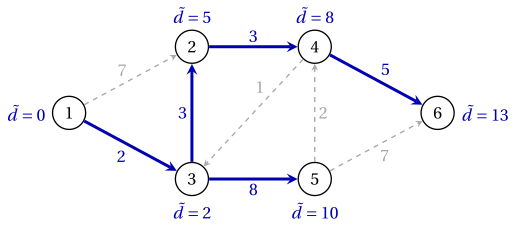
Without negative cycles reachable from the source, every subpath of a shortest path is shortest, the distances satisfy Bellman's equations, and one spanning tree contains a shortest path to every node.