5.7 Applications
Part 3 · Flows · Chapter 5 · Chapter 5: Maximum flow · Lecture notes, volume 3 (PDF) · Exercises: Maximum flow · App: Maximum flow: Ford–Fulkerson and Edmonds–Karp
5.7.1 Maximum matching in a bipartite graph
Definition 5.16: bipartite graph and matching
An undirected graph \(H=(V_1 \cup V_2,E)\) is bipartite if \(V_1\) and \(V_2\) are disjoint and every edge has one endpoint in \(V_1\) and one in \(V_2\); we write the edges as \(\{i,j\}\) with \(i \in V_1\) and \(j \in V_2\).
-
A matching is a set \(M \subseteq E\) of edges, no two of which have a common endpoint.
-
The maximum matching problem asks for a matching with the largest number of edges.
The network of \(H\) has the nodes \(\{s\} \cup V_1 \cup V_2 \cup \{t\}\), the arcs \((s,i)\) for \(i \in V_1\), \((i,j)\) for every edge \(\{i,j\} \in E\), \((j,t)\) for \(j \in V_2\), and all capacities equal to \(1\).
-
With \(V_1\) a set of workers, \(V_2\) a set of jobs, and an edge when a worker can do a job, a matching assigns jobs to workers, at most one job per worker and one worker per job.
-
In the order of the nodes, \(s\) comes first and \(t\) last; the other nodes keep their indices.
Proposition 5.17: matchings and flows
The maximum number of edges of a matching of \(H\) equals the maximum value \(\tilde{v}\) of a flow in the network of \(H\). If \(\tilde{\vet{x}}\) is an integer maximum flow, then \(M=\{\{i,j\} \in E : \tilde{x}_{ij}=1\}\) is a maximum matching.
Proof
-
From matchings to flows. Given a matching \(M\), set \(x=1\) on the arcs \((s,i)\), \((i,j)\), \((j,t)\) of every edge \(\{i,j\} \in M\), and \(x=0\) elsewhere. Every node of \(V_1 \cup V_2\) is an endpoint of at most one edge of \(M\), so the flow is feasible, and its value is \(|M|\).
-
From integer flows to matchings. Let \(\vet{x}\) be an integer feasible flow, so \(x_{ij} \in \{0,1\}\). A node \(i \in V_1\) has the single entering arc \((s,i)\), so at most one arc \((i,j)\) carries flow; a node \(j \in V_2\) has the single leaving arc \((j,t)\), so at most one arc \((i,j)\) carries flow. Hence \(M=\{\{i,j\} : x_{ij}=1\}\) is a matching. For \(S=\{s\} \cup V_1\), the forward arcs are the arcs \((i,j)\) and there are no backward arcs: by Lemma 5.3, \(v=|M|\).
-
By Corollary 5.10 there is an integer maximum flow \(\tilde{\vet{x}}\). By 1, no matching has more than \(\tilde{v}\) edges, and by 2 the matching of \(\tilde{\vet{x}}\) has \(\tilde{v}\) edges. □
Example 5.9: workers and jobs
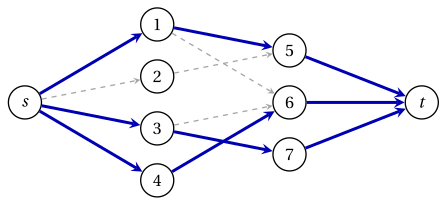
Four workers \(V_1=\{1,2,3,4\}\) and three jobs \(V_2=\{5,6,7\}\) have the edges
The Edmonds–Karp algorithm on the network of \(H\), with the nodes in the order \(s,1,2,\dots,7,t\), gives:
| iteration | augmenting path | \(r_{ij}\) on \(P\) | backward arcs | \(\delta\) | \(v\) |
|---|---|---|---|---|---|
| \(1\) | \(s,1,5,t\) | \(1,1,1\) | – | \(1\) | \(1\) |
| \(2\) | \(s,3,6,t\) | \(1,1,1\) | – | \(1\) | \(2\) |
| \(3\) | \(s,4,6,3,7,t\) | \(1,1,1,1,1\) | \((6,3)\) | \(1\) | \(3\) |
-
Iteration \(3\) uses the backward arc \((6,3)\): worker \(3\) leaves job \(6\) for job \(7\), and worker \(4\) takes job \(6\).
-
The maximum matching is \(M=\{\{1,5\},\{3,7\},\{4,6\}\}\), with \(3\) edges; worker \(2\) stays without a job. In the figure the arcs with flow \(1\) are blue.
-
At the stop the search labels \(S=\{s,1,2,4,5,6\}\); the forward arcs of the cut are \((s,3)\), \((5,t)\), \((6,t)\), with capacity \(3=|M|\).
5.7.2 Arc-disjoint paths
- Two directed paths are arc-disjoint if they have no common arc; they may share nodes.
Theorem 5.18: Menger, arc version
Let \(G=(N,A)\) be a directed graph and \(s \neq t\) two nodes. The maximum number of pairwise arc-disjoint directed paths from \(s\) to \(t\) equals the minimum number of arcs whose removal leaves no directed path from \(s\) to \(t\).
Proof
Give every arc the capacity \(1\), and let \(\tilde{v}\) be the maximum value of a flow.
-
Paths give flows. The sum of the incidence vectors of \(k\) arc-disjoint paths from \(s\) to \(t\) is a feasible flow of value \(k\): every arc carries at most \(1\), and every path enters and leaves its inner nodes. Hence \(k \le \tilde{v}\).
-
Flows give paths. By Corollary 5.10 there is a flow \(\vet{x}\) with \(x_{ij} \in \{0,1\}\) and value \(\tilde{v}\). If \(\tilde{v} \ge 1\), walk from \(s\) along arcs with \(x_{ij}=1\), each used at most once, until \(t\) is reached:
-
at a node \(i \notin \{s,t\}\) the walk has used one entering arc more than leaving arcs, and conservation gives an unused leaving arc with flow;
-
at \(s\) the walk has used as many leaving arcs as entering ones, while the arcs with flow leaving \(s\) are \(\tilde{v} \ge 1\) more than those entering: an unused one exists.
The walk ends, at \(t\), and it contains a path \(P\) from \(s\) to \(t\) (Chapter 1, Lemma «a walk contains a path»). Setting \(x_{ij}=0\) on \(P\) leaves a \(0/1\) flow of value \(\tilde{v}-1\); repeating gives \(\tilde{v}\) arc-disjoint paths.
-
-
Removing arcs. If removing a set \(F\) of arcs leaves no path from \(s\) to \(t\), the set \(S\) of the nodes still reachable from \(s\) has \(t \notin S\) and \(\delta^+(S) \subseteq F\), so \(|F| \ge u(S,N \setminus S) \ge \tilde{v}\). Conversely, every path from \(s\) to \(t\) leaves \(S\) through an arc of \(\delta^+(S)\): removing the \(\tilde{v}\) forward arcs of a minimum cut (Theorem 5.8) leaves no path. □
Example 5.10: arc-disjoint paths in the reference graph
On the reference graph with all capacities \(1\), \(s=1\) and \(t=6\), the Edmonds–Karp algorithm finds the paths \(1,2,4,6\) and \(1,3,5,6\), and \(\tilde{v}=2\). These two paths are arc-disjoint, and removing the two arcs \((1,2)\), \((1,3)\) leaving node \(1\) leaves no path from \(1\) to \(6\): both numbers of Theorem 5.18 are \(2\).
A maximum matching of a bipartite graph is an integer maximum flow in a network with unit capacities, and so are the arc-disjoint paths from \(s\) to \(t\); the minimum cut certifies both.
5.8 Typical mistakes
Warning
-
Counting the backward arcs of a cut. The capacity \(u(S,N \setminus S)\) adds up only the arcs from \(S\) to \(N \setminus S\).
-
Forgetting the backward arcs of the residual network. With forward arcs only, the method can stop at a flow that is not maximum, as at value \(5\) on the reference network.
-
Giving a backward arc the capacity \(u_{ij}\). The backward arc \((j,i)\) has \(r_{ji}=x_{ij}\): only the flow already sent can be sent back.
-
Taking the bottleneck from the capacities. The bottleneck is the smallest residual capacity \(r_{ij}\) on the path, not the smallest \(u_{ij}\).
-
Adding \(\delta\) on a backward arc. Along a backward arc \((j,i)\) the flow \(x_{ij}\) decreases by \(\delta\).
-
Reading the cut from the saturated arcs. The minimum cut is given by the nodes reachable from \(s\) in the residual network at the stop; the saturated arcs need not form a cut.
-
Calling Ford–Fulkerson polynomial. Its number of augmentations can grow with the capacities, as \(2M\) in Example 5.7; Edmonds–Karp makes at most \(n\,m\).
5.9 In summary
In summary
-
A feasible flow respects the capacities and is conserved at the nodes other than \(s\) and \(t\); its value is the net outflow of \(s\), and it equals the net flow across every \(s\)–\(t\) cut.
-
Weak duality: \(v \le u(S,N \setminus S)\) for every flow and every cut.
-
The residual network has forward arcs with \(r_{ij}=u_{ij}-x_{ij}\) and backward arcs with \(r_{ji}=x_{ij}\); an augmenting path raises the value by its bottleneck \(\delta\).
-
Max-flow min-cut: a flow is maximum if and only if no augmenting path exists, and \(\tilde{v}\) equals the minimum cut capacity; with integer capacities there is an integer maximum flow.
-
Ford–Fulkerson (depth-first search): with integer capacities at most \(\tilde{v}\) augmentations, pseudopolynomial. Edmonds–Karp (breadth-first search): at most \(n\,m\) augmentations, \(O(n\,m^2)\) time.
-
Maximum matchings in bipartite graphs and arc-disjoint paths are integer maximum flows.
The reference network at a glance.
| capacities, \(s=1\), \(t=6\) | \(\vet{u}=(5,4,3,2,4,2,4,2,3)\) |
| maximum flow (unique) | \(\tilde{\vet{x}}=(3,4,3,0,4,0,4,1,3)\), \(\tilde{v}=7\) |
| minimum cuts, capacity \(7\) | \(S=\{1,2\}\), \(\{1,2,3\}\), \(\{1,2,3,4,5\}\) |
| Ford–Fulkerson (DFS) | \(5\) augmentations, \(\delta=2,1,2,1,1\) |
| Edmonds–Karp (BFS) | \(3\) augmentations, \(\delta=3,3,1\) |
| all capacities \(1\) | arc-disjoint paths \(1,2,4,6\) and \(1,3,5,6\) |
Exercises on this chapter: Maximum flow